
Struggles

Forsaking and Fleeing

Then all the disciples forsook Him and fled.

These words startled me when I was reading my assigned passage from the gospels for the Bible Challenge the other day. I have read through Matthew many times, but for some reason, these words from the second half of Matthew 26:56 really made me stop and think that morning.

Peter’s denial happens later on in that chapter but before Peter ever denies Christ, Matthew tells us that all of the disciples have left their Messiah’s side when they realized that Jesus was being arrested.  As I went on in the chronological reading, I discovered that Mark recorded this in much the same way–

 Then they all forsook Him and fled. (Mark 14:50)

These eleven men (the twelfth had just betrayed Jesus), had seen Jesus, our Savior, Himself in the flesh. They had walked and talked with Him. And yet they fled from His side when the going got rough. They had seen Him turn water into wine (John 2:1-12), watched Him raise a dead man (John 11:38-44), and had witnessed the healing of the multitudes (Matthew 12:15). These same eleven men had watched as a few fish and several loaves of bread fed a huge, starving crowd–twice! (Matthew 14:17-21 and Matthew 15:33-39).  Astonishing and incredible miracles were just part of the course of a day with Jesus and these eleven men had witnessed them over and over again as His disciples.

Not only did they see miracles, but they sat under the teaching of Jesus, the perfect Teacher. They had learned wisdom and doctrine from God Himself.

They have spent three amazing years following and serving the true Messiah. And yet, when things get a little frightening, they all flee.

All of them.

Not one single one of them stood by Jesus when He was arrested.

Thankfully, their legacies do not stop there, amidst failure and fear. Instead, every single one of those disciples (with the exception of Judas, of course) went on to live devoted and whole-hearted lives for Christ. They traveled to places like India, Russia, and Persia spreading the gospel. They all, without exception, went on to do big things for the sake of Jesus Christ. (See Below)

What encourages me about this is that, quite clearly, failures and lapses in courage do not disqualify us from running the race that has been set before us. God knows our thoughts and desires. He can see when our hearts are stubbornly rebellious or when we are repentant and ready to submit to Him. He sees every sin we commit. Every failure. Every time we cower in fear. And yet, despite all of this, He loves and forgives us.

Somehow, knowing that the disciples forsook Jesus at such a critical time but then went on to spread the gospel far and wide is reassuring for me. It means that we can forsake and we can run, but there is forgiveness waiting for us when we choose to continue moving on for the sake of Christ.

God’s free gift of salvation and forgiveness for sins is not for perfect people who have mastered their sinful natures. Instead, it is for me. And for you. It is for cowardly, sinful people who make really bad choices and fail over and over again. How thankful I am for God’s marvelous grace and mercy!


If you are not familiar with what happened to each of the disciples, here is a brief overview taken from this article at Christianity.com

Into All the World
Reports and legends abound and they are not always reliable, but it is safe to say that the apostles went far and wide as heralds of the message of the risen Christ. An early legend says they cast lots and divided up the world to determine who would go where, so all could hear about Jesus. They suffered greatly for their faith and in most cases met violent deaths on account of their bold witness.

PETER and PAUL were both martyred in Rome about 66 AD, during the persecution under Emperor Nero. Paul was beheaded. Peter was crucified, upside down at his request, since he did not feel he was worthy to die in the same manner as his Lord.

ANDREW went to the “land of the man-eaters,” in what is now the Soviet Union. Christians there claim him as the first to bring the gospel to their land. He also preached in Asia Minor, modern-day Turkey, and in Greece, where he is said to have been crucified.

“Doubting” THOMAS was probably most active in the area east of Syria. Tradition has him preaching as far east as India, where the ancient Marthoma Christians revere him as their founder. They claim that he died there when pierced through with the spears of four soldiers.

PHILIP possibly had a powerful ministry in Carthage in North Africa and then in Asia Minor, where he converted the wife of a Roman proconsul. In retaliation the proconsul had Philip arrested and cruelly put to death.

MATTHEW the tax collector and writer of a Gospel, ministered in Persia and Ethiopia. Some of the oldest reports say he was not martyred, while others say he was stabbed to death in Ethiopia.

BARTHOLOMEW had widespread missionary travels attributed to him by tradition: to India with Thomas, back to Armenia, and also to Ethiopia and Southern Arabia. There are various accounts of how he met his death as a martyr for the gospel.

JAMES the son of Alpheus, is one of at least three James referred to in the New Testament. There is some confusion as to which is which, but this James is reckoned to have ministered in Syria. The Jewish historian Josephus reported that he was stoned and then clubbed to death.

SIMON THE ZEALOT, so the story goes, ministered in Persia and was killed after refusing to sacrifice to the sun god.

MATTHIAS was the apostle chosen to replace Judas. Tradition sends him to Syria with Andrew and to death by burning.

JOHN is the only one of the company generally thought to have died a natural death from old age. He was the leader of the church in the Ephesus area and is said to have taken care of Mary the mother of Jesus in his home. During Domitian’s persecution in the middle 90’s, he was exiled to the island of Patmos. There he is credited with writing the last book of the New Testament–the Revelation. An early Latin tradition has him escaping unhurt after being cast into boiling oil at Rome.


The Prison of Worry

worried-girl-413690_1280

I would like to tell you that I am worry-free. But, alas, I am not. There are just so many things that can go wrong! If we are the kind of person that thinks too much, we can tend to be worriers. Am I the only one who thinks there is something desperately wrong if I am unable to get a hold of my child on their cell phone for ten minutes or if I have a strange pain somewhere?

Worry can be so debilitating.

It steals our peace.

It controls our thoughts.

It takes our joy.

And the wonderful reward for all this worry?

Nothing.

Absolutely nothing.

The time we spend worrying steals our present, yet makes no difference in the future. Worry keeps us locked up in a prison of our own making, far away from the joys and blessings of life.

When I was a young twenty-something, I was positively crippled by worry. I would lay on my sofa for wasted hours feeling sick because of worry. It was so awful. But God rescued me. He taught me to take my thoughts captive. I learned to move my mind from my worry to something else. Oh, the first few months it felt impossible. But it got easier and easier, until it became a habit. Of course, every now and then, a few question marks show up in my life to remind me that I haven’t mastered worry.

Theologically, I have learned that worry is really an affront to God. When we worry, we are telling Him that He doesn’t know what He is doing. That we can’t trust Him.

But this week as I was reading in Luke 12 for the Bible Challenge, I found some very practical and helpful principles for this raging battle with worry and anxiety that so many of us face–

  1. We are loved and valued by the Father. Luke 12:7 tells us that not even a sparrow is forgotten before God and that we are of far more value to Him than many sparrows. We need not fear.
  2. The Holy Spirit will guide us through trials. Luke 12:11 tells us that the disciples brought before magistrates and authorities for the sake of Christ will be given words to answer the accusations through the Holy Spirit. When I read this verse the other day, I felt comforted to know that if (or when) the church faces persecution, we will not be alone. And there are other verses throughout scripture to show us that the Holy Spirit is there to comfort and to counsel us: John 14:26; Romans 15:13; 2 Timothy 1:14.
  3. Worry changes nothing. Luke 12:25-26 asks this: And which of you by worrying can add one cubit to his stature? 26 If you then are not able to do the least, why are you anxious for the rest? 
    When things are outside our control, many of us tend to stew and fret and make those around us miserable (if we are honest!) and yet, all that frustration and misery won’t change one thing. That is sobering to think about, isn’t it? Especially for us worriers. How many precious hours have we wasted on this time-sapping activity?
  4. God promises to take care of us. A little further on in Luke we read this in verse 28: If then God so clothes the grass, which today is in the field and tomorrow is thrown into the oven, how much more will He clothe you, O you of little faith?  Worry is probably a timeless sin that has affected almost all human beings at one time or another. And yet, Jesus tells us here that we can trust the Father. He will care for us.
  5. Knowing God and making Him known needs to be our first priority. I don’t think it is an accident that verses 34-35 (Sell what you have and give alms; provide yourselves money bags which do not grow old, a treasure in the heavens that does not fail, where no thief approaches nor moth destroys. 34 For where your treasure is, there your heart will be also.) follow right after this whole passage on worry. After all, worry is often the result of having our priorities a little out of order. It is much easier to yield our will to the Father’s when we can keep our worldly possessions in perspective or when we truly want to please the Father in all things first and foremost– even before our own health or popularity, before any relationship, or before our reputation. When we really keep God first in our lives and seek His kingdom, it helps us to sift and sort through all of the trivial–and not so trivial– things we worry about.

Of course, all of these principles are well and good, but if you are in the midst of a battle with worry this may feel a little rote to you. And some of you are facing really big struggles right now, with no good conclusion forthcoming. Illnesses, loss of jobs and income, straying kids. There are very legitimate causes for concern in so many of our lives. If this is the case, I encourage you to pray, begging God to help you live out these principles in your life. If you are a true believer, the Holy Spirit is there to comfort and guide you.

Sometimes in the midst of a deep, dark trial that has me captured by worry, I find myself unable to even pray. If you find yourself in a similar place ask a friend or family member to pray for you until you get though the worst of this.

But, most of all, let’s keep our eyes on the Father, the author and finisher of our faith. He will never leave or forsake us. Let’s glorify Him by showing the world that we trust Him implicitly instead of staying locked up in our prison of worry.


Finding Peace

Peace is hard enough to find in the best of times. But when tragedy strikes, it can feel impossible. Just yesterday I read of the terrible thing that occurred at the Oklahoma State University homecoming parade and the group prayer that followed at the football game. There is something in us that seeks for the peace we know only comes from God when something awful happens. Even atheists and agnostics will send up vague prayers, begging for God’s grace and mercy in the midst of a calamity.

But there is only one way of actually experiencing the peace that God promises us in the Bible. Only one.

As some of you already know, my brother pastors a small church. A few weeks ago terrible tragedy hit their small congregation. Because it is such a close-knit group, the loss of any is felt acutely. But perhaps even more so when one is removed so suddenly and tragically.

It was just a normal morning. A man from their congregation was traveling with his oldest son to a special event. Little did his wife know that it would be the last time she would see him this side of heaven. There was a terrible car accident that ended the life of her husband. Her son, left with a serious brain injury, was not expected to live.

Many, many people prayed and asked God to spare this teenager. In what seemed a miraculous turn of events, her son went from being at death’s door to being released from the hospital only a week later. The doctors and nurses have shared their amazement and disbelief with the family. They had told his mother to prepare for his death when he first arrived at the hospital. It is truly an awesome blessing from God.

And yet, there is still the devastating loss of his father–a godly man who loved the Lord and led his family well. He was not only a wonderful husband and father, but a vibrant Christian testimony in his workplace and community. He was also a dear friend of my brother’s.

How in the world do we find peace in such the midst of such heart-wrenching circumstances?

During the course of the week, my brother, Pastor Dean, wrote some update emails to an ever-growing list of recipients regarding this dear family. One of the emails was so profound–so helpful– in answering this very question, I asked him if I could share it here. My brother loves the Word of God and this is not his family’s first taste of tragedy. His counsel, straight from the Word of God, may not be the popular answer of the day but it is truth–

I am truly astounded at the recovery of {the son} – it is almost miraculous (those of you who know me, know I don’t use that word lightly!).  We abundantly thank the Lord for restoring him to us.  But we also mourn the death of our brother in Christ, Mark.  I know for me, the mornings have been the most difficult, just when I wake up.  It is of great importance that we, like David, encourage ourselves in the Lord our God  (1 Sam. 30:6).  We deal with an event like this either in faith or unbelief.  The difference is not in whether or not we weep, but whether or not we trust the Lord and His eternal and perfect promises.  He is the Rock, immovable and unchanging, and those who find refuge in Him (that is in His written Word and in Christ), will never be moved.  To see examples of how David encouraged himself in the Lord, see Psalm 18 and 27.  We must call upon Him, submit to Him, trust Him, and obey Him on the basis of what He has said to us in His Word.  As believers in Christ we do not weep as those who have no hope (1 Thess. 4:13-17).

But there are some who are reading this e-mail who do not have the peace of God because they do not have the God of peace.  You cannot have the peace of God without being reconciled to Him through His Son the Lord Jesus Christ (Colossians 1:15-23).  The reason we do not have peace is because we are sinners, rebels against God and His truth (Ps. 2:1-3).  We disobey His commands and refuse to believe His Word.  The result is death . . . and restlessness – “There is no peace, saith my God, to the wicked” Is. 57:21.  The first problem is that people do not think of themselves as wicked, but the Bible informs us that we all are wicked from birth (Ps. 51:5; 58:3).   Not only do we sin, but we are incapable of doing anything that is good in God’s sight (Romans 3:10-19; 8:8).  There is only one way to be reconciled to God, according to His Word (John 14:6) . . . it is through His Son Jesus Christ, who, as the Son of God, was sent by God to fulfill the Law on our behalf and be our Substitute by dying in our place (read Isaiah 53 – a prophecy about the Messiah written 700 years before Christ died on the Cross).  When we call upon the Lord through Jesus Christ, confessing our sins and repenting from our sins, we are forgiven and reconciled to God (“Therefore being justified by faith, we have peace with God through our Lord Jesus Christ” – Rom. 5:1).  Apart from faith in Christ, there is no hope for the sinner:  “When a wicked man dies, his expectation shall perish, and the hope of unjust men perishes” (Prov.11:7).  There is no ritual, there is no form of meditation, there is no pill, there is no action that you can take that will give you eternal peace – a peace that only God gives to His children who are born again through faith in Christ.

For those who do not know Christ, my prayer is that this day, they would call upon the Lord in faith.  For those who know Him, my prayer for you is that of Paul’s for the Ephesian believers in Ephesians 3:14-21:

For this cause I bow my knees unto the Father of our Lord Jesus Christ, of whom the whole family in heaven and earth is named,  that he would grant you, according to the riches of his glory, to be strengthened with might by his Spirit in the inner man;  that Christ may dwell in your hearts by faith; that ye, being rooted and grounded in love,  may be able to comprehend with all saints what is the breadth, and length, and depth, and height;  and to know the love of Christ, which passes knowledge, that ye might be filled with all the fullness of God.  Now unto him that is able to do exceeding abundantly above all that we ask or think, according to the power that works in us,  unto him be glory in the church by Christ Jesus throughout all ages, world without end. Amen.

Lessons from A Phone Bill

cell

About a month ago, I received an email that our business cell phone account had used all of its shared data. This was quite unusual, but since I literally hate to make phone calls to the customer service departments of large companies, I decided on a “wait and see what happens” approach.

And then a few days ago, in the middle of the following billing cycle, I received another one of those warnings. So at this point, I knew that I needed to make that dreaded call to get to the bottom of the “mysteriously disappearing data.”

I dialed the number and after pushing several numbers to get to a real, live person, I was pleasantly surprised to be connected to an English speaker that I was actually able to understand. She was quite friendly as I shared my problem and we started going over the bill together. She blamed the problem on an unauthorized change to our account that had happened almost a year ago and started trying to fix it. While I had my doubts that this was actually the cause of the “mysteriously disappearing data”, I also realized that this problem did need to be fixed so I let her do her thing. However, she didn’t really seem to know what she was doing exactly and I grew just a little more nervous as the minutes–very long minutes— ticked by.

After I had been on the call for over an hour, I finally told her that I had to go and asked if she would call me back or email me when she had sorted through it all. A half hour later I received a rather unsatisfactory email from her.  A few moments after that, I received another notice that our data was almost 100% used up.

*Sigh*

Obviously, whatever she had done had not solved the problem.

I really did not want to make another phone call to this company. I think I’d rather go to the dentist than make phone calls like this. They are long and time-consuming and generally very frustrating. I put it off for a short time. But the next day I decided I may as well get it over with as the problem–unlike the data– was not going to disappear.

This time, I ended up getting connected to a very nice lady who was also quite knowledgeable. Within a few moments, she had solved my problem and then handed me off to her supervisor to get the authorization for a very sizable credit that was due us.

Those two calls were like night and day. Literally. One phone call lead to over an hour of wasted time spent listening to an incompetent representative try to solve a problem that was way over her head. The second call was with someone who knew exactly what she was doing and she solved the problem efficiently and quickly.

This incident brought to mind a few spiritual correlations-

1.  We cannot grow or change without a little self-examination. If we just live at status quo our whole lives we will not only remain baby Christians but will also reap the costly consequences of this choice. When we don’t examine ourselves, we are like our company with that phone bill–thinking everything is fine, when, unknowingly, something is really wrong and we are actually paying dearly (2 Corinthians 13:5).

2.  Sometimes deeper, abiding issues come to light when we start examining our lives. I had no idea when I called about this more recent problem with our cell phone account, that there was also a completely separate issue going on. Actually, as we investigated our account thoroughly together, we found two other problems along with the original issue. This is true of our own self-examination, as well. Sometimes we will recognize a sin in our lives and when we start reading and studying the Word, other hidden and connected sins will come to light. For example, perhaps we struggle with being overweight. We know we shouldn’t overeat and we go to scripture for insight. In the process, we may come face to face with our own prideful heart as we discover the reason we really want to lose weight. Examination can lead to some real eye-opening moments.

3.   Waiting can be costly. While the phone company gave me that nice credit for the mistakes of the past year, life, unfortunately, gives no credits. Emotional and spiritual harm compounds as we live in ignorance and can never be completely rectified. Only the Holy Spirit in a saved heart can take something so broken and heal it, but still there will be scars. It is wiser to deal with our sin issues immediately, rather than letting them smolder in the background of our lives.

4.  Make sure you are talking to someone who knows what they are doing. How frustrating my first encounter was with the lady who thought she knew everything but didn’t really know anything. There are so many people who give counsel to us as we navigate life’s problems and yet so many have absolutely no idea what they are doing. So how do we know if they are someone who can help? The first test for me is always this question: Are they taking me to the Holy Bible? The Bible is God’s Word and it speaks to all of our problems. If the person who is counseling us is only using their personal experiences or their own human wisdom, they are probably not going to be much long-term help to the situation.

But we also need to remember that there is no person who will always give us perfect counsel. We are all flawed and born sinners. While people can– and often do–help us on our way, we need to seek our counsel first and foremost from God and His Word.

5.  When we get connected to the right person, it is amazing how quickly a problem can be solved. I experienced nothing but frustration until I got connected to the lady who knew what she was doing. Our spiritual life is a little like this. We will experience no true victory in the Christian life until we are connected to Jesus. Until we repent and place our faith and trust in Jesus Christ we will remain separated from God (John 14:6). Upon this saving faith, we know that our prayers will be heard (I John 5:12-15) and we can fully expect God to work as we surrender our lives and wills to Him.


And so I guess that phone bill incident wasn’t a complete waste of time. After all, I got a whole post out of it. But I will be very happy if I don’t have to make another call like that anytime soon!

The Wish List

Time

I have 244 items on my Amazon Wish List. Seriously. The great majority of the items are books I would like to read someday.

Someday.

That elusive word that helps us feel so much better about our now. But as I have grown older, I am starting to understand something–

Someday doesn’t usually come around without some intentional work in the now.

I will never reach someday with my wish list of books unless I make a priority to actually read them. This is so true about much in life, isn’t it?

We will never grow our business without lots of hard work. Or lose weight without making changes in how we eat and/or exercise. We will never be stable financially if we don’t work at staying on a budget. Our desires and dreams will rarely come true without some kind of effort and sacrifice and someday is probably not going to come without some intentional behavior on our part right now.

Most of us have at least one thing on our wish list that is pretty important to us. We wish to be thin. Or we wish to be rich. Or perhaps it is a great career that we long for. Some of us really wish for kids who will grow up to serve the Lord. Or maybe we wish for a great marriage. What is on your wish list? And what are you doing to get there?

But something much more important to reflect on is our spiritual “wish list”. Are we intentionally working to learn to know God and His Word? Are we giving deliberate effort to our purity and holiness? With all of the other wishes consuming our thoughts we often neglect the most important area of our lives– our own growth as a believer in Jesus Christ.

Stop and ponder this for just a moment. Where would you like to be as a believer in five years? What about twenty years?

What are you doing to get there?

Unfortunately, we can’t magically inhale the Bible one day and just know the Word. Instead, we have to study and memorize it. If we do so with humility and a heart of obedience, we will be changed.

One of my favorite verses is Hebrews 4:12–

For the word of God is living and powerful, and sharper than any two-edged sword, piercing even to the division of soul and spirit, and of joints and marrow, and is a discerner of the thoughts and intents of the heart.

And 2 Timothy 3:16-17 —

All Scripture is given by inspiration of God, and is profitable for doctrine, for reproof, for correction, for instruction in righteousness, that the man of God may be complete, thoroughly equipped for every good work.

If becoming a godly man or woman is on our wish list (and it should be for all genuine believers), it will never happen without serious dedication to the Word of God. God’s Word is so powerful. It teaches us truth and pure doctrine, giving us a solid grid through which to judge false teaching and every other thing that comes our way. By studying the Holy Bible, we become convicted of the sin in our lives and are trained in holy and righteous living.

But learning and studying the Word takes precious time. Time that we would often prefer to spend somewhere else.

I can almost hear some of you saying, “I don’t have a choice. You have no idea how busy I am.” And I get it. I remember those days when I felt like I was meeting the needs of my kids 24/7. I know that many of you are extremely busy with families or jobs. But may I submit to you–

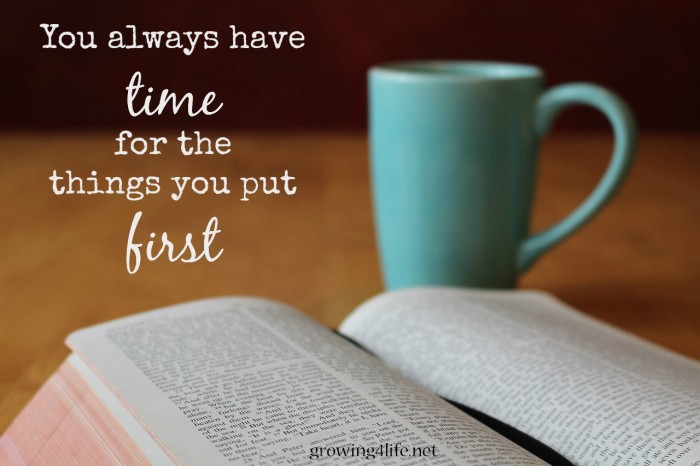
You always have time for the things you put first.

Where does God and growing as a believer fit in your list of priorities?

I have no idea how many of the books I will ever check off of my Amazon wish list. Some of them are much more important to me than others and they are the ones that I will read. The rest will probably just sit there on the list until I clean it up one day and purposefully remove them.

Perhaps it is time that we reflect on our “wish list”. Is it filled with things that should be important to us from an eternal perspective? And, if so, what are we doing to get there? And what is on the wish list of our lives that is taking up space and could be removed? Is godliness even on our wish list as a priority? These are certainly some questions to consider. 


Face Value

conversation1

I remember the conversation like it was yesterday. It was so unexpected. I was with a fellow Christian that I had known for a long time. We were different ages and in different circles but ended up working together fairly frequently. I had always assumed that we had the same respect and admiration for each other and that our occasional disagreements and debates were viewed as a healthy part of a relationship.

But, on that particular day, I found out that I was quite wrong.

This person did not have the same feelings toward me as I had towards them. In fact, that conversation showed me that they viewed me as a particularly irritating part of their life. There was no confession and no closure. Just a statement that needed no further elaboration. I didn’t really know them well enough to follow up the conversation any further and so I walked away that day with a shocking and hurtful realization:

People can act like they like you when they really don’t.

For many years after that, I found myself just assuming that most people did not like me. I assumed that I was irritating and that most people did not enjoy my company. Even if someone was really nice to me and I thought I had found a friend, I would hear a voice in the back of my head saying: They don’t really like you. They are only pretending. Just like _________.

It would take a long time for me to trust someone and believe that they actually did enjoy my company. After all, a fellow Christian had pretended to be my friend and it had never been true.

Isn’t it amazing how one conversation can change your life?

By my very nature, I am quite outgoing and outspoken (I can almost hear the “amens” even as I write this from those of you who know me!) It is so hard for me to just sit in a room quietly without speaking. I suppose my parents knew they had a problem on their hands when, as a young child, I spoke my unfiltered thoughts about a lady walking towards us on the street.

I’ve had a lifetime of trying to curtail my mouth. To learn to think before I speak. To honor God with the right tone, looks, and body language.

And I do think I have made progress, in large part due to God’s amazing grace and the Holy Spirit working in my life. I am not the same person I was. But I do still mess up sometimes. I still–quite unintentionally–make enemies. And I still worry about that. Especially when people are so good at covering their true feelings.

But, recently, I believe that God has been teaching me to take people at “Face Value”. I cannot know anything about a person that they do not choose to share with me. I cannot be responsible for their grudges and unforgiving hearts if they do not choose to come to me with their issues. If someone treats me like they like me, then I should assume that they do. If they are pretending, that is not my concern. That is between them and God. I can’t spend my time worrying about it and I can’t make assumptions that may not be true.

And since that first conversation, I have learned a few things. First, sometimes people are just really shy. It doesn’t mean they don’t like me. It just means they don’t know me. And, second, I’ve learned that moods often determine how people interact with me. Some people just aren’t friendly if they have had a rough day. It doesn’t mean that they have some deep, abiding hatred of me.

Instead of focusing on the reactions and thoughts of others (which are completely outside my control), my concern is to treat people with love and kindness. If there is a truth that needs communicated, then it is to be covered with prayer and spoken with much thought and tremendous grace. If I do these things, then I must let the rest up to God.

It’s been a long journey that I am still on, but I keep learning that I need to get the focus off of me and my feelings and keep it where it belongs– on God and His Word.

If someone doesn’t like me because of my stand for God, then I am okay with that. If they don’t like me because I’ve sinned against them, then, unless they tell me, there is absolutely nothing I can do about it. If they do confront me, it is my job to be humble and willing to receive the criticism with an open mind.

Relationships can be so tough. We can make assumptions and we have expectations. When we are disappointed or devastated in a relationship, it can really make a difference in how we treat others for the rest of our lives. But God’s Word shows us how to have healthy relationships. And the first step is almost always putting aside our own desires and thinking of what’s best for the other person. (Philippians 2:2-3). It’s painful. It’s so hard. But it works.


Lessons from Esther

queen-esther

After reading the prophets, I have to admit that I breathed a big sigh of relief to get to Esther. I have loved this story since I was a child. With this time through, I found it very helpful to see where it fits in chronologically. I did not realize that this story takes place while the Jews are still exiled in Babylon. I guess I just never really thought about the details of the story before.

As I was reading this time around, I was amazed at the practical lessons that we can take away from what appears on the surface to be just another story of God’s miraculous work in saving the lives of the Jews–

1.   Sometimes God uses beautiful and powerful people. We tend to place a lot of emphasis on the fact that God uses the weak and the broken. We sit in our mundane lives filled with financial pressures and family struggles and we enviously watch the lifestyles of the rich and famous, clinging to 2 Corinthians 12:9 and comforting ourselves with the promise that God uses normal people like us to accomplish His will. And He sure does. But Esther shows us that, sometimes, God uses beautiful people like Esther to accomplish His will, too. She, of all of the young women chosen to present to the king, is the one he prefers. God raised her to a place of great power and position and, through this providential placement, saved the Jews. God can use anyone. There are no limitations.

2.  You are where you are for such a time as this. When Mordecai presents the terrible plot to kill the Jews to Esther, he asks her to go to the king. She hesitates, knowing that he could command her execution on the spot (aren’t you glad you don’t live in that kind of world??). Mordecai then reminds her that just because she is in the King’s palace doesn’t mean she will escape death. And then he gives Esther a final and compelling reason: “And who knows whether you have not come to the kingdom for such a time as this?”

Since we know the end of the story, we know that she was put in the kingdom for just that reason. Just as we all are exactly where God wants us to be. We were born at the specific time and place God planned for us. There are no accidents with God. He knew that you and I would be in this world right now–a world that is pushing globalism and one-world everything. A world that is heating up in the Middle East. A world that is dark and lost and needs Jesus Christ–the real Jesus Christ of the Bible– not the fake, feel-good version so many claim to follow. What are you doing for God? What is the eternal reason you are where you are right now?

3.  Keeping ourselves as our top priority hinders our work for the Lord. After Mordecai presents his argument as to why Esther needs to go to the king and beg for the lives of her fellow Jews, she agrees. She asks him and all of the Jews in Susa to fast for her and then says she will fast, as well, in preparation for the fearful duty of speaking to the king. She concludes with this statement: If I perish, I perish.

Esther was willing to put her own safety and well-being aside in her efforts to save the Jews. How convicting is this for us? We don’t even want to give up our comfort and convenience to do good. We don’t go to church for reasons like soccer games or needing more sleep. We don’t visit our elderly neighbors or grandparents because it makes us uncomfortable or we find it boring. We don’t speak up when God’s name is cursed because we are fearful for our reputations. Why is this? Because we are our top priority. Our comfort, our convenience, our desires, our success, our health, our pride– these are the things that often keep us from doing the right thing. Saying no to self and submitting to God’s will is a constant battle but one we can never stop fighting. Esther sets a great example for us.

4. Planning is best. Some of us — we know who we are– are the ones in this world who speak before we think. Instead of thinking and planning, we emphatically present our half-baked ideas in our efforts to fix things. Esther shows us a better way. Instead of going to the king and stating her case with tears and anger, she asks him to come to a banquet, along with Haman; carefully planning her presentation to the king. I have to be honest, reading that this time around, convicted me. She was so deliberate and so tactful in how she went about it. That does not tend to be how I present things. I want to be more like her when I have an urgent situation that needs to be remedied, don’t you?

5. When you live a life of sin, your whole family pays. Haman was a wicked man. His pride and desire for power cost him not only his life, but the lives of his ten sons. I wonder if sometimes we forget about the cost that is involved for our kids when we practice sin? When we can’t make our marriages work, it isn’t just us who pay. When we cheat or lie or steal, our kids are watching. Our pride, our complaining spirits, our grudges–all of these hurt those around us. Sin is not a solitary exercise, is it? Instead it encompasses everyone in our circle of influence, raining down consequences on those we love.

6. God can turn what looks to us like inescapable tragedy into triumph. Instead of the Jews’ enemies being able to eradicate them, the tables were miraculously turned and the Jews were able to rid themselves of many of their enemies through the king’s edict. Verse 1 of chapter nine says that “the Jews gained mastery over those who hated them.” Think about how dreadful things looked for them only a few days before– there was much weeping and mourning about their certain doom. And yet, only a short time later, there they were– the victors! Of course, it doesn’t always happen this way, but we certainly do need to remember that anything is possible with God! The same God that saved the Jews in the book of Esther is the God we serve today. He has not changed. What a comforting thought!


And so concludes my lessons in Esther. I am sure there are more lessons there to be learned in this short book. Do you have any to share?

Today is October 1– and that means that we are now in the month that we start the New Testament! If you are still with me in the Bible Challenge, we can now say that we have made it almost 3/4 of the way through! Let’s keep going. Only a few months to go :)

Pressing Through the Storm

download2

Raising kids is hard. Really hard if you want to do it right. It means saying no when everyone else says yes. It means setting boundaries, being consistent, and setting a godly example in all areas of life–at least giving it our best effort and then resting in the knowledge that God will make up for our weaknesses. It requires much prayer and lots of time in The Word.

Being an influence for good in the workplace is hard. It’s really hard if you want to not only be a good influence, but a godly one. It means forsaking popularity. It means that you may be teased, harassed, and targeted. It requires lovingly telling the truth when no one wants to hear it. And standing apart from the crowd, being lonely, and loving difficult people.

How about being a godly spouse? Or a blessing to your church family?

These are things we know are God’s will. We are supposed to be godly parents and spouses. We are supposed to be working for God’s glory in our church family and in our workplaces. But sometimes it’s just downright hard. We try so hard to do the right thing but it doesn’t always work out like we hope. People don’t like us. Or they get in the way of the good things we are trying to accomplish. Sometimes very intentionally. We are hurt. We are attacked. We are afraid.

It is at this point that many–if not most–of us cave. The storm rages around us and we grow frightened. We lose any bit of courage we may have had and we tuck our tail and run.

We go into hiding in our workplaces, staying quiet as a mouse when the subject of God comes up. We laugh at the dirty jokes and gossip by the water cooler. Anything to keep from standing out.

We stay at the fringes of the church family. Never really knowing anyone. Or offering to help in any ministry. It’s just easier and much less painful.

We become ineffective (or even negative influences) in our homes. We let our screaming toddlers and rebellious teenagers do whatever they want. We give up on our spouses and we stop praying for them. We become tired and hopeless.

But yesterday, as I read Ezra 4 for our G4L Bible Challenge, I realized anew the importance of pressing on through the storms of life. When the Jews were sent back to rebuild the temple, there was a group of people who plagued them constantly. They tried to discourage them, to frustrate them, to keep them from building (Ezra 4:4-5). And, yet, they kept on plugging away. At one point, they were required to stop working because of a letter filled with lies that this group sent to the King. But they didn’t give up hope. And, sure enough, they were back working at the temple years later.

God wanted that temple re-built, and so it was going to be re-built.

No man can stand in God’s way.

But that was then. And this is now. Those were God’s chosen people living that story and we are Americans living a world away and thousands of years later. If we don’t need to build a temple for God then what does God want for our lives? What is His will for us?

Perhaps we are supposed to be temple-building, as well–

Or do you not know that your body is the temple of the Holy Spirit who is in you, whom you have from God, and you are not your own? For you were bought at a price; therefore glorify God in your body and in your spirit, which are God’s.(I Corinthians 6:19-20)

Our body is a temple– the dwelling place of the Holy Spirit. Our calling as believers is to keep our temples pure and holy, obeying and glorifying God. We are to be confessing and eradicating sin. We are to live apart from the world and shine as bright lights of hope.

Building our temple is giving our whole-hearted efforts to our roles as spouses and parents. It’s building up the church and being a godly example at work. As we build our temple, it will change every area of our lives.

When we grow scared or angry, we have to keep working on our temple. We weather through powerful storms with scripture study and prayer. We do this for the sake of our marriages, our kids, our churches, and for the lost who live and work beside us. We can’t become ensnared in human drama and give up. Like the Jews in Ezra, we need to keep building, placing one brick at a time until, one day as our eyes close in death, we can see the temple we have built before us– A lifetime of service to the one, true God!

Sure, we may be given a mandatory pause due to illness or some other unforeseen circumstance but then we get back at it again. And if it’s in our control, then let’s not pause for too long. Because when we stop using our muscles we atrophy. Our bodies grow weak and useless. And because kids don’t wait. Before you know it, they have grown and there is no more time for Bible memory verses or family devotions. And because people die and move away. And tomorrow, that co-worker may no longer be there.

We need to keep our eyes on the goal and let the rest go. Just let it go. The storm may howl around us. The winds may blow. But, through it all, we keep building, remembering what’s important–

To know God and to make Him known.


Practicing Joy When It’s Hard

IMG_2512rev

Sometimes the world around us seems so hopeless. We watch the news on TV, we age and our bodies grow weaker, and we hear so many stories of brokenness and tragedy. We come face to face over and over again with the hard reality that we live in a fallen world in a body headed for death.

These tough truths also come to light in the books of the Old Testament Prophets. These men of God predict the sword, famine, and pestilence on God’s chosen people. They have turned their hearts to idols and God has decided enough is enough. How would it have felt to be in Israel during that time? What would it have been like to live with the knowledge that the wrath of God was coming?

Could it be a little like right now? Oh, I know we aren’t Israel. And I know that the wrath of God fell hard on them in a way that will probably not be repeated until the Tribulation. But don’t you sometimes wonder how long the wrath of God will tarry for a nation that kills its babies at a rate of 2000+ per day? Or a nation that has declared God to be null and void and prefers to give credit to the ludicrous and illogical theory of evolution? How long can a nation last that lives like there are no moral absolutes? What can we expect when we turn our back on God’s chosen people, Israel? (Genesis 12:3)

I don’t tend to get dragged down too often by the state of this nation, but every once in awhile it just hits me. This is not the same nation it was. It is changing so fast it sometimes feels like it’s hard to catch your breath. And in the back of my mind is always this question: what will it mean for the faithful? What is ahead for us in a country that is becoming increasingly hostile towards anyone who follows the Jesus of the Bible?

This week, while I was thinking a bit about this, the Lord brought to mind my dear friend, Bea. It’s not often that you are good friends with someone who is 35 years older than you are, but we are a glorious exception. God has blessed our family tremendously by knowing her. She has functioned for many years as my kids’ third grandmother and as a source of godly wisdom for me.

I decided that I would ask her her thoughts on finding joy when things are looking dark. She has a lot she could be discouraged about. Her health is starting to fail and life is very different than it was even ten years ago. Looking to the future doesn’t bring much hope, as her body will probably continue to grow weaker. And yet when I stop in she always has a genuine smile on her face. A smile that comes from her heart. I asked her how she finds joy in the midst of discouraging days.

She had some great thoughts and I know that you will benefit from them as much as me. As always, her practical wisdom is so helpful. When I asked her how she fosters joy in her life, she gave the following thoughts–

1. Count Your Blessings.

She went on to share just how good God has been to her through the years. She prayed for her husband’s salvation for 32 long years and God answered that prayer. And now this husband treats her like a princess, loving on her in a way that wasn’t possible in their busy, younger days. She enjoys the more relaxed, living-in-the-moment that they are able to do now. And she looks for even small improvements in her health or other situations. She says there are always plenty of blessings to be remembered.

2. Talk to God a Lot.

She elaborated here and told me she talks to Him all the time. She asks for strength to get through the day. And to help her find a lost earring. She talks to Him about her feelings of discouragement. And she prays for others. Instead of just (or perhaps along with) one designated prayer time for the day, she keeps a running conversation going with God all day.

3. Choose to be thankful.

This kind of goes with the first one, but it is a bit more intentional. She thanks God for her good days. And for the healing that is taking place despite her aging body. She thanks God for the blessings that are in her life. Even the smallest blessing is worthy of gratitude.

4. Press on through the discouragement.

When I asked if she had anything more, she added this final thing. And perhaps this may be the most important of all. We have to keep putting one foot in front of the other, continuing in the service God has for us, no matter what the task. Bea’s tasks have changed considerably over the years and she now finds herself in a place where she can’t do that much physically. But she can still pray and she can still encourage others. She can still cook and do some things around the house. And she can still love her husband and her family. When we are tempted to stop walking in our difficult places, our focus turns inward and we withdraw from life if we aren’t careful. We often end up in a fog of depression and misery, oftentimes curled up in a ball in our beds or zoned out in front of the TV. Self pity doesn’t make things better. It makes things much worse.

Instead we need to keep pressing on through the pain and the discouragement, remembering the future that is in store for us if we are saved and always prepared, with hope, for the return of our Lord and Savior. Isn’t it just wonderful to contemplate a life without pain and without sorrow? It seems almost beyond the realm of our comprehension. But that is what we have been promised if we are God’s! This life is not the whole picture. It’s just a tiny part of the whole.

I guess you can tell how much I love my dear friend. She has been such an inspiration and godly example for me. And not only has she been a great role model, but she has always been willing to share her struggles and her heart with me. Ladies like this are rare and I consider it a great privilege to have her in my life. I want to keep learning from her as long as possible and continue mining the treasure of her 80+ years of experience.

I hope this post has inspired you to find joy in the hard places! But I also hope it has inspired any of you who are women to find a godly woman whom you can talk to and learn from. One who is willing to be open and honest and who has years of experience and can help you avoid some of the pitfalls we tend to make as wives and mothers.

And, as I write this, I find myself encouraged that perhaps it’s not so hopeless, after all. Sure, the world isn’t going anywhere great, but we can’t quit. We ordinary women can make a difference by building into the lives of others and sharing the things we have learned from God’s Word. Oh, we probably won’t change the world, but we can help the people that God places in front of us. And, according to Titus 2:3-5, perhaps that is what we are supposed to be focused on, anyway.

A Punch in the Gut

boxing-415394_1280

It felt a little like being punched in your stomach and getting the wind knocked out of you.

I had glanced over and had seen someone I knew from a former time in my life. There was that moment of recognition. I started to smile a hello. But the other person turned away.

Like they didn’t even know me.

Only both of us knew that they did know me.

I’d like to say this doesn’t hurt. But it does. I was never best friends with this person, but we had been friends at one time. And then there were choices followed by insidious lies. And somehow we came out on the other side as The Enemy, with never an opportunity to even defend ourselves.

And, yes, it still hurts.

Why do I share this here? It’s embarrassing. It’s painful. It’s not the stuff we like to talk about.

But it is real life.

I can’t imagine that some of you haven’t had similar experiences at one time or another. As much as we would wish it, life is not wrapped up neatly into a little box tied with a beautiful bow. Happy endings are for another world. True forgiveness is a rare treasure and second chances don’t come around often.

It is what it is.

These kinds of moments always make me think of one of my very favorite verses–

If it is possible, as much as depends on you, live peaceably with all men. (Romans 12:18)

What does this mean exactly? I am not going to give the deep theological meaning. I am going to give the very practical, applicable meaning in my life at the moment that the above encounter took place.

It means that I very purposely walked up to the other person, ignoring the pain, the fear of rejection, and the awkwardness, and said a friendly hello. It means I asked them about things in their life, trying to be genuinely gracious and kind as I did so.

I didn’t do this out of spite or manipulation. It wasn’t to say I’m better than anyone else. In fact, I didn’t want to do it at all. At all. So why did I do this?

I did it out of pure obedience. I did it because of this verse.

As believers, we are required to love our enemies. To bless those who curse us. To pray for those who persecute us. To do good to those who hate us. (Matthew 5:44; Luke 6:27)

Many are the times I have failed in doing this. It is so much easier to just walk away, adding more bricks to the wall already between me and someone else. But this one time, I think I did what would have pleased my Savior.

When I do take that tentative step of obedience, I can walk away knowing that I have done everything I can do to be at peace with that person who doesn’t like me, which brings that wonderful peace between me and my God. And I can honestly say it also helps to change how I feel about the other person. I’m not sure how or why, but it removes some of the bitterness that may be building in my heart, replacing it with grace and love towards the one who has hurt me. As this defies human logic, I have concluded that this must be God working in the obedient heart.

Oh, how I wish I could be so obedient all the time but, alas, I fail so often. There are few things more painful emotionally than rejection or broken, messy relationships, and working our way through them in a way that honors God is so difficult. But when we can make the choice to love our enemies, we grow in our faith and in our capacity to love. It is not a void decision that makes no difference, but instead fills us with love and peace and the knowledge that God is enough. Sure, one conversation doesn’t make that big of a difference, but it is sure a step in the right direction.

I have no idea what you are dealing with today. I don’t know if it’s a relationship within your family or perhaps your spouse’s family that is causing you great pain. Maybe it’s friends (or people you thought were your friends) at work or school or church. Whoever it is, do what’s right before God and treat them as you would want to be treated. As true soldiers of Christ, let’s commit to showing His love and grace, no matter what the response is from the one who is causing us pain. And in responding in such a surprising way we will not only grow stronger in our own faith but we will shine brightly and offer a choice of hope and love for the hurting, bitter world around us. We will show that Christ does make a difference in the life dedicated to living for Him.


Scroll to Top