
Christian Life

Is There More Than One Way to Interpret Scripture?

A few weeks ago, a friend asked me this question: How do I respond to those who say we can interpret scripture however we want? She had been talking with someone and they had claimed that there are many interpretations to scripture and people just interpret the Bible however they want to make it fit with their viewpoint. While the second half of that sentence is true (people try to make the Bible say whatever they want), it is the first part of this sentence that I want to examine today: Is there more than one interpretation?

This is a great battle in Christendom today because almost all false Gospels rely on the answer to this question being yes. If we desire to stick to the traditional view of the Word, we will often have to deal with people saying to us: Well, that’s your interpretation.

So let’s take a look at this so that, hopefully, we will be a little more prepared the next time someone makes a statement like this.

If you write a letter to someone, does it have one meaning? Or are there several?

When you were in high school or college, did your teacher claim that there was more than one interpretation of the Iliad and the Odyssey? Or Shakespeare? To any other literary source?

They did not. Because there isn’t.

While there may be principles and applications that we can find under the surface of any written work, there is never a completely different meaning.

But for some reason, people use an argument they would never use for any other written work. If we remember that the Holy Bible is God’s very word, inspired and inerrant, then we can understand their need to have more than one interpretation. For this is how a rebellious man can do a work-around and still call himself a Christian.

And we can see—as we have seen in the past few years—that the Bible can be twisted to mean anything anyone wants if we disregard the normal approaches to understanding written documents.

2 Timothy 2:15 counsels us to correctly handle the Word of Truth. This then would lead us to the understanding that there is a right and a wrong way to interpret scripture.

John MacArthur puts it this way in regards to scripture interpretation: “You can be right and I can be wrong or I can be right and you can be wrong or we can both be wrong. But we can’t both be right.”

Exactly.

We have a grave responsibility to use proper hermeneutics to figure out what each passage’s proper interpretation is. (Hermeneutics is the study of the principles and methods of interpreting the text of the Bible.)

I am almost finished with Roy Zuck’s Basic Bible Interpretation (one of the resources I will recommend below) and he says this:

“Interpreting the Bible is one of the most important issues facing Christians today. It lies behind what we believe, how we live, how we get on together, and what we have to offer the world.”

Interpreting the Bible correctly is key.

So how can we be sure that we interpret the Bible correctly? What are the steps? First, there are some qualifications for us:

  1. We must be regenerated. We read in I Corinthians 2:14 that the natural man cannot understand the things of God. So in order to interpret and study scripture correctly, we must be saved. Not only does God open our spiritual eyes upon our salvation but it is also at this time that we are indwelled by the Holy Spirit. He is our Helper in all things, including scripture interpretation (John 14:26).
  2. We must be humble. If we come to the scriptures with a proud heart we will severely limit our capability in understanding God’s Word (Proverbs 16:5). A proud heart leads to an unwillingness to surrender our will to the Father’s. Instead, we find ourselves looking for scripture to promote our ideas and our agendas. This has led to many a wrong interpretation.
  3. We must be reverent and sober-minded. If we have a lackadaisical and careless attitude towards the Holy Word of God (2 Timothy 3:15) we will have the same attitude in interpreting it.
  4. We must be willing to obey all that we read. Ahhh. So now we get to the heart of the matter. We must be willing to obey. If we take a look at almost any twisting of God’s Word or false system that uses Bible verses, what do we see? We will always see obedience to only part of God’s Word. Usually, the parts that elevate, bless, or otherwise make their lives easier. The parts that are hard, that are negative, or that require one to look and be different than the world are soundly ignored. Scripture can only be interpreted correctly if we are willing to obey it in full. (Psalm 119:1-16)
  5. We must approach the scriptures with sound judgment and reason. We must seek to be objective rather than subjective. We must try, as best we can, to come without prejudice or preconceived notions.
  6. We must pray. We must ask the Lord to give us insight and lead us to the correct understanding of what we are studying. We must recognize that, in and of ourselves, we are helpless and hopeless. We need His help and guidance for all things.

Now that we know how we should personally approach the scripture, let’s take a brief look at the best way to interpret the scripture—

  1. It should be interpreted literally. This means that it should be interpreted in its most natural form. If you pick up a letter from a friend, you are not looking for hidden meanings or allegories. You are reading it and taking it for what it means.
  2. It should be interpreted in context. This means we take some time to study the entire passage, we determine the author and who they were writing to, we find out why they were writing to that group or individual. We must study the verses surrounding the favorite verse. We must find out all we can about the context of the passage. It is only after studying these things and understanding the context that we can then look for principles to apply to our own lives.
  3. It should be interpreted with regard to its historical understanding. In the recent years, we have so many “new interpretations”. Tossing tradition and rules out the window has led to a completely different kind of Christianity. But Paul makes it clear that we should pay attention to what has been historically taught when he writes this in 2 Thessalonians 2:15: Therefore, brethren, stand fast and hold the traditions which you were taught, whether by word or our epistle.

Dividing God’s Word rightly takes work. I believe whole-heartedly that much of the error and heresy we see in the church today is due in great part to people not being willing to learn the Word for themselves. I find myself talking to more and more people who want to base their interpretation of scripture on how they feel (I just can’t believe in a God who…) or on what they have been taught by a teacher (But my teacher says…)

Whenever these two things become our guidelines we are in grave danger. Feelings have their place, after all they were created by God. They are not evil. And teachers can be most helpful to us. They can make us think and they can open our eyes. But we must, in a mature and objective manner, take responsibility for our own learning of the scriptures. We must leave milk behind us and feed on meat, always growing in our knowledge of the Word (Hebrews 5:13).

I hope that this has been helpful. There is so much that could be said regarding this subject and I feel like I have been woefully inadequate in what I have written here–like I barely scratched the surface. I will add some resource links below for those of you who would like to study this subject in a deeper way.


HELPFUL RESOURCES:

Principles of Interpretation by Pastor Dean Good

Got Questions: What is Biblical Hermeneutics?

Basic Bible Interpretation by Roy B. Zuck
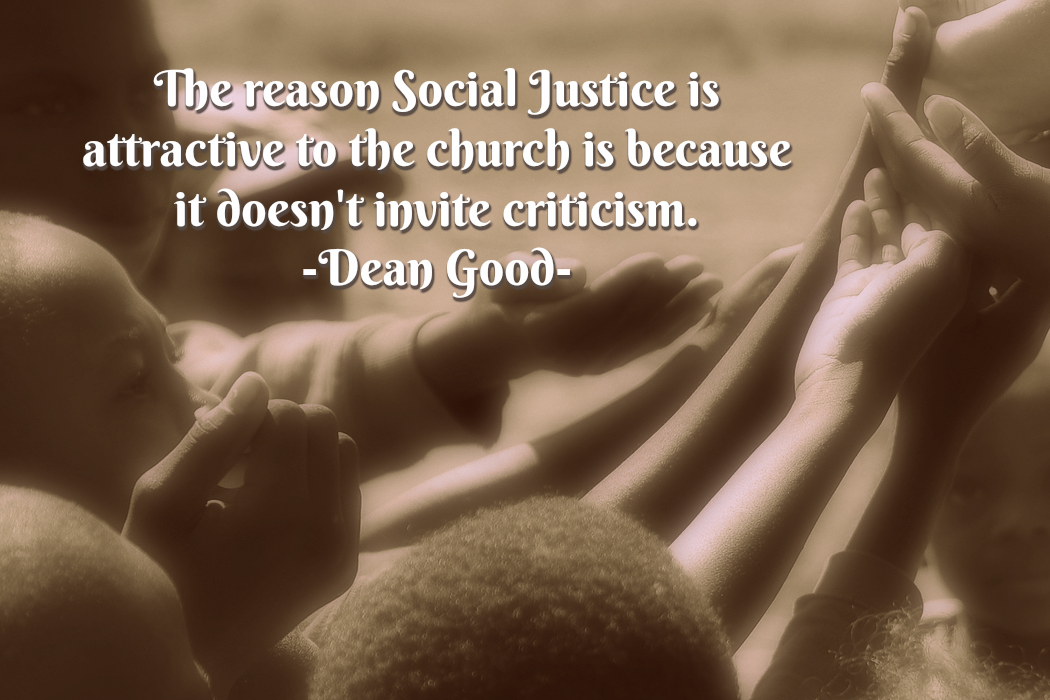


There’s More to Christianity Than Doing Good Works

“The reason Social Justice is attractive to the church is because it doesn’t invite criticism.” My brother (Pastor Dean) said these words as we talked on the phone yesterday. I immediately realized just how profound his words were.

Perhaps they are words each and every one of us should reflect upon.

There are many good things the church does that all people love. It matters not if they are Christian or not Christian. Nothing matters as we work hard with our fellow man to make the world a better place. This includes things like–

Feeding the hungry ♥ Adopting orphans ♥ Caring for the homeless ♥ Providing fresh water for third world villages ♥ Providing food, clothing, and shelter to needy families ♥ Giving money to charities

Who in their right mind is going to oppose such things?

And, just to be clear, I am not opposed to these things. And neither should any of us be. The Bible is clear: We are told to care for orphans (James 1:27); we are to help our fellow man– and particularly our Christians brothers and sisters– who are in need (Ephesians 4:28; Hebrews 6:10). These are good things to do.

But these aren’t the only things Christians are to be doing. Doing good for others is just a part of what it means to live a godly, righteous life.

There’s so much more. But the “more” doesn’t often draw the praise of man.

As soon as we go out into the world and preach the Gospel–the clear, unadulterated Gospel as the scripture teaches it–we immediately invite the antagonism, the scorn, and the hatred of the world.

And as soon as we try to teach and live out the Christian life that is clearly mandated in scripture among the murky and muddy waters that is the mainstream church we invite the antagonism, the scorn, and the hatred of that church.

When we bring a message the world doesn’t want to hear, such as you cannot be reconciled to God without believing in Jesus Christ (John 14:6), we will be criticized, mocked, and labeled. We may even be persecuted. By both the world and those claiming to belong to the church.

When we bring a message the mainstream church doesn’t want to hear, such as encouraging believers to practice discernment (Hebrews 5:14), be separate from the world (James 1:27), and strive for holiness (I Peter 1:15-16), criticism and animosity will often rain down upon our head from within the church doors.

This is why so many of us choose to do the Christian things that invite the praise and laud of people. And it’s also why we avoid doing the Christian things that invite criticism.

How much do you care what people think about you? Does this change what you stand for or stand against?

I have to be honest and let you know right up front that this has been–by far–my biggest battle in this ministry.

It is natural for people to want to be liked and I am no exception. I don’t want to be labeled divisive, negative, unloving, arrogant, and whatever other words I have been called.

And yet, over and over again, God continues to remind me that my job is to please Him, first and foremost. As believers, our priority is to do all to the glory and pleasure of our Lord, irrespective of the opinions of man.

The opinions of those around us are, in essence, irrelevant.

Now reflect on that truth for just a few seconds. Why do we do what we do? How do we feel if we do something good and it goes unnoticed? How do we respond when we are faced with a choice to speak out against something we know God hates or a false teacher that is leading someone we love astray? Do we have the courage to share the Gospel unapologetically with the lost all around us? Are we truly living like no one’s opinion matters but God’s?

Inside each of us, a battle rages between the flesh and our new man. And the flesh wants to be pleasing to our fellow man. It is just how we are. But when we are saved, we have a new purpose. We seek first God and His Kingdom (Matthew 6:33). We are new creatures (2 Corinthians 5:17). Everything is changed.

In theory, that is.

In real life, it doesn’t just happen. It is a daily struggle.

However, as new creatures, we must fight this fight. For if we let the flesh win, it is not without deadly consequences. Think of how many children in Christian homes have grown up and gone out to live ungodly lives in the world because parents didn’t want to be unpopular? Think of how many inroads Satan has made into the lives of believers because they want to be cool to their friends? How many have followed false teachers because their Christian friends are afraid to speak up? Think of the light that has gone out in the church because of the desire to win the praise of the world?

If we aren’t willing to be different than the world and if we are driven by a passion to please the world (or the compromised, mainstream church), we will be rendered ineffective for the cause of Christ.

Sure, we can do all sorts of nice things for others and make this temporal world a better place to live in, but if we aren’t sharing the Gospel and pointing people to biblical Christian living, what eternal good are we even accomplishing?

Are we more likely to do the things that draw the praise of man? Do we shy away from the righteous and good things that draw criticism?

Pastor Dean’s words really made me think. And, once again, I was reminded: My priority is to please God.

Am I living to please God or are my daily life choices based on pleasing those around me? It is an important question that we should probably all give some thought to.


Don’t Let Anyone Steal Your Peace This Holiday Season

Good morning! It is the Monday before Thanksgiving. As I thought about this holiday, I wondered how I could encourage a thankful heart in a new and different way that improves upon all that is out there. I decided I can’t so I am going to go a little different direction. But first, I wanted to take a few moments today to let you know of a few upcoming things here at Growing4Life–

First, the Growing4Life 2018 Christmas story is coming! Starting this Friday, I will share one part for the next five Fridays. The final part and ending will be posted on Friday, December 21. This year’s story is called Mending Fences and is about two sisters and how forgiveness changes everything. I hope you all enjoy reading it as much as I have enjoyed writing it.

Second, I have decided on the Growing4Life 2019 Bible Reading Challenge. (Can you believe it’s going to be 2019?? Where does the time go?) For next year’s challenge, we will be doing a chronological Bible read through. I did this 4 years ago for my 2015 Challenge. I have decided to do it again, because I think it it vital for every Christian to read through the Bible at least once. Reading through the Bible gives fundamental understanding and insight into God’s plan and story that one just cannot get in any other way.

Providing the G4L Challenge and an accompanying Facebook group where we can share and discuss what we are reading is my way to help and support my readers in this endeavor for anyone who desires to do this. I hope to get the details out for the new challenge within the next week or two. I do hope that many of you will join me!

I honestly don’t really know how many of you out there actually even read my posts (especially you, my subscribers, as emails just land in boxes and probably mostly go unread) but it continues to be my hope to be an encouragement for believers to walk with God in submission and obedience and to be a light that points people to the Word of God as their authority and guide in a culture that’s growing increasingly darker. I hope that both this year’s Christmas story and the 2019 Bible Reading Challenge will do just this.

_____________________________________________________

Now, for a few thoughts that may be a little different this Thanksgiving. Holidays can be a bit rough on many of us. Unsaved or deceived family members and friends can challenge or discourage us at gatherings. They can keep us from enjoying ourselves and we let them mess with our peace.

I was struggling with something the other day. Someone had responded unkindly to me and my dad shared with me something my Grandpa used to say. It was something like this–

Don’t let someone else and their problems steal your peace.

Have you ever thought how often we have done this? At least, I have. Someone is mean or angry with me and that affects my mood. Next thing you know I am short with my husband or someone else close to me.

It reminds me of a time a lady called us on Christmas Day because we hadn’t plowed her driveway yet. She was a widow with nowhere to go and she was angry because we hadn’t been there yet. As my heart grew defensive within me and I wanted to start yelling at her, I remembered something: Her husband had just died. She was lonely and hurting and this was her response. So many people get angry in response to deep hurts.

We need to remember that–

People always do what they do for a reason.

As believers, let’s show extra grace. They may be hurting. Or they may be caught up and deceived by a wrong philosophy. Whatever it may be, our response, as believers, is to have lots of grace and mercy, just as God has for us. Let us love even the unlovable because God loves us. For remember, God loved us when we were yet sinners (Romans 5:8).

Another thing to consider is this: If you have your mind set in a certain direction, what will be most likely to change it? Harsh, angry, words of debate and argument or kind, thoughtful words that encourage respectful discussion?

We live in a world that is increasingly divided. Whether it’s politics, personal rights, or false teachers, there are a million opinions out there. But the only opinion that matters is God’s. What does the Bible say? But, even as we try to share what scripture says, may we be respectful, kind, and loving. As God gives us opportunities, let us not grow angry or insistent. Only God can change a heart. That is not our responsibility.

So as we meet together with friends and family that may have differing opinions, let’s love them. Let us have unending grace. And let’s point them to scripture if and when the “hot” topics come up. Let us not allow anyone to make us frustrated or angry. Or to steal our peace. Let’s not give them that power. I do know that this feels almost impossible but the truth is that it is our choice.

And then, at the end of the day, when we have made the right choice, we can walk away in peace, knowing we have done the right thing, no matter what their response.

______________________________________________


I wish you all a wonderful Thanksgiving! I am so thankful for all of you, but particularly those of you that have taken your precious time to share that you appreciate what I do here at Growing4Life. Blogging about discernment and living a holy life in these difficult days is a rather lonely and discouraging thing and those of you that have encouraged me have been used by God to keep me going. God’s timing on your notes, emails, and Facebook messages has been incredible and I always marvel at this. So thank you. Thank you for reading. Thank you for encouraging. And thank you for being part of the Growing4Life family of believers. Let us continue to stir one another up to love and good deeds as we march forth as soldiers of the Cross!


My Way or His Way?

In 1969 a song was written by Paul Anka that was made popular by a crooner named Frank Sinatra. The song has a thoughtful and appealing tune and is called “My Way”.  The final stanza of the song does a good job of summing up the song–

For what is a man, what has he got?
If not himself, then he has naught
To say the things he truly feels and not the words of one who kneels
The record shows I took the blows and did it my way
Yes, it was my way

It’s pretty clear that this song is an anti-Christian song since the entire song is like a theme for humanism. The author did things his way and didn’t answer to any supreme being or any human being. Of course, the author will answer to God one day, if he hasn’t already. So why am I talking about a 50 year old song?

I’ll tell you why.

Because I have seen more and more people who claim to be Christians live by this mantra:

I did it my way.

I’ll do it my way.

And then, eventually, in our obsession with our dreams, our purposes, and our goals, we end up believing that…

God exists to help me do it my way.

We are concerned only about our way.

The thing is…

Biblical Christianity teaches the opposite–

• Instead of being obsessed with our own plans and dreams, we are to submit to God’s plans. (Rom 14:8)

• Instead of being driven by our selfish desires, we are to deny ourselves. (Luke 9:23)

• Instead of thinking only of ourselves and our purpose and desires, we are to think of others. (Phil 2:3)

It’s easy to point a finger at others and shake our heads in sadness or disgust. See how selfishly they are living? Isn’t that a shame? But, while we may not ascribe to self-centered living in theory, how often do we live it without realizing it?

I am amazed, even though I have been walking with the Lord all these years, at how often I am driven by my own selfish desires and will. And disgusted at how often I find myself obsessing about myself and my happenings. Can you relate? Or am I alone on this one?

I think one of the greatest challenges of walking with the Lord is this:

Living for Him instead of for me.

And, in this current church culture, we aren’t even given this challenge, are we? We are told that we can live for ourselves and expect God to swoop in and be our personal genie to help us fulfill our big dreams and realize our insanely important purposes.

But God cares far more about our holiness than our happiness. (Romans 5:3-5)

And it’s not about us. Our lives are just a teeny-tiny point on the map of the universe and the timeline of history; both of which are utterly and absolutely under the sovereignty of God. (Isaiah 46:10)

God is choosing to use us for His glory and His purposes at this time. His glory. His purposes. (Ephesians 2:10)

I guess Paul sums it up best for all of us in Galatians 2:20–

I have been crucified with Christ; it is no longer I who live, but Christ lives in me; and the life which I now live in the flesh I live by faith in the Son of God, who loved me and gave Himself for me.

This, as true believers, is our aspiration. We are to die to self and live for God. It is a message that isn’t heard very much anymore. You won’t hear it from most pulpits or read it in the Christian best-sellers. In a culture obsessed with only positive messages, this is a message that isn’t very popular.

Everyone wants to live life their way and they want a God who will bless them as they do things their way. And even those of us who truly desire to live for Christ can be swayed a bit by this wrong thinking about God.

And so I hope that today you will take some time to reflect on how you are living for yourself instead of for God. And while you do that, I’ll be doing the same. Just because I can write things like this, doesn’t mean I don’t struggle with the same things you do. It’s one thing to write. It’s another thing to live.

So let’s strive to live for God together, always turning to His Word for guidance and direction. And, in a world full of people obsessed with doing things “my way”,  let’s do things His way.


A Crash Course in Systematic Theology

The term “Systematic Theology” can scare us if we aren’t very educated. However, in its simplest definition, it just means organizing all the Bible teaches into categories. See? It’s not really all that scary! Systematic Theology gathers all of the information that the Bible has to say from Genesis to Revelation about a certain topic–such as God, or angels, or Jesus, etc.

We often hear that Christians are disinterested in doctrine. And I do think that is true. But, honestly, I think there are also quite a few who are intimidated by it. If we don’t have a lot of background in these things, the terms and phrases can be rather daunting.

But it doesn’t have to be this way! Pastor Dean Good makes it possible to learn the basics while removing the “intimidation” factor. He also makes it clear that we must never make theology or education our goal. As believers, our goal is to walk in the Truth of God’s Word. Nothing should ever take the place of that.

This past September I started teaching a Bible Study on the Fundamentals of the Faith. As I tried to deepen my knowledge of the doctrines we are studying, I found these Bible Study sessions by Pastor Dean, which he taught at the church where he is pastor (Grace Church of North Olmsted). Not only have they benefited me greatly but they have also helped those attending the studies who are interested in going that extra mile to learn more.

As I was reflecting on this over the weekend, I decided to compile these sessions all on one page so that you, my readers, might learn from these, as well. They give a wonderful overview of each topic in a way that anyone can understand.

I really think you will enjoy these if you take the time to listen. I hope this will be very helpful to you as you strive to grow in Christ. In the introduction Pastor Dean does a fantastic job giving us insight into why a study of doctrine is so important, so that’s a great place to start.

(P.S. Don’t let the big words scare you on this list. The academic words simply represent very familiar concepts.)

1. INTRODUCTION

Every good course needs a good introduction and this is one of the best around. Pastor Dean offers an easy-to-understand overview, as well as a few really practical reasons why this study is important.

Introduction to Systematic Theology


2. SCRIPTURE

What does the Bible say about itself? Why do we believe it to be the inspired and inerrant Word of God?

Doctrine of Scripture


3. GOD

What does the Bible teach us about God? Learn why we should be in such awe of God, the Father!

Doctrine of God


4. TRINITY

What does the Bible teach us about the trinity? This session may clear up some of your questions about this rather confusing doctrine.

Doctrine of the Trinity


5. CHRIST

What does the Bible teach us about Jesus Christ? Do you know who He really is, according to the scriptures?

Christology


6.HOLY SPIRIT

This is one of the most maligned and twisted doctrines of scripture in this current church age. What does the Bible say about the Holy Spirit and His work in our lives?

Pneumatology


7. ANGELS

What does the Bible teach about angels? Does what you believe about them match what scripture says?

Angelology 1

Angelology 2


8. MAN

Man is made in God’s image but what exactly does this mean? Find out what the Bible has to say about this.

Anthropology


9. SIN

What does the Bible teach about sin? What is sin? Are there levels of sin?

Hamartiology


10. SALVATION

What does the Bible teach about salvation? Pastor Dean spends four different sessions on this important topic.

Soteriology 1

Soteriology 2

Sanctification

Perseverance


11. CHURCH

What does the Bible teach about the universal Church and what is the role of the local church? This is an extremely important issue, especially with the development of the modern seeker-friendly and business model churches. Is this really what God had in mind?

Ecclesiology 1

Ecclesiology 2


12. ISRAEL

What does the Bible teach us about Israel? There are many people who believe that there is no role for Israel in the future. You may be one of them. I hope you will listen and find out why Pastor Dean believes that God is not yet finished with Israel.

Israelology 1

Israelology 2


13. PROPHECY

What does the Bible teach us about the last days? There are many different ways that people interpret Daniel and Revelation and it’s certainly not a salvific issue. But, while this is something we can agree to disagree on, Pastor Dean approaches Revelation the way he approaches all of scripture: Literally. He shows why we can and should interpret books of prophecy in the same way we interpret the rest of scripture.

Eschatology 1

Eschatology 2


Who Is Jesus?

Who is Jesus? One of the greatest travesties of this current age is the misunderstanding of who Jesus is. People throw His name around all the time, attributing characteristics and traits to Him. But do they actually match the real Jesus?

I hesitate to even write this, knowing that I can’t even begin to touch the surface of who Jesus really is in a blog post. But I feel compelled to at least write something in the face of all of the bad information that is out there. So here goes…

I want to first do a quick overview of who Jesus is and why He came before we look into some of the myths that are believed about Him.

It is important to start with who we are without Christ. We need to understand that we are sinners, lost and without hope, dead in our sins. We are not good people with good hearts. Romans 3:12 b is one of several verses that makes this abundantly clear–

There is none who does good, no, not one.

This leaves us lost and without hope. As sinners, we desperately need a way to be reconciled to God. All the good deeds in the world will not be enough to make us stand righteous before God. We cannot work our way to Heaven. Isaiah 64:6 a says this–

But we are all like an unclean thing, And all our righteousnesses are like filthy rags;

Since no good and righteous judge can excuse a lawbreaker, we know that we cannot just walk away without punishment. And so we needed a perfect sacrifice to pay for our sins. Maybe this analogy will help:

A murderer sits before a judge, awaiting his verdict. Perhaps he makes his case–yes, I did murder that man but, judge, I’ve given thousands of dollars here and I’ve spent hours helping the poor there. But, of course, we know that there isn’t any amount of good deeds that can make up for the sin that he committed. There is no “balance” between good and bad deeds in real life and there is no balance when it comes to God, either.

As a good and righteous judge, he must punish this murderer. To not do so would mean he is not just or fair. But then someone comes in to the court room and offers to take this man’s punishment. He is offering to pay the price so that this man can be set free. Who would ever do such a thing? I don’t know of any human.

But this is, in essence, what Jesus did for us. We are in that court room, awaiting our death sentence, and He has offered to pay our punishment with His death on the Cross, so that we may go free and have eternal life. We are reconciled to God through Christ’s death when we trust in Him and Him alone for salvation.

But Jesus didn’t stay in that grave.

He is alive and will return again someday! This is our Savior and Lord and King. The King of Kings (Revelation 19:16), almighty, all-powerful. He is calling us to live a godly and discerning life while we await His return (2 Peter 3:14-18).

I Timothy 1:15 says this: This is a faithful saying and worthy of all acceptance, that Christ Jesus came into the world to save sinners, of whom I am chief. 

Jesus came to the world to save sinners. He did not come to make our life here on earth easier, to give us a purpose, or to fill our lives with material wealth and good health. He came to save us from the eternal punishment we deserve because of sin.

But this is not the Jesus we generally hear about today. This modern day “Jesus” is our buddy and he exists to do our bidding and to make our lives better. With this Jesus we can be like the world, we never have to confront sin, and we can join with false teachers. We can lie, we can steal, we can cheat, we can live in sexual sin, we can do anything we want because Jesus always forgives us. This Jesus never gets angry, is never divisive, and never calls out sin. This Jesus accepts everyone into heaven and would never send anyone to hell.

Now before we do a biblical test of these things that we wrongly assume define Jesus, I do want to make it clear that some of the things currently ascribed to Jesus are most certainly true: Jesus loves us. Jesus does have great compassion for the lost sinner. Jesus does forgive our sins. He has no bias for class or race. He is kind and good.

But let’s take a look at some of the other traits ascribed to this character I will call “Cultural Jesus”.  Are the characteristics attributed to our Lord Jesus Christ true or are they false, according to scripture?

1. Our Buddy

The Bible does say that Jesus is our friend. But there is a condition to that friendship. We are only His friends if we do what He commands in His Word (John 15:14). If we do not do as He commands, we have declared by our actions that we are not His friend, no matter what we say.

2. Accepts Anyone and Everyone Into Heaven

“Cultural Jesus” doesn’t care what path people take to heaven. Of course, we know the real Jesus made it clear that He is the only way (John 14:6). “Cultural Jesus” also assures us that everyone is going to heaven. This is another myth. It was the real Jesus who said the way is narrow and few there are that find it (Matthew 7:13-14).

3. Never Confronts

“Cultural Jesus” never confronts sin. But we can quickly find out that this is not the real Jesus. No matter where He went or who He talked to, He called people to repentance and out of their sin. In fact, He had an advantage, because He knew people’s hearts, which often hide the most secret sin: that of motive (John 4).

“Cultural Jesus” also never confronts false teachers. But we can see in scripture that the real Jesus most certainly did call out false teachers–in public! He shows us by his actions that false teachers who pervert the truth of the Gospel can and should be called out publicly (Matthew 23).

4. Never Condemns

The real Jesus does offer us a way to be free from condemnation. And that is to repent and turn from our sins and trust in Him for salvation (Mark 1:15). However, He had little patience for those who were full of self-righteousness and hypocrisy and He did condemn them (Mark 7).

5. No Care for Our Daily Choices, Sinful or Otherwise

“Cultural Jesus” doesn’t care what we do. We can live like the world; go where we want; listen, watch, and read what we want without any break in fellowship. But we know from scripture that all of our choices matter. That they either lead us towards a deeper relationship with Christ or away from Him. And He desires that we abide in Him. In fact, this is the only way to have any fruit of lasting value. Without Him we can do nothing. (John 15:1-8)

6. Loved by the World

The world (and mainstream church) would have us believe that Jesus was the most popular man on earth but we know clearly from His own words that this isn’t true. He declared that we will be hated, just like He was hated. We are to expect this. This flies in the face of “Cultural Jesus” who is loved by everybody. (John 15:18-20)

7. Exists to Make Our Life Here on Earth Happier

“Cultural Jesus” exists to make our life happier and more fulfilled. But the real Jesus says nothing about making our temporal life better. Instead He tells us to forsake all and pick up our cross and follow Him (Matthew 10:38-39; Luke 14:25-33) and that we are to deny ourselves (Mark 8:34). He also assures us that we will experience hatred in our efforts to follow Him (John 15:18-19). While this sounds utterly unfamiliar to so many who use the name of Jesus, it is what we read in the scriptures.

8. Greatest Concern is Unity

“Cultural Jesus” compromises truth in order to be unified. But we know from scripture that this is certainly not true. In fact, Jesus says He came to bring division. (Luke 12:49-53) He also makes it clear that it is impossible to worship God in purity of heart unless we are worshiping in truth (John 4:24) This would then preclude any compromise with a false worship system.

9. Would Never Send Anyone to Hell

While Jesus’s ministry was focused on calling people to repentance, He did mention hell on a number of occasions. He spoke of it as a very real place. (Matthew 5:29; Matthew 10:28; Matthew 23:33; Luke 12:5 to name a few)

10. Indifferent to Sin

Is the real Jesus indifferent to sin? Let’s go to the scriptures to find out. There we will find that Jesus commands people to repent (Matthew 3:2; Mark 1:15; Luke 5:32) Merriam-Webster.com gives this definition of repent: to turn from sin and dedicate oneself to the amendment of one’s life. From this I believe we can safely conclude that Jesus is definitely not indifferent to sin but, instead, rightly expects us to turn from it.

He also tells the man healed at Bethesda (John 5:1-14) and the adulteress (John 8:7-11) to go and sin no more. From this we can assume that Jesus, who forgives our sin, desires that we strive to live a righteous life and to make an effort to sin no more.


I hope this short post starts you thinking about the difference between the “Cultural Jesus” and the real Jesus. There are so many more things I could have touched on. This is really a subject without end and one post hardly does it justice. But I do hope it at least brings to light that there is a major discrepancy going on here and instills in you a desire to study who Jesus really is, according to the Bible.

It is important as we hear people throw the name of Jesus around lightly that we take the time to study our Bibles and compare what we hear to what scripture says. How important it is that we understand who He really was during His time here on earth and who He is right now–our risen Savior and King who has promised to return for us!


A Life Above Reproach

Tomorrow is voting day here in the United States. Someone told me the other day of a conversation they had with the staff member of a local representative. This person was sharing her horror and disgust at the lies and slander that were being told about this man by his opponent. She listed a few things that the commercials had “asserted” and declared their impossibility given this man’s upstanding character.

We already know that we can’t believe everything we hear–especially during voting time.

But there is something else to consider:

This man’s closest friends and co-workers knew with certainty that the things being told about him were false. This should lead us to ask ourselves a question: Are we living life in the same way? Are we living above reproach in such a way, that if someone slandered us, we’d have those who know us best declaring there is no way it could be true?

Do you know that this is how it is supposed to be for us as believers? Peter puts it like this–

But sanctify the Lord God in your hearts, and always be ready to give a defense to everyone who asks you a reason for the hope that is in you, with meekness and fear; 16 having a good conscience, that when they defame you as evildoers, those who revile your good conduct in Christ may be ashamed. I Peter 3:15-16

How do we have a good conscience? We do this by living a life of integrity. While we can’t do this perfectly (we all continue to sin, unfortunately) we can and should choose to live righteous and holy lives.

If we always tell the truth; if we honor our marriage vows; if we never cheat, steal, or rob; if we respect authority; if we are kind and loving to others; if we are content with our lot in life; if we are humble; if we are careful not to put ourselves purposefully in the path of sin (such as bars, casinos, and wherever else we know temptation takes us to places we shouldn’t go) then we are living a life of integrity.

If we never take advantage of people in business deals; if we don’t manipulate and use people; if we don’t hold grudges and aren’t easily offended; if we conduct any company, church committee, or PTA business with fairness and honesty, then we are giving our enemies very little to grasp onto.

They are then forced to lie.

And we all know that this is what happens. If there is a man or woman of integrity that has an enemy, be sure they will be lied about.

But that person that’s being lied about? He has a clean conscience. He knows the truth and those that really know him know the truth. While it is a battle to be fought and there is much heartache that comes from false accusations, there is still an accompanying peace that comes from knowing that the accusations are false.

As I think about the recent Kavanaugh hearings, this comes to mind. You see, we as the public, are at a loss. And people like his enemies know this. They know that once a lie is told it puts a seed of distrust in the hearer’s mind. I have my guesses on what happened with that hearing but unless I’d get to know both parties personally, there is really no way for me to know the truth. False accusations are extremely powerful.

Opponents in political races know this. As do irritated agenda-driven church members, frustrated co-workers, and others who strive to knock someone down and out of place. Lies bring destruction.

While we can’t stop people from lying about us, we are able to choose to live a life above reproach. We can choose to live in righteousness so that when they do choose to say something about us, there is no foundation of truth to even be found upon which they can build their lie.

No, this doesn’t bring back the trust of others. No, this doesn’t take away the dreadful pain or even the consequences of the slander and false accusations. Elections are lost, godly men are forced out of ministry, and good workers leave companies because of lies. Christians even lose their lives because of lies. False accusations have often been what Satan has used throughout history to martyr many of our brothers and sisters in Christ. We can’t change this.

But we can live with a clean conscience so that, as Peter says: that when they defame you as evildoers, those who revile your good conduct in Christ may be ashamed.

It is a discouraging world where lies will win. But Satan is the father of lies (John 8:44) and the world is currently under his influence (I John 5:19). We also know that Satan is a Christian’s greatest enemy (Ephesians 6:11-12;I Peter 5:8). Therefore we should’t be surprised when we are the target of lies and slander.

So let’s not give Satan any handles to grab on to. Let’s live a life so above reproach that there is not even a hint of truth found in any accusations against us. It is in this way that we can honor the Lord Jesus as well as preserve our peace of mind and heart.

And while we are struggling (and hopefully growing in our faith) through those false accusations, we dare not forget this:

You have heard that it was said, ‘You shall love your neighbor and hate your enemy.’ 44But I say to you, love your enemies, bless those who curse you, do good to those who hate you, and pray for those who spitefully use you and persecute you, (Matthew 5:43-44)

Nothing is outside of God’s care, including false accusations. Even this is under His sovereignty and can be used to teach us and grow us in holiness and righteousness.


Ants and Donuts

A few weeks ago I came downstairs to find ants. Normal-sized ones and teeny-tiny ones* were making themselves right at home on my kitchen counter. I had been fighting a battle with them since it got cooler. I thought we had beat them, although I would still find an occasional one making its lone way across the countertop. Until that morning.

I grabbed some thick sheets of wet paper towel and just started wiping it across the counter, gathering all I could see in my broad swipes, muttering to myself all the while. I. Hate. Ants. Especially in my house.

Nearby sat a container of apple cider donuts leftover from a gathering the night before. I carefully lifted them up in the dim light, twisting and turning the clear container all around. I didn’t have my glasses on but from what I could tell, they looked okay. I breathed a sigh of relief and moved them to the kitchen island where, at least so far, no ants had been spotted.

A little while later, my husband mentioned that the donuts had ants all through them. Rather shocked, I put on my glasses and sure enough! They were all over those donuts. What looked like hundreds of them crawling over, under, and through the holes in the middle.

How could I have not seen them?

I threw the donuts away and went on with my day.

But I’ve been thinking a lot about this incident. There are a few lessons to be learned.

The first lesson that came to mind is that worry and anxiety are like those ants. They crawl in and around and through everything good in our lives and destroy it. While worry and anxiety do nothing to help change the future, they do destroy the present. I think this is why Jesus tells us in Matthew 6:34–

Therefore do not worry about tomorrow, for tomorrow will worry about its own things. Sufficient for the day is its own trouble.

The fact that Jesus mentions this would tell us that worry has always been around. What is the antidote for worry? How do we get to “Do Not Worry”? I am actually still working on that. However, I think there are two things that can really help.

First, and most importantly, we need to fill our minds with God’s Word. His Word fills us with comfort and peace and gives us an eternal perspective. We should memorize a few verses about who God is. And Matthew 6:34 (or even back up a few verses and catch the rest of what Jesus has to say about worry). Saturating our minds with God’s Word will serve us well when the anxieties loom over us and steal our joy.

Second, we need to turn our attention from inward to outward. It is hard to see the needs of others when we are focused on ourselves. We render ourselves fairly ineffective for God’s Kingdom when we are overtaken and haunted by worry and anxiety about the future. But when we can think outside ourselves and serve others, we will find that the thoughts of anxiety and worry will melt away as other thoughts fill our minds.

I believe that our battle with worry and anxiety is a sin because it shows that we are not trusting God or submitting to His will for our lives. I also believe that this sin is one that almost all of us fight at one time or another. The first key is to recognize it as a sin (and not just blame it on our personality or circumstances) and then we need to actively work to eradicate that sin from our lives.

The second lesson from those ants is this: We need our glasses on in order to see the ants. The Bible functions as our glasses. It gives us understanding and shows us who God is, who we are, what sin is, how we can be saved, and how we can grow in Christ. Everything we need for life and godliness is within its pages.

But, too often, we try to navigate life without it. And so we have ants on our donuts but we don’t even realize it! We think all is fine when it’s not fine at all. The Bible not only helps us get rid of the ants, it shows us that the ants exist.

You may think you’d just rather know the ants don’t exist. And I feel that way, too, sometimes. But God’s way is always perfect and finding those ants (and sins!) sooner rather than later is always going to be best for us!

So we need to put on our Bible glasses in order to see ourselves as we really are (instead of our “friend” glasses that have us comparing ourselves to those around us).

And then we need to do something about it. Remember what James says–

But be doers of the word, and not hearers only, deceiving yourselves. 23 For if anyone is a hearer of the word and not a doer, he is like a man observing his natural face in a mirror; 24 for he observes himself, goes away, and immediately forgets what kind of man he was. 25 But he who looks into the perfect law of liberty and continues in it, and is not a forgetful hearer but a doer of the work, this one will be blessed in what he does. James 1:22-25


I don’t like ants, but they did give me something to write about this morning, so as it’s the first day of November I can say, in the spirit of Thanksgiving, there’s even a reason to be thankful for ants on my counter! Have a great day!


*The exterminator told me the really tiny ants were baby ants! Who knew??


The Expedient Lie

A friend of mine and her husband have wisely decided that their family will not celebrate Halloween*. As they have been going out and about town these past few weeks her four-year-old has frequently been asked what he will be dressing up like for trick-or-treating. His consistent answer was that he wouldn’t be dressing up because “Mom says we only celebrate holidays that have to do with Jesus.”

But one day a lady asked him this same question and his answer was remarkedly different.

“Umm, I am going to be a superhero!”

“Ohh, which super hero?” the lady asked.

This peaked his mom’s interest, as he doesn’t even know any superheros. She stood back to watch where this was going.

“Ummm, well, it’s red and blue…” His mom realized he was describing a mask and cape that he had at home.

“Oh, nice.”

But the little guy wasn’t done yet. He added this, “And yeah, I am going to wear it to our Halloween party.”

She says, “Oh, a Halloween party?”

He proceeded to enthusiastically tell her that he would be eating cake and having fun there.

Mom didn’t say anything but later she asked him why he had told that lady he was dressing up and talked about a Halloween party.

He said something like this: “Well, I just got tired of telling people I don’t dress up and that we don’t celebrate Halloween and so I just decided I am going to tell them I am going to be a super hero and that way people are more excited.”

This little boy had done what so many of us do. We tell an expedient lie to avoid consequences. While we adults tend to justify these lies in our minds the little boy, like most children do, had been quite honest about why he did it. He didn’t feel like dealing with the questions anymore so he just told them what they wanted to hear.

Can you think of the last time you did this same thing? How often do we say something dishonest in order to avoid a hassle and/or ridicule?

I would say it’s pretty often. It’s actually pretty ingrained into this culture anymore. It’s hard to gauge people’s true opinions because they generally aren’t saying them. Oh, I know there are lots spouting off online and that’s not good either. But there are lots and lots of Christians who are just not saying their honest opinion about the things that matter because they don’t want the heat. It’s just easier to go along with the crowd or to make up an answer that people like.

Specifically, I can think of a few ways that we Christians do this in our homes, workplaces, and churches–

What do you think of _________ (ungodly movie, band, or book)

         (uhhh, it was okay. I really liked the part where…)

Did you finish that report today?

           (“oh, yes, I started it” while it’s laying in an unopened folder on our desk)

Will you be home by six?

        (“That’s my plan” knowing full well that there is no way it will happen)

Do you like my new hair style? (I hate this one. It’s so hard to navigate!)

             (“Yes, it’s so cute” when it’s not cute. At all)

And husbands will relate to this one: Wives ask, “do you think I’m fat?”

          (Oh, no, of course not, dear)

It’s just easier and much more expedient to lie most of the time. We avoid hurt feelings, fights, arguments, derision, and mockery when we do this. Surely God doesn’t have a problem with it, right?

Well, I’m not so sure.

God condemns lying very strongly in His word. Here are just a few of the many verses–

The wicked are estranged from the womb; They go astray as soon as they are born, speaking lies. Psalm 58:3

He who works deceit shall not dwell within my house; He who tells lies shall not continue in my presence. Psalm 101:7

Lying lips are an abomination to the Lord, But those who deal truthfully are His delight. Proverbs 12:22

Therefore, putting away lying, “Let each one of you speak truth with his neighbor,” for we are members of one another. Ephesians 4:25

Do not lie to one another, since you have put off the old man with his deeds, Colossians 3:9

Inevitably, when we discuss lying, the subject of Rahab comes up. She lied to protect God’s servants and was blessed for it (Joshua 6:17; Hebrews 11:31). Dare I point out the obvious?

Rahab was not lying to protect herself.

While I am not prepared to discuss what anyone should do in her circumstances, I think it is pretty clear that lying to protect our own selfish interests is clearly sinful. And, if we are completely honest, we are generally not protecting anyone other than ourselves when we lie. So to use Rahab (or even the Christians who hid Jews during the Holocaust) as our excuse to lie would be a pretty ridiculous cop-out.

God hates lying lips. We know this from His Word. And yet we all so easily fall into lying. Because it’s just easier. Perhaps it is time to carefully examine our words for how often we are speaking the truth.


*Should a Christian celebrate Halloween? I’ve vacillated through the years on my response to this question. Recently, though, with the rise of occultic activity and the growing fascination with all things dark (zombies, witches, vampires, magic) I would agree with my friend and would avoid celebrating this holiday. A good question to ask is this: Does this holiday glorify God or the devil? The obvious answer to this should give us a clue as to whether or not we should participate in this holiday.


When It’s Time to Reap

She sat there in her hospital room, old, confused, and alone. A lifetime of bitterness and grudges and pride was being harvested. Her unforgiving heart and her need to be in control had pushed away most of her friends and family, leaving her to walk through this latest health crisis alone. When one of her children reached out to her, she clung to her pride and her bitterness and pushed them firmly away.

It is, by far, one of the saddest, most heart-breaking things I have ever witnessed. And I was reminded of Galatians 6:7–

Do not be deceived, God is not mocked; for whatever a man sows, that he will also reap.

We reap what we sow. It is a principle of life we cannot escape. If we sow seeds of bitterness and unforgiveness and grudges, those seeds will grow into plants and those plants will produce fruit. Deformed, loathsome fruit.

If we sow seeds of love and grace and mercy, those seeds will produce good and healthy fruit.

But there are other bad seeds to sow, other seeds that produce bad fruit. Galatians 6 goes on to say this in verse 8–

For he who sows to his flesh will of the flesh reap corruption, but he who sows to the Spirit will of the Spirit reap everlasting life.

Any sowing that is done to our flesh will reap corruption. Any sowing that is done to the Spirit yields everlasting life.

BUT, you may be thinking, that old woman is not me. I am sowing good seeds, I have a good relationship with my family and friends. Lest we get too confident in ourselves, I remind you of something that John Stott once said–

“Every time we allow our mind to harbor a grudge, nurse a grievance, entertain an impure fancy, or wallow in self-pity, we are sowing to the flesh. Every time we linger in bad company who’s insidious influence we know we cannot resist, every time we lie in bed when we ought to be up and praying, every time we read pornographic literature, every time we take a risk that strains our self-control, we are sowing, sowing, sowing to the flesh.”

Oh, we all do it. Every. Single. Day. Maybe not to the extent that will leave us old and alone. But we all sow to the flesh, reaping the consequences of our sinful choices.

God sent His son to forgive our sins and give us eternal life. But salvation does not erase the consequences of sinful choices. We continue to live with those until we die.

Thankfully, living a life that is pleasing to the Lord eliminates so many of those ugly consequences. And that is something we can start to do right now! Today! His commands are not burdensome. They protect us! And what a wonderful protection they are.

We cannot change the consequences that we are experiencing from sinful choices of our past. BUT we can change the future. Here are a few questions we should ask ourselves as we contemplate our future harvest:

What seeds am I sowing that will yield an abundance of good fruit?

What seeds am I sowing that are going to yield the fruit of corruption?

AND…

What can I change to make my harvest so much better?


As God has a way of doing so often, He brings just the right book or sermon along at just the right time. That very thing happened this week. If you’d like to think on this topic a bit more, I recommend this sermon by John MacArthur on the principle of sowing and reaping: The Inescapable Law of Sowing and Reaping.


Scroll to Top