Family

As a Lab longeth for its food, so my soul…

My chocolate Lab, Macy, is consumed by the thought of food.  As soon as I get up, she hops up from beside my bed and wags her tail expectantly.  She knows that she needs to go do her “business” outside before I will feed her, so sometimes she will do nothing but make a token circle around the patio, and then beg to be let back in.   As soon as she is inside, she bounces around my feet and keeps trying to move me in the direction of the room where we feed her.  Once fed, she lays contentedly at my feet, sated and ready for another day.

The interesting thing is– she know who feeds her.  Anyone else can get up in my house before I do, and she will just lay there.  She knows that I am the one who feeds her and she will normally wait for me.  And, so, as irritating as it can be sometimes, I have somehow ended up as her “master” and I am the one that not only feeds her, but the one she follows everywhere.  Literally.  Whatever room I am in, I can be sure she is laying somewhere close by.

Her attachment to food and to the one who feeds her is pretty amazing.  Her loyalty is not divided.  Oh, she loves the others in this house very much and will play with them and even climb on their beds for an occasional night’s sleep (probably because she is not allowed to be on the bed in my room).   But I am the one she follows.  I am the one she trusts.

As I thought of all of this just this morning, it made me think of how hungry I should be for God’s Word.  And how attached I should be to the God who provided it for me.  Do I long to feed on God’s Word every morning –so much so that I can’t settle into my day before I have fed myself?  Do I trust and follow, without hesitation, the God who provided that food for me?

Sadly, I know that it isn’t so.   Oftentimes, I get started on my day and realize at the end of the day that I have never spent time in the Word.  Or perhaps it was a day when I sat down with good intentions and then got interrupted.  But, you know, Macy would never allow herself to be interrupted while eating.  I have tried it.  Even if I offer to pet her (her second favorite thing in the world), she will give a cursory glance at me and then turn her head back towards her food bowl.

Perhaps she knows what is important.  Perhaps she knows that she needs to eat and have her tummy filled before she can even enjoy being petted.  Who knows?  But, we should know that as humans, shouldn’t we?  We should know that we need to be filled with God’s Word before we can go on to live our day fully to the praise and glory of God.  Otherwise, we are stumbling on in our own power, relying on our own strength.

If you happen to have a Lab, then you probably can relate to this post.  If you have a different type of dog, then probably not.  Our other dog, Belle, a small, white Cavachon, likes to eat, but not with any kind of passion.  She will only get passionate about her food when she is really hungry.

I want to be like my Lab in my single-mindedness to fill my mind with God’s Word.  I want to have an insatiable appetite and a one track mind each morning.  And I want to lay at my Master’s feet the rest of the day, trusting in him implicitly to lead me through each moment.

Job 23:12  I have not departed from the commandment of His lips;  I have treasured the words of His mouth  More than my necessary food.

Psalm 42:1  As the deer pants for the water brooks, So pants my soul for You, O God.

Be a Blessing not a Burden

Be a Blessing

From the time my kids were small I sent them off with these words: “Be  a Blessing; not a Burden.”  I am not sure where I came up with it.  I think I just made it up. But whether they were headed to Grandma’s, a friend’s house, or a soccer game, those were often my last words to them. Did they always listen to me? I highly doubt it. But, hopefully, it got them thinking about others.

I still say it every once in awhile. And it is actually good to say to myself, as well. Because if we are concentrating on being a blessing to others and making an effort at not being a burden to them, it changes how we interact with others completely.

For instance, if I want to be a blessing, I will be looking for ways to encourage those around me. When conversing with them, I will want to find out how they are, I will ask questions, and I will genuinely care. If I want to be a burden, I will only talk about myself – my opinions, my problems, my issues– and not let the other person get a word in edgewise.

If I want to be a blessing, when I see the other person rushing to be first in line, I will slow my gait instead of speeding up to beat them to the line. Or if someone is holding one item to check out and I have a cart full of groceries, it means allowing them to go ahead of me.

Sometimes being a blessing means just not saying something that might be true. Many of us do this frequently. Whether it be directly to someone or it be about them, we say lots of words that just don’t need to be said. Who cares how her hair looks? Or what shirt she is wearing? Why not pray for their obvious budget or job problems instead of talk about them in a negative way? And sometimes it is not so much that we talk about it (how can we work together to help them financially at this time?) but how we talk about it (isn’t that the third time she’s worn that blouse this week? Can’t they afford anything else?)

Being a burden happens when I think only of myself. If I just scurry around in my day thinking only about me, then I won’t stop to ask someone how their weekend was, care about what they think about my “great” idea, or if they have any thoughts on the new plan I am putting in place. I won’t care if my kids believe they are the center of the universe and act like it on the soccer field. I will stand for my personal rights at all times and never back down. I will buy what I want, wear what I want, go where I want, eat what I want. “No one can tell me what to do,” will be my mantra.

In contrast, being a blessing is thinking about others. It includes things like: Asking those who will be affected how they feel about my new plan before just putting it into place; offering a drink to someone working hard in or outside my home; making my home a haven for anyone who visits; realizing my kids have faults,  admitting it, and dealing with it; talking it over with my spouse before buying a large item; saying please and thank you – instead of acting like I am entitled; giving in on the things that truly do not matter in the scope of life. The list could go on and on.

As I write this, my husband is blessing me by taking my girls to the school bus. This is the time of year he gets to sleep in- he works really hard and is up by 5 am most of the year- but he blesses me oftentimes in the winter by getting up early enough to take them, so I don’t have to go out into the cold, icy air. It is a great start to my day and I am always so very thankful for his kindness.

And I wonder how I can be a blessing to someone today? How about you? Who can you bless today?

Philippians 2:3-4  Let nothing be done through selfish ambition or conceit, but in lowliness of mind let each esteem others better than himself. Let each of you look out not only for his own interests, but also for the interests of others.


Practice Makes Perfect

My adorable piano student stood before me, unzipping the bag that held her piano books and hesitantly informing me that there were two songs she didn’t know very well.  When asked why, she said they were too hard.  When she sat at the piano, I asked her to play the first of those two songs.  As she faltered and stumbled through the first one, I realized what was going on.  She hadn’t even practiced the song because  she didn’t like the song.  It certainly wasn’t too hard.  It was filled with basic notes and timing–both of which had been familiar to her for awhile now.

When questioned if she liked the song, this little girl, a bit embarrassed, was truthful with me.  As I assigned the song again and told her that sometimes we have to do things we don’t like in order to really be successful, I thought of how much that is true in all of life.

Why do we have this idea that we can be good at something without practicing it?  And why do we think it happens without struggle and working above feelings?  Only through practicing – through songs we don’t like, through rhythms and measures that seem impossible, through working up the courage to play for an audience–do we become successful at playing an instrument.  The same would hold true of most anything in life.

And if that is true then the following two things are probably also true:

1.  If practice makes perfect, then older people probably have a lot of practice at living and perhaps we should listen to them a little bit more often.  In the rebellion and casting off of traditions we have seen in the last 25 years or so, I have seen a very disturbing trend in this country.  We treat our elderly like they are liabilities, instead of as precious assets who could teach us so much.  Let’s face it, the basics of life haven’t changed that much.  It is always amazing to me when I sit down and talk with someone who has lived a lot of life not only what I can learn, but how they have struggled through many of the same situations I struggle through…making a marriage work, raising children, trusting in God’s sovereignty, standing for Truth.

Yes, they should be precious to us and we cast them aside in our quest for something new and exciting and different.  In my opinion, this is a great tragedy.

2.  If we need to spend time at something in order to be successful at it, wouldn’t that mean the same for studying God’s Word?  Can we really know it if we aren’t studying?  And how can we live a holy life for God if we don’t know what that is?  I would submit to you that the only way to know what pleases our heavenly Father is to spend time in His Word, using reliable resources to help us to interpret it.

We only have one life to live.  And for many of us, we are looking at the word “elderly” and realizing that in just a few short years it will describe us.  May all of us – no matter what age we are — be reading God’s Word and practicing life in such a way that is glorifying our heavenly Father.  If we are reading God’s Word and applying it to our lives, young people will notice.  And if you are reading this as a young person, then remember –there is always someone younger than you watching you.

May we all strive to be godly examples for a generation that seems to have lost its way.  May we be “practicing” life in a manner that shows we are standing on the Solid Rock in the ocean of wishy-washy values and standards we find ourselves in.

What does Facebook say about you?

vixnj_hatejob_813233

I wonder if most of us realize what Facebook tells the world about us? When I was in that wonderful stage of dating (do you hear the sarcasm??), my parents had no idea what my date’s favorite bands were, what he liked to watch on television, or if he went to R-rated movies. They didn’t know if he was a whiner or a busy-body or used bad language.

Aah- how life has changed. As a parent, I love the tool of Facebook. I can tell immediately where someone’s heart is by looking at their info page. I can judge pretty quickly if the young person would be a friend that builds up or a friend that tears down. Because, like it or not, Facebook often shows our true character. It shows what we love, what we believe is important, and with what we fill our minds.

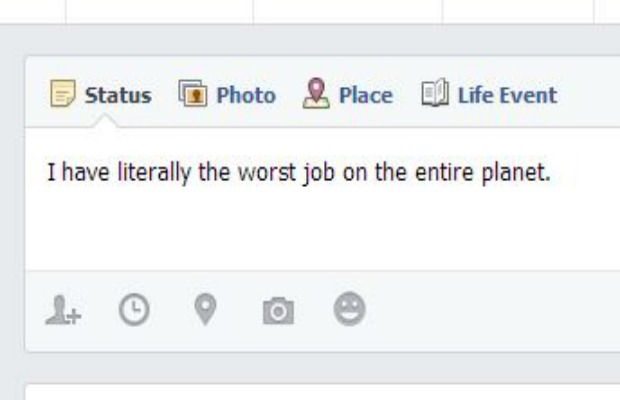
But it isn’t only our info pages that tells the world about us. Have you ever stopped to think what Facebook statuses and comments say about you? If we aren’t careful, we can fall into bad habits of complaining or bragging on this modern town square bulletin board.

When I first got my Facebook account, I tended to do some of this. It is easy to complain and now I had a chance to complain to the “whole world”!  There is also a great temptation to share only the good stuff to make yourself look like your life is totally together. But, after awhile, I realized that neither of these tactics was uplifting or benefiting anyone, including me.

Now there is certainly not anything wrong with sharing exciting news or family photos. It is fun to share our lives and reconnect with far-flung family and long-lost friends. And there is certainly nothing wrong with asking for prayer about a difficult situation or sharing with the world something that we are really struggling with (if we are truly okay that the whole world knows it!) Facebook can be a great networking tool for people without jobs or in a situation where we need encouragement. But when we find ourselves in a pattern of only writing the negative, it says something about us. It says we are a complainer. And we all know what God says about complaining:  Do all things without complaining and disputing (Philippians 2:14)  In fact, in the Old Testament, God hated complaining so much that he swallowed some of the Israelites up with fire!

Numbers 11:1  Now when the people complained, it displeased the LORD; for the LORD heard it, and His anger was aroused. So the fire of the LORD burned among them, and consumed some in the outskirts of the camp.”

The other thing we can tend to do on Facebook, if we are not careful, is to make underhanded comments or statuses meant to hurt or embarrass others. Have you seen these statuses? They will be stated in such a way that they are not quite accusatory and they certainly do not mention names, but everyone makes their own deductions about who these statements are directed towards, while the intended party of the accusation or embarrassing statement is left to figure out how best to deal with the slight. This isn’t a healthy way to use Facebook and certainly not a good way to communicate with others.

And, finally, I have noticed another trend recently. It is the trend for people to only care about their own statuses. They share all of the interesting news in their own lives but never show any interest in anyone else’s. But, then, I guess that is the case in much of life in the real world, too, isn’t it? I think it is so important to show we care about others and what is happening in their lives, both virtually (if you are part of that world) and in the real world (Philippians 2:3).

Facebook can be a great tool for connecting with others. It can be a great way to stand for the Truth in this very dark world. May we use it in a way that glorifies God. Colossians 3:17 says: And whatever you do in word or deed, do all in the name of the Lord Jesus, giving thanks to God the Father through Him. Believe it or not, “Whatever” includes Facebook, Twitter, and LinkedIn.

Disclaimer:  All characters appearing in this work are fictitious. Any resemblance to real persons, living or dead, is purely coincidental. ;)

**If you enjoyed this post, would you help me get the word out about Growing4Life by sharing it? Thank you!


Speaking God’s Language

My worried mom decided to take my brother to the doctor.   He was three years old and he wasn’t talking.  At all.  His communication consisted of making weird, throaty noises that sounded like “gunk! gunk!” and pointing.  At the time, I was four years old (we are only 17 months apart) and quite talkative.  In fact,  I embarrassed my mom at times with my blunt observations of things going on around me.

An appointment was set and off we went to the doctor.  After talking a bit with my mom and observing my brother and me, the doctor pointed to me and said, “She’s your problem.”

The doctor had correctly diagnosed that I was talking for my brother, making it quite unnecessary for him to speak a word.  I understood his primitive “gunk” language and functioned as his interpreter.   When my mom and dad started keeping a closer eye on me, my brother started talking in full sentences almost immediately.  My brother already knew how to talk.  He just didn’t have to.

As parents, there comes for each of us the day when our teens will start talking in full “spiritual” sentences.  Oh, the process may be delayed if we keep interpreting for them, as I did for my brother.  We can be tempted to make assumptions about whether or not our child is saved.  We often make excuses for our child’s behavior and motives.  But when we finally step back and our child starts speaking with his choices and actions about the things that matter, will he be speaking God’s language?

Many of us think our 3 year olds are too young to understand life.  We think our 8 year olds care nothing for anything except playing with legos or dolls.  But we have found in our home that children do care.

We have discussed a lot of topics in our home.  We talked about heaven and hell.  We talked about trials and hard decisions we were facing.  We talked about God’s Sovereignty and we talked about the debate of election vs. free will.  We talked about respect for authority, holiness, godly leadership and consequences of bad choices.  We have always used God’s Word as our resource.  If it isn’t in there, we can’t stand on it.  We have even had discussions of traditions we, as parents, held dear to our hearts, but after discussing it with our family, realized were just that: traditions.  They weren’t biblical and we admitted that.  And, through it all, our kids listened to these discussions.  And, as they got a little older, they participated.  Oftentimes, they began some of these discussions with their own questions or thoughts.   These discussions continue in our home even now on a very regular basis.

We have seen in the lives of our children the fruit of these discussions.  Oh, they aren’t perfect, as many of you can attest to.  But as we have let them “talk” on their own, we have seen that they were listening all along.

Raising kids is so difficult.  But we can do ourselves a great favor by not underestimating our children’s ability to understand adult topics.  Sure, there are some things they do not need to know.  But don’t protect them from life’s hard decisions and discussions.  If you show an example of relying on biblical Truth, they will see that.  Then when we step back to let them start talking with their lives, they will use the Bible as their guide, as well.  Are there some kids who are exceptions to this pattern?  Yes.  I acknowledge that there are.

We have a great responsibility as parents to teach our children God’s Truth.  This can’t be done if the only things we are discussing at the dinner table is sports, the neighbor’s dog, and how the party went last night.  Let’s discuss the important stuff, so that when our kids start talking in spiritual sentences, they are speaking God’s language.

Just do it.

For many of us, January 2 brings the opportunity for a fresh start.  Some of us have specifically set New Year’s resolutions.  But, if you are like me, those resolutions usually last about a month…if that.   So what truly brings about lasting change?  Why can even people who do not know the Lord change for the better?

Could it be that they just do it?  They just make up their mind to behave a certain way and then follow through on that decision?    When Nike came out with their logo of “Just do it” I wasn’t sure what to think. But recently, I realized the wisdom of that phrase.

Our language is so peppered with words like “try” and “maybe” and “perhaps” because we are so afraid to commit to change.   And maybe that is because we are so afraid to fail.    When we make the statement, “I will lose weight,” or “I will stay on a budget,”  it sets us up for failure.  It is much easier to say “I will try to lose weight,”  or “perhaps this is the year we will work on the budget,”.  Now, we have a way out.  A bit of a loophole that we can crawl through if it doesn’t work.

As I was thinking about this, I realized that the Bible never tells us to try to trust the Lord.  There is never a verse that says perhaps we should love the Lord with all of our heart, soul, mind, and strength.  Instead, the Bible is filled with verses of commands we are to obey.  There is no loop hole there.  Below, I have placed a few verses that I looked up as I was writing this.  I didn’t find one verse that gave me a way out of obedience.

So, how does that affect our resolutions?   I think it is because many of the resolutions we set have to do with sin issues in our lives.  Perhaps we are overweight (gluttony) or we are in debt (money is our idol) or we are wrapped up in an evil habit (spoken against in God’s Word).   So we know that these are areas that God wants us to have victory.   What are some steps we can take to assure that we succeed this year?

First:  We need to set attainable goals.  I am in the process of trying to figure out what are realistic goals for me.  If we make a resolution to run an hour a day and we are having a hard time even finding 15 minutes of extra time for exercise, we are setting ourselves up for failure.   In his book, Total Money Makeover, Dave Ramsey recommends paying off the smallest debt first, so that there will be some reward early on.  I think the same is true for setting goals.  Set one that you can actually reach.  And when that one becomes a habit, then stretch yourself a bit further.  It doesn’t have to be New Year’s Day in order to set a goal.

Second:  We need to pray and ask the Lord for His guidance as we set goals.  It is important that we make sure the goals we set are in accordance with His Word and His will for our lives.  Let’s ask Him to give us strength.  We need His help.

And  third: Once we have determined realistic and attainable goals and we have asked the Lord for guidance and strength, let’s commit each morning to doing them for just that day.  Let’s actually follow through.  We make it seem so hard.  But it’s not hard.  It just takes commitment.   We just need to do it.

Here’s to 2012 and attainable goals!


Proverbs 3: 5-6  Trust in the LORD with all your heart, And lean not on your own understanding; 6 In all your ways acknowledge Him,  And He shall direct[a] your paths. 

Mark 12:30  And you shall love the LORD your God with all your heart, with all your soul, with all your mind, and with all your strength.’ This is the first commandment.

Philippians 4:8 Finally, brethren, whatever things are true, whatever things are noble, whatever things are just, whatever things are pure, whatever things are lovely, whatever things are of good report, if there isany virtue and if there is anything praiseworthy—meditate on these things.

Colossians 3: 12-13  Therefore, as the elect of God, holy and beloved, put on tender mercies, kindness, humility, meekness, longsuffering; 13 bearing with one another, and forgiving one another, if anyone has a complaint against another; even as Christ forgave you, so you also must do. 

James 1: 2-3  My brethren, count it all joy when you fall into various trials, 3 knowing that the testing of your faith produces patience. 

James 4: 7-8  Therefore submit to God. Resist the devil and he will flee from you. 8 Draw near to God and He will draw near to you. Cleanse your hands, you sinners; and purify your hearts, you double-minded. 

Representing the King

In my last post I gave some ways to make 2012 a great year.   They were ideas from across the spectrum of life.  Since that post, I have had some more ideas.  But only one that I think is important enough to add to my list.  And here it is:

Remember who your Father is.

Can you remember when you were a child and you first became aware of the fact that when you did something wrong, you not only made yourself look bad, but you made your parents look bad, too?   As you grew into a teenager, you became very aware that your actions said something about your parents.  You might not have cared what your actions were saying about your parents…but a message was being given.  You see, while we were still living with our parents, we were, in effect, representing their household.

Now let’s think a moment about our relationship with God.  If he is our Heavenly Father, what do our actions say about Him?  He is All-Powerful and All-Knowing.  He is King of Kings.  If we are saved by grace, through the blood of Jesus Christ, we are children of this King.  We, in essence, belong to the household of God.  Our words and actions–if we call ourselves “Christians”–say something about God, our Heavenly Father.

So what message are we giving?  Do our actions speak highly of the one Who saved me by His grace, showing deep love and respect?  Or are my actions rebellious and seeking for ways to rationalize activities that are clearly spoken against in God’s Word, with no inclination or care towards what He thinks?

Going back to my original illustration, we can see this principle clearly at work in real life.  Which teenager represents his parents well?  Which teenager shows through his actions that he loves and respects his parents?  The rebellious teen who makes unwise choices or the obedient teen who makes wise choices?  Of course, the obedient teen best represents his parents and what they stand for.

In a perfect world, all parents are worthy of being represented.  But, here on earth, that is not the case.   Parents aren’t perfect and life gets messy.  However, we do not have the same issue when it comes to our Heavenly Father.  God loves us perfectly.  Any rebellion or foolishness or sin on our part doesn’t stem from anything He said or did.

And so as we head into 2012, let’s remember who our Father is.  In every little thing we say.  In every little thing we do.  Let’s remember that we are a child  of the King of kings!  We are His representatives here on earth.  Let’s represent Him well this coming year.

I wish you a very Happy New Year!

25 Ways to Make 2012 a Great Year

As we anticipate the new year, we often make lofty resolutions or set impossible goals.  But sometimes small, thoughtful actions can reap wonderful rewards.  Here are a few simple ideas on how to make next year a great one:

1.  Smile.  A lot.

2.  Ask someone a question about their life.  Be genuinely interested.

3.  Don’t waste time or energy thinking about things you can’t change.

4.  So everyone has a bad day.  Find perspective and choose joy.

5.  Study God’s Word.  Simply reading it isn’t enough.

6.  Open your mind to a different type of music.  Try classical, jazz, or hymns.

7.  Try something new and interesting this year.  How about painting, photography, ice skating, gardening, camping, baking, running, or learning to play an instrument?  The ideas are endless.  And, for goodness’ sake, stop telling yourself you are too old to try something new!

8.  Read a book that goes beyond boy meets girl.  Read something that will deepen your understanding of humanity.

9.  Find ways to serve others.  Don’t waste your time, energy, or money trying to impress them.

10. Turn the TV off.  Only turn it on if you know specifically what you are going to watch.  Make a rule never to turn it on while your family is sharing a meal together.

11. When someone says something hurtful, don’t defend yourself.  Just walk away.

12. Listen to someone’s point before jumping in with your own opinion.

13. Make a budget and stick to it.

14. Only eat when you are hungry.

15. Pick one area you would like to see changed in your life and pray about it daily.  Watch God work.  He may change the circumstances or He may change your attitude.

16. Don’t try to change people.  Instead inspire them.

17. Stop hedging and tell the truth.

18. Visit a museum and take the time to read the displays and increase your knowledge of the world around you.

19. Appreciate the ordinary moments. Life can change in a heartbeat.

20. Train your mind to gloss over real (or imagined) offenses of the past, whether they happened 5 years ago or 5 minutes ago.  Grudges aren’t beneficial to anyone.

21.  Develop a relationship with an elderly person.  We can learn so much from their experiences.  Don’t be so arrogant to think  they couldn’t possibly understand you or your predicament.  Life hasn’t changed that much.

22.  Remember that every choice has a consequence.

23. Think before you talk.

24. Think before you act.

25. While you are thinking, ask yourself these questions:  Will this glorify God?  Will it encourage someone? Is it necessary? What will be the consequences of these words or this action?

As I was writing this list, I realized that there are some changes that I would really like to implement.  However, it almost feels impossible to make a permanent change.  But perhaps, instead of seeing the looming, overwhelming need for a permanent change, we just think about the next 24 hours?  Which of these can we work on today?  And then do the same thing again tomorrow.  Before you know it, a year has gone by and we have changed.

Can you think of other ideas I should have added to this list?   I would love to have your input on other changes we can all make that would make 2012 a great year – for ourselves and, more importantly, for those around us.

The law of imperfection


portable-03

The other night we had the blessing of going to our daughter’s Christmas Concert at school.  She was only in two numbers during the whole two hours, so we had kind of psyched ourselves up to get through the evening.  When we arrived, we found some good friends to sit by and proceeded to move to our chairs.  Except when we went to sit down, we found ourselves bumping elbows and hips.  The seats were so closely put together that it was almost impossible to sit comfortably.

I started to complain almost immediately.  “Who set up these chairs?  What were they thinking?”  I tried in vain to wiggle my chair to the left and then to the right.  It was so uncomfortable.  I turned my head to the end of the row.  Could we possibly inch the chairs to the left or right?  Nope.  No chance.  They would obviously be out of line with the rest of the rows and there was not an inch of space between any of them.  I sat back and resigned myself to sitting diagonally on my seat to get through what was going to be a very long evening.  My husband (whom I nicknamed “MacGyver” a long time ago)  came up with a great solution.  We folded up an unused chair.  Aahhh.  Space to sit comfortably.  We adjusted our chairs and actually enjoyed the rest of the evening, which was filled with the songs of Christmas.

But as I pondered on my reaction, I realized something.  I complained when the chairs weren’t set up correctly, but I wouldn’t have even thought about the chairs if they would have been set up in a comfortable way.  I would never have entered the row and exclaimed how lovely it was that the chairs were positioned so comfortably.  We could just have easily solved that problem (i.e. fold up an extra chair) without my unnecessary complaining.  Are complaining and negative words necessary for solving an uncomfortable or difficult dilemma?

So why this human tendency to focus on imperfection?  Why do we so often notice the bad stuff but tend to ignore the good stuff?  Why do we feel the need to complain and criticize when something doesn’t suit us?  Why don’t we notice how wonderful something is?  Why don’t we appreciate when something goes as planned?

We find this law at play in our company.  We have several hundred customers we service regularly.  I bet you can guess who we hear from most often. Yep- you guessed it!  The ones who are dissatisfied.  We are always so very thankful for those customers who take the time to write a note thanking us or to pick up the phone and call just to tell us how pleased they are with the work we did for them.   What a blessing to us and to the employees who did the work.

Let’s take this thought and apply it to our homes, shall we?  When was the last time we thanked our husband or wife for doing something good- or even something very routine- that we expected them to do?  On the other hand, when is the last time we scolded, criticized, or even yelled at that same person for doing something we didn’t like?  Play the same scenario out in your head with your children, your friends, your parents, your pastor, and your co-workers.  You see, it is applicable in almost every area we find ourselves in.

Sure, sometimes the negative has to be addressed.  I am not talking about the unhealthy choice of ignoring serious problems.   What I am referring to are the things we say that just do not need to be said.  It’s the unnecessary comment I made about the chairs.  It’s the negative comments we make about our favorite sports team, our children’s schools, the restaurant, or the store where we shop.  It includes the unkind comments we make to our close friend about someone’s hair…or clothes…or choice of dog…or how they use their money.  Unless it is a biblical issue and against a commandment we find there, does it really matter?

The Christmas season is upon us.  What a great time to encourage others and set a good example with our language.  Let’s edify one another with our words and comments as we gather together for Christmas celebrations.

Proverbs 10: 19 In the multitude of words sin is not lacking, but he who restrains his lips is wise. 

Colossians 4:6 Let your speech always be with grace, seasoned with salt, that you may know how you ought to answer each one.

Proverbs 25:11 A word fitly spoken is like apples of gold in settings of silver.

The blessing of a gift

Around this time of year, the choruses of “I don’t need anything” start to ring out across the nation.   Gift-giving becomes a burden.  Gift cards sell like hotcakes because we just don’t know what else to get that person who has everything.  When so many people are in need across the world, why do we buy anything for each other, anyway?   And, in a lot of ways, I agree with that statement.  But I think we need to take a brief look at a different point of view.

For several years in a row, someone at church gave us a hand-crocheted heart with a card thanking us for our service in the church.  I want to tell you about what that gift meant.   You see, serving in any capacity, whether as a parent, a teacher, a church worker, or an employer is a pretty thankless job.   The fact that someone took the time to write a note and crochet a heart meant a lot.  It meant that what we did mattered.

And what about gift-giving as a way to express our appreciation and love for someone?   We seem to have lost sight of that, as well.   Some of us have stopped giving gifts, period.   And some of us become so overwhelmed with our Christmas to-do list that we  just start buying whatever is convenient or perhaps we just end up stuffing some money or a gift card inside an envelope.  We do this instead of really thinking about the person and what kind of gift they would enjoy most.

I know a couple of people who literally suck all of the joy out of gift-giving.  Do you know anyone like that?  If they are around, they take all of the joy out of giving.  They tend to make you feel guilty for buying gifts, for giving gifts, for receiving gifts.

But they are missing the point.  Gifts aren’t necessarily about what we need.  Gifts are to show love, appreciation, and care.  I think we have this gift-giving thing all mixed up.  We rush around and feel burdened to “buy” a gift, instead of enjoying it.  Gift giving should be a blessing.

Think with me for a moment about your closest family and friends.  Have you expressed your love for them recently?  Think about those who serve you in some capacity…perhaps it is a mailman or a babysitter…a teacher or a crossing guard.  Do they know you appreciate them and what they do for you?  Think with me about your neighbors.  Do these people know you care?  (Do you care??)  Gifts do not have to be elaborate or expensive to make a statement.  They just need to be heartfelt and sincere.

And so it would be correct to say that many of us do not need anything.  But is that really the only thing that matters when it comes to giving gifts?  Perhaps it is time to start putting our hearts and some of our time into thoughtful gift-giving.   Let’s choose to bless someone this holiday season!


Scroll to Top