discernment

What I Learned from Jury Duty

A few months ago I got the letter. I was called to serve the county as a juror by showing up at the Courthouse at 8:15am on Monday, February 4, 2019.

I sighed. Jury duty is such an unknown. Will it be for one day or will it be for two weeks? It had been quite a few years since I had been called and my memory was not serving me well. I really didn’t know what to expect.

But whatever I did expect was nothing like what actually happened–to say the least. But we will get to that.

A month or so after that first letter, I received another letter. “You do not need to come for jury duty until Thursday, February 7, 2019.” I was so excited. I didn’t know why they changed it, but that meant I got half of my week back. I thanked the Lord and prepared to go on Thursday.

Going into a room of strangers and having to come to a consensus on a decision with them is not my idea of a fun time so I really wasn’t looking all that forward to this. But Thursday came and off I went to the County Courthouse to do my civic duty.

Here are a few things I learned that day–

1. I can live without my cell phone for a whole day. The first thing I saw when I arrived was a sign that said “Absolutely no cell phones on Floor___”. Ughhh. Now the day was going to be realllly long. I traipsed back to the car and said good-bye to my connection to the outside world.

After it was all over I realized that, not only did I survive a whole day without my cell phone, but I actually kind of enjoyed it. There is something extremely freeing about being without it. I do appreciate my phone and the communication it allows me with family and friends near and far, but to take a break for an hour or two or eight is definitely not a bad thing. It is truly amazing how your concentration level deepens without that thing calling your name all the time.

As I headed back to enter the building, I ended up behind two twenty-something girls yacking away. They lead me to my second lesson…

2. Give yourself plenty of time. I thought I had left in plenty of time (and I did) but I did not plan on a) having to park so far away, b) having to walk back to the car parked so far away to put my phone in it and then walk back to the building or c) having two girls ahead of me that took–literally–5-7 minutes (or more?) to get through the security at the Courthouse.

There were two rather elderly people manning the security and, although friendly enough, they moved about as fast as molasses in the winter. They pulled things out of purses, requested the girls remove their cigarettes from their jacket pockets and a few other various items; unhurriedly putting some of the unapproved items in plastic bags and tagging them for pick-up on their way out. It felt like an eternity. At this point, I am noticing that I am the only one in line behind them. All the other jurors must already be in place. I had no clock but I knew time was ticking away. When I finally rushed upstairs, I found my room and hesitantly entered, expecting to be greatly frowned upon for my tardiness. It was then that I learned another lesson…

3. Friendliness goes a very, very long way in setting people at ease. I walked in the door to receive a big smile from the lady there. “Hello, can I have your name?” She kindly joked and made conversation with all of us sitting there so stiffly and, in so doing, washed away a great deal of the nervousness most of us were experiencing. I knew the importance of friendliness before that day but it was a definite reminder that this goes a long way to make people feel at ease and cared about.

And, as believers, who should be more kind, thoughtful, and generous than we? It always greatly pains me to hear that so many in the world view Christians as unfriendly, stingy, and mean because of how some Christians act. How tragic! Today, let’s determine to be friendly to that mom in the store with the screaming toddler or to the grumpy store clerk. Let’s be extra-kind to the irritating co-worker or the mean neighbor. Let’s give a decent tip to that waitress who works hard for a low wage, depending on tips to make a decent living. And–perhaps the hardest thing of all–let’s treat our families with kindness and courtesy. Let’s not be one thing when we are out and another when we are at home. A real challenge, for sure, and one I am sure we all need to work on, but so very important. But I digress…

Anyway–

As we all sat there, the judge came in and told us that we would be serving as jury on a civil trial and it was a bit different than normal. Along with this information, he assured us that we would only be there for one day. I thanked the Lord right there and then (silently, of course!) I was just so relieved. And then the judge started asking a few questions. Does anyone know anyone related to the case? Did they ever hear of this case? A few raised their hands and were excused to leave. That left twenty of us. We walked into the courtroom to take some questions from the lawyers. After they had asked us questions, a few more were excused to leave. That left fourteen. At that point, the judge asked us if any of us would like to be excused due to personal convenience or schedule. (I mean..yeah…I wanted to go home, but I didn’t really have a pressing reason…) None of us raised our hands. “Okay, then we will just have fourteen on this jury. Let’s just pull up two more chairs.” Uhhhh….what..??

Which leads me to my next lesson…

4. When your mind raises a question it is probably for a reason. It was around this time that my mind started to turn. Either things had drastically changed since I was here the last time or there was something unusual about this case. It just didn’t seem quite right. I think this is often how God gets our attention about a false teacher or teaching. Our mind raises a question but we squish it down. Instead of researching and looking for the truth, we just ignore it and hope it will go away. Unfortunately, those questions often do go away, and in that process, our discernment muscle becomes weak and useless.

Okay, so back to the story…

Without giving too many details, the case was one where all fourteen of us had to come up with a single amount of money to award the plaintiff.

We spent the entire morning listening to both sides and then it was lunchtime. They brought us subs which we ate in the actual courtroom while we deliberated and tried to come to an agreement. We had about an hour and ten minutes to agree on an amount. Thankfully, in civil cases, you only need a majority. We needed 12 of us to agree. Doesn’t seem too terribly hard, right? Which leads me to my next lesson…

5. Every single person is remarkably different with greatly varying life experiences. Again–I knew this. Very well. But I was reminded of this as recommendations were hundreds of thousand dollars apart and consisted of everything in between. That was because everyone came at it from different perspectives. We finally were able to get nine of us to agree. But there were five more who wouldn’t budge. They felt very strongly and they refused to move even an inch. I started to realize that we would probably be there for most of the day and great frustration started to settle into my heart. It was just about that time I learned another lesson…

6. Just when you are ready to give up hope, there is light. Oh, this doesn’t always happen, of course, but, eventually, there is a little light or a silver lining or a bright spot that helps carry us on in a hard time. In this particular case, just when we were ready to throw our hands up in despair at ever agreeing, the judge came in and told us we don’t have all day (?? Another indication that this was not a normal trial!) and that we should all fill out these little pieces of paper with our juror number and the amount we thought should be given. I wrote down what I truly believed was the right thing to write down and I thought that was that…

However, I had one more important lesson to learn…

7. Be ready to defend your answer. Would I have written down the same answer if I knew I was going to have to give my reasons for writing it? I think I would have because I believed it to be the best answer, but I would have definitely thought twice.

But let me back up for a moment. We filled out our little papers and went back to our seats in the jury box. Those involved in the case gathered back into the courtroom. And then the judge proceeded to read each juror number and their answer.

It was around that time that the judge finally filled us in on what was going on. It was a new-ish thing to do–at least in our county–and had only been done a few times before. I am not sure of the real title of it, but it was like a “mediation trial.” They had gathered a jury to hear the case and to give their opinions, in order to give both sides a “reality check”, as the judge called it.

It is actually a fantastic idea. Instead of taking three to five days to listen to testimonies of doctors, police officers, and others involved (along with wasting hours of time and thousands of dollars) we listened to one testimony and saw two PowerPoint presentations. From this we made our decisions and these decisions were read by the judge. He was going to then take both parties, now that they had heard realistic settlement amounts, and try to come to some kind of settlement with them. It was a rather old case and I think all parties involved were ready to wrap it up.

After he had explained this to us, he did something else very unusual. He allowed the lawyers to ask the jurors questions. He even asked us one or two himself. It was completely unexpected but also very interesting. It was at this time that I was asked why I had written the specific amount that I had. I had to explain why I had written what I had written. I did feel like I gave a decent answer and I do hope they found it helpful.

But this made me think of how often we say or do things without being able or ready to give a defense. Especially as believers we should be able to take people to the Word and explain. It reminds me of I Peter 3:15–

But sanctify the Lord God in your hearts, and always be ready to give a defense to everyone who asks you a reason for the hope that is in you, with meekness and fear;

Yes! I was caught off-guard and had to defend my answer. So, too, we may be caught off-guard as believers. It is so very important that we know why we believe what we believe, so that we are ready to give an answer at all times.

And, there you have it. An unusual day in the life of me. Thankfully, before we were excused the judge told us that this did count as official jury duty and we wouldn’t be called for another three years. Whew!


 

When God Opens Our Eyes

A few weeks ago I had the privilege of going to Florida with a couple of my dear friends. It was planned before I knew I was headed back to work and, at first, I stewed a bit. Could I really afford to give up five days to vacation in Florida? And then I realized that God was well aware of what my situation would be and perhaps He thought I needed a bit of down-time before jumping from one busy season to the next. I decided to just enjoy it.

Before I left I realized my favorite shampoo was running low. Thankfully, I thought of it while I was at the grocery store and I hurriedly grabbed a bottle from the shelf while shopping a day or two before. I took it home and squeezed a bunch of it into an emptied travel shampoo bottle to tuck into my carry-on. The bottle still had a little water in it from trying to rinse out the previous shampoo so I wasn’t sure if that would mess up the shampoo or not. I wasn’t too worried.

The first morning, as I began to wash my hair in the shower a bunch of water came out of the bottle. Oops. As I took the rather gloppy shampoo and rubbed it a bit in my hands it didn’t feel quite right. As I rubbed it through my hair it was even more weird. Would a little water make that much difference?? I didn’t think so. But, of course, I was using unfamiliar water, as well. Maybe it was harder…or softer…or just different than what I was used to. My hair was notoriously flat and lifeless that day and every day of that vacation because of this weird shampoo experience.

It wasn’t until the final day that it FINALLY hit me!

Like a lightening bolt, it hit me.

As I rubbed that lifeless, watery formula through my hair for the last day, my eyes were suddenly opened. This wasn’t shampoo at all. It was conditioner.

How could I have been so stupid not to realize it before? I still couldn’t confirm it but the more I thought about it the more certain I was that this must be the problem.

When I got home, I pulled the “shampoo” bottle from the shower. Sure enough. The company that manufactures it uses the exact same bottle for shampoo and for conditioner and I had carelessly pulled one from the shelf, never checking to make sure it was actually shampoo.

Now besides feeling really stupid, I felt…well…enlightened.

I finally had solved the puzzle.

And that was a good thing.

And–you know by now–I can’t let such a good analogy pass me by without talking about it here. Even if it does let the whole world know my rather embarrassing story.

Because I think this happens to us. We are listening to our favorite preachers. Reading the books of our favorite authors. Following our favorite celebrity speakers on social media. Perhaps we are in the habit of doing a favorite activity that we’ve never thought about being wrong before. But then something doesn’t seem right. Red flags are raised but we can’t quite put our finger on it. And then God opens our eyes. Through His Word, through a concerned fellow believer, or any other number of ways and, suddenly, we realize and we connect the dots.

What we do at that point is critical. If I had continued to use that conditioner even though my eyes were opened to the truth of the situation, you would have wondered about my intellectual capacity (you may already be wondering that, anyway, given my admission above!) Of course–like anyone else would–I stopped using conditioner and started using shampoo.

And, yet, do we respond this same way when it comes to spiritual things? Do we stop listening, reading, following the wrong things and very intentionally fill our minds with the right things? Do we stop doing something that we know is wrong even though we love to do it? Do we then replace these things with things that are true, righteous, and good, as we evaluate them according to God’s Word? It’s easy to make excuses. There are plenty of ways to rationalize why we can continue to follow someone or continue on in an activity that we know is unpleasing to the Lord.

Now, of course, I would never rationalize using conditioner for the rest of my life.

But we all know why. Conditioner made my hair lifeless and dull. I never use it. Ever. And so the consequences of using conditioner were not pleasant for me.

So no big deal to switch. My life is much more pleasant using shampoo than using conditioner.

And there is probably the real difference. What some of these false and/or compromising teachers teach makes our lives seemingly more happy. What they bring us is attractive to us, if we are living only in the temporal and not considering the eternal. They offer us popularity; pleasing philosophies; encouraging, uplifting (and extremely self-centered) messages. They allow us to have our cake and eat it, too. No turning from the world, no self-denial, no concern for turning from sin. These things matter not as long as we are happy.

And our entertainment and activities make our lives more fun. We look less weird and we are more popular if we just watch, wear, and do what everyone else does.

It is incredibly hard to turn away from teachers and activities that would seem to make our lives more pleasant and enjoyable. It truly is.

But, of course, the question to ourselves should never be: “Is this too hard for me?”

But should always be: “Is this the right thing for me to do?”

We sometimes get a little mixed up about which question to ask. Especially in this self-obsessed world.

And so I encourage you to follow through. If the Lord has been opening your eyes, submit yourself to the pain, acknowledge the hurt, and then turn away and move on. It will be a very real hurt if you choose to turn away from someone you have trusted to teach you the truth. It will be a real hardship to give up an activity that has bonded you to people you love to be with. Yes, it will be a very painful process. But, in the long run, you will be so thankful you did. Just like pouring alcohol on a wound stings dreadfully when it provides a necessary cleansing, so, too, does ridding ourselves of false teachers and ungodly activities.

But when God opens our eyes, He has given us an amazing opportunity. We need to grab hold of it and take it!


Don’t Be Just Another Fan

If you are on Facebook, you may have noticed that I have been sharing the posts of others less and less on the Growing4Life Facebook page. Why is this? Do I think I am the only one who is right? By all means NO. I don’t think this at all. And I am truly grateful for those who have the courage to stand up for the truth. I am just so hesitant to promote others because, in this strange new world, I never know where someone will end up and I don’t want to be responsible for promoting someone that leads another astray.

I have been thinking more of this because of what I have observed in the recent days: We not only have false teachers who gain huge followings of undiscerning people, we also have teachers who are teaching the truth in the wrong way who have gained huge followings. They are snide, prideful, and rude. They are careless and make jokes about things they shouldn’t. They are not sober-minded nor are they handling the Word with the care and awe with which it deserves. They write about certain false teachers, but leave others free to do their own thing. If a teacher is backed by a favored denomination or favored for some other reason, blatant evidence is ignored and we hear…nothing.

Does that mean we shouldn’t read and learn from them? No, of course not. But I want to remind you of how careful we must be when we follow anyone. We should never be an undiscerning fan and simply imbibe what someone says (and, yes, this applies to Growing4Life and what I write here, as well). I can’t stress how important this is. We must take responsibility for our own beliefs about God, His Word, and what is going on in the world around us.

Of course, most of us don’t want to do this because this means work. And we don’t have the time or the will or the desire to do the work necessary. We are tired, busy, or lazy.

Hopefully there are a few of you out there who care enough to do the work to study. And it is for those few that I offer the following tips to get started in discerning on your own rather than simply ingesting anything a favorite author or blogger has to say.

1. Read, study, and memorize your Bible. I know I say this all the time but that is because it is the most crucial component to being a godly Christian with proper discernment in this alarming church culture.

2. Do not assume that just because something or someone is labeled “Christian” they actually are. It is almost unbelievable how much self-worship has been cloaked as “Christian”. This should be the first test: What does this person teach about self? Are they promoting the way of the cross or the way of self-realization and self-glory?

3. Don’t follow a favored author or blogger without discernment. Pay attention to what they are posting. This doesn’t mean you stop following them at every small disagreement. We will never agree fully with everyone. But we must not only watch for accuracy in their posts, but also for attitudes and character. The key is that we don’t want to ever let down our guard as we choose authors, teachers, and bloggers to follow–even those who specialize in “discernment”.

4. Don’t let charisma trick you into believing someone. I could write a whole post on this and maybe someday I will. If you put two teachers side by side and the first is teaching truth in a rather dry and matter-of-fact way and the second is taking one Bible verse and then expounding on it falsely but with charisma and excitement, most Christians will choose the second. Certain people have what is appropriately called magnetism and we are drawn to them. It explains why so many false teachers have been wildly successful. It is critical that we don’t let this be our determination of who we follow. Charisma is utterly and completely irrelevant to truth.

5. Read and study the works of old preachers and pastors who wrote before the chaos that is the church today. We tend to be people who are obsessed with the “latest and greatest”. And we have probably been trained that way by Apple and Microsoft over these past twenty years. But I have found that, when it comes to spiritual material, the latest is rarely the greatest. Some of the best works were written over a hundred years ago and they are free from the politically correct garbage and the self-worshiping and self-exalting filth that clutters almost every modern-day offering. I recommend you start with J.C. Ryle and Charles Spurgeon. They are both not only generally solid, but they are easy to read, easily found online for free, and their books are often only .99 on Kindle.

6. Determine to only be loyal to God’s Word. While some people are fickle and easily move on to the next church, teacher, or author, many of us are super loyal. We find someone we trust and we never think about it again. I am so incredibly saddened to say that the days for this are over. I have seen many trusted pastors, authors, and bloggers start to go a wrong direction. It is subtle and almost imperceptible at first. While I don’t want to encourage an attitude of mistrust or constant skepticism, I do recommend a healthy dose of discernment for anyone we choose to follow. Only the Bible deserves our loyalty in full.

7. Pray. Ask the Lord to help you in this treacherous time. Ask for courage and strength and abundant wisdom. I have never seen such a time where truth is mixed with error in such a subtle way. I have never seen a time where Satan’s lies of self-exaltation, self-gratification, and self-glory have been so subtly cloaked and taught as “Christianity”. I have never seen a time when those who call themselves Christians are swallowing the lies and being deceived by the thousands. And I have never seen a time when those who would teach biblical truth would be so ostracized, persecuted, and outcast.

—————————————

You know, I understand why people want to just ignore all of this and remain in ignorance. Some days I wish for that, too. But as believers who have the opportunity and responsibility to impact our children, grandchildren, fellow believers, co-workers, and all others around us, for the cause of Christ we cannot afford to make the choice to put our heads in the sand.

Yes, it can be unpleasant and distressing. But we must be sure we are following and teaching a biblical faith in order to make a difference for Christ. We must keep our eyes and hearts focused on God and His Word. For only from this source will we receive the pure and unadulterated truth. Don’t blindly follow any human. Don’t be just another fan.


There’s More to Christianity Than Doing Good Works

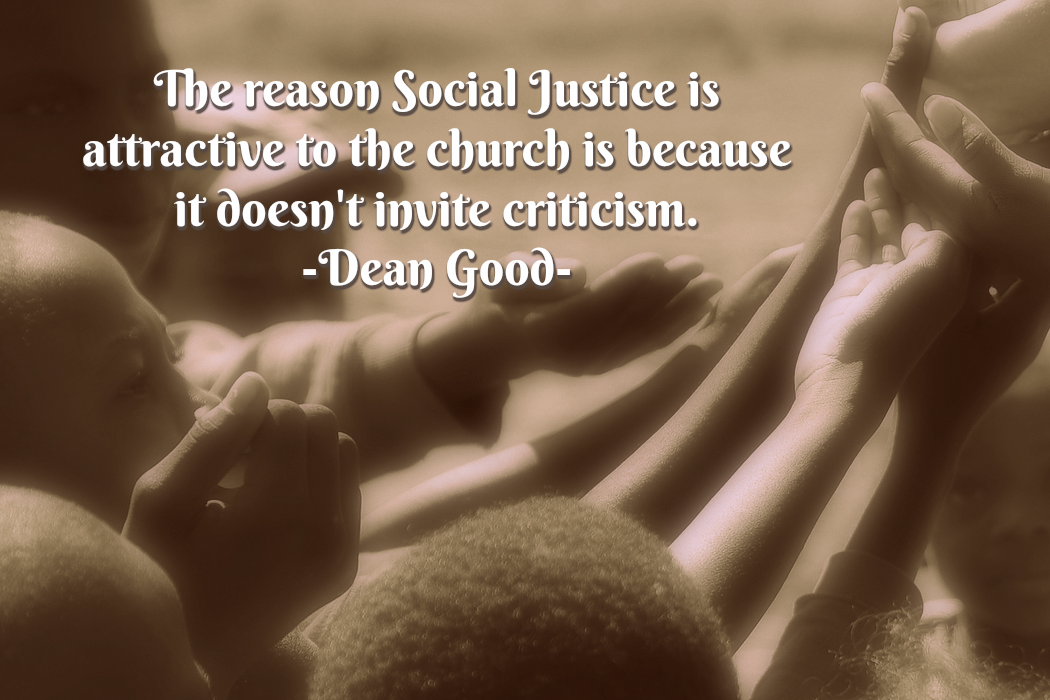
“The reason Social Justice is attractive to the church is because it doesn’t invite criticism.” My brother (Pastor Dean) said these words as we talked on the phone yesterday. I immediately realized just how profound his words were.

Perhaps they are words each and every one of us should reflect upon.

There are many good things the church does that all people love. It matters not if they are Christian or not Christian. Nothing matters as we work hard with our fellow man to make the world a better place. This includes things like–

Feeding the hungry ♥ Adopting orphans ♥ Caring for the homeless ♥ Providing fresh water for third world villages ♥ Providing food, clothing, and shelter to needy families ♥ Giving money to charities

Who in their right mind is going to oppose such things?

And, just to be clear, I am not opposed to these things. And neither should any of us be. The Bible is clear: We are told to care for orphans (James 1:27); we are to help our fellow man– and particularly our Christians brothers and sisters– who are in need (Ephesians 4:28; Hebrews 6:10). These are good things to do.

But these aren’t the only things Christians are to be doing. Doing good for others is just a part of what it means to live a godly, righteous life.

There’s so much more. But the “more” doesn’t often draw the praise of man.

As soon as we go out into the world and preach the Gospel–the clear, unadulterated Gospel as the scripture teaches it–we immediately invite the antagonism, the scorn, and the hatred of the world.

And as soon as we try to teach and live out the Christian life that is clearly mandated in scripture among the murky and muddy waters that is the mainstream church we invite the antagonism, the scorn, and the hatred of that church.

When we bring a message the world doesn’t want to hear, such as you cannot be reconciled to God without believing in Jesus Christ (John 14:6), we will be criticized, mocked, and labeled. We may even be persecuted. By both the world and those claiming to belong to the church.

When we bring a message the mainstream church doesn’t want to hear, such as encouraging believers to practice discernment (Hebrews 5:14), be separate from the world (James 1:27), and strive for holiness (I Peter 1:15-16), criticism and animosity will often rain down upon our head from within the church doors.

This is why so many of us choose to do the Christian things that invite the praise and laud of people. And it’s also why we avoid doing the Christian things that invite criticism.

How much do you care what people think about you? Does this change what you stand for or stand against?

I have to be honest and let you know right up front that this has been–by far–my biggest battle in this ministry.

It is natural for people to want to be liked and I am no exception. I don’t want to be labeled divisive, negative, unloving, arrogant, and whatever other words I have been called.

And yet, over and over again, God continues to remind me that my job is to please Him, first and foremost. As believers, our priority is to do all to the glory and pleasure of our Lord, irrespective of the opinions of man.

The opinions of those around us are, in essence, irrelevant.

Now reflect on that truth for just a few seconds. Why do we do what we do? How do we feel if we do something good and it goes unnoticed? How do we respond when we are faced with a choice to speak out against something we know God hates or a false teacher that is leading someone we love astray? Do we have the courage to share the Gospel unapologetically with the lost all around us? Are we truly living like no one’s opinion matters but God’s?

Inside each of us, a battle rages between the flesh and our new man. And the flesh wants to be pleasing to our fellow man. It is just how we are. But when we are saved, we have a new purpose. We seek first God and His Kingdom (Matthew 6:33). We are new creatures (2 Corinthians 5:17). Everything is changed.

In theory, that is.

In real life, it doesn’t just happen. It is a daily struggle.

However, as new creatures, we must fight this fight. For if we let the flesh win, it is not without deadly consequences. Think of how many children in Christian homes have grown up and gone out to live ungodly lives in the world because parents didn’t want to be unpopular? Think of how many inroads Satan has made into the lives of believers because they want to be cool to their friends? How many have followed false teachers because their Christian friends are afraid to speak up? Think of the light that has gone out in the church because of the desire to win the praise of the world?

If we aren’t willing to be different than the world and if we are driven by a passion to please the world (or the compromised, mainstream church), we will be rendered ineffective for the cause of Christ.

Sure, we can do all sorts of nice things for others and make this temporal world a better place to live in, but if we aren’t sharing the Gospel and pointing people to biblical Christian living, what eternal good are we even accomplishing?

Are we more likely to do the things that draw the praise of man? Do we shy away from the righteous and good things that draw criticism?

Pastor Dean’s words really made me think. And, once again, I was reminded: My priority is to please God.

Am I living to please God or are my daily life choices based on pleasing those around me? It is an important question that we should probably all give some thought to.


My Way or His Way?

In 1969 a song was written by Paul Anka that was made popular by a crooner named Frank Sinatra. The song has a thoughtful and appealing tune and is called “My Way”.  The final stanza of the song does a good job of summing up the song–

For what is a man, what has he got?
If not himself, then he has naught
To say the things he truly feels and not the words of one who kneels
The record shows I took the blows and did it my way
Yes, it was my way

It’s pretty clear that this song is an anti-Christian song since the entire song is like a theme for humanism. The author did things his way and didn’t answer to any supreme being or any human being. Of course, the author will answer to God one day, if he hasn’t already. So why am I talking about a 50 year old song?

I’ll tell you why.

Because I have seen more and more people who claim to be Christians live by this mantra:

I did it my way.

I’ll do it my way.

And then, eventually, in our obsession with our dreams, our purposes, and our goals, we end up believing that…

God exists to help me do it my way.

We are concerned only about our way.

The thing is…

Biblical Christianity teaches the opposite–

• Instead of being obsessed with our own plans and dreams, we are to submit to God’s plans. (Rom 14:8)

• Instead of being driven by our selfish desires, we are to deny ourselves. (Luke 9:23)

• Instead of thinking only of ourselves and our purpose and desires, we are to think of others. (Phil 2:3)

It’s easy to point a finger at others and shake our heads in sadness or disgust. See how selfishly they are living? Isn’t that a shame? But, while we may not ascribe to self-centered living in theory, how often do we live it without realizing it?

I am amazed, even though I have been walking with the Lord all these years, at how often I am driven by my own selfish desires and will. And disgusted at how often I find myself obsessing about myself and my happenings. Can you relate? Or am I alone on this one?

I think one of the greatest challenges of walking with the Lord is this:

Living for Him instead of for me.

And, in this current church culture, we aren’t even given this challenge, are we? We are told that we can live for ourselves and expect God to swoop in and be our personal genie to help us fulfill our big dreams and realize our insanely important purposes.

But God cares far more about our holiness than our happiness. (Romans 5:3-5)

And it’s not about us. Our lives are just a teeny-tiny point on the map of the universe and the timeline of history; both of which are utterly and absolutely under the sovereignty of God. (Isaiah 46:10)

God is choosing to use us for His glory and His purposes at this time. His glory. His purposes. (Ephesians 2:10)

I guess Paul sums it up best for all of us in Galatians 2:20–

I have been crucified with Christ; it is no longer I who live, but Christ lives in me; and the life which I now live in the flesh I live by faith in the Son of God, who loved me and gave Himself for me.

This, as true believers, is our aspiration. We are to die to self and live for God. It is a message that isn’t heard very much anymore. You won’t hear it from most pulpits or read it in the Christian best-sellers. In a culture obsessed with only positive messages, this is a message that isn’t very popular.

Everyone wants to live life their way and they want a God who will bless them as they do things their way. And even those of us who truly desire to live for Christ can be swayed a bit by this wrong thinking about God.

And so I hope that today you will take some time to reflect on how you are living for yourself instead of for God. And while you do that, I’ll be doing the same. Just because I can write things like this, doesn’t mean I don’t struggle with the same things you do. It’s one thing to write. It’s another thing to live.

So let’s strive to live for God together, always turning to His Word for guidance and direction. And, in a world full of people obsessed with doing things “my way”,  let’s do things His way.


What Determines Truth for You?

“You can’t argue against someone’s experience”

“But this book {that doesn’t line up with scripture} helped me and made me feel closer to God.”

“We play rock music in our church service {or have sermons based on movies or hold church poker nights} because it makes the unsaved feel comfortable and want to come.”

These are all things that I’ve heard people say at least once. Some more than once. And it makes sense to them. If something works why not use it or read it or do it?

In other words, truth is determined by consequences.

Pragmatism first became popular in the late 1800s and was introduced to society by several different men–two of whom you may recognize. John Dewey (instrumental in creating the public school system) and C.S. Lewis, the “Christian” apologist. I use quotes because C.S. Lewis’s beliefs and interests were actually not all in line with the Cristian faith (see here and here and here for more information). I continue to remain amazed and dismayed that he has become so respected in the Christian world.

There are some real problems with the ideology of pragmatism for a Christian. Although Christians try to join their biblical beliefs with this philosophy all the time, we can see how pragmatism is a slippery slope that leads us away from scripture.

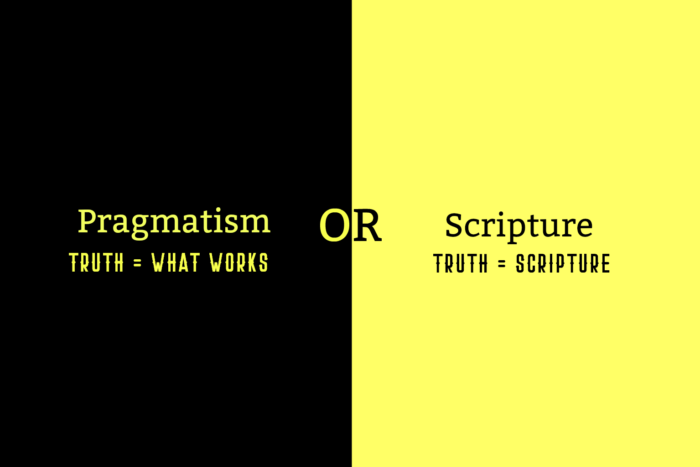
First, we have to recognize that only one thing can determine truth. Is it scripture or is it by what works? We can’t philosophically have it both ways. We will have to make a choice.

For instance, take the Christian who reads a book that makes them feel good but has a message that does not align with scripture and then they go on to recommend that book to all of their friends. They have chosen pragmatism over scripture. By default, they have made the choice to elevate the consequences (their good feelings) over what the Bible says.

Or take a church that brings in secular rock music or worldly movies to their services. They nobly profess to do this to make the unbeliever comfortable. This works. But, again, they are elevating what works (unsaved in their pews and feeling comfortable) over what scripture teaches (Love not the world or the things that are in the world I John 2:15).

In fact, that church had already given in to pragmatism when they realized that their numbers would increase if they chose to market to the unsaved rather than to follow the biblical church model. In scripture we find that the local church isn’t for the unsaved but for the saved; and that it doesn’t exist to make us feel comfortable but to encourage, teach and support us as we strive to grow in holiness. Comfort is never the goal of church. For saved or unsaved. And, yet, pragmatism, would say that comfortable = increased numbers at church. See how this works?

Can you see how this has infiltrated and changed everything?

It has crept into our own lives far more than we even realize. I wrote in this post how I was struggling to get through Jeremiah and mentioned to my brother (Pastor Dean) that I just wasn’t enjoying that particular book of the Bible. He laughed and reminded me that the Bible wasn’t for my enjoyment but to teach me about God. Oh, how dismayed I was to realize that I was viewing my personal Bible reading pragmatically! I was judging my Bible reading by how it made me feel.

Can you see how seductive this belief is? How invasive and natural it has become for us to judge things in this manner? We see it not only in churches, but on a large scale in the corporate world, in the academic realm, and everywhere else. It has invaded en masse and it’s not going anywhere soon.

But we can’t have it both ways. We can’t have our experience determine truth and the Bible determine truth. If we don’t intentionally set a line in the sand and say we choose the Bible, I can almost guarantee that we will be lured away into this dangerous and faith-squashing philosophy.

Second, we have to recognize that if truth is determined by consequences, then it must follow that truth is changeable. What works one year may not work another year. What worked in the past may not work in the future.

But God tells us that truth never changes. His Word is the same yesterday, today, and tomorrow. It is the same forever. Isaiah 40:7-8 puts it like this–

All flesh is grass,
And all its loveliness is like the flower of the field.
7 The grass withers, the flower fades,
Because the breath of the Lord blows upon it;
Surely the people are grass.
8 The grass withers, the flower fades,
But the word of our God stands forever.”

Peter repeats this thought in I Peter 1:23-25

Since you have purified your souls in obeying the truth [i]through the Spirit in [j]sincere love of the brethren, love one another fervently with a pure heart, 23 having been born again, not of [k]corruptible seed but [l]incorruptible, through the word of God which lives and abides [m]forever, 24 because

“All flesh is as grass,
And all[n]the glory of man as the flower of the grass.
The grass withers,
And its flower falls away,
25 But the[o]word of the Lord endures forever.”

From these verses we know that God’s truth does not change. Current culture does not change it. Modern desires and demands do not change it. Because truth doesn’t change.

The Bible remains a blessed anchor in the midst of a world where “truth” is what anyone wants it to be. Where “truth” is what works for that moment.

Pragmatism is a big word but it has literally affected each and every one of us. It is important that we examine our hearts and lives for the fruits of this deadly philosophy that so easily and subtly slip in.

Because we know that the Scripture does determine truth and we know that the truth we find there never changes. What a relief in this ever-changing and mixed-up world!

When to Stop Talking

Every year there are “Christian” books that rise to the popular status of “everyone must read”. This kind of popularity always raises a red flag for me because the Bible’s message of denying self and taking up our cross is definitely not popular in a world that teaches self-absorption and the importance of following our dreams.

And usually (but not always) these trendy books that are labeled Christian show their true colors when we dig a little deeper. Underneath all of the Christian lingo, we will generally find them full of human wisdom and new age principles.

Of course, Christians are the ones that catapult these books to the bestseller list, imbibing all their appealing, comforting, and uplifting messages without ever really stopping to think if they line up with scripture.

It started with books like Experiencing God, Purpose-Driven Life, The Shack, Jesus Calling, The Circle Maker, Your Best Life Now and it has continued on until now there are so many, it is hard to keep track. There is always a latest, greatest book that all Christians “should read”.

And these books are changing the way we view God and His Word. By inserting man-centered, new age, occultic thoughts and principles, these authors are successfully weaving mainstream Christianity into something that will melt right into the New World Order. This is not conspiracy. This is fact. If you think I am crazy for saying this, I encourage you to do a little research. You will find that it cannot be denied.

Sadly, many Christians are reading these books instead of reading their Bibles, essentially presenting themselves as prey to all kinds of false teachers and doctrines.

But here’s the thing: Most don’t care.

That’s right. Most who call themselves Christians do not care that the Bible doesn’t line up with what they are reading.

I am always amazed to read the comments of a solid book review that compares the latest, greatest “Christian” book to what scripture teaches. Christians, in droves, will go to battle to defend these books. The negative comment will often start like this–

“Well, I think…” or “The book made me feel…” and “But it had so much good…”

The thing is this: Of course it made you think and feel good things. It wouldn’t be a best seller if it didn’t. And, of course, it contained a few biblical messages. That is the only way Satan can sell it to Christians. He can’t make it too obvious or we won’t buy it.

But most don’t care that the essence of the book’s message is full of man’s wisdom and not biblical. They just don’t care. They are much more concerned about their feelings than they are about adhering to the Word of God. Even if you show them specific ways that a book (or ministry or teacher) contradicts scripture and use a plethora of verses to prove your point from the Bible, they will continue in their defense of the unbiblical book (or false teacher or heretical ministry).

And that is when we stop talking.

We cannot make someone care about what scripture says. We cannot force them to hold the Bible as the authority and guidebook for their lives. We cannot coerce someone to open their blind eyes.

And so we stop talking. Otherwise, we will just create unnecessary rifts and divides. Of course, oftentimes, it’s not as simple as this. Some people like debates and they want to keep talking. But we must remember that, while it is healthy to have a good discussion, it is also important that we discern when our words are doing more harm than good.

We have to understand that our words hold no weight if the other person doesn’t care what the Bible has to say. Because God’s Word is literally our only defense. It is the only base from which to speak truth. Our opinions about these matters mean absolutely nothing.

And so it takes some wisdom and discernment to know when it’s best to just stop talking and to start praying. For it is God and only God that changes the heart.

And praise God for those who do want to know! In this age of rampant apostasy and easy-believism, we can grow discouraged at the great number of Christians who just don’t seem to care. But let’s be thankful that there are still those that want to know the truth. There are still so many who want to live by God’s Word and yet they are simply unaware that they are ingesting heresy.

And let’s not forget one very important thing: We don’t know everything. Just because God may have opened our eyes in one area doesn’t mean our eyes are opened in every area. It is so important that we stay humble and teachable, willing to listen to what others have to say and thoughtfully compare it to the Word of God.

So let’s be humble and talk when we are given opportunities, but let’s also carefully discern when it is best to stop talking, take a step back, and really pray for someone. For it is only God who can make the blind eyes see.


Is This Really Happening?

I have to admit that I am absolutely astonished at the most recent turn of events in the evangelical world. But, if we are honest, we could see this coming for some time now.

If you are completely out of the loop of what’s going on, let me fill you in briefly.

In the last ten or so years, there has been a tremendous push by some key evangelical leaders, particularly Tim Keller, Russell Moore, along with others, to add social justice issues to the Gospel of Jesus Christ. In plain language, they are putting the need to be socially just (keep in mind this is a communist term and never anywhere in scripture) as a necessary addition to the Gospel in order to be right with God.  They have both implied as well as clearly stated that true Christians should and will be socially just in order to be saved. This is exploding with the race issue. The sexual orientation issue isn’t far behind with the help of Sam Allberry.

This is just wrong on so many levels. Of course, there is a call as believers for us to care deeply for others and to hold no bias. These things are clearly the outcome of a saved and transformed life. But they take it too far. They are promoting anti-biblical, marxist ideas under the guise of the Gospel. They are adding things to the Gospel that are simply not in scripture. To find out more about it, please read this awesome post by John MacArthur: No Division in the Body. He expresses very clearly what is going on and it’s frightening and, frankly, incredibly strange.

Most of the men involved are part of the Gospel Coalition. They are pastors and authors who, in the past, have been trustworthy and biblical. The other organization that is functioning as a driving force behind this movement is The Ethics and Religious Liberty Commission of the Southern Baptist Convention. So why would they do this? Why would they add to the Gospel?

In an effort to speak out against this atrocity, some men have gathered to create “The Statement on Social Justice and the Gospel”. Here are the first two paragraphs of the introduction–

In view of questionable sociological, psychological, and political theories presently permeating our culture and making inroads into Christ’s church, we wish to clarify certain key Christian doctrines and ethical principles prescribed in God’s Word. Clarity on these issues will fortify believers and churches to withstand an onslaught of dangerous and false teachings that threaten the gospel, misrepresent Scripture, and lead people away from the grace of God in Jesus Christ.

Specifically, we are deeply concerned that values borrowed from secular culture are currently undermining Scripture in the areas of race and ethnicity, manhood and womanhood, and human sexuality. The Bible’s teaching on each of these subjects is being challenged under the broad and somewhat nebulous rubric of concern for “social justice.” If the doctrines of God’s Word are not uncompromisingly reasserted and defended at these points, there is every reason to anticipate that these dangerous ideas and corrupted moral values will spread their influence into other realms of biblical doctrines and principles.

I encourage you to read this entire document. This is what is going on in the evangelical circles and it is a BIG deal. The document was created for pastors, leaders, authors, and anyone else to sign as an affirmation of their position on biblical truth regarding this issue.

There are a {very} few familiar names who have openly given their support to this document. John MacArthur, Voddie Baucham, Phil Johnson, James White, and Justin Peters have all affirmed and signed it.

But I am gravely concerned about something Pulpit and Pen brought to light recently regarding this document:

It is heart-breakingly revealing to observe those who will not or have not signed.

Al Mohler, D.A. Carson, Mark Dever, David Platt, Matt Chandler, J.D. Greear, Ligon Duncan, Steve Lawson, Tim Challies, and Tim Keller (of course) have not signed it. Along with other trusted authors and pastors.

Why is this? Why wouldn’t they?

Could it be that these men we have trusted to lead us in the right direction are actually going in the wrong direction? Is that a possibility?

It does make one wonder but, of course, we obviously can’t know why these men haven’t signed this document. Wrong direction or peer pressure or even ignorance?

However–no matter the reason–we should be extremely concerned if they haven’t. I have read the document and it asserts what every Bible-believing Christian from the last two thousand years should assert.

I am writing this today to make you aware of what’s going on and to also encourage you to write to your favorite authors and pastors and ask them to sign this. If they actually get back to you and let you know that they refuse, ask them why. (And, yes, I have signed it, just in case anyone is wondering.)

Christianity is being divided into two very different and opposing camps. One is marxist, socialistic, communist, melt-right-into-the New World Order and the other is the tiny, shrinking remnant that is left of true biblical Christianity.

Put on your life jackets and buckle your seat belts. I have a feeling this sea is going to get rougher.


Cultivating A Healthy Soul (Why we need both the positive and the negative to be healthy Christians)

Something that has disturbed me greatly over the past ten or so years is the belief that if a message is positive it is good and righteous and if a message is negative it is bad and sinful.

Where did this belief come from? For it is certainly not from the Bible. (Actually I do know where this belief originates and there is a link further on in this post for those of you who would like to know, too.)

Jesus Himself tells us to look out for false teachers, to deny ourselves, to expect hatred from the world, explains the awful (and extremely negative) things to expect in the last days, and calls out and even severely criticizes false teachers. These would not be called positive messages by anyone’s standards.

Paul follows the example of Jesus and encourages us to confront fellow Christians living in sin, publicly calls out those who have left the faith, and encourages all of us to examine our lives for sin. Again, not positive by anyone’s standards.

Thankfully, both Jesus and Paul also abound in positive messages. The Bible provides the perfect balance of both because the Bible is the holy and inerrant Word of God.

Yesterday I heard an illustration by A.W. Tozer regarding this very thing. It had to do with the human body and how it stays healthy. It so impacted me that I actually did an online search to find it in print. I found it in a book called Gems from Tozer. Here is a brief portion of it–

The healthy soul, like the healthy blood stream, has its proper proportion of white and red cells. The red corpuscles are like faith: they carry the life-giving oxygen to every part of the body. The white cells are like disbelief: they pounce upon dead and toxic matter and carry it out to the drain. Thus the two kinds of cells working together keep the tissues in good condition. In the healthy heart there must be provision for keeping dead and poisonous matter out of the life stream. This the credulous person never suspects. He is all for faith.*

I have been thinking about this since I heard it and how applicable this comparison is to our spiritual lives. I even did some further research. What happens if our blood is out of balance? Without getting too technical, I thought I’d give a quick overview. The field of medicine is not my field (by any stretch of the imagination) so hopefully I get this right–

Too Many Red Blood Cells: The condition of the body creating too many red blood cells is called polycythemia vera. This slow-growing cancer actually can sometimes be symptom-free. But whether the person feels it or not, the blood is thickening and the blood flow is slowing down, which can lead to all kinds of issues, including death. You can be feeling great but still have this fatal disease. Thankfully, the medical world has developed a treatment for this cancer and those that have it can expect to live a fairly normal life as long as they make regular visits to the hospital for treatment. But the key here is that this can cause symptoms in a person or it might not but, either way, the over-production of these red blood cells will eventually cause death if there is no treatment.

Too Few Red Blood Cells: The condition of having too few blood cells is called anemia. Most of us have heard of this. It is a condition that leads to sluggishness and exhaustion. When the red blood cells are working properly they distribute oxygen and also carry carbon dioxide to your lungs from other parts of the body to be exhaled. If there aren’t enough red blood cells they can’t do their job and it keeps the body from functioning properly.

Too Many White Blood Cells: This condition is called leukocytosis. Elevated white blood cell count can be caused by many things–leukemia, infection, stress, immune system disorders, and smoking can all lead to an elevated count. High white blood cell count is an indication that something is wrong in the body and the body is working to fight against it.

Too Few White Blood Cells:Called leukopenia, this condition leaves your body at risk for other infections. This is the reason that some patients die from diseases and infections unrelated to their original diagnosis. Chemotherapy will often cause this and this is why cancer patients must be so concerned about catching colds. Without a proper white blood cell count, the body is in grave danger.

Okay, so let’s pretend that the red blood cells are the happy, positive thoughts and words and white blood cells are the negative, unpleasant thoughts and words.

We obviously need both in order to have a healthy soul.

If we only focus on the happy and the positive, we may not realize it, but we will be putting our souls at peril. We may feel great but, meanwhile, a deadly lethargy is invading our blood stream while we are blithely unaware. However, if we never focus on the good and positive things, we put ourselves at risk for an apathy in the faith. We will lack vibrance and joy. We won’t encourage, we won’t be lifting others up, and we will have a tired and lackluster faith. Both extremes lead to a severe and harmful imbalance.

And, of course, if we only focus on the negative and unpleasant, constantly talking only about how bad this world is and making sure everyone knows every false teacher that is out there, then this is an indication that something is not quite right with the health of our soul. We should never be so focused on the negative that we completely ignore the positive. But, on the opposite side of things (and where I believe more people are) are those that never want to focus on the negative and believe it to be a sin. These folks put their souls in grave danger. They have compromised their spiritual immune systems and are at risk to fall for all kinds of false teachings and wrong belief systems.

We can see that none of these are ideal. And just as we shouldn’t have too many or too little of red or white blood cells, we also shouldn’t be spiritually imbalanced when it comes to our focus on the positive or the negative.

As I mentioned above, I believe that there are few that focus on the negative. That type of life style has been so maligned that we have been almost (not quite but almost) led to believe that someone who focuses on the negative is not a Christian. And they most certainly aren’t a good Christian, even if they are one. After all, negative words aren’t kind words (according to most) and the majority of Christians don’t want to be known as the negative, unkind one (not understanding that “unkind” is being defined by this culture and not by it’s historical definition).

I think far more of us have bought the lie that positive messages are all we should speak. That negative words are sinful. This is what we are being taught in so many different ways. Whether it’s the latest “Christian” books, TV preachers, popular blogs and podcasts, social media, and even sometimes in our own churches, we find that we are praised by men for speaking the positive and uplifting and we are marginalized and condemned for speaking the negative and discerning. Ironically, and tragically, the truth seems to be irrelevant.

Of course, if we are serious about our walk with the Lord we desire to have a healthy soul. We want to be obedient and submissive children. So how do we do this? We do this by getting our instructions for living from the Bible and not from pop Christianity or humanistic psychology. What does the Bible teach? What does the Bible say?

2 Timothy 3:16 can get us started–

All Scripture is given by inspiration of God, and is profitable for doctrine, for reproof, for correction, for [a]instruction in righteousness,

There we find both the positive (doctrine and instruction in righteousness) and negative (reproof and correction). If you have time, do a study of this topic in God’s Word.

For it is only by knowing what God has to say about this that we can defend ourselves against the plethora of lies that abound around the idea of “positive thinking” (which is an occult/new age teaching, by the way! find out more at this link).

We must have a balance of the positive and the negative; of both love and truth; both grace and justice. Leaning one way or the other will cripple our souls and hinder our work for Christ.

May we be filled with plenty of red blood cells–positive, encouraging, happy thoughts and words that carry life and oxygen to our souls and to the Body of Christ and may we also have a healthy amount of white blood cells–discerning the true from the false, diligently removing and warning of the toxins that threaten our own soul as well as the souls of other believers. For both are critical to cultivating a healthy soul.


*Tozer, A. W.. Gems from Tozer: Selections from the Writings of A.W. Tozer (Uqp Poetry) (Kindle Locations 625-629). Moody Publishers. Kindle Edition.

Other resources:

https://www.mayoclinic.org

http://blog.insidetracker.com/45247913486-high-white-blood-cell-count-what-you-should


What Does the Bible Say About…(Being Relevant)?

I am not sure I can remember when the church wasn’t caught up in relevance. I guess when I was a child it was only beginning, but, even then, the “Jesus Music” had already been birthed and the direction had been set to bring in worldly entertainment. Looking even further back, there was a move to wed the church to the world in philosophy. I am sure Satan places some of his greatest effort into wooing the church with the world, since this renders the church ineffective.

And that is exactly what we have seen. A church caught up in being like the world becomes the world. The true Gospel disappears in the frenzy to stay relevant.

And what a futile task. It is impossible to stay relevant in a world that changes constantly. At first, it was only music. What is wrong with that? Throw out the stuffy hymns and bring in something new! But new grows old rather quickly and, since we have become a people fixated on “new”, we always need something different, something greater, something better. And so we have seen a steady increase in bringing in the latest, greatest thing. I have even heard of a church that brought in a strip tease act! Can you even imagine?

But how can this be?

Because the church’s people aren’t hungering for the right thing. Because the church’s people are most likely goats and not sheep.

Funny how the Bible never, ever mentions relevance. The passage that is most often used to defend relevance is in I Corinthians 9, so let’s unpack that a bit here today–

verses 19-23–For though I am free from all, I have made myself a servant to all, that I might win more of them. 20 To the Jews I became as a Jew, in order to win Jews. To those under the law I became as one under the law (though not being myself under the law) that I might win those under the law. 21 To those outside the law I became as one outside the law (not being outside the law of God but under the law of Christ) that I might win those outside the law. 22 To the weak I became weak, that I might win the weak. I have become all things to all people, that by all means I might save some. 23 I do it all for the sake of the gospel, that I may share with them in its blessings.

There are three differences to Paul’s style of evangelism and that of the modern day church’s style (that uses this passage to back up their warped view of evangelism)–

1. Paul was not interested in pleasing the world or making sure he was good friends with someone before sharing Christ. He had only the Gospel in mind. Nothing else. All he did was for the sake of the Gospel. This is far different from what we see today, where there seems to be a race to see how much we can be like the world and still be a Christian. And what we can see is that with this style of living, the Gospel becomes irrelevant and old-fashioned and eventually disappears altogether.

2. Paul was not willing to sin in order to share the Gospel. When Paul says that he will be like certain groups of people, he did not mean he would participate in their sinful activities. How do we know this? We know this because that would conflict with a hundred other passages Paul wrote to us about the Christian life. That means Paul wouldn’t have hung out at a bar drinking with his buddies and getting tipsy. He wouldn’t have sat down at a poker table and gambled away his day’s wages. He wouldn’t have joined his friends at the movie theater to watch a film filled with sex and violence. And he certainly wouldn’t have sanctioned bringing in worldly entertainment into God’s holy church. Paul would never advocate compromise with sin. Thinking that this is what that passage means is taking it completely out of the context of the rest of Paul’s writings.

3. Paul was a servant. Paul did what he did with a servant’s heart and not a selfish heart. He did so with a humble heart and not a prideful heart. This is very different than what we see today as people talk about what they can do or don’t have to do under the banner of the freedom that’s found in Christ. While there may be a pretense of service, when the veneer is stripped away, we find it’s really about feeding one’s appetite for the world and justifying it.

Darby sums up this passage very nicely in his commentary–

“It was the power of charity which denied itself in all things, in order to be the servant of all, and not the selfishness which indulged itself under the pretence of gaining others. He did so in every respect for the sake of the gospel, desiring, as he said, to be a partaker with it, for he personifies it as doing the work of God’s love in the world.”

So what did Paul mean with those verses? I think a comparable example in today’s society would be something like this–

If I am going to minister to the homeless on the street, I am not going to wear high heels and diamonds. If I am going to minister to the wealthy, I am not going to dress in rags. I will do all I can do–without sinning–to be like the group I am with, in order to gain an audience in which to share the Gospel.

This is a far cry from what we are hearing and seeing today. And, honestly, the church that brings in the world is so far gone as to have separated herself from the true church now. The true colors are finally showing. But there are still some walking the fence and it is to those that I address this post.

God never sanctions fence-walking. He demands we clearly pick a side. I John 2:15 makes it clear–

Do not love the world or the things in the world. If anyone loves the world, the love of the Father is not in him.

As does James 4:4–

You adulterous people! Do you not know that friendship with the world is enmity with God? Therefore whoever wishes to be a friend of the world makes himself an enemy of God.

We cannot be friends with God and be friends with the world. The two are mutually exclusive. And because of this, we know that the mainstream church has swallowed a lie that has led to her demise.

But what saddens me beyond measure are the many, many true churches that have swallowed this lie and have made or are making this final compromise that will lead to their death. It is tragic. And it is everywhere.

While there is probably little most of us can do to change the wrong direction of the churches, there is much we can do personally. Let’s keep ourselves from falling prey to the lie that we need to be “like the world in order to win the world”. In our personal Christian life and evangelism, may we be like Paul: Doing all out of a heart of charity, with a passion to live a holy life, and all for the sake of the Gospel.


Scroll to Top