How We Are Like the Moon

Isn’t a full moon so incredible? Of course, most of the month, the moon is not near so bright. And some nights it is simply an unimpressive sliver up in the sky.

Even though early astronomers didn’t realize it, we now understand that the moon is simply a reflection of the sun’s glory. The moon itself does not have light, but it reflects the light of the sun.

A reader recently brought to my attention how much we believers are like the moon–

Our light is not our own, but is merely a reflection of God’s glory.

Our reflective light is easily dimmed by the dark shadows of sin and worldliness, just as the moon’s is dimmed by the shadow of the earth.

Our light, if we are a true reflection of Jesus Christ, lights up the dark night just like a full moon does.

And we know that some love that light. And some hate it.

Some love the moonlight and the way it helps them see. And others, with things to hide, hate it. They want the cover of darkness to hide their evil deeds.

While I know that sin does serious damage to our reflective light, I want to write a bit about worldiness and the damage it does. I have been writing a series on worldliness (which you can find here) and so this seems to be very relevant to that series.

As my reader pointed out, just as the world comes between the sun and the moon and blots out the light, so, too, does this same thing happen with us. The world gets between us and the Father and we grow dim because of it.

You see, when we allow worldly thinking to enter our minds, whether it be through entertainment, education, or careers or through social media, our circle of friends, or family–and any other way it finds its way into our hearts and brains–our lights start to dim.

Think about it.

Let’s say you spent the last two hours watching a movie full of violence or immorality. Is that an accurate reflection of God? Are we doing what He would do? Are we making a choice that makes us look more like Him?

Or are we purposely taking a step away in order to satisfy our own selfish desires?

Or how about how we choose to raise our kids, live out our marriages, or treat the boss or co-workers at our jobs? We have a choice to be a reflection of God and His desires or to follow after the world and look like everyone else, causing us to melt into the blackness that surrounds us.

Christian marriages, parenting, and relationships with unbelievers should look very different than that of unbelievers. But, so often, because of our desire to follow so closely after the world, we end up simply looking like everyone else.

Our lives become unremarkable and we end up casting just a dim reflection of light in the inky blackness that surrounds us.

Now this is so devastating for a few reasons–

First, we cannot be used by God. He has chosen to use us but in order to do that we must be pure and holy vessels. When we choose to live in sin or to look and act like the world, we are not fit for service.

Second, we lose opportunities to share Christ. No Christian can honestly say that they would feel comfortable sharing Jesus with a friend after partying for the whole night alongside them. And if someone says they do, there is little to commend any religious message they may spout off. We are automatically discounted when we join in the sinful activities of the world around us. If we look just like the world, they have no need to have what we have. They don’t need it. If our children look like everyone else’s children, if our attitudes are like everyone else’s attitudes, if our friendships, our marriages, and our families mirror the world, what use do they have with us?

Anyone can travel the path of least resistance. In order to stand out we need to stand on the Word. In order to fully reflect God’s light we need to do things His way.

Third, we lose opportunities to testify to the difference God can make in our lives. When we continue to be the best reflection of God’s light that we can be, we show the world that not only is God almighty and able to change us but that His love and grace is all that we need. We show them that being transformed is not about rules but about our deep love for God.

Knowing God is the only eternal light. While earthly things may flicker up briefly, only God gives us a new life that gives us a permanent reflection of light.

_________________________

Perhaps this would be a good time to remember that pure and holy are not synonymous with perfect. We do not have to–in fact we cannot--live perfect lives. Never forget that our Christian lives are not about perfection but about direction.

All believers, whether young or old, are a reflection. The question is this: Are we a teeny sliver of light in the darkness or a full moon lighting up the night?


Sometimes Chairs Break

The other night I was sitting with a friend on a porch swing that has been in our backyard for many years. In my arms I held my youngest grandson in my lap and I was leaning him down in front of me and then pulling him back up to make him laugh. We were having a grand old time when, quite suddenly and without any warning at all, the swing pulled away from its anchor and we landed on the ground.

Other than a jolt to my back, we were all okay. I was so very thankful that, in God’s Providence, the swing had crashed when my grandson was up and not down. It could have ended much worse.

I rubbed my back a bit and my friend and I went on with our evening, but there was lesson in what happened and it did not elude me for very long.

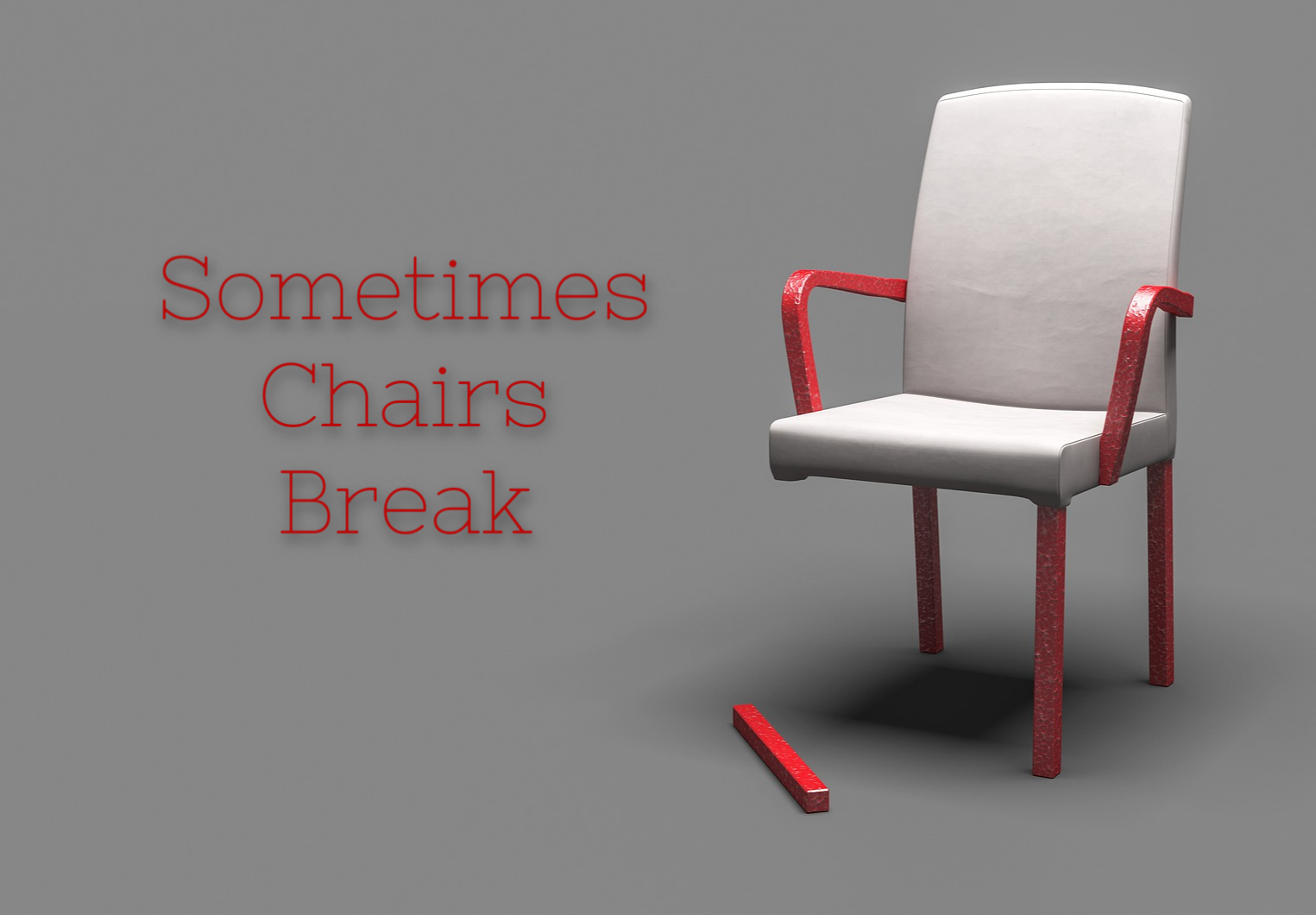
Swings break. Chairs break. Things we have trusted to hold us sometimes don’t hold us. They may break quite suddenly, like what happened to me on Saturday night. Or they may slowly start to erode away in the elements until one day you realize the chair is no long trustworthy.

This same thing can happen with people. Leaders. Singers. Authors. Preachers. Pastors. Churches.

Just because they have been trustworthy for a million years does not mean that they are incapable of slipping or changing direction. We need to understand that just because someone has had a wonderful ministry for many years does not automatically keep them immune from making a bad decision or falling away completely.

I have especially noticed undying, passionate loyalty among certain camps within evangelicalism. There is a seriously unhealthy idolization of these men and women that breeds a serious lack of discernment.

Currently, the joining of the true teachers with the false teachers is taking place in all circles and camps. I can’t think of one that has not been compromised in this way.

While I have been watching this kind of thing happening in overdrive over the past few years from most corners of modern day evangelicalism, it’s now also happening with teachers I’ve trusted for many years to stand firm to the end.

What is going on? And why are they doing this? There is just no possible way to answer these questions.

However..

Just like we need to realize that sometimes we need to stop trusting the chair that holds us, so, too, we need to understand that men we have trusted for years are capable of leading us down a wrong road. When someone makes a really bad choice to partner with a false teacher or to say something that isn’t biblical or to promote a new age author, this should raise red flags– no matter who they are. It should lead us to be just a bit more cautious and a lot more watchful. Is this a one-time bad decision or is this a direction they are going? Only time will tell. But if we close our eyes to it, we are making ourselves so very vulnerable.

The fall I took when that swing dropped was a hard one and it could have been so much worse. It could have been avoided had we realized the swing was in need of repair. Sometimes we can’t see things coming and we are caught off-guard. But sometimes we can. If God opens our eyes to an inconsistency or false teaching or a bad choice by someone we have trusted, then we must be willing to face that fact bravely and without rationalizing it away.

Does this mean you never use the chair again? Not necessarily. Some chairs must be cast aside because they are beyond repair. But sometimes chairs can be fixed. Occasionally, someone will recognize their error and return to truth. This doesn’t happen often but it does happen. One bad choice or one partnership with darkness does not make a heretic. We don’t want to be head hunters.

The main point of this post is to challenge you to only be perfectly loyal to God and His Word. No man or woman deserves our loyalty to the point where we rationalize unwise and even sinful choices. No human deserves this kind of loyalty. (If they are truly following Jesus Christ, they don’t even want this kind of loyalty). I’ve said this often but I see this as a really big problem as we navigate this confusing time of compromise and wrong choices made by people we have trusted for so many years.

I am growing less and less enamored with anyone that has a platform. I see a huge level of joining together with false teachers across the board. Ecumenism is worming its way into all areas of evangelicalism. I can’t think of one that has not been affected.

So if you don’t take anything else away from this post, I beg you to remember this–

Sometimes chairs break. We trust them but sometimes they break.

This is a very important thing to keep in mind as we navigate the strange synthesis of those who have a history of adhering to biblical doctrine joining with those that clearly don’t.

Just in case you think I am a little over-the-top, I remind you of these important verses–

I Timothy 6:3-5 If anyone teaches otherwise and does not consent to wholesome words, even the words of our Lord Jesus Christ, and to the [a]doctrine which accords with godliness, he is proud, knowing nothing, but is obsessed with disputes and arguments over words, from which come envy, strife, reviling, evil suspicions, [b]useless wranglings of men of corrupt minds and destitute of the truth, who suppose that godliness is a means of gain. [c]From such withdraw yourself.

Please Note: We are to withdraw from false teachers–not invite them to conferences.


Ephesians 5:11 And have no fellowship with the unfruitful works of darkness, but rather [c]expose them.

Please Note: We are to expose false doctrines–not pretend like they don’t exist.


2 Timothy 3:5 having a form of godliness but denying its power. And from such people turn away!

Please Note: We are to turn away from those that pretend to be godly but don’t do things according to God’s Word–not join with them at conferences.


Romans 16:17 Now I urge you, brethren, note those who cause divisions and offenses, contrary to the doctrine which you learned, and avoid them. 

Please Note: We are to avoid them–not quote them in our books.


Look, let me say one more time–I am not judging motives or hearts. But I think if we are going to be honest, we have to say there is something wrong here. Men and women who have taught that it is not right to join with false teachers are turning around and doing what they have preached against. It doesn’t Make. Any. Sense.

Get frustrated with me. Or call me negative. Or cancel your subscription to Growing4Life. None of those things changes the facts. Chairs are breaking and eroding all over the place and the only people that get ridiculed and bullied are the ones who actually acknowledge that it is happening and venture to ask a couple of questions.

There is no way to know who is making an innocent mistake and who knows exactly what they are doing and we can’t even begin to guess. But we should acknowledge that, for whatever reason, it is happening.

So stay in the Word and give your loyalty to God alone. Don’t rationalize away a bad choice. Acknowledge it and stay watchful. God is faithful and will keep us on the narrow path, if we but trust in Him alone to lead us.


Standing Strong in a Confusing Christianity

In the recent years, some really puzzling things have happened. From trusted celebrity Christians promoting an anti-biblical agenda to churches ignoring their very solid doctrinal statements. From well-known Christian men and women turning away from biblical truth or even renouncing their faith to trusted preachers and authors partnering with false teachers. It is a CONFUSING Christianity and, in many ways, feels like a real spiritual mine field.

So how do we stand strong and stay sound in this kind of Christian culture? (I use the term “Christian” loosely because we must understand from the Word of God that most of what is called “Christianity” today just isn’t.)

But how do we reconcile in our minds the strange fusions of the true with the false? How do we work through the many who speak biblical words and yet have actions that don’t match what they preach? How do we handle all of the inconsistencies, the confusion, the chaos that falls under the umbrella that is called “Christianity”??

We should feel baffled, disturbed, and unsettled as we watch all of this play out in front of us. At best, it’s simply bizarre. At worst, it’s a giant funnel that’s sucking thousands–maybe even millions–of deceived “Christians” into the coming one-world religion.

So how do we stand strong in such a strange and unprecedented Christian culture? What do we do to make sure we are not deceived?

I hope these six things encourage you, and me, too, to stand strong in the tsunami of turbulence that makes up Christianity today–

First, and most important by far, we must be in the Word of God on a daily basis. We must be dedicated to not only reading a few verses each day but to really understand what we are reading and to study it diligently.

Second, and also very important, we must pray faithfully for spiritual protection. God is faithful and He will keep our eyes open and our minds spiritually alert, if we but ask Him. I also pray often for the spiritual protection of those I love.

Third, recognize there is a problem. So many Christians just wander through life living from day to day, only concerned about their own lives. They rarely, if ever, look at the Big Picture or are curious about what is going on. When something is labeled Christian, they take it at face value. When someone mentions God or prayer, they assume they are a Christian. But those days are long gone. We can no longer make assumptions like this (and, quite honestly, probably never should have). While we shouldn’t be obsessed or overly concerned about what is happening in Christian culture, we must recognize that there is a big problem which will then lead us to test, examine, check, and re-check all things that have entrance into our hearts and minds and the hearts and minds of those for whom we are responsible.

Fourth, don’t hitch your wagon to any celebrity “Christian”. Oh, the strange loyalty people develop towards their favorite authors, preachers, and musicians. I believe Satan knows this and we’ve watched thousands and thousands of people follow celebrities right off a cliff. I noticed this phenomenon with young Disney stars, too. They’d be in these fun, “innocent” shows as pre-teens and teens, but then as they got older, their choices would take them to darker and more sinister places. We’d watch their fans go right with them. Taylor Swift is another example. She garnered a huge fan base and took them with her to the dark side. It’s a scary phenomenon and one we need to be oh, so careful to avoid. We can do this by keeping our loyalty to God alone. We can never, never, never be so committed to a person that we ignore false teaching, ungodly associations, or unbiblical direction.

Fifth, be willing to generally be viewed as strange. If you are going to stand strong in all of this craziness, many Christians will keep a bit of a distance. Some will be frustrated or annoyed. Any time someone doesn’t go with the flow they tend to be singled out and ignored or ridiculed.  Of course, many people are very nice but, even in their niceness, they still view you as strange and definitely as a little too over-the-top in the way you live out your Christianity. Thankfully, God brings kindred spirits and people along the way. We are not alone. There are others that are sober and watchful, just like you and me. But there aren’t really that many, so we must be prepared and learn to be content with not being the most popular person around.

Sixth, remember that God is your strength. We are held in His hand and He will hold, protect, and care for us–even in the most confusing of times. Maybe especially in those times. If we are yielded to His will and willing to obey His commands, no matter how much pain and persecution may come our way, then we will prevail. Nothing will be able to shake us because God is on our side!

________________________________________

I hope these six things will help you stand strong in this chaotic, bewildering Christian culture and that they will help you overcome in a world where right is called wrong and wrong is called right–in a world where confusion reigns and rationality doesn’t matter.

God is with us. Fellow Christian believers are with us. We are not alone. Stand strong, my friend, stand strong!


What is Your M.O.?

Frustration filled the voice of the caller. She had just had a meeting with someone and they were inflexible, unkind, and unhelpful. The real rub was that the person she had just talked to was supposedly a Christian–the kind that actually holds to what the Bible teaches.

This can often be the M.O. ( *modus operandi) of Bible-believing Christians. I am not sure how or why this is but, too often, the terms “unloving” and “harsh” apply all too well to those who call themselves believers.

On the other hand, love and kindness are often what we encounter when we meet up with Christians that care very little about doctrine. Despite their disinterest in most of the Bible, for some reason they have grabbed hold of the passages about love in the scriptures and they take them seriously.

Why is this? Why is it so hard to be passionate about truth and love?

There are probably a few reasons that make sense. A commitment to truth can yield arrogance in a prideful heart. Because of that commitment to truth, they consider themselves better than those who are not committed to truth. Another reason may be that they believe to be separated from the world means not talking to, not conversing with, having nothing to do with the world and so they respond coldly to anyone seeming to be from the world. And, of course, for most it may simply be cultural. They know no different and they have never even thought of being different. They are like their parents and their grandparents and their aunts and uncles. This is the way of the church they grew up in. The legalistic, judgemental church where you must wear the right thing, say the right thing, and do the right thing in order to be a “good Christian”.

In an age where the majority of those who call themselves Christians are ignoring all biblical commands in favor of living a worldly life, there are still a handful of us clinging to biblical truth.

But how is God going to use us if, as we cling to truth, we forget about love?

Loving others should be part of who we are. In fact, in I John 4, we read this–

 If someone says, “I love God,” and hates his brother, he is a liar; for he who does not love his brother whom he has seen, [d]how can he love God whom he has not seen? 21 And this commandment we have from Him: that he who loves God must love his brother also.

Loving others is not simply a command. It is a test for whether or not we are a true believer!

Love is not an option but it is, rather, a natural outpouring of God’s work in our lives. If it is missing, we have serious cause for concern.

Now, of course, let me say here, there is a worldly definition for love that does not apply when we are having this discussion, right? The kind that agrees with sin, that applauds the sinner in their sin, that affirms and approves, no matter what the choice. That isn’t love. That is foolishness.

But when it comes to real love and kindness–what would people say about you?

Personally, I have come to realize that when I get in a discussion regarding something I feel passionate about, I can become rather intense as I discuss. I don’t mean to be harsh or unkind but I have finally recognized that this is how some people perceive me. I have gone back to apologize more than once and try to stay very conscious of this tendency, but I am still learning how to balance my passion for truth with heartfelt love.

It is important to consider what is our M.O. as we walk through our lives. When our family and friends think of us, do the words love and kindness come to mind?

I have written many posts about loving the truth because it is so important and because it is so terribly lacking in today’s church. But we also need to recognize the importance of love.

Let’s consider three reasons that we should–and even must–love others–

First, it is commanded and proves that we are a true believer. This could not be clearer, as demonstrated by the verses above.

Second, no one wants to listen to us talk about anything–much less God and truth–without love. If someone speaks to you in a harsh, unkind, or sarcastic way, do you even care what they are saying? They have already discredited themselves and their words considerably.

And, third, life is so much sweeter when we love. Have you thought about that? If we are all caught up in manmade rules and policing others, we lose so much joy. When we can understand that God takes each person on their own journey of spiritual growth and that we are not responsible for them, it yields so much more peace and joy in our lives. Whether it is our child, our spouse, or a friend, we must release them to God and just keep loving them and challenging them with biblical truth as we are given the opportunity. But there is no need to pound truth over their heads or to spend our lives frustrated and irritable. And there is certainly no cause for thinking that we are somehow better than they are. There, but for the grace of God, go I!


Oh, how important and necessary is this balance of truth and love. One without the other is like the day without the night. Both must be present in order to function best as a believer. The fact that both are present is not only an assurance of our salvation but is a demonstration to the world that we belong to Christ.

So go out and show some kindness! Love the people God has placed in your life today!


* modus operandia particular way or method of doing something, especially one that is characteristic or well-established.


Thinking Beyond the Obvious (Part 5)

This is Part 5 in a series that is exploring just how the world’s ways and philosophies sneak into our lives unawares. So often when people think of worldliness, it is with a very narrow definition. Perhaps they believe worldliness is equal to worldly entertainment and so they discern in this area, while letting the world affect their thinking in so many other areas. Perhaps they believe worldliness to equal materialism and so they are sure to live simply and generously, while worldly music and movies dominate their entertainment. You see, worldliness is not just one thing but it is a whole way of thinking that is anti-God.

The natural bent for all of us is to go towards the world. This is for a number of reasons. First, it is always easier to row downstream than upstream. When we become a believer we are rowing upstream and against the natural, sinful inclinations that we are born with. It is exhausting and takes a lot of effort. Second, we like to be like the world, insomuch that we don’t stick out and get made fun of. In other words, we want to be part of the crowd, even if it’s at the very edge. Otherwise, we look strange or eccentric or like some kind of fanatic. This is very important to most of us and this desire keeps many of us at the edges of the world hanging around the fence. And, third, and probably the biggest reason, is that the modern day false religion going by the name of Christianity says we can have salvation and keep the world, too. We can be like the world and still be saved, as long as we said “the prayer”. If one believes this, there is no reason to turn away from the world because they can have both things at the same time. Of course, this type of person can not possibly be in the Word because we can see over and over that this is not the case. But so many who would call themselves believers live in the world without nary a conviction because of the wave of easy-believism that has infected the ranks of true Christians in the last 50 or so years.

Today I want to take a look at how worldliness has seeped into our relationships. As I have been reflecting on this the past week, I became aware that there is far more world in the relationships of us believers than I first realized.

This will be hard to keep to a normal blog post length, but I am going to do my very best to be concise and to the point! Here we go–

8. RELATIONSHIPS. Relationships can be challenging under the best of circumstances. Even in a relationship where both are growing believers, there can be some hard moments. But, often, the holier we are the less challenges we will face. Each type of relationship has its own special challenges. But we can also find encouragement and guidance from scripture for each of these, as well, as we try to swim upstream in our relationships in a downstream world.

I want to take a look at a few of the most common relationships we all have and explore how the world’s thinking may be permeating them and then take a look at what the Bible teaches–

A. In Marriage

The World: In practice, the world promotes the woman as the head of the home, while the husband meekly follows her. While many men are involved with their kids (which is a good thing!) it is often in the capacity as servant to their wife’s desires. What she says he just does with very little leadership coming from him. I see this even in many Christian homes where the husband will just obey the wife, whatever she asks. This is completely opposite of what God designed for marriage.

The world would also tell us that our happiness is primary, so we are free to leave a marriage when it isn’t working for us. There are no parameters on this except for our own feelings of happiness.

A very loud minority of the world is demanding that marriage can be between any two consenting people, including those of the same sex. Even many who have called themselves Christians are abandoning God’s Holy Word and agreeing with this definition of marriage so that the minority is quickly becoming a majority with the onslaught of this philosophy literally coming at us from all angles.

What the Bible Says:

–On ROLES

God says that the man is to be the leader. Not only does he get to make the decisions but he also has to take responsibility for those decisions. I have always been glad that I am not a man! It is a real weight to bear if one is serious about their family’s well-being. Husbands are to love their wives and wives are to submit to their husbands. When it is done God’s way it is a beautiful thing. A wife well-loved finds it much easier to submit. God’s way always works best (Ephesians 5:22-24).

–On HAPPINESS

The only option to leave a marriage is if there is sexual immorality (Matthew 19:9). Our lack of happiness is never given as an acceptable reason to leave a marriage. I think there are many of you that could probably testify that some of your greatest spiritual growth has taken place through a really bad marriage. While we always must counsel young people to be oh, so careful in who they marry and while some marriages cannot be saved due to an unsaved or unwilling spouse, it is possible to grow and thrive spiritually in a bad marriage. And sometimes God will use this to bring an unbelieving spouse around. God speaks specifically to women regarding this in I Peter 3:1–Wives, likewise, be submissive to your own husbands, that even if some do not obey the word, they, without a word, may be won by the conduct of their wives,

How important that we never give up hope, even in the midst of a bad marriage.

–On the DEFINITION OF MARRIAGE

Could there be anything more unpopular than speaking the words “I believe marriage is between one man and one woman”? And, yet, that is exactly what we find in scripture (Genesis 2:24). And, in fact, anything other than this is an abominable corruption of God’s design (Romans 1:26-27).

Marriage has been seriously attacked by the enemy. And he is winning in many places. How important that we do not allow him to win in our own homes! With time in the Word, prayer, and serious dedication to living a holy life, God will help us to navigate our marriage relationships.

Okay, I’ll be briefer with the last five. Promise!

B. Adult Children with Parents

I remember watching the interchange with someone with their elderly parent one day and was amazed and rather saddened at the lack of respect that was shown. While I am not yet dealing with elderly parents, I can only imagine that this would be a real challenge and frustration to adult children. And yet, as believers, we must respect our parents even when –or perhaps especially when–they grow old and frail. They have little dignity left and one way we can bless them is to continue to respect them and their desires.

The world says that there is no value in anything old. New is always better. This has filtered its way into how we feel about people. Youth is what matter in this culture while the elderly are often cast aside.

As adult children with parents, we can start to be affected by this worldly attitude and become disrespectful if we aren’t very careful. Of course, sometimes the disinterest and disrespect is a result of a parent who was always demanding or unkind getting their due, but, as believers, this is not an option for us–no matter what kind of relationship we have with our parents (Proverbs 20:29 and I Corinthians 13)

May we treat our parents with love and respect throughout all of their days.

C. With Friends

The world says friends are there to hang out, have fun, and party with. But God’s Word says something very differently. Who we hang around with is a very clear indication of our spiritual health. It is best to find friends who can help us grow and encourage us in our spiritual walk. A true friend will tell us the truth. If they see us going a wrong direction they will gently let us know and we will be thankful! (Proverbs 13:20; 27:5-6, and 27:17) Friendship between two believers is a truly wonderful thing!

D. With Co-Workers

The world says climb the ladder and step over whoever you want. The world says gossip and malign and tear down. But God says to consider others and to do nothing out of a selfish motive. God tells us to edify (build up) with our words. We should be a blessing and not a burden in the workplace. We should be the kind of person that people want to talk to instead of talk about. We should be the kind of person that gently steers the conversation a different way when the gossip is started in the break room (Philippians 2:3-4 and Proverbs 16:28).

When we are surrounded by unbelievers, it is so easy to become like them. Getting started in the Word each day and even memorizing some verses will help us remember that we are to be a light in a dark place.

E. In Broken Relationships/With Our Enemies

I touched on this a bit last time, but it bears repeating. The world will tell us that anyone that offends us or disagrees with us is our enemy and that we should treat them with ridicule, antagonism, and anger–maybe never even talk to them again. But, of course, we know that, as believers we are to respond completely opposite. We are to lovingly confront when we are upset and we are to forgive without measure. We are to extend grace to those who offend us and to those whom we disagree with. And when that same grace is not extended to us, we are to keep on loving that person anyway and “killing them with kindness” despite their ill treatment of us. This is far easier said than done and all of this–the grace, the forgiveness, the love–can only be done through the power of the Holy Spirit. There is no other way (Matthew 5:43-48; Colossians 3:13; Ephesians 4:31-32).

F. With Those in Authority

Whether it’s church leadership or a police officer or the boss at work, the general current consensus from the world is that “no one is going to tell me what to do!” You hear some form of this almost every day if you are out in the world. The lack of respect towards anyone in authority is astounding. But I guess not so much when you consider that the entertainment industry really breeds disrespect and rebellion. Think of what has been going on in pop culture since the 1960’s and it is pretty easy to see how we got here.

But the really sad thing is how this attitude has permeated the lives of Christians. No one is going to tell them what to do–even someone who holds a place of authority in their life.

When it all comes right down to it, the root of this is pride, plain and simple. There is a lack of humility and teachability in a person who is disrespectful and this breeds disrespect for the leaders that God has placed in his or her life.

But we are told in God’s Word that rebellion is as the sin of witchcraft! (I Samuel 15:23) That’s certainly a sobering thought, now, isn’t it?? And we are also told to show proper respect to everyone and to honor those in leadership (I Peter 2:17; Romans 13:1-7; I Thessalonians 5:12-13).

__________________________________________________

I feel like each one of these would have been worth a whole post but I can’t write about this topic forever, right? I hope that this post has been helpful in getting you to think how worldliness may be affecting how you view certain relationships. Just one more way the world has seeped into our hearts and lives–sometimes without us even realizing it!

**If this series on worldliness is a blessing to you would you consider letting me know? It is so hard to know if what I am writing is helpful–especially when it comes to a series…

(You can find the entire series at this link.)

His Will, Not Mine

Shortly after three of our four kids left the house (which happened within a little over a year), I found myself fairly troubled. Perhaps I even experienced a case of slight depression. I was not where I wanted to be. And, in fact, what made it worse was that I didn’t even know where I wanted to be. Did I want to go back to being a mom of preschoolers or teen-agers? No, I certainly didn’t want to do that. But I also knew that I didn’t want to be at this place where I had no idea who I was or what I was supposed to be doing. I had left my comfort zone of full-time mommyhood behind me and had no idea what lay ahead. Compounding this were several other dynamics that, all combined, thrust me into a rather dark period of my life.

Many times, during my quiet time, I would complain and simply pity myself (ashamed to say it but true) because my life had gone by so quickly. I wasn’t ready for this new stage. I just wasn’t ready. I had been very content and comfortable in my mother role and I just wasn’t ready for it to be over. Tears would fall as I reflected on the past. The thought that kept repeating itself over and over in my mind was “This isn’t what I want. This isn’t where I want to be.”

Even as I had this thought, I recognized the utter selfishness of it. If I truly believed the Bible, then I knew that my life should never be centered on what I wanted. While in my head, I knew that I exist on this earth to know God and to make Him known, my emotions put up a giant struggle to be heard and obeyed. I knew there was a much bigger picture (and that what I wanted was fairly irrelevant in that picture)–and yet– even as a committed believer in Jesus Christ, I found myself in a tremendous battle with my emotions.

Thus I was thrust into God’s kiln to be tested and tried in a way I had not experienced before.

(Let me just say here that this is one of the things in my life that God has used to teach me submission to His will. I am aware that there are some women who long for the day when their kids leave the house–I just wasn’t one of them. I know this will seem utterly foolish to some of you and you won’t get it at all. God may be using or has already used something totally different in your life. Honestly, I never had any idea that my whole identity and a good chunk of my security was wrapped up in my role as a mom. But I also recognize that not all of you will relate to this. I do hope this post takes the reader beyond the details and focuses more on learning how to respond when something we want is refused or taken away.)

The last five years or so have been some of the most difficult of my life. I thought I knew who I was and then, suddenly, I realized I didn’t know who I was at all. God gave me the opportunity to live out all that I had talked and written about all through the years and I was failing. Miserably. I became slightly obsessed with figuring out who I was supposed to be now that my mother role was just about over. I faced a whole new wave of uncertainty when my baby left for college a few years later. (I still don’t really know exactly where God is taking me, by the way. Every time I think I am supposed to go one way, God shuts the door and pushes me another direction. What I am learning through all of this is that I need to simply submit and yield without fuss. He is teaching me to be content even when things don’t go at all as I had planned. It’s an excruciatingly slow process and I doubt I will ever be able to say that I have arrived in this area of my life.)

There were two especially bright spots during this time and I treasure them both greatly. First was the birth of my grandchildren. Kids just bring sunshine wherever they go. How can you not smile when they are around?

And, second, and much more importantly, was how aware I became of my need for Jesus. Up until this time, if I am being totally honest here, I thought I was a pretty good person. Yes, I needed a Savior but not as much as some people did. I am almost ashamed to write it and I never officially “thought” it, but as I look back, I can see this is what I believed.

But when I came face to face with my self-centeredness and spoiled-brat mentality, I recognized pretty quickly just how utterly sinful my heart is. My appreciation for Jesus Christ’s sacrifice on the cross has increased a hundred-fold in the past few years.

I am still on this journey of putting what I want on the back burner while focusing on what God wants. And He keeps giving me opportunities to yield to Him and His will. It’s not been easy but I do feel like I am moving the right direction.

Why am I sharing this now? I don’t really know except that it all came to mind when Eric and I had the opportunity to spend a few uninterrupted hours talking with my brother (Pastor Dean) a few weeks ago. As most of you know, he lost his wife in April after a year and a half battle with cancer. Even as I write this it still seems surreal. My sister-in-law of 20 years is now with the Lord. Still feels like it just can’t be. As we talked, he shared how he had given Grace to the Lord before he even met her. All he owns is God’s, and that included his much beloved wife. His commitment to Christ is truly a beacon of light in the ever-increasing self-focused, dream-following, mainstream church.

One of the things he said that sort of summed up what I have been struggling through is that he doesn’t ask what he wants but always tries to focus on what God wants. Of course, no one can do this perfectly but this should be our goal.

Sometimes our wants line up with God’s. And sometimes they don’t. This can happen in big things like the heart-breaking devastation of losing a wife and mother to cancer. God called Grace home, despite her family’s longing for her to stay here on this earth with them. Other times, it’s an unimportant, mundane thing where our will doesn’t line up with God’s–like a mom dealing with the empty nest. My time as full-time mom had passed far too quickly and was never going to return, despite my deep sadness and the disconcerting uncertainty that accompanied it. God uses both the big things and the little things to test and grow us.

Perhaps you are facing something totally different. A move you don’t want to make. A lost job. A child that has turned away from the faith. Financial burdens. Family strife. Elderly parents with health issues. There is no end to the problems and struggles that we face on a daily basis. And, often, in these situations our wills don’t line up with God. Many times God seems to says no and the burdens seem to last forever. Or He says wait and we find ourselves stalled in a place we just don’t want to be.

Many times our “wants” are centered on relief from hurt and pain. Our “wants” are often focused on experiencing a carefree, easy, comfortable, and happy life that is free of burdens and problems. But there are also many wants that we have for others, like the salvation of a loved one or relief from pain, disease, or addiction for a family member or a friend. These are wants not centered on us but still leave us wondering when they go unanswered.

And, yet, so often it is when God says no or wait that we experience our greatest growth. These are also the times that we get to shine with real biblical faith before the dark world and the false church. It is easy to smile when things are going well. Having hope, peace, and joy in the hard times–well, that’s when we really stand out as believers. It is actually when we don’t get what we want that we have the potential to be the most effective for Christ!

In this false religion that goes by the name of Christianity, we find people obsessed with self and purpose and following dreams. It is so easy to fall prey to this same mindset if we aren’t extremely careful.

There is a little verse in John 3:30 that flies directly against self-centered Christianity–

He must increase, but I must decrease.

Read that again.

He must increase but I must decrease.

What I want doesn’t really matter in the scope of life. The critical question in regards to our lives is “What does God want”?

Luke 9:23 clarifies this thought even more–

Then He said to them all, “If anyone desires to come after Me, let him deny himself, and take up his cross daily, and follow Me.

If we desire to come after Christ, we must deny ourselves. We must pick up our cross and follow Him. Does this sound like a self-centered faith to you?

One of the most effective tests to find out just how yielded we are is when God’s will doesn’t match ours.

Do we put up a fuss and complain (even if it just to God or to ourselves)? Do we desperately try to fix situations ourselves? Do we grow depressed or anxious? These are all signs that we are putting our own wants and desires ahead of God. They are showing us that we don’t really trust God and His sovereignty in all areas of life.

It is a hard lesson to learn. To say the least.

I remember talking with my sister-in-law a few months before her death. She told me that she was at peace. That she had fought her battle with God’s sovereignty ten years earlier when she had been diagnosed with cancer for the first time.

Oh, dear readers, until we can bow before God in all things, we will not experience His peace.

His will, not mine.

When we fully accept God’s will for our lives and trust that He knows best, we will find the peace and joy that is promised in the scriptures. No matter what disappointment and hurt and pains swirls around us. He will never leave us or forsake us. We will never, ever be alone.

Not getting what we want is not an indication that He doesn’t care. Instead, it’s a reminder of our sinful, demanding nature–like an ant shaking its fist at a human being is a little how we must look to the God of the universe when we demand and manipulate and sulk to get our own way.

His will, not mine.

May that be what carries us on through the difficult days and the unanswered prayers.


Thinking Beyond the Obvious (Part 4)

If you are a regular reader, then you will know that this is the fourth installment of a series I am currently writing on worldliness. You will find the rest of the series at this page.

Thinking through this subject of worldliness is not a very popular thing to do. Those who call themselves Christians, as a general rule, are very comfortable in looking exactly like their worldly counterparts. In so doing, they blend in instead of looking different, they aren’t mocked and persecuted, and they get to do all of the fun things the world gets to do and still have fire insurance against hell. Who wouldn’t want that kind of Christianity? Oh, these folks might give a little more money away and display a bit more kindness, but when it comes to how most who call themselves Christians dress, entertain themselves, where they go, how they spend their money, how they react and respond–well, most tend to be little clones of the rest of the world and nary give it a thought.

Even for Christians who do desire to keep worldliness on our “radar”, it so easily and subtly slips in that we can get caught up in a worldly attitude or action before we even realize it. It is for those who truly desire to decrease worldliness in their lives that I write this series. Most out there who take on the name of Christian would never bother to read a series like this and this is why this blog will never be on any “top ten” list. Which is totally fine with me because I don’t aim to please man with what I write, anyway. Fame is definitely not my end game and it is God who I want to please. The “Christian” culture of today (I use quotes because it is not Christianity but some false religion going by that name) requires no sacrifice, no self-denial, no persecution. Of course, no true Christian could write to please this current culture without serious compromise. This is probably worth a post of its own but I’d better move on to the topic at hand before I digress too far off-course! I do hope that this series is a blessing to those who truly desire to live for Christ, even in this area of worldliness. Today’s topic especially hit home for me. This is topic #7 in the series–

7. RESPONDING TO CRITICISM. Ooohhh, this is a convicting topic. The world has seeped into this area of Christians’ lives so easily and so thoroughly. Most of us are probably completely unaware. I know this because of my own struggle to respond like Christ and also because of the way I hear Christians talking about others who have had the audacity to criticize them.

The World: If someone dares criticize you, the world tells you to defend yourself. And to get angry and perhaps even hold a grudge. The world encourages antagonism, avoidance, hatred,  rejection, and scorn towards anyone who dares to speak any word that you might perceive as criticism against you. In fact, it doesn’t even matter if it’s not true criticism but are words born out of love and concern–if the person hearing the words even feels criticized, the world tells us that the person speaking those words is the enemy!

What the Bible Says: We are given a completely different response to criticism in the pages of scripture–

We are to forgive.

For if you forgive men their trespasses, your heavenly Father will also forgive you. 15 But if you do not forgive men their trespasses, neither will your Father forgive your trespasses. Matthew 6:14-15

There is no exception clause to this and so we can assume that this also means we must forgive someone who speaks words we don’t want to hear. But it goes even a step further–

We are to examine and test ourselves.

Examine yourselves as to whether you are in the faith. Test yourselves. Do you not know yourselves, that Jesus Christ is in you?—unless indeed you are disqualified. 2 Corinthians 13:5

If we truly desire to grow in Christ, then we must be willing to hear what others have to say and give it some consideration. Does what the person say have merit? Is this an area in which I need to change? If it is then we should do something about it. And if we carefully evaluate it and we believe all is well, then we can–and must–let it roll out of our minds without a trace of bitterness.

I fear I must mention this here: Most of us have people in our lives who criticize us constantly. Nothing we do is right. A lot of times the criticism is about things that have no moral component or biblical issue. This can be very difficult. Many of you have critical parents or in-laws, adult kids, friends, co-workers, bosses. How do we deal with this as believers?

First, consider their words first. Is there any truth to them? If so, be humble enough to acknowledge this and work to change. And if not? IF it’s petty and mean and unnecessary? THEN, my friends, we must choose to let it roll. If it is something that won’t help your relationship or to do your job better, or it isn’t a biblical issue, then just let it roll.

Second, remember how this continually critical person makes you feel and be sure you don’t do the same thing!

We are to be kind and long-suffering in all circumstances.

Love suffers long and is kind; love does not envy; love does not parade itself, is not puffed up; I Corinthians 13:4

Even if we feel deeply hurt and offended by words spoken to us, it does not give us the right to lash out in anger. Again, there is no exception clause given in I Corinthians 13. As Christians, we are to be long-suffering and kind–no matter what the circumstances.

Pride is the reason we so easily fail in this area of responding to criticism. So few of us have the humility it takes to respond immediately to any kind of criticism in a way that is pleasing to the Lord. This week, my pastor said something that really brings this down to the nitty-gritty. When someone criticizes you, what is your immediate response?

Self-Defense or Self-Assessment?

Ouch.

I know how often I lash out in self-defense. How dare they think that about me? How could they make this assumption or that accusation? Pride rears its ugly head and off we go, almost before we realize what we are doing.

For most of us Christians, we do a turnabout face fairly quickly as we recognize the sinfulness of this response. But it is SO hard to get that first response right. Can I get an Amen?

This is especially true when the criticism or accusation is false. When someone outright lies about you or accuses you of something you did not do, our self-righteousness rears its ugly head and we feel quite justified in speaking our defense. Of course, there isn’t anything wrong with speaking the truth in response. I am referring here to the attitude with which we tend to do so. We may be angry at the person or allow it to determine our mood. We may have feelings of hatred or even revenge. We may struggle to forgive that person. We may hold a grudge or feel bitter towards them. What does the Bible say about this?

Well, pretty much the same thing we’ve already covered–

Forgive, examine yourself, and be kind and long-suffering.

And then there are three more things that would be particularly applicable in the case of unfounded criticism–

Turn the Other Cheek.

But I tell you not to resist an evil person. But whoever slaps you on your right cheek, turn the other to him also. Matthew 5:39

Let the Lord Deal With It.

Beloved, do not avenge yourselves, but rather give place to wrath; for it is written, “Vengeance is Mine, I will repay,” says the Lord. Romans 12:19

Love Your Enemies.

But I say to you who hear: Love your enemies, do good to those who hate you, Luke 6:27

We are to turn the other cheek, let the Lord take care of any repayment, and love our enemies. We are not to get into a shouting match or any type of battle with someone who treats us unfairly or unkindly. We are to turn the other cheek. We are to avoid fighting. We are to leave revenge with our King and never take it into our own hands. God knows every detail of what has transpired and we can trust Him to deal with it in His time and in His way. We are to love. Our duty is to forgive and to love. Can you imagine? Only a true believer can love their enemy for it is truly impossible to do this without Christ. In our obedient choice to love our enemies, we will set ourselves drastically apart from how the rest of the world responds.

So let’s go into the world today and respond to criticism–whether it’s constructive or unfounded– in a way that is befitting those who represent Christ!

(You can find the entire series at this link.)

Thinking Beyond the Obvious (Part 3)

I have a little garden behind our house. I drive my husband a little crazy with it because it is a cottage-style garden that derives its loveliness from its disorganization. What I mean is: The plants aren’t neat and tidy and trimmed–as he prefers.

Over the winter, he started talking about ripping the garden out. At first, I was very against this but as I started thinking about it, I began to realize that this would mean one less thing for me to keep after and I started to warm up to the idea. Although we never had an “official” conversation about it, I assumed it was going away. And so when spring came, I ignored that garden. But so did my husband. It grew wildly and crazily without barely a glance at it. It was starting to spill over on the pathway and I did think I should do something about that, but with the crazy busy spring/early summer we had, I just kept putting it off. We didn’t use that pathway that much, anyway.

Finally, on Saturday, in preparation for a gathering we were having at our house, I decided to give that garden a little care. And what I found was a little overwhelming. The weeds had not only kept some of my favorite perennials from showing their faces at all, but they had also taken over and were growing so high, so as to overtake the perennials that had fought for life. The few flowers that did bravely poke their heads through to the sun were rather anemic-looking.

There was a particular type of weed that had really taken over. It was one that I had planted as a perennial many years ago, naively not realizing that it was invasive. Oh, how sorry I am that I planted that plant. It has made that garden a major challenge since that time.

So why am I sharing this on a post about worldliness? Because, my dear readers, that invasive weed is just like the world. It looks very beautiful, at first, and we naively have no idea of the deadly damage it can-and will–do. But, sooner or later, if we don’t keep after that weed, it will take over our garden so subtly and so comprehensively that not one piece of spiritual fruit will remain untouched by the effects of that weed.

Worldly thinking is such a danger to the believer. We can not–we must not–forget this as we strive to live obedient lives for God. Worldliness is deadly to the spiritual health of every believer.

But put on the Lord Jesus Christ, and make no provision for the flesh, to fulfill its lusts. Romans 13:14

Putting on the Lord Jesus Christ is the polar opposite of fulfilling the desires of our flesh. We are in a constant battle to think like the Lord instead of like the world. The world says fulfill your flesh and follow your lusts. But the Lord says to yield to Him, obey His commands, and to practice godly wisdom. In all avenues of life we should carefully examine if and how worldliness has entered into our thinking.

In today’s Part 3 of this series, I want to take a look at how worldly thinking has invaded this area of Problem-Solving. (You will find the posts on Items 1-3 here and on Items 4 & 5 here.)

6. PROBLEM-SOLVING. There are thousands of books published each year that claim to contain methods and miracle cures to help us fix any bad habit or issue we may face. There is an abundant amount of therapists and counselors and coaches for almost every possible problem that is stealing our happiness. There are more websites, ministries, and organizations to help people with their problems than ever before. And yet, there seems to be just as many problems as before. Are the worldly methods effective in solving problems? I am sure they are at times. However, according to scripture, we know that how Christians approach their trials and problems and even their bad habits should be vastly different than how the world does.

The World: The world says the ultimate goal is to fix the problem so that you can be happy. Do anything to make yourself happy, even if it means divorcing your spouse, leaving your children, or dishonoring your parents. Look out for Number One. The world promotes the ungodly, self-centered philosophies that flow from psychology. It says we have the strength to fix things on our own and that anything is possible if we just believe in ourselves. We don’t need God or any other strength or help outside of ourselves.

What the Bible Says:

1. We are to crucify our flesh, not satisfy it–

And those who are Christ’s have crucified the flesh with its passions and desires. 25 If we live in the Spirit, let us also walk in the Spirit. Galatians 5:24-25

This verse immediately takes the focus off of ourselves and gives us a different perspective, doesn’t it? Our desires and our passions are pretty irrelevant in the scheme of things. We have died to ourselves and we live for Christ. All trials, problems, and situations that we face should be viewed through this lens of the “Big Picture”. Perhaps our suffering and struggle may inspire someone else to turn toward the Lord. Perhaps it will change us profoundly and give us a stronger walk. Perhaps it will show the validity of our faith to a doubting co-worker or family member. There is a bigger picture.

2. It says that trials and problems make us stronger–

My brethren, count it all joy when you fall into various trials, 3 knowing that the testing of your faith produces patience. 4 But let patience have its perfect work, that you may be perfect and complete, lacking nothing. James 1:2-4

This means that God is sovereignly allowing trials and problems in our lives to make us stronger and to build our characters. This means that the goal isn’t about our temporal happiness but about looking more like Jesus, step-by-step. Our goal shouldn’t be relief from our problems but instead we should desire to learn and grow from any that comes our way.

3. The world’s thinking on any subject will look foolish when compared to God’s–

Where is the wise? Where is the scribe? Where is the disputer of this age? Has not God made foolish the wisdom of this world? 21 For since, in the wisdom of God, the world through wisdom did not know God, it pleased God through the foolishness of the message preached to save those who believe. I Corinthians 1:20-21

When the world is all for something, it is usually a sign that we should avoid it. So many of today’s methods and claims and popular programs are full of new age philosophies and worldly wisdom. We should always be oh, so carefully discerning in this area of life (even with those that claim to be Christian, as so many have been fatally compromised.)

4. Problems will rarely be solved instantly–

But those who wait on the Lord Shall renew their strength; They shall mount up with wings like eagles, They shall run and not be weary, They shall walk and not faint. Isaiah 40:31

In this age of instant-everything, scripture says that our strength will be renewed when we choose to quietly wait and rest in the Lord’s care and sovereign will. While the world says “fix it as fast as you can in any way you can so as to avoid pain and sorrow and inconvenience and unpleasantness”, scripture teaches us that waiting is sometimes best.

5. We aren’t alone. We have a strength bigger than ourselves to support and aid us–

God is our refuge and strength, a very present help in trouble. Psalm 46:1

It is wonderful to have the support of others, but the Bible tells us that, as believers, we can find refuge and strength from God. Have you ever thought about how amazing that is? I’ve often wondered how people can get through such terrible trials without this.

6. We must recognize that some of our problems and bad habits are just plain sinful–

Let not sin therefore reign in your mortal body, that you should obey its lusts thereof Romans 6:12

Some (not all, by any means) of our problems and issues and struggles come because we are choosing to sin. This word is not looked upon too kindly in the world or even in many churches these days. But it is always best to evaluate and examine our own behavior in the light of this concept. Is there any sin that is a part of this struggle I am currently facing? Am I responding in a biblical, loving manner? Am I behaving like a follower of Christ should? Is there an idol that has a grip on my life that is causing this issue? This is an important question as we go through the process of solving any problem.

From the above verses and so many more, we can safely conclude that our happiness and relief from a problem should never be our ultimate goal. While, of course, we desire to be relieved from our burden or trial, we shouldn’t be willing to sin or to go against God’s Word in order to fix it or to make it better.

We need to understand that so many of the methods that are used in counseling and psychology go directly against the Word of God. The truth of the matter is that the science of human psychology is deeply, deeply flawed. On so many levels. And so we need to be so careful not only who we listen to but on what we actually apply in our lives.

I think the other thing that needs to be mentioned in this post is our attitude towards even biblical counseling. I have noticed an interesting trend that is rather disturbing. If someone is in biblical counseling but it isn’t solving their problem or there is a demand for personal change, they tend to quit. When the going gets hard, we can tend to just quit.

If we are going to undertake true biblical counseling then we should expect it to be a difficult and rocky path. We are going to have to carefully examine our lives for sin. No more blaming others for our problems. What have we done to exacerbate and worsen the situation at hand? What changes can we make to better things? This is the attitude with which we should approach any counseling.

And what about when it can’t get better? What if we are struggling with a spouse or a child or a co-worker who has no interest in making the relationship work? What then? Do we give up? Or do we allow this difficult situation to grow us and perfect us, as James tells us in the verse above?

Biblical counseling can be helpful when approached with a humble, willing spirit. But even that requires great discernment as there are so many promoting themselves as “biblical counselors” who have absorbed so many of the world’s philosophies. Especially the philosophy of self-esteem–one of the most invasive and destructive worldly philosophies to ever make its way inside the church. It is in complete opposition to what the scriptures teach.

It is so tempting to allow worldliness to seep in when we are seeking to be rescued from a difficult or painful problem. But we must be so very, very careful to never allow our thinking to get skewed just because we are in pain, frustrated, or feeling imprisoned by our circumstances. This is when we are often at our most vulnerable to the wiles of Satan and can so easily fall to temptation. How important that we continue to seek God’s way even in the midst of the problems and trials and bad habits.

(You can find the entire series at this link.)
God’s Battle Plan for the Mind

A few months ago, we were able to visit the church where my brother pastors. Many of you know him as Pastor Dean as I’ve shared quite a few things here on the blog by him. In the lobby, I found a mini bookshelf with about ten books that he recommends to his congregation for reading. One of the books caught my attention. It’s title was God’s Battle Plan for the Mind and it was written by David Saxton. The subtitle was: The Puritan Practice of Biblical Meditation.

Kind of like he’s hijacked the symbol of the rainbow, Satan has also hijacked this word “meditation”. So I was interested in reading about the biblical view of meditation. Just what did the Puritans have to say about it?

I picked up the book and paged through it. I saw that, for a small donation, I could purchase the book and so I decided to do just that. Now, I have a bit of a problem. I buy a LOT of books and read so few of them. I have the best of intentions but there are just SO many that I’d like to read. I’ll never have enough time.

But I started reading this one almost immediately and it was so incredibly useful and insightful that I kept right on reading until it ended. I was rather sad for it to end. I find that it’s always hard to come to the end of any good book, no matter what genre it is.

I highly recommend this book. Here are the links for your benefit (I get no proceeds from these links but provide them simply for your convenience). The Paperback edition can be found on Amazon or, for $5 less, you can get it at Christianbook.com  You can also get the kindle version here or the ebook version here.

Of course, I do recognize that the majority of you, for whatever reason, will probably never read it. And so I decided to take a few moments today to share a few of its best quotes and ideas, so that all my readers can benefit at least a bit from this book.

When I read a book, I keep a highlighter pencil (they don’t bleed onto other pages) and sticky tabs next to me. I mark things that really make me think or that I want to remember. This book has a lot of tabs sticking out from it. It will be hard to choose what to share.

These days meditation is pretty much understood to be the eastern, mystical practice of “emptying the mind.” But this is in complete opposition to what scripture teaches us. Here are some thoughts on biblical meditation that I hope will encourage you not only in its importance, but also in its practice. Quotes from the book are in italics.

What is the danger of an empty mind? Henry Scudder explains:

When you are alone, be sure that you are well and fully exercised about something that is good, either in the works of your calling, or in reading, or in holy meditation or prayer. For whensoever Satan does find you idle, and out of employment in some or other of those works which God has appointed, he will take that as an opportunity to use you for himself, and to employ you in some of his works. (p. 41)

What about devotions? Is this the same thing as biblical meditation? Well, not necessarily. The author puts it like this:

Meditation and spending time with the Lord is like a good meal–it takes time to prepare and time to enjoy. Many Christian devotions resemble a person who is wolfing down a burger while driving on the freeway. However, our time with the Lord should look more like a couple who enjoy each aspect of a seven-course meal. (p. 57)

This thought really struck me because it is easy to have our devotions or quiet time just another thing to be checked off of our to-do list. How often do I view it as something to be cherished and savored? Something special rather than something I “have” to do? This was so convicting to me.

Why is meditation important? What good does it do? I’ve really been thinking about this as I have started to give more effort to memorizing scripture in the past few months. I am not as regular or dedicated as I want to be but I am taking baby steps in the right direction. One thing I have noticed about this is how often the words I have memorized will come to me in a situation just when I need them. If I am anxious, I will find Philippians 4:6-7 or Matthew 6:34 ease my mind. If I am going for a second piece of cake, Proverbs 25:16 will leap to mind. If I am worried about the future, Psalm 37:23-24 will come to mind. The truth is that: Unless we really spend time hiding the Word in our hearts–either through memorization or deeply reflecting on what we read, our spiritual growth will be seriously hindered.

Thomas Watson puts it like this–

“without meditation the truth of God will not stay with us; the heart is hard, and the memory slippery, and without meditation, all is lost.” (p. 66)

Saxton continues–

Although many read the Bible with giving meditation any merit, this is the only way to read the Bible in a completely profitable way. This will bring lasting change and spiritual growth. The believer reads scripture not for the reading itself but to consider its various truths. This gives power to the Scriptures to impact life. Watson wrote:

“Meditation without reading is erroneous; reading without meditation is barren. The bee sucks the flower and then works it into the hive, and so turns it into honey. By reading we suck the flower of the Word, by meditation we work it into the hive of our mind, and so it turns to profit…The reason we come away so cold from the reading of the Word is because we do not warm ourselves at the fire of meditation.” (p. 66)

Isn’t this so true? Bible reading is so much sweeter and profitable when we take some time to chew on what we have read, rather than to read distractedly so we can move to the next thing. Memorizing takes it even a step further and keeps the Word in our minds to chew on when we have a spare moment.

Why should we meditate? What’s the big deal? I greatly appreciated this quote by the author–

Without redeeming the time through godly meditation, one will be overcome with the evil of the age and be left vulnerable to polluted, depraved thoughts that incessantly seek a mind upon which to work their evil. Christians come into the faith with a sandstorm of carnal baggage swirling around in their minds. No believer will overcome the effects of mental pollution without using his time to continually renew himself. Christians who refuse to use their time to meditate upon the Word are as foolish as an army sentry without bullets or a fireman without a water source. (p. 101)

Oh, how true! Aren’t we so much more protected from the evil within our own hearts and the wickedness of the world around us when we are in the Word and meditating upon it?

___________________________

I have so many more quotes and thoughts I could share from this book but I think this is probably enough to chew on for today. I hope I have whetted your appetites and that some of you will consider reading it. I really think you will be glad you did!

God has created a great defense in the battle for our minds and it is biblical meditation. Don’t let the word “meditation” and Satan’s abuse of it scare you from practicing it in the way God intended.


Thinking Beyond the Obvious (Part 2)

If we are in the Word, we know that God hates when we love the world. We know that we are to remain unspotted from the world (James 1:27) and that to be friends with the world is to be God’s enemy (James 4:4). But what exactly does worldliness look like?

In the first part of this series we defined worldliness according to scripture and then we looked at a few areas where worldliness creeps in. In that post we talked about entertainment, networking, and language. Today, starting with #4, I’d like to continue to look at areas where we are so prone to worldly thinking–

4. HOW WE PARENT. Christian parenting has undergone extreme changes. Most have fallen for modern day philosophies of raising children in some way. Often, there is nary a difference between the behavior and attitudes of children from Christian homes when compared to the rest of society’s children.

The World: Don’t ever punish your child or speak negatively to them. Always listen to the professionals because they know best. Resign yourself to never again enjoying a meal or any other event that includes your child. If you love your child you will satisfy their every whim and desire and occupy your child every moment of every day.

What the Bible Says: Let’s take all of these things the world says and look at them individually–

First, we know that the Bible tells us to discipline our children. We are told that discipline and correction keep our children from ending up foolish (Proverbs 22:15) or going astray (Proverbs 10:17). We also know that disciplining in a biblical manner not only protects our child but also shows our child how much we love them. No parent loves to punish their child. It takes true love to do something we so hate to do because we know it is in the best interest of our child. The one thing I will say here to any young parents who might happen to be reading this: If your child understands that mom and dad are the authority when they are two, there will be much more family peace and joy for future years. We cannot expect to let them be little tyrants at three, four, or five and then decide to discipline them when they are twelve. The concrete hardens with each passing year. Don’t miss the wonderful opportunity of  not only loving and snuggling our wonderful, forgiving little preschoolers but also establishing loving discipline and parental authority.

Second, we are to look at what the Bible says about parenting and not what worldly professionals tell us. We often say that the Bible is our guide for life but then proceed to ignore it when it comes to this most important of duties–raising the precious children God has given us. May I suggest that parents look up in the Word everything they can find about parenting. Look at examples of parenting in the Word. Find biblical books on parenting, instead of the modern day fodder calling itself Christian but greatly influenced by worldly psychology.

We can and should also look to godly families for our examples rather than to worldly blogs, books, and speakers. One of the things that I suggest to young parents is that they find a Christian family that has teen or adult children who are like they want their kids to be and then talk to them. Find out what they did. How they did it. It is only by following the Bible and godly examples that we can expect to raise kids who love the Lord. The world will always steer us in the wrong direction.

Third, true love is shown by discipline and boundaries and not by fulfilling every wish and desire. We can know this easily by the way God talks about chastening and disciplining us. Hebrews 12:7-11 puts it like this–

If[d] you endure chastening, God deals with you as with sons; for what son is there whom a father does not chasten? But if you are without chastening, of which all have become partakers, then you are illegitimate and not sons. Furthermore, we have had human fathers who corrected us, and we paid them respect. Shall we not much more readily be in subjection to the Father of spirits and live? 10 For they indeed for a few days chastened us as seemed best to them, but He for our profit, that we may be partakers of His holiness. 11 Now no [e]chastening seems to be joyful for the present, but painful; nevertheless, afterward it yields the peaceable fruit of righteousness to those who have been trained by it.

These days, there actually are fathers who never chasten their children. But this is unnatural. Throughout all time, it was recognized that a parent that truly loves his children will not cater to them. They will chasten them and discipline them in order to yield the fruit of a moral or godly life. A parent who loves their child recognizes that some pain–both for themselves and for the child–must be endured now in order to yield fruit later.

How critical it is that we remember that never saying “no” will yield a tyrant; gratifying our child’s every whim will yield a self-centered, selfish adult; and failing to biblically discipline them will hinder their future in every possible way.

Parenting is a very challenging and critically important job. Let’s use the scriptures to determine how we parent rather than the worldly philosophies that will surely fail us.

5. OUR VIEW OF EDUCATION. This particular one is often a very, very touchy among believers as they decide how to educate their children and then choose how to navigate the criticisms of their choice. But I want to actually view education as a whole. It has become a bit of an idol to even Christians. If someone has a title behind their name or a bunch of letters after it, they are given immediate respect. I am not against this, as a rule. Many of these people have managed to stay true to God’s Word while increasing their education. They have learned how to remain free from compromise. But what I have found is that so many who are educated have compromised. Just because they are educated does not mean we should listen. We must first establish that they are committed 100% to the inerrancy and inspiration and correct interpretation of God’s Word. This should be our first and most important litmus test of anyone–including anyone with a degree or two or four or ten degrees.

Now, don’t get me wrong–I am in no way against education. But I think it is also extremely important to recognize that the majority of learning institutions in the world are not guiding us towards Christ but very emphatically leading us away from Him. They are not filling our heads with biblical knowledge but very decidedly filling it with human wisdom and vain philosophies. From elementary school through college there is a joined effort to brainwash us away from biblical Christianity, absolute values, and having a moral compass. If we choose to educate our children in public schools or to attend a university or seminary, we must be ever vigilant to counteract the unbiblical information that’s being heard with the Word of God. Vain philosophies and ungodly thinking has entered higher education, both Christian and secular, on a massive, unprecedented scale and we must be Bereans or be led astray.

The World: Education is the golden ticket to freedom and to having authority. If you are educated you have the right to be heard. Professionals are always correct in their assumptions–even if there is no scientific data behind it.

What the Bible Says: I Corinthians 1:18-31 sums this subject up pretty nicely–

For the [g]message of the cross is foolishness to those who are perishing, but to us who are being saved it is the power of God. 19 For it is written:

“I will destroy the wisdom of the wise,
And bring to nothing the understanding of the prudent.”

20 Where is the wise? Where is the scribe? Where is the [h]disputer of this age? Has not God made foolish the wisdom of this world? 21 For since, in the wisdom of God, the world through wisdom did not know God, it pleased God through the foolishness of the message preached to save those who believe. 22 For Jews request a sign, and Greeks seek after wisdom; 23 but we preach Christ crucified, to the Jews a [i]stumbling block and to the [j]Greeks foolishness, 24 but to those who are called, both Jews and Greeks, Christ the power of God and the wisdom of God. 25 Because the foolishness of God is wiser than men, and the weakness of God is stronger than men.

26 For [k]you see your calling, brethren, that not many wise according to the flesh, not many mighty, not many [l]noble, are called. 27 But God has chosen the foolish things of the world to put to shame the wise, and God has chosen the weak things of the world to put to shame the things which are mighty; 28 and the [m]base things of the world and the things which are despised God has chosen, and the things which are not, to bring to nothing the things that are, 29 that no flesh should glory in His presence. 30 But of Him you are in Christ Jesus, who became for us wisdom from God—and righteousness and sanctification and redemption— 31 that, as it is written, “He who glories, let him glory in the Lord.”

If we are going to choose to follow Christ and His Word, the world will call us foolish. They will mock, disdain, and ridicule us. As believers, we so often want our cake and to eat it, too. We want to please God and to also win the praise of man. But in so many ways, this is impossible and perhaps no place more so than in this area of education.

Education is a good thing and not wrong, in and of itself. But, just as with any other area of life, we must stay on guard if we want to avoid worldliness when it comes to this topic of education–

First, we must stay on guard against the human wisdom that is in complete opposition to godly wisdom.

Second, we must stay on guard against the pride that can start to invade and take up residence in our hearts when we start to have a few degrees behind our name.

Third, we must carefully evaluate anyone we choose to respect and listen to, rather then giving a free pass simply because of a degree.

________________________________

Well, I had planned to cover more than two areas today but to do so would make this post way too long. In fact, it’s probably too long already. I hope that this post has caused you to think and to be encouraged to search the scriptures for yourself.

If you call yourself a Christian, then the Bible should be your final authority in all aspects of life. The world so easily creeps in, doesn’t it? But we can’t let it. And we can only keep this from happening by faithfully running everything–whether it’s how we raise our kids or a choice about education or anything else–through the grid of God’s Word.

(You can find the entire series at this link.)

Scroll to Top