
Struggles

An “Unofficial” Kid Study

The other night our company participated in a community fair (which I also wrote about last time). We kept it pretty simple with just a few brochures and portfolios and then filled the table with bins of different types of treats. To the left side of the table was a big spinning wheel (like a small “wheel of fortune”) that was labeled with all of the items on the table.

There is just something about spinning a wheel to see what you get. Even some adults were drawn to spinning the wheel at our encouragement. But, mostly, it was kids.

Toddlers and big kids, shy kids and bold kids, poor kids, rich kids, happy kids, quiet kids. Kids with the light of a good life in their eyes. Kids who were already knee deep in the struggles of life. But for a few minutes all of that was put aside as they’d tug at that wheel.

I enjoyed observing them and started doing my own unofficial “kid study”. As the evening wore on, I was able to break them down into a few different types–

The Shy Kid–The boy or girl who had to be pulled by the arm towards the wheel or cajoled by a parent or sibling in order to be brave enough to spin the wheel.

The Greedy Kid–The kid (many of them) who came back over and over until we had to tell them {very politely} that it would be nice to give someone else a turn.

The Embarrassed Kid–These are the ones that were just on the cusp of being an adult and felt like they should be too old to enjoy something like this–but they just couldn’t resist.

The Manipulative Kid–This is the one that would try to manipulate the wheel to the item of their choice. I only saw this once and he was also a greedy kid–trying to come back over and over to get what he wanted until, finally, with the last spin, he just moved the wheel to what he wanted. I pretended I didn’t see.

The Happy Kid–These are the ones that were just having a good time. It didn’t matter what the wheel landed on, they were happy about it.

The Discontented Kid–These are the ones that were never happy with what the wheel landed on. Sometimes they’d even lie and say they couldn’t have such and such kind of candy but they could have this other. What gave them away was that both kinds they’d mention had the same ingredients (dyes, sugar, etc) so it wouldn’t make any sense at all. But we’d just laugh and give them what they wanted.

The Charismatic Kid–The one that would lead all his friends to the wheel.

All of these kids had one thing in common–they were sinners. They had all different types of personalities and traits and life experiences, but they are all sinners. Just like we all are.

Isn’t it so interesting that we can see those same types of kids in the adults around us? We never really outgrow our personalities.

We have the shy and embarrassed ones–the ones who are so concerned about how they will look (selfishness) that they won’t step out in faith and do what they should. We have the greedy ones that are always looking for a deal, always searching for a way to get ahead or to get rich quick. We have the discontented–oh so many of the discontented–no matter how much they have it is never enough. And the manipulative ones–the ones using people and stepping on them to their own advantage. And the happy ones. The only thing we realize about the happy ones as we become adults is that it is often a cover for a lot of pain and hurt underneath. Not always, of course, but often.

These things don’t go away just because we become adults. Our challenge is to take our natural bents and personality traits and to use them for good and not evil. To eradicate the sin and to maximize the gifts God has given us.

This isn’t always, easy, for certain, but it’s one of our most important assignments, as believers. Think about how many people turn away from the Gospel each year because of these two things–

1. Christians living in their sin and not turning away from it (hypocrites)

or

2. Sinners who claim Christ but are probably not saved because they have zero fruit (liars)

There is nothing to turn people away from the Gospel more than hypocrites and liars. And how do we keep from becoming one of those? We stop pretending like we are perfect and acknowledge we are sinners–

not broken, not sick, not diseased

but downright, ugly, hopeless, lost

SINNERS

And then, with that recognition, we recognize Christ’s sacrifice for us. That we cannot be saved without Him. That reconciliation with God is utterly hopeless unless Christ’s takes our sin on Himself, presenting us spotless before God.

And then we start our journey of sanctification and holiness–a never-ending task. Difficult but not unpleasant. God changes our hearts so we want what He wants. His commands are not arduous and distasteful to follow, for we are changed. Sure, our flesh cries out in dismay at the rules and we long for things we can’t have sometimes but we recognize that for what it is. We can see the bigger picture and we know that God has our best interests in mind. Our hearts long to serve Him. And, along the way, we strive to give God the glory in our victories. It is Him working through us that brings change and transformation.

Let’s be honest. Kids are cute. And we find things like a little boy turning the wheel to get what he wants quite humorous. But it isn’t so funny in an adult. What is cute for a kid is often distasteful or even downright ugly in an adult. It is important that we grow up and out of those sins that would beset us so that we can shine the bright (and rare) light of an authentic, Christian testimony in this world.


The Half Trees

I was driving along on a familiar road when I saw them. I can’t believe I hadn’t noticed them before. I wish I could have stopped and taken a photo.

Towering pines reached to the sky and yet they were forlornly bare on one side because of the electric wires that ran next to them. The choice had been made to remove the branches to protect the wires, rather than to cut down the trees completely. They had been granted life but at what a cost!

Imagine if you will a strong, tall pine tree without any boughs on the one side. Only the scars of cut off branches remained. There was a whole row of them.

It reminded me of us. We desire to be so perfect but our bad choices starts removing our boughs. The axe of consequences and sin scar our trunk and starts cutting off our beautiful, green boughs. Sometimes it is the choices of others that brings that terrible axe into our lives and starts hacking away. And many times it is the axe of trials that are completely outside of our control that starts to remove those branches, one by one.

Until some of us are left with a half a tree.

And yet, in Christ, we can still be so strong.

The trees I saw were beautiful in their own way. Sure, they weren’t perfect but they stood so stately as if to say–we survived. We are marred and imperfect but we are strong and we have survived.

You can’t really imagine how something so imbalanced could grow so tall and strong–and yet–they did.

And so can we. God is in the business of strengthening, supporting, nourishing, and transforming those He has saved. Sure, we won’t ever be perfect. And we will continue to live out the consequences of sin and a fallen world. Some of us more than others. It is the nature of life.

But that doesn’t mean the Lord can’t use us. That we are rendered ineffective for the cause of Christ.

In fact, if those trees wouldn’t have been cut in such a way, I wouldn’t have even noticed them. It was in their very uniqueness that they stood out. They were different. They showed that even without wholeness there can be health.

Just as those trees remained a tall and stately witness to living a healthy life of incompleteness, so, too, are we called to live out a testimony of a healthy life lived in and for the Lord–despite our imperfections and deformities.

And, rather than be a deterrent to the Lord, we actually stand out and can draw people to the Lord when we bring glory to His name and point people to Him, no matter what the struggle or trial.  Sure, we come out on the other side minus a branch or two, but God will often use this very thing to demonstrate His power and strength. As healthy, imperfect “half-trees” we give people hope!

Just as a light shines so much brighter in the darkness, so the power of Christ is evidenced more fully when we turn to Him in our trials and struggles. No matter what the consequences (or lost branches), God can use these things to make us stronger, to draw people to Himself, and to be a witness to His power and glory.

Paul says something about this in 2 Corinthians 12:7-10–

And lest I should be exalted above measure by the abundance of the revelations, a thorn in the flesh was given to me, a messenger of Satan to [b]buffet me, lest I be exalted above measure. Concerning this thing I pleaded with the Lord three times that it might depart from me. And He said to me, “My grace is sufficient for you, for My strength is made perfect in weakness.” Therefore most gladly I will rather boast in my infirmities, that the power of Christ may rest upon me. 10 Therefore I take pleasure in infirmities, in reproaches, in needs, in persecutions, in distresses, for Christ’s sake. For when I am weak, then I am strong.

So I want to encourage you this morning to use your scars, your past, your current trials–whether brought on by bad choices or they are hopelessly outside of your control–to point people to Christ. To show that God is the great and ultimate healer and that we can be strong and healthy despite the consequences of sin in our lives.

Just as those tall, stately half-trees stand as a testament to health despite their many removed branches, so let us, too, be a testament of our amazing God, showing how He has worked and is working to make us whole and healthy on the inside–no matter how we might look on the outside.


And Then There Was Only a Trickle

I stood under the shower trying to rinse out my short hair in the pathetic stream of water that trickled from the shower head. What in the world? The water stream had been weakening as the weeks passed by. And I kept forgetting to ask my husband about it.

Finally, after weeks of these miserable showers, I asked him what was going on. He informed me that the shower head needed replaced, as years of gunk and buildup had impeded the water flow. He had already bought a new one but hadn’t gotten around to installing it yet.

A day or two later, he switched out the shower head and–Wow! What an incredible difference! The change in pressure was like night and day. Taking a shower was once again easy and even enjoyable. I had not realized just how weak the water flow actually had been because the change had been so gradual.

This incident reminded me of I Thessalonians 5:19–

Do not quench the Spirit.

I found this paragraph on this verse at StudyLight.org, written by Adam Clarke–

“The Holy Spirit is represented as a fire, because it is his province to enlighten and quicken the soul; and to purge, purify, and refine it. This Spirit is represented as being quenched when any act is done, word spoken, or temper indulged, contrary to its dictates. It is the Spirit of love, and therefore anger, malice, revenge, or any unkind or unholy temper, will quench it so that it will withdraw its influences; and then the heart is left in a state of hardness and darkness. It has been observed that fire may be quenched as well by heaping earth on it as by throwing water on it; and so the love of the world will as effectually grieve and quench the Spirit as any ordinary act of transgression.”

Just like our shower head became filled with debris that stopped its flow, so, too, can our lives so gradually become filled with habitual sins, unholy attitudes, or a love for the world, that we quench the Holy Spirit’s work in our lives. We can quench it by following after false teaching, by our lack of submission and obedience to God, by holding grudges, by keeping immoral company, and by a lifestyle of idleness or selfishness.

A lack of prayer and a disregard for our time spent in the Word keeps the gunk and buildup firmly in place, hardening there and diminishing the flow of the outworking of the Holy Spirit in our lives.

And then one day–just like that day in the shower when I realized just how bad the pressure really was–we suddenly realize that we are living a powerless Christian life that feels dead. We do not feel close to God and we do not understand why.

An honest inventory of our lives will often reveal the real reason. Some sin we love. Some worldly entertainment that we aren’t willing to give up. Some person we aren’t willing to forgive. A lack of trust in or anger over God’s sovereign will in our lives. The list goes on. Something is there that is quenching the work of the Spirit in our lives.

I Corinthians 13:5 puts it this way–

Examine yourselves as to whether you are in the faith. Test yourselves. Do you not know yourselves, that Jesus Christ is in you?—unless indeed you are disqualified.

But most of us do not enjoy self-examination. It is painful and change can feel daunting. Or we love our sin and aren’t willing to give it up. And so we content ourselves with a weak and ineffective Christian life, never feeling like we live in victory.

And this is when so many fill in the gaping gaps left with the things that make one feel close to God–supernatural experiences, personal messages from God, being led by dreams and visions. I am convinced that an unwillingness to examine our lives for sin and unholy attitudes has left us with a gaping hole that is being filled in a desperate attempt to feel close to God without sacrificing our own personal and fleshly desires.

You see, scripture makes it clear that a holy life is necessary if we are going to truly be close to God. But that takes a lot of work and sacrifice and so we must decide: Is it worth it?

Are we going to stand in a shower that trickles, looking for counterfeit ways to convince ourselves that we are in a shower that is full pressure? Or are we going to go to the work of cleaning, fixing, and repairing so that we actually return to full pressure?

Are we going to pretend that we are close to God (something that Satan is more than happy to help us with) or are we going to follow the scriptural principles of self-denial, confession of sin, and sacrifice that is required for a healthy relationship with God?

And let’s not forget: Confessing sin and denying self leads us into the most fulfilling and wonderfully victorious Christian life we could live. It seems a contradiction, but it is true. What looks so unappealing to our flesh actually leads us to the full working of the Holy Spirit in our lives.

Which is truly a miracle.


The Other Side of the Equation

On Monday I wrote about the “Tactless Art of Making People Feel Small”. In that post I shared how important it is that we treat others as we want to be treated instead of acting like we are better than they are. It was an important post because it’s an easy (and acceptable) sin to commit. I hope you will take the time to read it if you haven’t done so yet.

Ironically…

On Tuesday (the day after that post was written), I was planting flowers for a few of our customers. I actually don’t do a whole lot of on-the-job work for our landscaping company but planning and planting the flowers in the busy month of May is something my husband has asked me to do.

Our second job of the day took us to the house of a customer who has mastered the art of making others feel small. We just know that this is the case with him and I tried to prepare myself for his condescension and abrasive attitude. While we were there he came out of the house and got into this car that was parked in the driveway. I glanced over with a smile and a ready wave, but he completely and absolutely ignored my daughter and me planting flowers in his front yard as he drove away in his {very expensive} car. And, yes, I’m pretty sure he knew we were there. That’s just the kind of guy he is. This is not the first time this kind of thing has happened and I am sure it won’t be the last. Unfortunately.

But my reason for writing is not this customer’s treatment of me. Rather, it is about my very wrong reaction to his treatment of me.

I was actually rather surprised at the intensity of the feelings that stirred up in my heart against him. Who does he think he is? The smallness I felt was almost tangible and my first reaction was indignation and animosity towards him.

The Holy Spirit almost immediately convicted me as I realized that this man doesn’t know the Lord. He is lost in his sins and my sinful anger won’t help Him to know my Savior but, in fact –should he ever find out my bad attitude towards him–would serve to drive him away from Christ. This really had me thinking as I sat there digging holes in the dirt and planting pink supertunias.

You see, there is another side to this equation of making someone feel small and that is: How we respond when someone makes us feel small. Because I think we have all been there. Whether it’s a customer who thinks they are better than us, an arrogant co-worker or boss who is constantly demanding things from us, a friend who directs unkind, sarcastic remarks at us, or any other countless situations that remind us that there are those who think we just aren’t important, all of us have been there at one time or another.

And how do we respond? Actually, don’t answer that. If you are like me, you won’t be very proud of the answer.

So let’s, instead, go to the Bible and see how we should respond–

First, Jesus tells us to love our enemies in Matthew 5:44: But I say to you, love your enemies, bless those who curse you, do good to those who hate you, and pray for those who spitefully use you and persecute you.

While this is talking specifically about those who hate us, I think we can safely say that if we are to love those who hate us, we should do the same for those who would make us feel small. It is easy to build a lot of resentment and bitterness towards someone who does this because it feels so very personal. But, instead, we must forgive and then forgive again. We must let the remarks roll off our backs without building up a mountain of anger inside that festers.

In fact, Jesus tells us in Matthew 18:21-22 that we are to continue to forgive someone, even if they continue to hurt us: Then Peter came to Him and said, “Lord, how often shall my brother sin against me, and I forgive him? Up to seven times?” 22 Jesus said to him, “I do not say to you, up to seven times, but up to seventy times seven.

This can be hard to do with someone who is making us feel so incredibly unimportant and small.

(And if I may go down a quick bunny trail–I had to wonder why I was so angry about this as I stood in the front yard with my frozen smile on my face as I watched him drive away. And I realized it is that ugly old sin of pride cropping up yet again!! It revealed my own ugly self-importance that will probably plague me my whole life. And it makes me glad, once again, for a wonderful Savior who covers my sin and makes me right before God.)

And, second, I think it’s important we take it a step further as we respond to people like this by remembering that something is going on. While many of us struggle with making people feel small on occasion, there are those who do this to us all the time, which makes it harder to forgive. And yet, we have to understand that if someone is living in a pattern of this type of behavior, we can know that they are either lost and headed to hell in their arrogance and pride or they are saved but struggle with a deep-seated problem of insecurity and the only way to make themselves feel better is to make others feel small. Either way, they should be the recipients of our forgiving loving-kindness that would echo the same forgiveness and loving-kindness that God showed us– But God demonstrates His own love toward us, in that while we were still sinners, Christ died for us.(Romans 5:8).

If we need to wait for someone to treat us kindly before we treat them kindly, we are doing it all wrong. God can fill us with His love for someone like this, if we only just ask Him.

And, finally, we have to remember to put ourselves on the back seat and consider our ultimate objective–to save those who are lost and to draw believers to the Word of God and to walk closer with Him. What reaction will best further this goal? Instead of worrying about our foolish pride, we must toss it aside as the rubbish it is and turn our eyes towards eternal matters. What does it matter if someone thought they were better than us if they end up in hell?? It is sobering to think how often we let self  keep us from our ultimate objective.

Anyway, these are all the things I have been thinking about since that incident on Tuesday. I am sure that some of you do not struggle in the same way with that ugly root of pride, but for those of you that do, I hope that this post has encouraged you. God’s Word has the answers, it is just a matter of obeying it. Therein lies the real challenge.


What Does the Bible Say About… (Our Response to False Teachers)?

While many, many people minimize the Bible–or even discard it completely–as they try to live out their “Christian lives”, there are many who just don’t know what it says. This new series “What Does the Bible Say About…” is for those of you who just don’t know. While I can’t make someone care about what the Bible says, I can help those of you that truly desire to know the truth found in God’s Word. Whether you are a new believer or you are someone who has been deceived by false doctrine and God is now opening your eyes or you are simply filled with a fresh hunger to know God’s Word and what it says, this series is for you.

So few people know what the Bible teaches about things anymore that most conversations are simply about personal opinions. But personal opinions (including mine) do not matter. Only what God says matters and we can only find this in God’s written Word: the Holy Bible. It is my desire that this series will help you learn what God has to say about certain topics and that, in learning this, you will be better able to sort through all of the stuff that comes your way when these topics are brought up at church, at family gatherings, or at work.

I have a few ideas about topics, but if you have any you’d like me to cover, please email me at leslie {at} growing4life {dot} net. I will be happy to do some research and dig in the Word to find answers, as my time allows.

This first installment will focus on false teachers. What exactly does the Bible teach about false teachers and our response to them? This seems like a good topic, because I am regularly called to task for pointing out false teachers or errant doctrine. I am told that I am being unloving and unkind and should focus elsewhere. I know that this same thing happens to many of you, as well. But what does the Word say about false teachers? Because that is all we really need to know.

So let’s start off by taking a little quiz and then I will cover each question, one-by-one below.
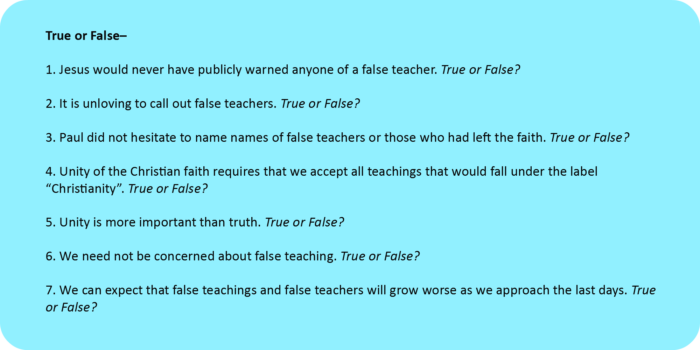
Okay, so do you have your answers in your head? Time to see what scripture has to say…

1. FALSE. Jesus did publicly denounce both the Pharisses and the Sadducees in Matthew 16. He does so again in Matthew 23. In Matthew 15:12-14 Jesus warns his disciples to stay away from the Pharisees–

Then His disciples came and said to Him, “Do You know that the Pharisees were offended when they heard this saying?”13 But He answered and said, “Every plant which My heavenly Father has not planted will be uprooted. 14 Let them alone. They are blind leaders of the blind. And if the blind leads the blind, both will fall into a ditch.”

While Jesus was always extremely kind and loving to those who were lost (such as Zacchaeus and the Samaritan Woman), we know that He treated false teachers–those who would pervert truth–with harshness. He even drove out the money changers and upturned the tables in the temple in righteous anger because these evil men were offending God’s Holy name (Matthew 21:12-13).

It is really important that we know and understand the Jesus of the Bible, rather than get our information from people who claim to “hear personal messages from Him” and describe Jesus from a source from which we have no way of knowing to be true. While that “Jesus” may be more appealing, the Jesus we find in the Bible is the real Jesus. And the real Jesus did not hesitate to call out false teachers.

2. FALSE. Calling out false teachers and making others aware of false teaching is actually one of the most loving things we can do. Think of it like this: If someone is running at top speed towards a cliff, would you just let them fall off the edge without shouting out a warning? Warning of false teachers is no different. Spiritual danger and calamity abounds when we leave the solid ground of sound doctrine and fall off the cliff and on to the hard, jagged rocks of false teaching. True loves calls out a warning. Paul puts it like this in Ephesians 4:14-16:

that we should no longer be children, tossed to and fro and carried about with every wind of doctrine, by the trickery of men, in the cunning craftiness of deceitful plotting, 15 but, speaking the truth in love, may grow up in all things into Him who is the head—Christ— 16 from whom the whole body, joined and knit together by what every joint supplies, according to the effective working by which every part does its share, causes growth of the body for the edifying of itself in love.

These verses make it clear that in order to have healthy growth in the body of Christ, we must hold truth in high esteem. Otherwise, we will be misguided and deceived by the trickery of men and carried away by false doctrine. This will lead to division and strife (which is exactly what we are seeing take place today).

And I John 3:18 confirms this, as well:

My little children, let us not love in word or in tongue, but in deed and in truth.

Speaking the truth is how we show love. Another example would be this: Let’s say your best friend finds out that your husband is having an affair. What is the most loving thing for her to do? Simply ignore it and pretend it isn’t happening? Is this what a loving friend who cares about you would do? Of course not. True friends tell the truth because they care more about the long-term ramifications and devastating consequences that will affect their friend than they care about the short-term hurt feelings and unpleasantness that may result from speaking the truth.

And I Timothy 3:3-6 clarifies and confirms this even further–

As I urged you when I went into Macedonia—remain in Ephesus that you may charge some that they teach no other doctrine, nor give heed to fables and endless genealogies, which cause disputes rather than godly edification which is in faith. Now the purpose of the commandment is love from a pure heart, from a good conscience, and from sincere faith, from which some, having strayed, have turned aside to idle talk, desiring to be teachers of the law, understanding neither what they say nor the things which they affirm.

Real division and disputes are caused by those who bring in the false teaching. Not by those who lovingly confront it. How backwards and upside down the church has become. We have swallowed unbiblical, politically-correct thinking “hook, line, and sinker”.

3. TRUE. We have several examples of Paul naming names in scripture. See 2 Timothy 1:15 and 4:14. Another example is 2 Timothy 2:16-18–

And their message will spread like cancer. Hymenaeus and Philetus are of this sort, 18 who have strayed concerning the truth, saying that the resurrection is already past; and they overthrow the faith of some.

We also see that John was unafraid to call out a false teacher in 3 John, verses 9-10:

I wrote to the church, but Diotrephes, who loves to have the preeminence among them, does not receive us. 10 Therefore, if I come, I will call to mind his deeds which he does, prating against us with malicious words. And not content with that, he himself does not receive the brethren, and forbids those who wish to, putting them out of the church.

If we have several examples of this in the scriptures from Jesus, Paul, and John, shouldn’t we naturally assume that it is not sinful to call out a false teacher? In fact, should we not consider it our duty? Let’s look at a few verses that command us to call out false teaching and false teachers–

Ephesians 5:11  And have no fellowship with the unfruitful works of darkness, but rather expose them.

Romans 16:17-18 Now I urge you, brethren, note those who cause divisions and offenses, contrary to the doctrine which you learned, and avoid them. 18 For those who are such do not serve our Lord Jesus[d] Christ, but their own belly, and by smooth words and flattering speech deceive the hearts of the simple.

Jude 3-4 Beloved, while I was very diligent to write to you concerning our common salvation, I found it necessary to write to you exhorting you to contend earnestly for the faith which was once for all delivered to the saints. For certain men have crept in unnoticed, who long ago were marked out for this condemnation, ungodly men, who turn the grace of our God into lewdness and deny the only Lord God[b] and our Lord Jesus Christ.

4. FALSE. We are not to accept every wave of doctrine so that we can preserve unity. We can see this from the verses right above. We also know that Scripture teaches that true unity can only be protected by keeping our doctrine pure. I Timothy 6:3-5 says this:

If anyone teaches otherwise and does not consent to wholesome words, even the words of our Lord Jesus Christ, and to the doctrine which accords with godliness, he is proud, knowing nothing, but is obsessed with disputes and arguments over words, from which come envy, strife, reviling, evil suspicions, useless wranglings[a] of men of corrupt minds and destitute of the truth, who suppose that godliness is a means of gain. From such withdraw yourself.

From such withdraw yourself. Notice it does not say “unify with” or “compromise”. Instead it says we are to withdraw ourselves from those who do not teach the truth.

5. FALSE. We know that unity cannot be more important than truth, because Jesus Himself says this in Luke 12:49-53:

I came to send fire on the earth, and how I wish it were already kindled! 50 But I have a baptism to be baptized with, and how distressed I am till it is accomplished! 51 Do you suppose that I came to give peace on earth? I tell you, not at all, but rather division. 52 For from now on five in one house will be divided: three against two, and two against three. 53 Father will be divided against son and son against father, mother against daughter and daughter against mother, mother-in-law against her daughter-in-law and daughter-in-law against her mother-in-law.

If unity were more important, He would never have said such a thing. But from these verses we can also realize that there are two paths that can never be unified. They are in complete opposition to one another and go two completely different directions. This is further confirmed in Matthew 7:13-14, where Jesus contrasts the narrow way with the broad way of destruction:

Enter by the narrow gate; for wide is the gate and broad is the way that leads to destruction, and there are many who go in by it. 14 Because[a] narrow is the gate and difficult is the way which leads to life, and there are few who find it.

From these verses, we know that there is the path of truth and there is the path of falsehood and destruction and the two can never be unified. Therefore, truth will always have to trump the false unity that comes from compromising with unbiblical teaching. Compromised doctrine or teaching will automatically lead people to the broad road of destruction. Just as a drop of poison contaminates a clear glass of water, so even a drop of false teaching leads people away from the narrow path.

6. FALSE. I am not sure how so many passages on false teaching can be so intentionally ignored, but the Bible is clear in a number of places that false teaching is a very real thing and that we must be concerned about it–

I John 4:1-3 Beloved, do not believe every spirit, but test the spirits, whether they are of God; because many false prophets have gone out into the world. By this you know the Spirit of God: Every spirit that confesses that Jesus Christ has come in the flesh is of God, and every spirit that does not confess that[a] Jesus Christ has come in the flesh is not of God. And this is the spirit of the Antichrist, which you have heard was coming, and is now already in the world.

2 Peter 2:1-3 But there were also false prophets among the people, even as there will be false teachers among you, who will secretly bring in destructive heresies, even denying the Lord who bought them, and bring on themselves swift destruction. And many will follow their destructive ways, because of whom the way of truth will be blasphemed. By covetousness they will exploit you with deceptive words; for a long time their judgment has not been idle, and their destruction does[a] not slumber.

2 Corinthians 11:12-15 But what I do, I will also continue to do, that I may cut off the opportunity from those who desire an opportunity to be regarded just as we are in the things of which they boast. 13 For such are false apostles, deceitful workers, transforming themselves into apostles of Christ. 14 And no wonder! For Satan himself transforms himself into an angel of light. 15 Therefore it is no great thing if his ministers also transform themselves into ministers of righteousness, whose end will be according to their works.

Matthew 7:15-20 Beware of false prophets, who come to you in sheep’s clothing, but inwardly they are ravenous wolves. 16 You will know them by their fruits. Do men gather grapes from thornbushes or figs from thistles? 17 Even so, every good tree bears good fruit, but a bad tree bears bad fruit. 18 A good tree cannot bear bad fruit, nor can a bad tree bear good fruit. 19 Every tree that does not bear good fruit is cut down and thrown into the fire. 20 Therefore by their fruits you will know them.

I Thessalonians 5:21-22 Test all things; hold fast what is good. 22 Abstain from every form of evil.

7. TRUE. We do know that false teaching will continue to grow as we approach the last days, since the Bible makes this very clear–

Matthew 24:23-25 Then if anyone says to you, ‘Look, here is the Christ!’ or ‘There!’ do not believe it. 24 For false christs and false prophets will rise and show great signs and wonders to deceive, if possible, even the elect. 25 See, I have told you beforehand.

2 Timothy 3:1-7 But know this, that in the last days perilous times will come: For men will be lovers of themselves, lovers of money, boasters, proud, blasphemers, disobedient to parents, unthankful, unholy, unloving, unforgiving, slanderers, without self-control, brutal, despisers of good, traitors, headstrong, haughty, lovers of pleasure rather than lovers of God, having a form of godliness but denying its power. And from such people turn away! For of this sort are those who creep into households and make captives of gullible women loaded down with sins, led away by various lusts, always learning and never able to come to the knowledge of the truth.

2 Timothy 3:13-15 But evil men and impostors will grow worse and worse, deceiving and being deceived. 14 But you must continue in the things which you have learned and been assured of, knowing from whom you have learned them, 15 and that from childhood you have known the Holy Scriptures, which are able to make you wise for salvation through faith which is in Christ Jesus.


This is not my normal kind of post. However, it is my prayer that this post will not only help those who honestly want to know what the Bible says about false teachers, but that it can also be bookmarked and used as a reference for those of you who are faced with accusations that you are being divisive and unkind and unloving when you call out a false teacher. The verses above should bolster and encourage us when we are ready to cave or to just be quiet. God’s Word reminds us that we are doing the right thing by calling out false teaching and false teachers.

More and more, people will throw accusations as you seek to protect and defend God and the truth of His Word. They will marginalize you, call you names, and be angry with you. But we must be like soldiers and put on our spiritual armor (Ephesians 6:13f). We must be filled with love and grace as we fight, but we cannot back down. It takes a great deal of courage but God is faithful and He will give us the strength and boldness we need. Keep up the good fight, dear readers. Keep up the good fight.




The Smallest Crack

If you live in the country you know that mice can get in the smallest, teeniest, tiniest crack there is. They can slip under a door or scurry through a small hole in the wall. They will find any area that has not been sealed properly. Even when you think you have everything boarded up tight, you will find that mice will often find a way in. Especially in the fall when it’s starting to get cold.

As I was finishing up the final chapter of a *Bible Study based on the book of James last week, there was a list of questions given at the end that made me realize that pride is just like that mouse. It slips in quietly, often unnoticed, in the unsealed places of our hearts and minds. We had spent the last several chapters of the study learning about biblical humility and pride. James does not mince words, as we can see in chapter 4, verses 6–

But He gives more grace. Therefore He says:

“God resists the proud,
But gives grace to the humble.”

God resists the proud. And He gives grace to the humble. We already know this. But have we given thought recently to just how pride will slip in through even the smallest crack in our spiritual armor? It slithers in unbeknownst to us while we are patting ourselves on the back for not being prideful. It slides down into our hearts when we are least expecting it. Compliments and applaud and rewards make us even more vulnerable.

The more I study the Bible, the more I understand these three things: 1) how much God hates pride 2) just how deadly pride is to godly, righteous living and 3) how susceptible I am to it at all times.

As I worked on that final chapter and read through those questions, I thought that you all might appreciate this, as well. I think these questions are very revealing. They help us understand that pride isn’t simply boasting or having an arrogant attitude. It is so very much more than that, as we will see by this list of questions. At the end of the final chapter of his Bible Study on James, Steve Pettit says this–

Sometimes we view humility as the absence of outrageous vanity and boasting. But evaluating our pride should go much deeper than such surface observations. Consider the following questions (I have added a few comments in parentheses):

1.  Am I a critical person?

2. Do I regularly question authority?

3. Do I make fun of weaker, less privileged people?

4. Do I treat people differently based on their status? (Or on their wealth or their position in the company where I work or their leadership role at church?)

5. Am I dissatisfied with God’s Word as sufficient for life and godliness? (Or do I crave a supernatural experience that will make me feel special and important?)

6. Do I make plans without making the Lord the center of my life?

7. Do I shift blame instead of taking responsibility for my actions? (Do I get defensive if someone confronts me?)

8. Do I widely proclaim my views but rarely listen? (At home, at work, at church, on the sidelines–am I more concerned with being heard or with hearing others?)

9. Do I hold grudges instead of extending forgiveness?

10. Do I put up a front instead of confessing my faults to those who can help? (Do I confess my sins to God? To others? Am I willing to humbly apologize?)

11. Do I pray sparingly? (Lack of prayer indicates that we believe we can do life on our own.)

I don’t know about you, but this is quite a list! How did you do? Were you as convicted as me?? Does this list help you recognize that pride is something very real in your life? That it has seeped into the cracks of your armor–even when you didn’t realize it? Like that tiny mouse or a slithering poisonous snake, it slides through the smallest crack and takes up residence in our heart before we even know it.

Pettit gives this final paragraph–

The point of these questions is not to drive you to simply to do better. Answering yes to some of these questions is the first step toward repentance and receiving God’s grace, because a humble person is honest. He understands what David confessed–that God wants us to have integrity in our hearts (Psalm 51:6). Recognizing spiritual unfaithfulness and pride does not mean we pull ourselves up by our own bootstraps. It means running to Christ for superabundant grace. It means humbling ourselves to get back on the path of wisdom from above.

We have to face the fact that we can’t fix ourselves. In this day and age of self-help, we think we should be able to. Removing ourselves from the path of earthly, human wisdom means discarding our pride and putting on humility, recognizing that only God can give us the grace and strength we need for permanent change and righteous living.

And then we must remain in the Word and keep our eyes open because that deadly pride will slip in through the cracks once again, as soon as we leave even the slightest chink in our armor. We will see it when we argue with our spouse. It will crop up when someone criticizes something we did. And when we are tempted to criticize someone else. It rears its ugly head when we are hurt and rejected, when someone tells us what to do, when someone compliments us, or when we get too busy to pray. It is a constant danger to all believers and we must be on the lookout at all times.

So, over the next few days, let’s reflect on how pride tends to manifest itself in our own lives. Let’s ask the Lord to grow us in humility. Let’s be sure to keep our spiritual armor on (Ephesians 6:10-20), so that we may withstand those arrows of temptation thrown at us every day. And let’s thoroughly and regularly examine our spiritual armor for chinks and gaps so that– while we are busy defending ourselves from the “bigger sins”–pride doesn’t slip in, quiet as a mouse, and take up residence in our hearts.


*From Wisdom from Above: A Study in James by Steve Pettit

An Unpleasant and Unpopular Truth

Narrow is the way

God, through the writing of Paul, gives us such a clear picture of what an unregenerate soul looks like. This is especially clear in the third chapter of Titus, but we find it in many other passages, as well.

I find it curious that–while this is so clear in scripture–so few pastors and teachers are willing to teach that this kind of life would indicate that someone is in danger of hellfire. It would appear that, if someone professes with their mouth that they are saved and yet has no fruit to back up that profession, we have adopted a “hands-off” approach, yielding to the politically-correct dogma that would teach that to challenge their profession of faith would be to demean, belittle, or even hate them.

But could anything be further from the truth? Wouldn’t the most loving thing to do in a situation like this be to show them the truth from God’s Word? Let’s take a look at how the Word describes unbelievers and believers. (When describing unbelievers it refers to ingrained patterns of behavior where there is no conviction, no confession, and no repentance and where there is no effort to remove oneself from temptation or the sinning behavior. Keep in mind that no person–believers included–can ever be sinless. The key is the battle. True believers hate sin and continue to fight it, always working, through the power of the Holy Spirit, to grow in their sanctification and holiness.)

Okay, let’s take a look at some of these passages–

For we ourselves were once foolish, disobedient, led astray, slaves to various passions and pleasures, passing our days in malice and envy, hated by others and hating one another. (Titus 3:3)

The unregenerate are foolish, disobedient, easily led astray, and slaves to various passions and pleasures. They pass their days in malice and envy. They are hated by others and they hate one another.

This is how the Word describes us before we are saved. As unpleasant as it is to contemplate, we have to admit that if someone lives like this–day in and day out–without any conviction or desire to change, we have to recognize that they are probably not saved, no matter what they say with their mouth. True belief is always revealed by actions.

Let’s think of this in terms of a marriage. If a husband says he loves his wife but then he cheats on her and abuses her and fills their home with the things she hates, then we have to conclude that he is only saying the words but doesn’t really mean them. His actions have not backed up his words.

Let’s go back to Titus 3. After describing the unredeemed, Paul then goes on to pen these verses–

But when the goodness and loving kindness of God our Savior appeared, he saved us, not because of works done by us in righteousness, but according to his own mercy, by the washing of regeneration and renewal of the Holy Spirit, whom he poured out on us richly through Jesus Christ our Savior, so that being justified by his grace we might become heirs according to the hope of eternal life. (Titus 3:4-7)

This is the difference that Jesus makes! Isn’t this a beautiful thought? We are redeemed and changed through God’s transforming power!

When we minimize the transformation of a saved soul through the blood of Jesus Christ and the power of the Holy Spirit we diminish the miraculous and radical thing that salvation really is. When we don’t expect someone to grow or we nonchalantly classify someone as “definitely saved” when they give no evidence of it, we belittle the work that Jesus Christ did on the cross.

Let’s look at a few more verses that would indicate the differences between believers and unbelievers. I can think of no better place to go for this than Galatians 5:16-24–

But I say, walk by the Spirit, and you will not gratify the desires of the flesh. 17 For the desires of the flesh are against the Spirit, and the desires of the Spirit are against the flesh, for these are opposed to each other, to keep you from doing the things you want to do. 18 But if you are led by the Spirit, you are not under the law. 19 Now the works of the flesh are evident: sexual immorality, impurity, sensuality, 20 idolatry, sorcery, enmity, strife, jealousy, fits of anger, rivalries, dissensions, divisions, 21 envy,[d] drunkenness, orgies, and things like these. I warn you, as I warned you before, that those who do[e] such things will not inherit the kingdom of God. 22 But the fruit of the Spirit is love, joy, peace, patience, kindness, goodness, faithfulness, 23 gentleness, self-control; against such things there is no law. 24 And those who belong to Christ Jesus have crucified the flesh with its passions and desires.

Here we find a long and comprehensive list of the sins of the flesh. This whole list–like it or not–describes the unregenerate. How do I know this for sure? It is in verse 22 with that little word “but” where we can see that the fruits of the Spirit are in total opposition to the works of the flesh. Verse 24 clarifies further: And those who belong to Christ Jesus have crucified the flesh with its passions and desires. This is what believers do–we have crucified, we continue to daily crucify–the flesh. Any person who isn’t willingly doing this or isn’t even slightly interested in doing this is giving evidence that they very well may not be saved.

Look–I don’t take joy out of saying this. I wish it were different. But this is what the Word of God says. I know that this is an extremely unpopular message in today’s church. I do get that. In fact, just yesterday I saw a post by a very popular “Christian” blogger who declared on Twitter that she could never serve a God who would send most everyone to hell. The comment thread that followed made anyone who did believe in what the Bible teaches about hell look ridiculously archaic and incredibly stupid.

But should unpopularity keep us from speaking the truth as we find it in the Bible?

Galatians 5 would indicate that after we are saved and the Holy Spirit indwells us, our lives should increasingly show the fruits of the Spirit which are love, joy, peace, patience, kindness, goodness, faithfulness, gentleness, and self-control.

Now none of us exhibit these fruits perfectly. And none of us live our new life in Christ without fighting some of these sins of the flesh. Some of us have victory in one of these areas, while others remain a lifelong challenge for us. But remember–the key is in the battle. This is the sin nature and we know that we will fight this battle against sin until the day we die (Romans 7:18-25). While this can be a discouraging thought, we also have these marvelous promises–

Romans 6:6Knowing this, that our old man is crucified with Him, that the body of sin might be destroyed, that henceforth we should not serve sin.

2 Corinthians 5:17Therefore if any man be in Christ, he is a new creature: old things are passed away; behold, all things are become new.

Philippians 1:6Being confident of this very thing, that He which hath begun a good work in you will perform [it] until the day of Jesus Christ:

The battle with sin may be always with us but we never have to serve sin again. We have a new Master who walks with us, works in us for His glory, and we are new creatures living for God.

One who is regenerated gives evidence of this in their life. The one who is not saved lives for himself/herself.

How many people claim the name of Christ today and yet live wholly and fully for themselves? How many say they walked the aisle or said a prayer and yet haven’t given any evidence of a transformed life in Christ? The numbers that fall into this category are staggering. And yet, somehow, the church has sanctioned this and would criticize not the hypocrite but those who would reveal this tragic truth that is clearly taught in scripture (Matthew 7:15-20).

I would like to just add one final thing as I close and this is a really important aspect of this conversation: None of us knows what is going on in the heart of any person. Only God knows. I would never–and you should never–tell someone they aren’t saved. There is no possible way for us to know this and that is God’s job. But what we can do is lovingly point them to what God’s Word says about their lifestyle, behavior, or actions. We can pray for opportunities to talk with them about their lack of fruit or disinterest in living a holy life. We can open our eyes to the possibility that they might not be saved and begin diligently praying for them instead of living in the comfortable place of naive assumptions.

Because the stakes are high. So high.

We know of this danger because Jesus Christ makes it clear for us in these verses–

Matthew 7:14 For the gate is narrow and the way is hard that leads to life, and those who find it are few.

Matthew 7:21-23 Not everyone who says to me, ‘Lord, Lord,’ will enter the kingdom of heaven, but the one who does the will of my Father who is in heaven. 22 On that day many will say to me, ‘Lord, Lord, did we not prophesy in your name, and cast out demons in your name, and do many mighty works in your name?’ 23 And then will I declare to them, ‘I never knew you; depart from me, you workers of lawlessness.’

There are few sadder verses in scripture than these. Let’s take them to heart, dear reader. Not only for ourselves but for those we love. We never want to leave unsaid what could have–and should have– been said. Life is so fragile. I have become more aware of that than ever these last few weeks. When our loved ones are snatched away by that great thief, Death, we don’t want to be left with uncertainty when we ask that final question: Where are they now?


How to Have a Productive Quiet Time

As believers, we recognize the value of a quiet time each day with the Lord. While we aren’t commanded anywhere specifically to have this time, the Bible does tell us to meditate on and to delight in the Word (Psalm 1:2; Psalm 19; Psalm 119) and to spend time in our closets in prayer (Matthew 6:6).

From the time I was a little child, I remember being encouraged to have my “devotions”, in which I would read from a book that would give a few verses and then a paragraph or two about those verses. The older I got, the more I recognized that many of those devotional books aren’t real meat. While there isn’t anything wrong with some of them, they are more like a dessert. Most aren’t giving enough scripture to be the meat we need for our sustenance as a growing believer. But they are easier and so we like them. We can read the portion for the day and then check “quiet time” off our day’s to-do list.

It wasn’t until I started reading the actual Bible every day that I started to really grow. But, let’s be honest, Satan doesn’t want us in the Word. Since the power for life and godliness is within its pages, he wants to do all he can to keep us out of it. Biblical illiteracy and neglect renders us ineffective for Jesus Christ’s purposes and it often keeps us imprisoned by sin. (For those of us who would point fingers at the “obvious” sins, don’t forget that a complaining or anxious or selfish heart is also sin…very real temptations for all of us!)

And so as we start studying the Word in a deeper way and spending more time in prayer, what can we do to make sure our quiet time is as productive as possible? I thought I would break this down a bit today and offer a few helpful suggestions. Interestingly enough, this post is born out of my own distractions the other day. I started thinking about this while I was supposed to be having my quiet time!! Anyway…here are six things that may be keeping us from having the best quiet time we can have–

1. Life

Life is just busy. Sports schedules, workouts and training, committee meetings, church activities, jobs–all of these can wear us out and distract us from our relationship with the Lord. If we have preschool or home-schooled children, it can add a whole different dynamic to this idea of finding a half hour to dedicate to this. How do we keep from being distracted by life duties and pressures? Here are a few suggestions–

First, plan a time. Morning, evening, afternoon–it doesn’t really matter. But plan it like you plan your workout or coffee with a friend or your favorite TV show. If you say you don’t have time, then I encourage you to examine your schedule to see what you can eliminate. Nothing should be more important than this. Sure, some of us are temporarily caught up in a whirlwind of activity beyond our control, but that is not the case for most of us. If you have kids at home, designate a quiet time for all of you. I did this when I home-schooled and it became the hour that energized me for the rest of the day. At 1pm every day the children would go to their rooms. They didn’t have to sleep but they did have to look at or read books or quietly rest. And then I would have my quiet time. Or at least that was the idea–but, instead, I’d often be distracted by my “to-do” list. Which leads me to…

Second, make your time with the Lord a priority. Recognize the value in spending time with Him and realize that whatever is calling your name is not more important than your time with Him. I look back and can see this now. I hope I can encourage you to not make the same mistake I did!

2. Feelings

Feelings can be SO deceiving. And think of how often we obey them! We think if we don’t feel like praying or getting in the Word, then it is perfectly fine not to do so. I struggle with this so much. And, yet, I find that when I ignore my feelings and do it anyway, my feelings soon tag along afterwards and I am so glad that I moved ahead and did the right thing, despite my feelings. This is worthy of a blog post alone because this is what is driving so many choices regarding all of life! If we can say NO to our feelings and YES to doing the right thing, we will have won a HUGE victory in our battle with the flesh.

3. Technology

Have you ever been in the middle of praying when suddenly you hear that little ding or buzz go off on the table beside you? Your curiosity drives you to look at your phone–interrupting your prayer time. Or perhaps you are reading scripture and it brings something to mind you want to look up…and since your phone or tablet is right beside you and you can look anything up at any time…

I confess that this is something I really struggle with. I have learned it is best for me to keep my phone and iPad in a different room when I am praying and reading my Bible every morning.

Technology is a wonderful thing, but it is also a very exacting taskmaster. We have become enslaved to our phones and instant communication. We believe it is our responsibility to be available to everyone at all times. But will the world really stop if we don’t respond for 30 minutes?

This is such a struggle for me. Did I mention that? Sometimes I really long for the old days–at least when it comes to having my quiet time…

4. Self-Absorption

Track with me here as I unpack this one. I have recognized that my quiet time can often be overtaken by my absorption with myself. Whether it’s reading the scripture, greedily searching for some personal comfort or it’s my prayer time being consumed with my own selfish desires, I find I quickly fall into the trap of selfishness during my quiet time. This attitude will keep me from having a productive quiet time. A truly quality quiet time has us humble and yielded before the Lord with a heart that desires to obey. Coming before the Lord with a prideful, greedy, selfish heart will keep us from having a close relationship with the Lord–no matter how many hours we may spend with Him.

5. Sinful Attitudes

This is a bit similar to #4 but I don’t think we always see that. When we come to our quiet time with an unforgiving heart or with a grudge against someone, we are putting a wall up between us and the Lord. Walls are also built by our anxious heart (we are saying with our actions that we don’t trust the Lord), our envious or jealous heart (we are discontent with what the Lord has provided), and our prideful heart (we are saying we don’t need the Lord). These things keep us from drawing near to the Lord in spirit, even if we are physically sitting and reading the Bible.

6. Improper View of God and Man

Okay, so this is a little deeper theologically than the others, but please keep reading. I think this is really important. This really encompasses all of the above.

I believe we are often kept from a productive quiet time because we don’t really know God. We don’t give any thought to the fact that He is omnipotent (all-powerful), omniscient (all-knowing), immutable (never-changing), and absolutely sovereign. We don’t have a big enough view of Him and we treat Him like a casual friend. Yes, He is our friend but He is so much more than that! He is God! We should have reverence and godly fear when we approach Him.

And, then, we have a wrong view of self. We have nothing to offer God. We couldn’t even live and breathe if God didn’t allow it. We must recognize our dependence upon God for every single thing. Realizing this naturally changes how we approach scripture and prayer.

Having a proper view of God and self are so critical to a thriving and vibrant walk with the Lord. And proper views will help us navigate and eliminate the first five items on this list.

Well…

That was a lot to take in, wasn’t it? But I hope that this list of six things may give you some ideas on improving your quiet time. I know it really made me think as I wrote it. If we love God and we want to walk as closely with Him as possible, it is imperative that we make our quiet time as productive as we possibly can.


How Do I Respond to My Enemies?

So often Christians find themselves at odd with other Christians. There will be two true believers who just do not agree. Whether it’s a disagreement over something as simple as a remodeling project at church or it’s a deeper issue of how a certain scripture passage should be interpreted, we will always find someone that we will disagree with about something.

What keeps two people who disagree with each other from being enemies? What brings true Christian unity?

Please keep in mind that this post is referring to unity between true believers and not to the “fake” unity that warmly embraces all perversions of the Gospel and even religions that don’t adhere to the Gospel at all to be unified under the broad term of “Christianity”. We know that this kind of unity is not biblical, according to Galatians 1:9–

As we have said before, so now I say again, if anyone preaches any other gospel to you than what you have received, let him be accursed.

But there is something that is called true, Christian unity. This unity can only exist between brothers and sisters in Christ. This kind of unity keeps us moving toward the same goals and embracing the same purpose. This unity builds bridges instead of walls. It will fill Christians with loving concern for one another instead of filling them with grudges, resentment, and jealousy.

This sounds so wonderful, doesn’t it? But it is often hard to find. Why is this?

Why does someone decide they do not like someone?

Sometimes we don’t care for someone based on a shallow, silly thing. And then there are also better reasons, based on things like biblical error or a prideful, arrogant spirit that is consistently divisive.

But we have to ask ourselves: Are any of these reasons good enough? If you were to stand before God today and tell Him your reason for not liking a certain person, would He say, “Way to go, my child. I agree with you completely.” ??

Of course we know the answer, don’t we? Because we know that God is love. We shouldn’t view anyone as an enemy, much less a brother or sister in Christ.

Romans 12:8 puts it like this–

If it is possible, as much as depends on you, live peaceably with all men.

We should, to the best of our ability, work at being at peace with everyone, believer and non-believer. This verse naturally brings two thoughts to my mind.

First, what if someone won’t be at unity with me?

Of course, since we know that the world will hate us (John 15:19), we know that it isn’t always possible to be at peace with those in the world. But sometimes it is a fellow Christian who refuses to forgive us. Or perhaps they just don’t like us but won’t tell us why. What then? These kinds of situations are heart-breaking and lead to feelings of helplessness as we try to navigate the back-biting, the whispering, and the cold shoulders.

I have a friend who taught me an important lesson about this very thing. Our daughters were playing soccer together and something happened to her little girl that could have started some real drama on the team. And this was her advice to her daughter, “kill them with kindness”. I heard her say that so often when her daughter would feel slighted or frustrated about something. And then, following her example, I started to say this to my kids. Yes, this is what we are called to do.

In fact, Jesus takes it even further in Matthew 5:43-44, telling us to love them, bless them, do good to them, and to pray for them!–

You have heard that it was said, ‘You shall love your neighbor and hate your enemy.’ 44 But I say to you, love your enemies, bless those who curse you, do good to those who hate you, and pray for those who spitefully use you and persecute you.

This is a tall order, is it not? But there it is. Commanded by Jesus in the Holy Bible. Instead of gossiping, instead of returning the coldness, instead of resentment or anger, we love, we bless, we do good things, and we pray for them.

But we do this because it is right, not because it will necessarily change anything. Let’s go back to the beginning of Romans 12:18–

“if it is possible, as much as it depends on you”

We know from these words that Paul realized it isn’t always possible. It is part of living life as a sinner, alongside sinners, in a fallen world. Sometimes we just have to follow Jesus’s words and find contentment even when there is no resolution and no forgiveness. A hard thing, indeed. But, you know what? This is just another thing that God uses to grow us and to teach us that we must find our peace and joy in Him alone.

Second, we won’t be best friends with everyone.

Even among truly unified Christian brothers and sisters, there will be those who are “kindred spirits” and those who are not. And that’s okay. But so often special friendships between Christians are viewed with resentment or jealousy. As believers we should realize that we will be better friends with some than others. It is how God designed us. Remember David and Jonathan? If you read I Samuel 18, you will realize that their friendship was very special. Once in a while, God will bring these special Christian friends into our world. They are true treasures and, instead of feeling jealous, we should be glad for others if they have found a special friend.

If we are still longing for this type of friendship, then pray and ask God to bring you a friend. I remember as a young mom feeling the need for this type of friend and so, unbeknownst to me, my mom started praying. And within a year or so of her prayers, God led me to Deb. We realized we were kindred spirits as we sat in a group of women and chatted and, shortly after, became best friends. Don’t underestimate the power of prayer if you need a friend!

And then there are those fellow Christians in our lives who could never be a kindred spirit. In fact, some of them drive us a little crazy. We may feel guilty if we don’t appreciate a Christian brother or sister like we know we should. What then?

God made us all different and certain personalities may grate on us. We may find them hard to get along with or their mannerisms alone might irritate us. They may be boastful or arrogant.

But if we take a look at Philippians 2:1-2, we have to acknowledge that God doesn’t give us any caveat for difficult people–

Therefore if there is any consolation in Christ, if any comfort of love, if any fellowship of the Spirit, if any affection and mercy, fulfill my joy by being like-minded, having the same love, being of one accord, of one mind.

We are to be like-minded with all Christians–as much as it depends on us. We obviously can’t control the other person.

So how do we do this? How can we be like-minded? These verses show us–we have the same love, the same accord, the same mind as our fellow Christians. This can only be done if we are diligently studying the scriptures together, submitting our desires and wills to God, joyfully obeying the commands we find there, while increasing our knowledge of God. When people are not getting along, it often goes back to this. Biblical illiteracy once again rears its ugly head in church matters.

And, along with knowing God’s Word, we find the oil that keeps things working together smoothly in Colossians 3:14–

And over all these virtues put on love, which binds them all together in perfect unity.

I Corinthians 13:4-6 gives us a description of this love that will break down barriers and bind Christians together in perfect unity–

Love is patient, love is kind. It does not envy, it does not boast, it is not proud. It does not dishonor others, it is not self-seeking, it is not easily angered, it keeps no record of wrongs. Love does not delight in evil but rejoices with the truth. It always protects, always trusts, always hopes, always perseveres.

And I Peter 4:8 is further confirmation of this idea that love will bring unity–

Above all, love each other deeply, because love covers over a multitude of sins.

Even when we don’t particularly appreciate a fellow Christian, we can love them. We are commanded to love them. And we should thank the Lord for them, for they are helping us to grow in patience and self-control!

Enemies are just part of life. If we are going to take any stand at all on the things that matter, we will have enemies. We cannot control how they treat us, but we can control how we treat them. And let’s intentionally work at not having needless enemies. We must back away from the stuff that doesn’t matter. Will it matter in a hundred years what color carpet is used in the church? Is a slight difference in how someone interprets the book of Revelation really a cause for division? Let’s wisely and, oh so carefully, choose our battles. Most hills we choose to stand on are just not worth dying on. We don’t always have to be right. We don’t always have to have our way. So often it just doesn’t matter.

And most of all, when we find ourselves in the midst of a heated disagreement with a fellow Christian or facing a full-blown enemy, then let’s love them. Love them, bless them, do good to them, and pray for them. If you don’t remember anything else from this post, I hope you will remember these words of Jesus.


How Do You Listen to Gossip?

Have you ever had one of those conversations where you are talking about a TV show like it’s really happening? The people, the situations, the happenings? I had one of those the other day and as I walked away from that conversation, I realized that we often have more loyalty for and kindness and grace towards people on TV.

I know it seems silly to even compare the two, since we are obviously personally affected by real people so that makes all the difference in the world, but it does seem sad that we can keep so level-headed and impartial when discussing TV friends and completely lose that when discussing real people.

Of course, we shouldn’t really be discussing real people most of the time. Sure, there are instances where we need to work through a problem with a trusted, godly friend or mentor, but, overall, we should not be talking about people. Ephesians 4:29 says this: Let no corrupt word proceed out of your mouth, but what is good for necessary edification, that it may impart grace to the hearers.

But this is not a post about spreading or speaking gossip. It’s a post about listening to gossip and our subsequent actions after we’ve heard it.

So many of us hear will listen to someone talk about someone and, instead of defending them or kindly asking them to stop, we will just jump right in and join the conversation. Or we will listen without speaking while making assumptions that will change our friendship with the person being spoken about. There is no grace. No kindness. No loyalty.

Or perhaps someone will talk about someone behind their back, telling you terrible things that person said about you. What do you do? Do you do what you should?

This happened to friends of ours. But let me first give some background. We had made a really, really tough decision after much prayer and agony. Because of the nature of the decision, there were many rumors flying around about us and lies told. We know of at least three specific lies that were told about us that made their way to our ears “through the grapevine”.

But only one couple actually loved us enough to call us. The wife called and asked us specifically if we had said such-and-such about them. My heart sank when I realized that someone I had trusted had said such a vicious thing about us. But, even in my dismay, I realized that this couple–instead of believing the worst–loved us enough to confront us and ask us about it.

We lost a lot of friends through those swirls of rumors and accusations, but these two remain our friends to this day. They exemplified what true biblical love and friendship are. They didn’t believe the worst about us, as seems to be the natural thing to do, but they bravely went right to the source. They cared enough to ask.

So what do we do when we hear gossip? Do we automatically believe it? Do we jump on the bandwagon and join the fun? Do we internalize it and allow it to create a cool distance with the person who has absolutely no idea what was said behind their back?

We have to be oh, so careful of this, don’t we? So many of us who wouldn’t ever be caught gossiping just aren’t very good at listening to gossip.

So how should we listen to gossip? Let’s see what scripture says–

First, we should view them as innocent until proven guilty. If there is a personal accusation involved, ask them lovingly and kindly if the words spoken are true. If they aren’t, move on. If they are, forgive and move on. Life is just too short for grudges. It really is. (Of course, this is the “simplified model” of relationships and it doesn’t always work. Especially with those who have no evidence of the fruit of the Spirit in their lives.)

Colossians 3:12-14  Therefore, as the elect of God, holy and beloved, put on tender mercies, kindness, humility, meekness, longsuffering; 13 bearing with one another, and forgiving one another, if anyone has a complaint against another; even as Christ forgave you, so you also must do. 14 But above all these things put on love, which is the bond of perfection.

Second, we should not let it affect our relationship with them. Does it really matter? Does it affect you personally? If the answer is no (and most times it is) then just continue your relationship with that person. Remember that you don’t know any of the details at all. You don’t know the situations, the circumstances, the agony, the fear, the anxiety that was all part of that person’s journey to whatever choice they made. Unless it is something that is currently hurting you, them, or others around them, just forget you heard it. We all have done things in the past we aren’t proud of, am I right??

Luke 6:31 And just as you want men to do to you, you also do to them likewise. 

Third, if what you hear is about a Christian involved in sin (such as that person is involved in an affair or addicted to a substance), prayerfully consider speaking to them about it. Talk with a trusted leader in your church or some other godly person you know to ask for their advice.

Galatians 6:1 Brethren, if a man is overtaken in any trespass, you who are spiritual restore such a one in a spirit of gentleness, considering yourself lest you also be tempted.

Fourth, pray for that person. Instead of letting gossip fill your heart with disgust or anger or frustration, let it fill your heart with love and compassion that will remind you to pray. Oh, how often we accuse, examine, and talk about without ever lifting that person up before the throne of Grace.

James 5:16 Confess your trespasses[e] to one another, and pray for one another, that you may be healed. The effective, fervent prayer of a righteous man avails much.

Fifth, and when appropriate, steer the conversation a different way. You be the one to change the course of the discussion. Instead of joining, be the deflector. Instead of listening, be the one who changes the direction.

Proverbs 16:24 Pleasant words are like a honeycomb, Sweetness to the soul and health to the bones.


As always, I offer this post not as someone who has this nailed down but, instead, as a lowly servant of Jesus Christ who still struggles with all of this. As I write, I can see so many weaknesses in my own handling of gossip. God’s Word powerfully convicts you and me to grow in our faith and move beyond the status quo Christianity that so easily ensnares us.

I leave you with these beautiful verses from I Corinthians 13. We most often hear these spoken at weddings, as two people pledge their lives to one another. But perhaps we should read them every day. They remind us of not only the spirit with which we should listen to gossip, but also give us a pattern for how we should treat others in every other way, as well.

Love suffers long and is kind; love does not envy; love does not parade itself, is not puffed up; does not behave rudely, does not seek its own, is not provoked, thinks no evil; does not rejoice in iniquity, but rejoices in the truth; bears all things, believes all things, hopes all things, endures all things.


Scroll to Top