
Christian Life

The Tactless Art of Making People Feel Small

There is a way to instantly get on someone’s bad side. This builds walls between parents and children and creates barriers between friends. It can ruin ministries and destroy relationships.

I have seen it take place between adult children and their elderly parents. And between teenagers and their bewildered parents. I have seen it take place between teacher and student, pastor and congregation member, husband and wife, and clerk and customer.

It isn’t talked about a whole lot as a sin, but it is a very real (and accepted) sin for which we need to be on guard at all times.

So what is it, you may ask?

It is the art of making people feel small. The great art of condescension, which is defined as an attitude of patronizing superiority; disdain.

Have you ever been around someone who has done this to you?

How did this make you feel?

I can tell you how it makes me feel. It makes me feel unimportant and ridiculous. It makes me feel that I have no more value than a bug to be squashed on the sidewalk.

I know I have done this to others myself and I mourn over this. Do you feel the same way? Some of us are more prone to this than others.

I am especially heart-broken when I see this happen between adult children and their elderly parents. The rolling eyes, the patronizing attitude as I watch an adult child treat their parent with such disdain just fills me with sadness. Shouldn’t someone who raised us be worthy of our respect?

Now, first let me state that I have not been in the place of taking care of elderly parents yet. All four of our parents are still very independent so please know that I am not casting a pointing finger of judgement at any of you. I know there are real challenges in being a caregiver for someone who resists your care.

Rather, what I hope to do with this post is to gently encourage you to consider your communication with and attitude towards your elderly parents. And your children. Your co-workers and fellow believers and family members and friends. And clerks and bank tellers and landscapers and the people who pick up your trash.

Because there is little more to crush the spirit of another than to act like you know everything and they know nothing. Anger and frustration quickly build when someone gives the impression that they are way more important than the other person. There are few things that will as quickly create barriers between people than for one person to make another one feel stupid.

I’ve experienced both ends of the spectrum on this. I used to be condescending on a regular basis with my husband. It shames me to say it, but it’s true. I am thankful that he brought this to my attention and that God has worked in my heart but I am still so imperfect in this area (as well as so many others!) And, as lowly landscapers, we often feel condescension from those who would never choose a laborious job such as working with their hands and digging in the dirt. Quite thankfully, we have so many wonderful customers that make up for those that would treat us like dirt–no pun intended!! ;)

And, as is the case with all sin, the ugly root of this sin is pride. And, once again, we see clear evidence that–

Pride destroys and humility repairs

Pride builds walls and humility tears them down

Pride leads to dissension and humility leads to harmony


Another thing we need to keep in mind in regards to condescension is that it can be done with a big smile and sweet words. Have you ever run into one of those people that appear so sweet and kind but underneath it is hardened pride that keeps you from having any productive conversations with them? They are condescending but it is in the nicest way. In some ways this is the art of making people feel small at its finest. It can be done while still maintaining a godly and wholesome reputation.

So how do we keep ourselves from falling prey to this sin? What can we do to make sure we don’t patronize others? These are two things that I have found helpful, so I am passing them along–

1. Remember how Jesus treated others.

Jesus was never patronizing with people. We read of so many accounts he had with others–Zaccheus, the Samaritan Woman, Nicodemus, and others and condescension is never conveyed by even the slightest word or deed. Even when Jesus was angry with the Pharisees for their false teaching, He demonstrated that anger in clearly communicated words and not through snide and sarcastic condescension. Jesus’s sinless example is the one we want to follow as we reflect on how we should treat others.

2. Treat others as you would want to be treated.

Mark 12:31 says this: And the second, like it, is this: ‘You shall love your neighbor as yourself.’ There is no other commandment greater than these.”

Love your neighbor as yourself. How would you want someone to tell you a hard truth? How would you want your adult child to treat you if you were the elderly parent losing your ability to do things independently and your dignity right along with it? Imagine yourself in the other person’s shoes and really take to heart how you would want to be treated if you were them.


Remembering these two things will bring a big change in this area of condescension. Keeping these in mind will fill us with a special grace and thoughtfulness that will naturally yield an attitude of loving-kindness and gentleness towards others rather than an air of superiority and disdain.

So let’s discard the tactless art of making people feel small and develop the art of making people feel special! Let’s eliminate the destructive root of pride that yields a superior, patronizing disdain for others and, instead, develop godly humility that tears down barriers and builds relationships.

This is God’s will for all of us, so we know His Holy Spirit will guide and direct us as we seek to make changes. We know that this is a prayer that God will answer if we are seriously seeking to do what’s right. God will be with us all as we seek to build rather than to tear down and as we strive to make others feel important and loved rather than stupid and worthless.


The Sure Road to Happiness

What is the sure road to happiness? This is a worthwhile question because there seems to be so little true happiness in this world. Even church-goers and those who claim Christ do not seem to show any real happiness (as opposed to fleeting merriment).

In my last post I shared with you a portion from Home Truths by J.C. Ryle which was about the counterfeit shortcuts we often try to take to happiness. They are many and we are all–even us Christians–guilty of turning off onto one of these shortcuts on occasion. But Ryle, in the next chapter, tells us about the sure road to happiness.

What he writes may go against all that the world says. It may even go against what the mainstream church is teaching these days. But should we be surprised at that?

One of the things I have often marveled at is that true happiness and true sense of purpose comes from yielding our lives to the Lord. What we most dread doing and often live in rebellion against is the one thing that will give us peace. It is a wonderful thing that what most pleases the Lord is what brings us true happiness! How kind of the Lord to create us in this way. True, unhindered surrender, submission, and obedience brings a very real happiness that no man can take away. This is an amazing truth from God’s Word that is so little spoken of today.

But I am jumping ahead of Ryle. Let’s see what he has to say–

(In order to keep this post from being too long, I had to cut out a bit of it. To read the entire chapter–which I highly recommend–you can purchase the book here. I get no proceeds from any purchases but simply want to let you know where to find it in case you want to read it.)

There is a sure path which leads to happiness, if men will only take it. There never lived the person who travelled in that path, and missed the object that he sought to attain.

It is a path open to all. It needs neither wealth, nor rank, nor learning, in order to walk in it. It is for the servant as well as for the master. It is for the poor as well as for the rich. None are excluded but those who exclude themselves.

It is the one only path. All that have ever been happy since the days of Adam have journeyed on it. There is no royal road to happiness. Kings must be content to go side by side with their humblest subjects, if they would be happy.

Reader, where is this path?

Where is this road? Listen and you shall hear. The way to be happy is to be a real, thorough-going, true-hearted Christian. Scripture declares it. Experience proves it. The converted man, the believer in Christ, the child of God, he and he alone is the happy man. It sounds too simple to be true. It seems at first sight so plain a receipt that it is not believed. But the greatest truths are often the simplest. The secret which many of the wisest on earth have utterly failed to discover, is revealed to the humblest believer in Christ. I repeat it deliberately, and defy the world to disprove it. The true Christian is the only happy man.

What do I mean when I speak of a true Christian? Do I mean everybody who goes to church or chapel? Do I mean everybody who professes an orthodox creed, and bows his head at the belief? Do I mean everybody who professes to love the Gospel? No! indeed! I mean something very different. All are not Christians who are called Christians. The man I have in view is the Christian in heart and life. He who has been taught by the Spirit really to feel his sins—he who really rests all his hopes on the Lord Jesus Christ, and His atonement—he who has been born again, and really lives a spiritual, holy life—he whose religion is not a mere Sunday coat, but a mighty constraining principle, governing every day of his life—he is the man I mean, when I speak of a true Christian.

“What do I mean when I say the true Christian is happy? Has he no doubts and no fears? Has he no anxieties and no troubles? Has he no sorrows and no cares? Does he never feel pain and shed no tears? Far be it from me to say anything of the kind. He has a body weak and frail like other men. He has affections and passions like every one born of woman. He lives in a changeful world. But deep down in his heart he has a mine of solid peace and substantial joy which is never exhausted. This is true happiness.”

—————————————-

Do I say that real true Christians are equally happy at all times? No! not for a moment. All have their ebbs and flows of comfort; some like the Mediterranean sea, almost insensibly—some like the tide at Chepstow, fifty or sixty feet at a time. Their bodily health is not always the same. Their earthly circumstances are not always the same. The souls of those they love fill them, at seasons, with special anxiety. They themselves are sometimes overtaken by a fault, and walk in darkness. They sometimes give way to inconsistencies and besetting sins, and lose their sense of pardon. But as a general rule, the true Christian has a deep pool of peace within him, which even at the lowest is never entirely dry.[2] The true Christian is the only happy man, because his conscience is at peace. That mysterious witness for God, which is so mercifully placed within us, is fully satisfied and at rest. It sees in the blood of Christ a complete cleansing away of all its guilt. It sees in the priesthood and mediation of Christ a complete answer to all its fears. It sees that, through the sacrifice and death of Christ, God can now be just, and yet be the justifier of the ungodly. It no longer bites and stings and makes its possessor afraid of himself. The Lord Jesus Christ has amply met all its requirements.

Conscience is no longer the enemy of the true Christian, but his friend and adviser. Therefore he is happy.

The true Christian is the only happy man, because he can sit down quietly and think about his soul. He can look behind him and before him, he can look within him and around him, and feel, “all is well.”—He can think calmly on his past life, and however many and great his sins, take comfort in the thought that they are all forgiven. The righteousness of Christ covers all, as Noah’s flood over-topped the highest hills—He can think calmly about things to come, and yet not be afraid. Sickness is painful. Death is solemn. The judgment day is an awful thing. But having Christ for him, he has nothing to fear—He can think calmly about the Holy God whose eyes are on all his ways, and feel “He is my Father, my reconciled Father in Christ Jesus. I am weak. I am unprofitable. Yet in Christ He regards me as His dear child, and is well pleased.” Oh! what a blessed privilege it is to be able to think, and not be afraid! I can well understand the mournful complaint of the prisoner in solitary confinement. He had warmth, and food, and clothing, and work, but he was not happy. And why? He said, “he was obliged to think.”

The true Christian is the only happy man, because he has sources of happiness entirely independent of this world. He has something which cannot be affected by sickness and by deaths, by private losses and by public calamities, the peace of God which passeth all understanding. He has a hope laid up for him in heaven. He has a treasure which moth and rust cannot corrupt.

He has a house which can never be taken down. His loving wife may die, and his heart feel rent in twain. His darling children may he taken from him, and he may he left alone in this cold world. His earthly plans may be crossed. His health may fail. But all this time he has a portion which nothing can hurt. He has one friend who never dies. He has possessions beyond the grave, of which nothing can deprive him. His nether springs may fail, but his upper springs are never dry. This is real happiness.

The true Christian is happy, because he is in his right position. All the powers of his being are directed to right ends. His affections are not set on things below, but on things above. His will is not bent on self-indulgence, but is submissive to the will of God. His mind is not absorbed in wretched perishable trifles. It desires useful employment. It enjoys the luxury of doing good—Who does not know the misery of disorder? Who has not tasted the discomfort of a house, where everything and everybody are in their wrong places, the last things first and the first things last? The heart of an unconverted man is just such a house. Grace puts everything in that heart in its right position. The things of the soul come first, and the things of the world come second. Anarchy and confusion cease. Unruly passions no longer do each one what is right in his eyes. Christ reigns over the whole man and each part of him does his proper work. The new heart is the only really light heart, for it is the only heart that is in order—The true Christian has found out his place. He has laid aside his pride and self-will. He sits at the feet of Jesus, and is in his right mind. He loves God and loves man, and so he is happy. In heaven all are happy, because all do God’s will perfectly. The nearer a man gets to this standard the happier he will be.

Ah! reader, the plain truth is, that without Christ there is no happiness in this world. He alone can give the Comforter who abideth for ever. He is the sun; without Him men never feel warm. He is the light; without Him men are always in the dark. He is the bread; without Him men are always starving. He is the living water; without Him men are always athirst. Give them what you like—place them where you please—surround them with all the. comforts you can imagine—it makes no difference. Separate from Christ, the Prince of Peace, a man cannot be happy.

Give a man a sensible interest in Christ, and he will be happy in spite of poverty. He will tell you that he wants nothing that is really good. He is provided for. He has riches in possession, and riches in reversion. He has meat to eat that the world knows not of. He has friends who never leave him nor forsake him. The Father and the Son come to him, and make their abode with him. The Lord Christ sups with him, and he with Christ. (Revelation 3:20) Give a man a sensible interest in Christ, and he will be happy in spite of sickness. His flesh may groan and his body be worn out with pain, but his heart will rest and be at peace. One of the happiest people I ever saw was a young woman, who had been hopelessly ill for many years with disease of the spine. She lay in a garret without a fire. The straw thatch was not two feet above her face. She had not the slightest hope of recovery: but she was always rejoicing in the Lord Jesus. The spirit triumphed mightily over the flesh. She was happy, because Christ was with her.[3]

Give a man a sensible interest in Christ, and he will be happy in spite of abounding public calamities. The government of his country may be thrown into confusion. Rebellion and disorder may turn everything upside down. Laws may be trampled under foot. Justice and equity may be outraged. Liberty may be cast down to the ground. Might may prevail over right. But still his heart will not fail. He will remember that the kingdom of Christ will one day be set up. He will say like the old Scotch minister who lived unmoved throughout the turmoil of the first French revolution: “It is all right: it shall be well with the righteous.”

Reader, I know well that Satan hates the doctrine which I am endeavouring to press upon you. I have no doubt he is filling your mind with objections and reasonings, and persuading you that I am wrong. I am not afraid to meet these objections face to face. Let us bring them forward and see what they are.

You may tell me that “you know many very religious people who are not happy at all.” You see them diligent in attending public worship. You know that they are never missing at the sacrament of the Lord’s Supper. But you see in them no marks of the peace which I have been describing.

But are you sure ‘ that these people you speak of are true believers in Christ? Are you sure that with all their appearance of religion they are born again and converted to God? Is it not very likely that they have nothing but the name of Christianity without the reality, and a form of godliness without the power? Alas! reader, you have yet to learn that people may do many religious acts and yet possess no saving religion. It is not a mere formal, ceremonial Christianity that will ever make people happy. We want something more than going to church, and going to sacrament to give us peace. There must be real vital union with Christ. It is not the formal Christian, but the true Christian, that is the happy man.

You may tell me, that “you, know really spiritually-minded and converted people who do not seem happy.” You have heard them frequently complaining of their own hearts, and groaning over their own corruption. They seem to you all doubts and anxieties and fears. And you want to know, where is the happiness in these people of which I have been saying so much?

I do not deny that there are many saints of God such as these whom you describe, and I am sorry for it. I allow that there are many believers who live far below their privileges, and seem to know nothing of joy and peace in believing. But did you ever ask any of these people, whether they would give up the position in religion they have reached, and go back to the world? Did you ever ask them, after all their groanings, and doublings, and fearings, whether they think they would be happier, if they ceased to follow hard after Christ? Did you ever ask these questions? I am ‘ certain if you did, that the weakest and lowest believers would all give you one answer. I am certain they would tell you that they would rather cling to their little scrap of hope in Christ, than possess the world. I am sure they would all answer, “Our faith is weak, if we have any—our grace is small, if we have any—our joy in Christ is next to nothing at all—but we cannot give up what we have got. Though the Lord slay us, we must cling to Him.” Ah! reader, the root of happiness lies deep in many a poor weak believer’s heart, when neither leaves nor blossoms are to be seen.

————————————–

{Now} let me offer a few hints to all true Christians for the increase and promotion of their happiness. I offer these hints with diffidence. I desire to apply them to my own conscience as well as to your’s. You have found Christ’s service happy. I have no doubt that you feel such sweetness in Christ’s peace, that you would fain know more of it. I am sure that these hints deserve attention.

Believers, if you would have an increase of happiness in Christ’s service, labour every year to grow in grace. Beware of standing still. The holiest men are always the happiest. Let your aim be every year to be more holy, to know more, to feel more, to see more of the fulness of Christ. Best not upon old grace. Do not be content with the degree of religion whereunto you have attained. Search the Scriptures more earnestly. Pray more fervently. Hate sin more. Mortify self-will more. Become more humble the nearer you draw to your end. Seek more direct personal communion with the Lord Jesus. Strive to he more like Enoch, daily walking with God. Keep your conscience clear of little sins. Grieve not the Spirit. Avoid wranglings and disputes about the lesser matters of religion. Lay more firm hold upon those great truths, without which no man can be saved. Remember and practise these things, and you will be more happy.

Believers, if you would have an increase of happiness in Christ’s service, labour every year to be more thankful. Pray that you may know more and more what it is to “rejoice in the Lord.” Learn to have a deeper sense of your own wretched sinfulness and corruption, and to be more deeply grateful, that by the grace of God you are what you are. Alas! there is too much complaining and too little thanksgiving among the people of God. There is too much murmuring and poring over the things that we have not. There is too little praising and blessing for the many undeserved mercies that we have. Oh! that God would pour out upon us a greater spirit of thankfulness and praise!

Believers, if you would have an increase of happiness in Christ’s service, labour every year to do more good. Look round the circle in which your lot is cast, and lay yourself out to be useful. Strive to be of the same character with God. He is not only good but “doeth good.” Alas! there is far too much selfishness among believers in the present day. There is far too much lazy sitting by the fire, nursing our own spiritual diseases, and croaking over the state of our own hearts. Up! and be useful in your day and generation! Is there no one in all the world that you can read to? Is there no one that you can speak to? Is there no one that you can write to? Is there literally nothing that you can do for the glory of God, and the benefit of your fellow men? Oh! I cannot think it, I cannot think it. There is much that you might do, if you had only the will. For your own happiness sake, arise and do it without delay. The bold, outspeaking, working Christians are always the happiest. The more you do for God the more God will do for you. Reader, I ask you to ponder the things I have been saying. May you never rest till you can give a satisfactory answer to my question, ARE YOU HAPPY?

Reader, if you are able to answer my question satisfactorily, I ask you never to forget that great decision in Christ’s service is the secret of great happiness. The compromising, lingering Christian must never expect to taste perfect peace. THE MOST DECIDED CHRISTIAN WILL ALWAYS BE THE HAPPIEST MAN.


Ryle, J.C. . Home Truths. E4 Group. Kindle Edition.

Counterfeit Shortcuts to Happiness

I recently came upon a .99 Kindle book called Home Truths that compiles eleven of J.C. Ryle’s tracts. Ryle lived from 1816-1900, so his tracts were not the kind you think of today but were more like little booklets that were fairly popular among believers back in the day.

If you have been around Growing4Life for any length of time, you will know that J.C. Ryle is, by far, one of my favorite writers. Even though he lived so many years ago, his gift of writing in a clear, easy-to-understand, and concise manner regarding Christian living is–in my opinion–unparalleled.

In the first chapter of this little booklet that is entitled “Are You Happy?”, he offers this wise counsel regarding finding happiness–

“To be truly happy a man must have sources of gladness which are not dependent on anything in this world. There is nothing upon earth which is not stamped with the mark of instability and uncertainty. All the good things that money can buy are but for a moment. They either leave us, or we are obliged to leave them. All the sweetest relationships in life are liable to come to an end. Death may come any day and cut them off. The man whose happiness depends entirely on things here below, is like him who builds his house on sand, or leans his weight on a reed.”*

And then in chapter 2, he goes into the roads we are so often tempted to travel as we search for happiness. As I read this chapter, I just knew that I had to share this here. I believe that almost all of us will find one or two of these that will be our weak spot(s). They will be the things that tempt us most to take a shortcut to happiness. And all of these–no matter which road we choose–inevitably leads us to emptiness. Just like a mirage in the dessert, we travel that road, get to the end, and then find ourselves standing by our tired and thirsty camels, staring at the hot, dry sand, and longing for fresh water more than ever.

I hope that this piece by Ryle challenges and encourages you. I actually had to cut a bit of it out because it was too long (hence the break-line) but if you want to read the whole thing, you can buy the Kindle book here. Some of the spelling is different because he lived in England in the 1800’s, so just keep that in mind, as well. And, so, without any further words from me, here are some very wise words from J.C. Ryle regarding the subject of finding happiness–


“There are several roads which are thought by many to lead to happiness. In each of these roads thousands and tens of thousands of men and women are continually travelling. Each fancies that if he could only attain all he wants he would he happy. Each fancies, if he does not succeed, that the fault is not in his road, but in his own want of luck and good fortune. And all alike seem ignorant that they are hunting shadows. They have started in a wrong direction. They are seeking that which can never be found in the place where they seek it.

Suffer me, reader, to mention by name some of the principal delusions about happiness. I do it in love, and charity, and compassion to your soul. I believe it to be a public duty to warn people against cheats, quacks, and impostors. Oh! how much trouble and sorrow it might save your heart, if you would only believe what I am going to say.

It is an utter mistake to suppose that rank and greatness alone can give happiness. The kings and rulers of this world are not necessarily happy men. They have troubles and crosses, which none know but themselves. They see a thousand evils, which they are unable to remedy. They are slaves working in golden chains, and have less real liberty than any in the world. They have burdens and responsibilities laid upon them, which are a daily weight on their hearts. The Roman Emperor Antonine often said, that “the imperial power was an ocean of miseries.” Queen Elizabeth, when she heard a milk-maid singing, wished that she had been born to a lot like her’s. Never did our great Poet write a truer word, than when he said,

“Uneasy lies the head that wears a crown.”

It is an utter mistake to suppose that riches alone can give happiness. They can enable a man to command and possess everything but inward peace. They cannot buy a cheerful spirit and a light heart. There is care in the getting of them, and care in the keeping of them, care in the using of them, and care in the disposing of them, care in the gathering, and care in the scattering of them. Oh! he was a wise man who said that “money” was only another name for “trouble,” and that the same English letters which spelt “acres” would also spell “cares.”

It is an utter mistake to suppose that learning and science alone can give happiness. They may occupy a man’s time and attention, but they cannot really make him happy. They that increase knowledge often increase sorrow. The more they learn, the more they discover their own ignorance. It is not in the power of things on earth or under the earth to “minister to a mind diseased.” The heart wants something as well as the head. The conscience needs food as well as the intellect. All the secular knowledge in the world will not give a man joy and gladness, when he thinks on sickness, and death, and the grave. They that have climbed the highest, have often found themselves solitary, dissatisfied, and empty of peace. The learned Selden at the close of his life confessed, that all his learning did not give him such comfort as four verses of St. Paul. Titus 2:11-14.

It is an utter mistake to suppose that idleness alone can give happiness. The labourer who gets up at five in the morning, and goes out to work all day in a cold clay ditch, often thinks, as he walks past the rich man’s door,” what a fine thing it must be to have no work to do.” Poor fellow! he little knows what he thinks. The most miserable creature on earth is the man who has nothing to do. Work for the hands or work for the head is absolutely essential to human happiness. Without it the mind feeds upon itself, and the whole inward man becomes diseased. The machinery within will work, and without something to work upon, will often wear itself to pieces. There was no idleness in Paradise. Adam and Eve had to “dress the garden and keep it.” There will be no idleness in heaven. God’s “servants shall serve Him.” Oh! be very sure the idlest man is the man most truly unhappy.

It is an utter mistake to suppose that pleasure-seeking and amusement alone can give happiness. Of all roads that men can take in order to be happy, this is the one that is most completely wrong. Of all weary, flat, dull, and unprofitable ways of spending life this exceeds all. To think of a dying creature, with an immortal soul, expecting happiness in feasting and revelling—in dancing and singing—in dressing and visiting—in ball-going and card-playing—in races and fairs—in hunting and shooting—in crowds, in laughter, in noise, in music, in wine! Surely it is a sight that is enough to make the devil laugh and the angels weep. Even a child will not play with its toys all day long. It must have food. But when grown up men and women think to find happiness in a constant round of amusement, they sink far below a child.

Reader, I place before you these common mistakes about the way to be happy. I ask you to mark them well. I warn you plainly against these pretended short cuts to happiness, however crowded they may be. I tell you that if you fancy any one of them can lead you to true peace, you are entirely deceived. Your conscience will never feel satisfied. Your immortal soul will never feel easy. Your whole inward man will feel uncomfortable and out of health. Take any one of these roads, or take all of them, and if you have nothing besides to look to, you will never find happiness. You may travel on and on and on, and the wished for object will seem as far away at the end of each stage of life as when you started. You are like one pouring water into a sieve, or putting money into a bag with holes. You might as well try to make an elephant happy by feeding him with a grain of sand a day, as try to satisfy that heart of your’s with rank, riches, learning, idleness, or pleasure.

Do you doubt the truth of all I am saying? I dare say you do. Then let us turn to the great book of human experience, and read over a few lines out of its solemn pages. You shall have the testimony of a few competent witnesses on the great subject I am urging on your attention.

A king shall be our first witness; I mean Solomon king of Israel. We know that he had power, and wisdom, and wealth, far exceeding that of any ruler of his time. We know from his own confession that he tried the great experiment, how far the good things of this world can make man happy. We know from the record of his own hand the result of this curious experiment.

He writes it by the inspiration of the Holy Ghost, for the benefit of the whole world, in the book of Ecclesiastes. Never, surely, was the experiment tried under such favourable circumstances. Never was any one so likely to succeed as the Jewish king. Yet what is Solomon’s testimony? You have it in his melancholy words, “all is vanity and vexation of spirit.” (Ecclesiastes 1:14)

———————–

Reader, I think it very likely that you do not believe what I am saying. I know something of the deceitfulness of the heart on the subject of happiness. There are few things which man is so slow to believe, as the truths I am now putting forth about the way to be happy. Bear with me then, while I say something more.

Come and stand with me some afternoon in the heart of the city of London. Let us watch the faces of most of the wealthy men, whom we shall see leaving their houses of business at the close of the day. Some of them are worth hundreds of thousands. Some of them are worth millions of pounds. But what is written in the countenances of these grave men whom we see swarming out from Lombard Street and Corn Hill, from the Bank of England and the Stock Exchange? What mean those deep lines which furrow so many a cheek and so many a brow? What means that air of anxious thoughtfulness which is worn by five out of every six we meet? Ah! reader, these things tell a tale. They tell us that it needs something more than gold and bank notes to make men happy.

Come next and stand with me near the Houses of Parliament, in the middle of a busy session. Let us scan the faces of peers and commoners, whose names are familiar and well-known all over the civilized world. There you may see on some fine May evening the mightiest statesmen in England hurrying to a debate, like eagles to the carcass. Each has a power of good or evil in his tongue which it is fearful to contemplate. Each may say things before to-morrow’s sun dawns which may affect the peace and prosperity of nations, and convulse the world. There you may see the men who hold the reins of power and government already. There you may see the men who are daily watching for an opportunity of snatching those reins out of their hands, and governing in their stead. But what do their faces tell from their care-worn countenances? What may be read in many of their wrinkled foreheads, so absent-looking and sunk in thought? Ah! reader, they teach us a solemn lesson. They teach us that it needs something more than political greatness to make men happy.

Come next and stand with me in the most fashionable part of London, in the height of the season. Let us visit Regent Street or Pall Mall, Hyde Park or May Fair. How many fair faces and splendid equipages we shall see! How many we shall count up in an hour’s time, who seem to possess the choicest gifts of this world—beauty, wealth, rank, fashion, and troops of friends! But alas! how few we shall see who appear happy! In how many countenances we shall read weariness, dissatisfaction, discontent, sorrow, or unhappiness, as clearly as if it was written with a pen. Yes! it is a humbling lesson to learn, but a very wholesome one. It needs something more than rank, and fashion, and beauty to make people happy.

Come next and walk with me through some quiet country parish in merry England. Let us visit some secluded corner in our beautiful old father-land, far away from great towns, and fashionable dissipation, and political strife. There are not a few such to be found in the land. There are rural parishes where there is neither street, nor public house, nor beershop—where there is work for all the labourers, and a church for all the population, and a school for all the children, and a minister of the Gospel to look after the people. Surely, you will say, we shall find happiness here! Surely such parishes must be the very abode of peace and joy!

Go into those quiet-looking cottages one by one, and you will soon be undeceived. Learn the inner history of each family, and you will soon alter your mind. You will soon discover that backbiting, and lying, and slandering, and envy, and jealousy, and pride, and laziness, and drinking, and extravagance, and lust, and petty quarrels, can murder happiness in the country quite as much as in the town. No doubt a rural village sounds pretty in poetry, and looks beautiful in pictures. But in sober reality human nature is the same evil thing everywhere. Alas! it needs something more than a residence in a quiet country parish, to make any child of Adam a happy man.

I know these are ancient things. They have been said a thousand times before without effect, and I suppose they will be said without effect again. I want no greater proof of the corruption of human nature than the pertinacity with which we seek happiness where happiness cannot be found. Century after century wise men have left on record their experience about the way to be happy. Century after century the children of men will have it, that they know the way perfectly well, and need no teaching. They cast to the winds our warnings. They rush every one on his own favourite path. They walk in a vain shadow and disquiet themselves in vain, and wake up when too late to find their whole life has been a grand mistake. Their eyes are blinded. They will not see that their visions are as baseless and disappointing as the mirage of the African desert. Like the tired traveller in those deserts, they think they are approaching a lake of cooling waters—Like the same traveller, they find to their dismay that this fancied lake was a splendid optical delusion, and that they are still helpless in the midst of burning sands.

Reader, are you a young-person? I entreat you to accept the affectionate warning of a minister of the Gospel, and not to seek happiness where happiness cannot be found. Seek it not in riches. Seek it not in power and rank. Seek it not in pleasure. Seek it not in learning. All these are bright and splendid fountains. Their waters taste sweet. A crowd is standing round them, which will not leave them. But, Oh f remember that God has written over each of these fountains, “He that drinketh of this water shall thirst again.” Remember this, and be wise.

Reader, are you poor? Are you tempted to fancy that if you had the rich man’s place you would be quite happy? Resist the temptation, and cast it behind you. Envy not your wealthy neighbours. Be content with such things as you have. Happiness does not depend on houses or laud. Silks and satins cannot shut out sorrow from the heart. Castles and halls cannot prevent anxiety and care coming in at their doors. There is as much misery riding and driving about in carriages as there is walking about on foot. There is as much unhappiness in ceiled houses as in humble cottages. Oh! remember the mistakes which are common about happiness, and be wise.”**


Don’t you find his words ring so very true?? So, of course, the question that begs to be asked by the world is: So what road do I take to happiness? We Christians should know this answer already, but I fear we still often find ourselves on one of the counterfeit shortcuts, despite our knowledge. Next time, I will share a bit of what Ryle has to say about where to find true happiness.


*Ryle, J.C. . Home Truths (Kindle Locations 111-116). E4 Group. Kindle Edition.

**Ryle, J.C. . Home Truths (Kindle Locations 141-286). E4 Group. Kindle Edition.

It’s Not Just a Book!

This probably isn’t going to be the most popular post I’ve ever written but it may be one of the most important. It won’t be the most popular–not because it is controversial or has a message people hate–but because this is something so many just don’t really care about. It’s rarely taught anymore and that’s probably because it’s something that doesn’t meet “felt needs” or provide any specific application.

But, oh, it is so critical we understand this as believers so that we can protect ourselves from the very real danger of false doctrine and from that self-centered religion that calls itself by the name of Christianity but looks nothing like it.

What is this, you may ask?

Well, it’s about the Bible. Understanding just what it is and being dedicated to interpreting it correctly. In other words: dividing it rightly. Officially it’s called Hermeneutics.

Hermeneutics is a big word, but it simply means this (according to dictionary.com): the science of interpretation, especially of the Scriptures.

I was listening to a powerful sermon yesterday entitled “Cutting it Straighter” by Dr. Abner Chou. He is a professor at the Masters University, so it was more like a lecture and there was a lot to take in because he talks pretty fast. But I was absolutely struck with just how important it is that we approach the scriptures with the right hermeneutics. Improper hermeneutics is the path to all false teaching.

Dr. Chou encouraged his listeners to first have a hermeneutic of surrender. We must be willing to bow our knee to what the scripture says. He went on to say how important it is that we know what the author intended to say.

Not what we want it to say. Not what it seems to say at first glance. Not some lesson we like that we can squeeze out of a particular passage. But what the author intended to say.

Have you ever thought of that before? This sermon was for pastors who are weekly expositing the Word before their congregations, but it is helpful for any of us who are in the Word on a regular basis.

For, you see, reading the Bible is only half of the equation. How we approach what we read is equally important.

Have you ever heard someone say that they read their Bible every day and yet they have no fruit to show for it? This is because they do not have a hermeneutic of surrender.

So just what is the Bible? Why does it matter? I thought it might be a good idea to just give an overview of this marvelous book to increase our awe of it and its contents. To give us the bigger picture of God’s plan. This will help us to remember that the Bible isn’t just about us in this minuscule bit of time and space. It will help us to understand that there is great value to all verses of the Bible–not just the ones that comfort and encourage us. And it will remind us of the Author, Who, behind the scenes, has woven all of scripture together and then preserved it so perfectly, that it can only be described as miraculous.

There are 66 books in the Bible. They were written over a period of 15 centuries by over 40 different authors. It is broken down into the Old Testament, which has 39 books and the New Testament, which has 27 books.


The Old Testament focuses on the history of Israel and the promise of the coming Savior.

The New Testament focuses on the person of Christ and the establishment of the Church.


The Old Testament is broken down into five categories–

1. The Law (5 books: Genesis – Deuteronomy)

2. History (12 books: Joshua – Esther)

3. Wisdom (5 books: Job – Song of Solomon)

4. Major Prophets (5 books: Isaiah – Daniel)

5. Minor Prophets (12 books: Hosea – Malachi)


There were then 400 years of silence that was broken by the arrival of John the Baptist announcing that the promised Savior had come.


The New Testament is broken down in this way–

1. The four Gospels record the birth, life, death, resurrection, and ascension of Jesus. Of special note: Matthew looks at Christ through the perspective of His Kingdom; Mark through the perspective of His servanthood; Luke through the perspective of His humanness; and John through the perspective of His deity.

2. Acts records the impact of the life, death, and resurrection of Jesus Christ, which results in the establishment of the Church.

3. The 21 epistles are written to churches and individuals to explain the significance of the person and work of Jesus Christ.

4. Revelation which starts by recording the current church age and culminates with Christ’s return to establish His earthly kingdom.


Every portion of scripture–whether Old or New Testament– relates to one of these dominant themes–

1. The character and attributes of God.

2. The tragedy of sin and disobedience to God’s holy standard.

3. The blessedness of faith and obedience to God’s standard.

4. The need for a Savior by whose righteousness and substitution sinners can be forgiven, declared just, and transformed.

5. The coming glorious end of redemptive history in the Lord Savior’s earthly kingdom and the subsequent eternal reign and glory of God and Christ.

(The above is from Biblical Doctrine , pages 42-47, by John MacArthur and Richard Mayhue)


Answers in Genesis also provides a framework through which we can understand the overall themes of scripture. As Ken Ham and Stacia McKeever put it here in this article: Most people look at the Bible as a book that contains many interesting stories and theological teaching. While this is true, the Bible is so much more—it’s a history book that reveals the major events of history that are foundational to the Bible’s important messages.

They have come up with these 7 C’s that will help us to remember the Bible’s overall theme and message–

1. Creation (In the beginning…)

2. Corruption (Adam and Eve and original sin)

3. Catastrophe (The Great Flood)

4. Confusion (Tower of Babel)

5. Christ (The Coming of Jesus Christ to earth the first time)

6. Cross (Jesus’s death on the cross and sacrifice for sin brings hope to all)

7. Consummation (The second coming and final reign of Jesus Christ!)


Okay, so that is a lot of information. And even this is just touching the surface, quite honestly. So what is my purpose in giving it to you? I want you to see that the Bible is not just some book that is full of unrelated verses. It is not just a book that we should let lie around gathering dust while we read the fodder of modern man and their take on the Bible. No!

It is a book that we should pick up daily with reverence and awe. It is something that should be studied with diligence and a desire to know and understand the bigger picture. And it is something that should be approached with humility and surrender and a willingness to obey. It is critical for us to interpret in context and to be dedicated to using sound, biblical resources as we seek to understand what the Word says. We must use the proper hermeneutic and take care to divide it rightly. Because…

It’s not just a book!


What Does the Bible Say About… (Our Response to False Teachers)?

While many, many people minimize the Bible–or even discard it completely–as they try to live out their “Christian lives”, there are many who just don’t know what it says. This new series “What Does the Bible Say About…” is for those of you who just don’t know. While I can’t make someone care about what the Bible says, I can help those of you that truly desire to know the truth found in God’s Word. Whether you are a new believer or you are someone who has been deceived by false doctrine and God is now opening your eyes or you are simply filled with a fresh hunger to know God’s Word and what it says, this series is for you.

So few people know what the Bible teaches about things anymore that most conversations are simply about personal opinions. But personal opinions (including mine) do not matter. Only what God says matters and we can only find this in God’s written Word: the Holy Bible. It is my desire that this series will help you learn what God has to say about certain topics and that, in learning this, you will be better able to sort through all of the stuff that comes your way when these topics are brought up at church, at family gatherings, or at work.

I have a few ideas about topics, but if you have any you’d like me to cover, please email me at leslie {at} growing4life {dot} net. I will be happy to do some research and dig in the Word to find answers, as my time allows.

This first installment will focus on false teachers. What exactly does the Bible teach about false teachers and our response to them? This seems like a good topic, because I am regularly called to task for pointing out false teachers or errant doctrine. I am told that I am being unloving and unkind and should focus elsewhere. I know that this same thing happens to many of you, as well. But what does the Word say about false teachers? Because that is all we really need to know.

So let’s start off by taking a little quiz and then I will cover each question, one-by-one below.
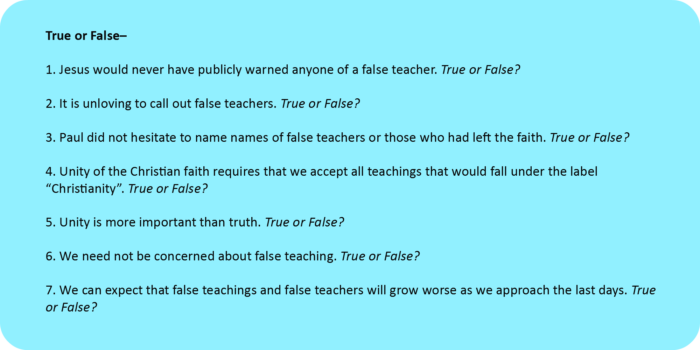
Okay, so do you have your answers in your head? Time to see what scripture has to say…

1. FALSE. Jesus did publicly denounce both the Pharisses and the Sadducees in Matthew 16. He does so again in Matthew 23. In Matthew 15:12-14 Jesus warns his disciples to stay away from the Pharisees–

Then His disciples came and said to Him, “Do You know that the Pharisees were offended when they heard this saying?”13 But He answered and said, “Every plant which My heavenly Father has not planted will be uprooted. 14 Let them alone. They are blind leaders of the blind. And if the blind leads the blind, both will fall into a ditch.”

While Jesus was always extremely kind and loving to those who were lost (such as Zacchaeus and the Samaritan Woman), we know that He treated false teachers–those who would pervert truth–with harshness. He even drove out the money changers and upturned the tables in the temple in righteous anger because these evil men were offending God’s Holy name (Matthew 21:12-13).

It is really important that we know and understand the Jesus of the Bible, rather than get our information from people who claim to “hear personal messages from Him” and describe Jesus from a source from which we have no way of knowing to be true. While that “Jesus” may be more appealing, the Jesus we find in the Bible is the real Jesus. And the real Jesus did not hesitate to call out false teachers.

2. FALSE. Calling out false teachers and making others aware of false teaching is actually one of the most loving things we can do. Think of it like this: If someone is running at top speed towards a cliff, would you just let them fall off the edge without shouting out a warning? Warning of false teachers is no different. Spiritual danger and calamity abounds when we leave the solid ground of sound doctrine and fall off the cliff and on to the hard, jagged rocks of false teaching. True loves calls out a warning. Paul puts it like this in Ephesians 4:14-16:

that we should no longer be children, tossed to and fro and carried about with every wind of doctrine, by the trickery of men, in the cunning craftiness of deceitful plotting, 15 but, speaking the truth in love, may grow up in all things into Him who is the head—Christ— 16 from whom the whole body, joined and knit together by what every joint supplies, according to the effective working by which every part does its share, causes growth of the body for the edifying of itself in love.

These verses make it clear that in order to have healthy growth in the body of Christ, we must hold truth in high esteem. Otherwise, we will be misguided and deceived by the trickery of men and carried away by false doctrine. This will lead to division and strife (which is exactly what we are seeing take place today).

And I John 3:18 confirms this, as well:

My little children, let us not love in word or in tongue, but in deed and in truth.

Speaking the truth is how we show love. Another example would be this: Let’s say your best friend finds out that your husband is having an affair. What is the most loving thing for her to do? Simply ignore it and pretend it isn’t happening? Is this what a loving friend who cares about you would do? Of course not. True friends tell the truth because they care more about the long-term ramifications and devastating consequences that will affect their friend than they care about the short-term hurt feelings and unpleasantness that may result from speaking the truth.

And I Timothy 3:3-6 clarifies and confirms this even further–

As I urged you when I went into Macedonia—remain in Ephesus that you may charge some that they teach no other doctrine, nor give heed to fables and endless genealogies, which cause disputes rather than godly edification which is in faith. Now the purpose of the commandment is love from a pure heart, from a good conscience, and from sincere faith, from which some, having strayed, have turned aside to idle talk, desiring to be teachers of the law, understanding neither what they say nor the things which they affirm.

Real division and disputes are caused by those who bring in the false teaching. Not by those who lovingly confront it. How backwards and upside down the church has become. We have swallowed unbiblical, politically-correct thinking “hook, line, and sinker”.

3. TRUE. We have several examples of Paul naming names in scripture. See 2 Timothy 1:15 and 4:14. Another example is 2 Timothy 2:16-18–

And their message will spread like cancer. Hymenaeus and Philetus are of this sort, 18 who have strayed concerning the truth, saying that the resurrection is already past; and they overthrow the faith of some.

We also see that John was unafraid to call out a false teacher in 3 John, verses 9-10:

I wrote to the church, but Diotrephes, who loves to have the preeminence among them, does not receive us. 10 Therefore, if I come, I will call to mind his deeds which he does, prating against us with malicious words. And not content with that, he himself does not receive the brethren, and forbids those who wish to, putting them out of the church.

If we have several examples of this in the scriptures from Jesus, Paul, and John, shouldn’t we naturally assume that it is not sinful to call out a false teacher? In fact, should we not consider it our duty? Let’s look at a few verses that command us to call out false teaching and false teachers–

Ephesians 5:11  And have no fellowship with the unfruitful works of darkness, but rather expose them.

Romans 16:17-18 Now I urge you, brethren, note those who cause divisions and offenses, contrary to the doctrine which you learned, and avoid them. 18 For those who are such do not serve our Lord Jesus[d] Christ, but their own belly, and by smooth words and flattering speech deceive the hearts of the simple.

Jude 3-4 Beloved, while I was very diligent to write to you concerning our common salvation, I found it necessary to write to you exhorting you to contend earnestly for the faith which was once for all delivered to the saints. For certain men have crept in unnoticed, who long ago were marked out for this condemnation, ungodly men, who turn the grace of our God into lewdness and deny the only Lord God[b] and our Lord Jesus Christ.

4. FALSE. We are not to accept every wave of doctrine so that we can preserve unity. We can see this from the verses right above. We also know that Scripture teaches that true unity can only be protected by keeping our doctrine pure. I Timothy 6:3-5 says this:

If anyone teaches otherwise and does not consent to wholesome words, even the words of our Lord Jesus Christ, and to the doctrine which accords with godliness, he is proud, knowing nothing, but is obsessed with disputes and arguments over words, from which come envy, strife, reviling, evil suspicions, useless wranglings[a] of men of corrupt minds and destitute of the truth, who suppose that godliness is a means of gain. From such withdraw yourself.

From such withdraw yourself. Notice it does not say “unify with” or “compromise”. Instead it says we are to withdraw ourselves from those who do not teach the truth.

5. FALSE. We know that unity cannot be more important than truth, because Jesus Himself says this in Luke 12:49-53:

I came to send fire on the earth, and how I wish it were already kindled! 50 But I have a baptism to be baptized with, and how distressed I am till it is accomplished! 51 Do you suppose that I came to give peace on earth? I tell you, not at all, but rather division. 52 For from now on five in one house will be divided: three against two, and two against three. 53 Father will be divided against son and son against father, mother against daughter and daughter against mother, mother-in-law against her daughter-in-law and daughter-in-law against her mother-in-law.

If unity were more important, He would never have said such a thing. But from these verses we can also realize that there are two paths that can never be unified. They are in complete opposition to one another and go two completely different directions. This is further confirmed in Matthew 7:13-14, where Jesus contrasts the narrow way with the broad way of destruction:

Enter by the narrow gate; for wide is the gate and broad is the way that leads to destruction, and there are many who go in by it. 14 Because[a] narrow is the gate and difficult is the way which leads to life, and there are few who find it.

From these verses, we know that there is the path of truth and there is the path of falsehood and destruction and the two can never be unified. Therefore, truth will always have to trump the false unity that comes from compromising with unbiblical teaching. Compromised doctrine or teaching will automatically lead people to the broad road of destruction. Just as a drop of poison contaminates a clear glass of water, so even a drop of false teaching leads people away from the narrow path.

6. FALSE. I am not sure how so many passages on false teaching can be so intentionally ignored, but the Bible is clear in a number of places that false teaching is a very real thing and that we must be concerned about it–

I John 4:1-3 Beloved, do not believe every spirit, but test the spirits, whether they are of God; because many false prophets have gone out into the world. By this you know the Spirit of God: Every spirit that confesses that Jesus Christ has come in the flesh is of God, and every spirit that does not confess that[a] Jesus Christ has come in the flesh is not of God. And this is the spirit of the Antichrist, which you have heard was coming, and is now already in the world.

2 Peter 2:1-3 But there were also false prophets among the people, even as there will be false teachers among you, who will secretly bring in destructive heresies, even denying the Lord who bought them, and bring on themselves swift destruction. And many will follow their destructive ways, because of whom the way of truth will be blasphemed. By covetousness they will exploit you with deceptive words; for a long time their judgment has not been idle, and their destruction does[a] not slumber.

2 Corinthians 11:12-15 But what I do, I will also continue to do, that I may cut off the opportunity from those who desire an opportunity to be regarded just as we are in the things of which they boast. 13 For such are false apostles, deceitful workers, transforming themselves into apostles of Christ. 14 And no wonder! For Satan himself transforms himself into an angel of light. 15 Therefore it is no great thing if his ministers also transform themselves into ministers of righteousness, whose end will be according to their works.

Matthew 7:15-20 Beware of false prophets, who come to you in sheep’s clothing, but inwardly they are ravenous wolves. 16 You will know them by their fruits. Do men gather grapes from thornbushes or figs from thistles? 17 Even so, every good tree bears good fruit, but a bad tree bears bad fruit. 18 A good tree cannot bear bad fruit, nor can a bad tree bear good fruit. 19 Every tree that does not bear good fruit is cut down and thrown into the fire. 20 Therefore by their fruits you will know them.

I Thessalonians 5:21-22 Test all things; hold fast what is good. 22 Abstain from every form of evil.

7. TRUE. We do know that false teaching will continue to grow as we approach the last days, since the Bible makes this very clear–

Matthew 24:23-25 Then if anyone says to you, ‘Look, here is the Christ!’ or ‘There!’ do not believe it. 24 For false christs and false prophets will rise and show great signs and wonders to deceive, if possible, even the elect. 25 See, I have told you beforehand.

2 Timothy 3:1-7 But know this, that in the last days perilous times will come: For men will be lovers of themselves, lovers of money, boasters, proud, blasphemers, disobedient to parents, unthankful, unholy, unloving, unforgiving, slanderers, without self-control, brutal, despisers of good, traitors, headstrong, haughty, lovers of pleasure rather than lovers of God, having a form of godliness but denying its power. And from such people turn away! For of this sort are those who creep into households and make captives of gullible women loaded down with sins, led away by various lusts, always learning and never able to come to the knowledge of the truth.

2 Timothy 3:13-15 But evil men and impostors will grow worse and worse, deceiving and being deceived. 14 But you must continue in the things which you have learned and been assured of, knowing from whom you have learned them, 15 and that from childhood you have known the Holy Scriptures, which are able to make you wise for salvation through faith which is in Christ Jesus.


This is not my normal kind of post. However, it is my prayer that this post will not only help those who honestly want to know what the Bible says about false teachers, but that it can also be bookmarked and used as a reference for those of you who are faced with accusations that you are being divisive and unkind and unloving when you call out a false teacher. The verses above should bolster and encourage us when we are ready to cave or to just be quiet. God’s Word reminds us that we are doing the right thing by calling out false teaching and false teachers.

More and more, people will throw accusations as you seek to protect and defend God and the truth of His Word. They will marginalize you, call you names, and be angry with you. But we must be like soldiers and put on our spiritual armor (Ephesians 6:13f). We must be filled with love and grace as we fight, but we cannot back down. It takes a great deal of courage but God is faithful and He will give us the strength and boldness we need. Keep up the good fight, dear readers. Keep up the good fight.




The Smallest Crack

If you live in the country you know that mice can get in the smallest, teeniest, tiniest crack there is. They can slip under a door or scurry through a small hole in the wall. They will find any area that has not been sealed properly. Even when you think you have everything boarded up tight, you will find that mice will often find a way in. Especially in the fall when it’s starting to get cold.

As I was finishing up the final chapter of a *Bible Study based on the book of James last week, there was a list of questions given at the end that made me realize that pride is just like that mouse. It slips in quietly, often unnoticed, in the unsealed places of our hearts and minds. We had spent the last several chapters of the study learning about biblical humility and pride. James does not mince words, as we can see in chapter 4, verses 6–

But He gives more grace. Therefore He says:

“God resists the proud,
But gives grace to the humble.”

God resists the proud. And He gives grace to the humble. We already know this. But have we given thought recently to just how pride will slip in through even the smallest crack in our spiritual armor? It slithers in unbeknownst to us while we are patting ourselves on the back for not being prideful. It slides down into our hearts when we are least expecting it. Compliments and applaud and rewards make us even more vulnerable.

The more I study the Bible, the more I understand these three things: 1) how much God hates pride 2) just how deadly pride is to godly, righteous living and 3) how susceptible I am to it at all times.

As I worked on that final chapter and read through those questions, I thought that you all might appreciate this, as well. I think these questions are very revealing. They help us understand that pride isn’t simply boasting or having an arrogant attitude. It is so very much more than that, as we will see by this list of questions. At the end of the final chapter of his Bible Study on James, Steve Pettit says this–

Sometimes we view humility as the absence of outrageous vanity and boasting. But evaluating our pride should go much deeper than such surface observations. Consider the following questions (I have added a few comments in parentheses):

1.  Am I a critical person?

2. Do I regularly question authority?

3. Do I make fun of weaker, less privileged people?

4. Do I treat people differently based on their status? (Or on their wealth or their position in the company where I work or their leadership role at church?)

5. Am I dissatisfied with God’s Word as sufficient for life and godliness? (Or do I crave a supernatural experience that will make me feel special and important?)

6. Do I make plans without making the Lord the center of my life?

7. Do I shift blame instead of taking responsibility for my actions? (Do I get defensive if someone confronts me?)

8. Do I widely proclaim my views but rarely listen? (At home, at work, at church, on the sidelines–am I more concerned with being heard or with hearing others?)

9. Do I hold grudges instead of extending forgiveness?

10. Do I put up a front instead of confessing my faults to those who can help? (Do I confess my sins to God? To others? Am I willing to humbly apologize?)

11. Do I pray sparingly? (Lack of prayer indicates that we believe we can do life on our own.)

I don’t know about you, but this is quite a list! How did you do? Were you as convicted as me?? Does this list help you recognize that pride is something very real in your life? That it has seeped into the cracks of your armor–even when you didn’t realize it? Like that tiny mouse or a slithering poisonous snake, it slides through the smallest crack and takes up residence in our heart before we even know it.

Pettit gives this final paragraph–

The point of these questions is not to drive you to simply to do better. Answering yes to some of these questions is the first step toward repentance and receiving God’s grace, because a humble person is honest. He understands what David confessed–that God wants us to have integrity in our hearts (Psalm 51:6). Recognizing spiritual unfaithfulness and pride does not mean we pull ourselves up by our own bootstraps. It means running to Christ for superabundant grace. It means humbling ourselves to get back on the path of wisdom from above.

We have to face the fact that we can’t fix ourselves. In this day and age of self-help, we think we should be able to. Removing ourselves from the path of earthly, human wisdom means discarding our pride and putting on humility, recognizing that only God can give us the grace and strength we need for permanent change and righteous living.

And then we must remain in the Word and keep our eyes open because that deadly pride will slip in through the cracks once again, as soon as we leave even the slightest chink in our armor. We will see it when we argue with our spouse. It will crop up when someone criticizes something we did. And when we are tempted to criticize someone else. It rears its ugly head when we are hurt and rejected, when someone tells us what to do, when someone compliments us, or when we get too busy to pray. It is a constant danger to all believers and we must be on the lookout at all times.

So, over the next few days, let’s reflect on how pride tends to manifest itself in our own lives. Let’s ask the Lord to grow us in humility. Let’s be sure to keep our spiritual armor on (Ephesians 6:10-20), so that we may withstand those arrows of temptation thrown at us every day. And let’s thoroughly and regularly examine our spiritual armor for chinks and gaps so that– while we are busy defending ourselves from the “bigger sins”–pride doesn’t slip in, quiet as a mouse, and take up residence in our hearts.


*From Wisdom from Above: A Study in James by Steve Pettit

An Unpleasant and Unpopular Truth

Narrow is the way

God, through the writing of Paul, gives us such a clear picture of what an unregenerate soul looks like. This is especially clear in the third chapter of Titus, but we find it in many other passages, as well.

I find it curious that–while this is so clear in scripture–so few pastors and teachers are willing to teach that this kind of life would indicate that someone is in danger of hellfire. It would appear that, if someone professes with their mouth that they are saved and yet has no fruit to back up that profession, we have adopted a “hands-off” approach, yielding to the politically-correct dogma that would teach that to challenge their profession of faith would be to demean, belittle, or even hate them.

But could anything be further from the truth? Wouldn’t the most loving thing to do in a situation like this be to show them the truth from God’s Word? Let’s take a look at how the Word describes unbelievers and believers. (When describing unbelievers it refers to ingrained patterns of behavior where there is no conviction, no confession, and no repentance and where there is no effort to remove oneself from temptation or the sinning behavior. Keep in mind that no person–believers included–can ever be sinless. The key is the battle. True believers hate sin and continue to fight it, always working, through the power of the Holy Spirit, to grow in their sanctification and holiness.)

Okay, let’s take a look at some of these passages–

For we ourselves were once foolish, disobedient, led astray, slaves to various passions and pleasures, passing our days in malice and envy, hated by others and hating one another. (Titus 3:3)

The unregenerate are foolish, disobedient, easily led astray, and slaves to various passions and pleasures. They pass their days in malice and envy. They are hated by others and they hate one another.

This is how the Word describes us before we are saved. As unpleasant as it is to contemplate, we have to admit that if someone lives like this–day in and day out–without any conviction or desire to change, we have to recognize that they are probably not saved, no matter what they say with their mouth. True belief is always revealed by actions.

Let’s think of this in terms of a marriage. If a husband says he loves his wife but then he cheats on her and abuses her and fills their home with the things she hates, then we have to conclude that he is only saying the words but doesn’t really mean them. His actions have not backed up his words.

Let’s go back to Titus 3. After describing the unredeemed, Paul then goes on to pen these verses–

But when the goodness and loving kindness of God our Savior appeared, he saved us, not because of works done by us in righteousness, but according to his own mercy, by the washing of regeneration and renewal of the Holy Spirit, whom he poured out on us richly through Jesus Christ our Savior, so that being justified by his grace we might become heirs according to the hope of eternal life. (Titus 3:4-7)

This is the difference that Jesus makes! Isn’t this a beautiful thought? We are redeemed and changed through God’s transforming power!

When we minimize the transformation of a saved soul through the blood of Jesus Christ and the power of the Holy Spirit we diminish the miraculous and radical thing that salvation really is. When we don’t expect someone to grow or we nonchalantly classify someone as “definitely saved” when they give no evidence of it, we belittle the work that Jesus Christ did on the cross.

Let’s look at a few more verses that would indicate the differences between believers and unbelievers. I can think of no better place to go for this than Galatians 5:16-24–

But I say, walk by the Spirit, and you will not gratify the desires of the flesh. 17 For the desires of the flesh are against the Spirit, and the desires of the Spirit are against the flesh, for these are opposed to each other, to keep you from doing the things you want to do. 18 But if you are led by the Spirit, you are not under the law. 19 Now the works of the flesh are evident: sexual immorality, impurity, sensuality, 20 idolatry, sorcery, enmity, strife, jealousy, fits of anger, rivalries, dissensions, divisions, 21 envy,[d] drunkenness, orgies, and things like these. I warn you, as I warned you before, that those who do[e] such things will not inherit the kingdom of God. 22 But the fruit of the Spirit is love, joy, peace, patience, kindness, goodness, faithfulness, 23 gentleness, self-control; against such things there is no law. 24 And those who belong to Christ Jesus have crucified the flesh with its passions and desires.

Here we find a long and comprehensive list of the sins of the flesh. This whole list–like it or not–describes the unregenerate. How do I know this for sure? It is in verse 22 with that little word “but” where we can see that the fruits of the Spirit are in total opposition to the works of the flesh. Verse 24 clarifies further: And those who belong to Christ Jesus have crucified the flesh with its passions and desires. This is what believers do–we have crucified, we continue to daily crucify–the flesh. Any person who isn’t willingly doing this or isn’t even slightly interested in doing this is giving evidence that they very well may not be saved.

Look–I don’t take joy out of saying this. I wish it were different. But this is what the Word of God says. I know that this is an extremely unpopular message in today’s church. I do get that. In fact, just yesterday I saw a post by a very popular “Christian” blogger who declared on Twitter that she could never serve a God who would send most everyone to hell. The comment thread that followed made anyone who did believe in what the Bible teaches about hell look ridiculously archaic and incredibly stupid.

But should unpopularity keep us from speaking the truth as we find it in the Bible?

Galatians 5 would indicate that after we are saved and the Holy Spirit indwells us, our lives should increasingly show the fruits of the Spirit which are love, joy, peace, patience, kindness, goodness, faithfulness, gentleness, and self-control.

Now none of us exhibit these fruits perfectly. And none of us live our new life in Christ without fighting some of these sins of the flesh. Some of us have victory in one of these areas, while others remain a lifelong challenge for us. But remember–the key is in the battle. This is the sin nature and we know that we will fight this battle against sin until the day we die (Romans 7:18-25). While this can be a discouraging thought, we also have these marvelous promises–

Romans 6:6Knowing this, that our old man is crucified with Him, that the body of sin might be destroyed, that henceforth we should not serve sin.

2 Corinthians 5:17Therefore if any man be in Christ, he is a new creature: old things are passed away; behold, all things are become new.

Philippians 1:6Being confident of this very thing, that He which hath begun a good work in you will perform [it] until the day of Jesus Christ:

The battle with sin may be always with us but we never have to serve sin again. We have a new Master who walks with us, works in us for His glory, and we are new creatures living for God.

One who is regenerated gives evidence of this in their life. The one who is not saved lives for himself/herself.

How many people claim the name of Christ today and yet live wholly and fully for themselves? How many say they walked the aisle or said a prayer and yet haven’t given any evidence of a transformed life in Christ? The numbers that fall into this category are staggering. And yet, somehow, the church has sanctioned this and would criticize not the hypocrite but those who would reveal this tragic truth that is clearly taught in scripture (Matthew 7:15-20).

I would like to just add one final thing as I close and this is a really important aspect of this conversation: None of us knows what is going on in the heart of any person. Only God knows. I would never–and you should never–tell someone they aren’t saved. There is no possible way for us to know this and that is God’s job. But what we can do is lovingly point them to what God’s Word says about their lifestyle, behavior, or actions. We can pray for opportunities to talk with them about their lack of fruit or disinterest in living a holy life. We can open our eyes to the possibility that they might not be saved and begin diligently praying for them instead of living in the comfortable place of naive assumptions.

Because the stakes are high. So high.

We know of this danger because Jesus Christ makes it clear for us in these verses–

Matthew 7:14 For the gate is narrow and the way is hard that leads to life, and those who find it are few.

Matthew 7:21-23 Not everyone who says to me, ‘Lord, Lord,’ will enter the kingdom of heaven, but the one who does the will of my Father who is in heaven. 22 On that day many will say to me, ‘Lord, Lord, did we not prophesy in your name, and cast out demons in your name, and do many mighty works in your name?’ 23 And then will I declare to them, ‘I never knew you; depart from me, you workers of lawlessness.’

There are few sadder verses in scripture than these. Let’s take them to heart, dear reader. Not only for ourselves but for those we love. We never want to leave unsaid what could have–and should have– been said. Life is so fragile. I have become more aware of that than ever these last few weeks. When our loved ones are snatched away by that great thief, Death, we don’t want to be left with uncertainty when we ask that final question: Where are they now?


How to Have a Productive Quiet Time

As believers, we recognize the value of a quiet time each day with the Lord. While we aren’t commanded anywhere specifically to have this time, the Bible does tell us to meditate on and to delight in the Word (Psalm 1:2; Psalm 19; Psalm 119) and to spend time in our closets in prayer (Matthew 6:6).

From the time I was a little child, I remember being encouraged to have my “devotions”, in which I would read from a book that would give a few verses and then a paragraph or two about those verses. The older I got, the more I recognized that many of those devotional books aren’t real meat. While there isn’t anything wrong with some of them, they are more like a dessert. Most aren’t giving enough scripture to be the meat we need for our sustenance as a growing believer. But they are easier and so we like them. We can read the portion for the day and then check “quiet time” off our day’s to-do list.

It wasn’t until I started reading the actual Bible every day that I started to really grow. But, let’s be honest, Satan doesn’t want us in the Word. Since the power for life and godliness is within its pages, he wants to do all he can to keep us out of it. Biblical illiteracy and neglect renders us ineffective for Jesus Christ’s purposes and it often keeps us imprisoned by sin. (For those of us who would point fingers at the “obvious” sins, don’t forget that a complaining or anxious or selfish heart is also sin…very real temptations for all of us!)

And so as we start studying the Word in a deeper way and spending more time in prayer, what can we do to make sure our quiet time is as productive as possible? I thought I would break this down a bit today and offer a few helpful suggestions. Interestingly enough, this post is born out of my own distractions the other day. I started thinking about this while I was supposed to be having my quiet time!! Anyway…here are six things that may be keeping us from having the best quiet time we can have–

1. Life

Life is just busy. Sports schedules, workouts and training, committee meetings, church activities, jobs–all of these can wear us out and distract us from our relationship with the Lord. If we have preschool or home-schooled children, it can add a whole different dynamic to this idea of finding a half hour to dedicate to this. How do we keep from being distracted by life duties and pressures? Here are a few suggestions–

First, plan a time. Morning, evening, afternoon–it doesn’t really matter. But plan it like you plan your workout or coffee with a friend or your favorite TV show. If you say you don’t have time, then I encourage you to examine your schedule to see what you can eliminate. Nothing should be more important than this. Sure, some of us are temporarily caught up in a whirlwind of activity beyond our control, but that is not the case for most of us. If you have kids at home, designate a quiet time for all of you. I did this when I home-schooled and it became the hour that energized me for the rest of the day. At 1pm every day the children would go to their rooms. They didn’t have to sleep but they did have to look at or read books or quietly rest. And then I would have my quiet time. Or at least that was the idea–but, instead, I’d often be distracted by my “to-do” list. Which leads me to…

Second, make your time with the Lord a priority. Recognize the value in spending time with Him and realize that whatever is calling your name is not more important than your time with Him. I look back and can see this now. I hope I can encourage you to not make the same mistake I did!

2. Feelings

Feelings can be SO deceiving. And think of how often we obey them! We think if we don’t feel like praying or getting in the Word, then it is perfectly fine not to do so. I struggle with this so much. And, yet, I find that when I ignore my feelings and do it anyway, my feelings soon tag along afterwards and I am so glad that I moved ahead and did the right thing, despite my feelings. This is worthy of a blog post alone because this is what is driving so many choices regarding all of life! If we can say NO to our feelings and YES to doing the right thing, we will have won a HUGE victory in our battle with the flesh.

3. Technology

Have you ever been in the middle of praying when suddenly you hear that little ding or buzz go off on the table beside you? Your curiosity drives you to look at your phone–interrupting your prayer time. Or perhaps you are reading scripture and it brings something to mind you want to look up…and since your phone or tablet is right beside you and you can look anything up at any time…

I confess that this is something I really struggle with. I have learned it is best for me to keep my phone and iPad in a different room when I am praying and reading my Bible every morning.

Technology is a wonderful thing, but it is also a very exacting taskmaster. We have become enslaved to our phones and instant communication. We believe it is our responsibility to be available to everyone at all times. But will the world really stop if we don’t respond for 30 minutes?

This is such a struggle for me. Did I mention that? Sometimes I really long for the old days–at least when it comes to having my quiet time…

4. Self-Absorption

Track with me here as I unpack this one. I have recognized that my quiet time can often be overtaken by my absorption with myself. Whether it’s reading the scripture, greedily searching for some personal comfort or it’s my prayer time being consumed with my own selfish desires, I find I quickly fall into the trap of selfishness during my quiet time. This attitude will keep me from having a productive quiet time. A truly quality quiet time has us humble and yielded before the Lord with a heart that desires to obey. Coming before the Lord with a prideful, greedy, selfish heart will keep us from having a close relationship with the Lord–no matter how many hours we may spend with Him.

5. Sinful Attitudes

This is a bit similar to #4 but I don’t think we always see that. When we come to our quiet time with an unforgiving heart or with a grudge against someone, we are putting a wall up between us and the Lord. Walls are also built by our anxious heart (we are saying with our actions that we don’t trust the Lord), our envious or jealous heart (we are discontent with what the Lord has provided), and our prideful heart (we are saying we don’t need the Lord). These things keep us from drawing near to the Lord in spirit, even if we are physically sitting and reading the Bible.

6. Improper View of God and Man

Okay, so this is a little deeper theologically than the others, but please keep reading. I think this is really important. This really encompasses all of the above.

I believe we are often kept from a productive quiet time because we don’t really know God. We don’t give any thought to the fact that He is omnipotent (all-powerful), omniscient (all-knowing), immutable (never-changing), and absolutely sovereign. We don’t have a big enough view of Him and we treat Him like a casual friend. Yes, He is our friend but He is so much more than that! He is God! We should have reverence and godly fear when we approach Him.

And, then, we have a wrong view of self. We have nothing to offer God. We couldn’t even live and breathe if God didn’t allow it. We must recognize our dependence upon God for every single thing. Realizing this naturally changes how we approach scripture and prayer.

Having a proper view of God and self are so critical to a thriving and vibrant walk with the Lord. And proper views will help us navigate and eliminate the first five items on this list.

Well…

That was a lot to take in, wasn’t it? But I hope that this list of six things may give you some ideas on improving your quiet time. I know it really made me think as I wrote it. If we love God and we want to walk as closely with Him as possible, it is imperative that we make our quiet time as productive as we possibly can.


How Do I Respond to My Enemies?

So often Christians find themselves at odd with other Christians. There will be two true believers who just do not agree. Whether it’s a disagreement over something as simple as a remodeling project at church or it’s a deeper issue of how a certain scripture passage should be interpreted, we will always find someone that we will disagree with about something.

What keeps two people who disagree with each other from being enemies? What brings true Christian unity?

Please keep in mind that this post is referring to unity between true believers and not to the “fake” unity that warmly embraces all perversions of the Gospel and even religions that don’t adhere to the Gospel at all to be unified under the broad term of “Christianity”. We know that this kind of unity is not biblical, according to Galatians 1:9–

As we have said before, so now I say again, if anyone preaches any other gospel to you than what you have received, let him be accursed.

But there is something that is called true, Christian unity. This unity can only exist between brothers and sisters in Christ. This kind of unity keeps us moving toward the same goals and embracing the same purpose. This unity builds bridges instead of walls. It will fill Christians with loving concern for one another instead of filling them with grudges, resentment, and jealousy.

This sounds so wonderful, doesn’t it? But it is often hard to find. Why is this?

Why does someone decide they do not like someone?

Sometimes we don’t care for someone based on a shallow, silly thing. And then there are also better reasons, based on things like biblical error or a prideful, arrogant spirit that is consistently divisive.

But we have to ask ourselves: Are any of these reasons good enough? If you were to stand before God today and tell Him your reason for not liking a certain person, would He say, “Way to go, my child. I agree with you completely.” ??

Of course we know the answer, don’t we? Because we know that God is love. We shouldn’t view anyone as an enemy, much less a brother or sister in Christ.

Romans 12:8 puts it like this–

If it is possible, as much as depends on you, live peaceably with all men.

We should, to the best of our ability, work at being at peace with everyone, believer and non-believer. This verse naturally brings two thoughts to my mind.

First, what if someone won’t be at unity with me?

Of course, since we know that the world will hate us (John 15:19), we know that it isn’t always possible to be at peace with those in the world. But sometimes it is a fellow Christian who refuses to forgive us. Or perhaps they just don’t like us but won’t tell us why. What then? These kinds of situations are heart-breaking and lead to feelings of helplessness as we try to navigate the back-biting, the whispering, and the cold shoulders.

I have a friend who taught me an important lesson about this very thing. Our daughters were playing soccer together and something happened to her little girl that could have started some real drama on the team. And this was her advice to her daughter, “kill them with kindness”. I heard her say that so often when her daughter would feel slighted or frustrated about something. And then, following her example, I started to say this to my kids. Yes, this is what we are called to do.

In fact, Jesus takes it even further in Matthew 5:43-44, telling us to love them, bless them, do good to them, and to pray for them!–

You have heard that it was said, ‘You shall love your neighbor and hate your enemy.’ 44 But I say to you, love your enemies, bless those who curse you, do good to those who hate you, and pray for those who spitefully use you and persecute you.

This is a tall order, is it not? But there it is. Commanded by Jesus in the Holy Bible. Instead of gossiping, instead of returning the coldness, instead of resentment or anger, we love, we bless, we do good things, and we pray for them.

But we do this because it is right, not because it will necessarily change anything. Let’s go back to the beginning of Romans 12:18–

“if it is possible, as much as it depends on you”

We know from these words that Paul realized it isn’t always possible. It is part of living life as a sinner, alongside sinners, in a fallen world. Sometimes we just have to follow Jesus’s words and find contentment even when there is no resolution and no forgiveness. A hard thing, indeed. But, you know what? This is just another thing that God uses to grow us and to teach us that we must find our peace and joy in Him alone.

Second, we won’t be best friends with everyone.

Even among truly unified Christian brothers and sisters, there will be those who are “kindred spirits” and those who are not. And that’s okay. But so often special friendships between Christians are viewed with resentment or jealousy. As believers we should realize that we will be better friends with some than others. It is how God designed us. Remember David and Jonathan? If you read I Samuel 18, you will realize that their friendship was very special. Once in a while, God will bring these special Christian friends into our world. They are true treasures and, instead of feeling jealous, we should be glad for others if they have found a special friend.

If we are still longing for this type of friendship, then pray and ask God to bring you a friend. I remember as a young mom feeling the need for this type of friend and so, unbeknownst to me, my mom started praying. And within a year or so of her prayers, God led me to Deb. We realized we were kindred spirits as we sat in a group of women and chatted and, shortly after, became best friends. Don’t underestimate the power of prayer if you need a friend!

And then there are those fellow Christians in our lives who could never be a kindred spirit. In fact, some of them drive us a little crazy. We may feel guilty if we don’t appreciate a Christian brother or sister like we know we should. What then?

God made us all different and certain personalities may grate on us. We may find them hard to get along with or their mannerisms alone might irritate us. They may be boastful or arrogant.

But if we take a look at Philippians 2:1-2, we have to acknowledge that God doesn’t give us any caveat for difficult people–

Therefore if there is any consolation in Christ, if any comfort of love, if any fellowship of the Spirit, if any affection and mercy, fulfill my joy by being like-minded, having the same love, being of one accord, of one mind.

We are to be like-minded with all Christians–as much as it depends on us. We obviously can’t control the other person.

So how do we do this? How can we be like-minded? These verses show us–we have the same love, the same accord, the same mind as our fellow Christians. This can only be done if we are diligently studying the scriptures together, submitting our desires and wills to God, joyfully obeying the commands we find there, while increasing our knowledge of God. When people are not getting along, it often goes back to this. Biblical illiteracy once again rears its ugly head in church matters.

And, along with knowing God’s Word, we find the oil that keeps things working together smoothly in Colossians 3:14–

And over all these virtues put on love, which binds them all together in perfect unity.

I Corinthians 13:4-6 gives us a description of this love that will break down barriers and bind Christians together in perfect unity–

Love is patient, love is kind. It does not envy, it does not boast, it is not proud. It does not dishonor others, it is not self-seeking, it is not easily angered, it keeps no record of wrongs. Love does not delight in evil but rejoices with the truth. It always protects, always trusts, always hopes, always perseveres.

And I Peter 4:8 is further confirmation of this idea that love will bring unity–

Above all, love each other deeply, because love covers over a multitude of sins.

Even when we don’t particularly appreciate a fellow Christian, we can love them. We are commanded to love them. And we should thank the Lord for them, for they are helping us to grow in patience and self-control!

Enemies are just part of life. If we are going to take any stand at all on the things that matter, we will have enemies. We cannot control how they treat us, but we can control how we treat them. And let’s intentionally work at not having needless enemies. We must back away from the stuff that doesn’t matter. Will it matter in a hundred years what color carpet is used in the church? Is a slight difference in how someone interprets the book of Revelation really a cause for division? Let’s wisely and, oh so carefully, choose our battles. Most hills we choose to stand on are just not worth dying on. We don’t always have to be right. We don’t always have to have our way. So often it just doesn’t matter.

And most of all, when we find ourselves in the midst of a heated disagreement with a fellow Christian or facing a full-blown enemy, then let’s love them. Love them, bless them, do good to them, and pray for them. If you don’t remember anything else from this post, I hope you will remember these words of Jesus.


How Do You Listen to Gossip?

Have you ever had one of those conversations where you are talking about a TV show like it’s really happening? The people, the situations, the happenings? I had one of those the other day and as I walked away from that conversation, I realized that we often have more loyalty for and kindness and grace towards people on TV.

I know it seems silly to even compare the two, since we are obviously personally affected by real people so that makes all the difference in the world, but it does seem sad that we can keep so level-headed and impartial when discussing TV friends and completely lose that when discussing real people.

Of course, we shouldn’t really be discussing real people most of the time. Sure, there are instances where we need to work through a problem with a trusted, godly friend or mentor, but, overall, we should not be talking about people. Ephesians 4:29 says this: Let no corrupt word proceed out of your mouth, but what is good for necessary edification, that it may impart grace to the hearers.

But this is not a post about spreading or speaking gossip. It’s a post about listening to gossip and our subsequent actions after we’ve heard it.

So many of us hear will listen to someone talk about someone and, instead of defending them or kindly asking them to stop, we will just jump right in and join the conversation. Or we will listen without speaking while making assumptions that will change our friendship with the person being spoken about. There is no grace. No kindness. No loyalty.

Or perhaps someone will talk about someone behind their back, telling you terrible things that person said about you. What do you do? Do you do what you should?

This happened to friends of ours. But let me first give some background. We had made a really, really tough decision after much prayer and agony. Because of the nature of the decision, there were many rumors flying around about us and lies told. We know of at least three specific lies that were told about us that made their way to our ears “through the grapevine”.

But only one couple actually loved us enough to call us. The wife called and asked us specifically if we had said such-and-such about them. My heart sank when I realized that someone I had trusted had said such a vicious thing about us. But, even in my dismay, I realized that this couple–instead of believing the worst–loved us enough to confront us and ask us about it.

We lost a lot of friends through those swirls of rumors and accusations, but these two remain our friends to this day. They exemplified what true biblical love and friendship are. They didn’t believe the worst about us, as seems to be the natural thing to do, but they bravely went right to the source. They cared enough to ask.

So what do we do when we hear gossip? Do we automatically believe it? Do we jump on the bandwagon and join the fun? Do we internalize it and allow it to create a cool distance with the person who has absolutely no idea what was said behind their back?

We have to be oh, so careful of this, don’t we? So many of us who wouldn’t ever be caught gossiping just aren’t very good at listening to gossip.

So how should we listen to gossip? Let’s see what scripture says–

First, we should view them as innocent until proven guilty. If there is a personal accusation involved, ask them lovingly and kindly if the words spoken are true. If they aren’t, move on. If they are, forgive and move on. Life is just too short for grudges. It really is. (Of course, this is the “simplified model” of relationships and it doesn’t always work. Especially with those who have no evidence of the fruit of the Spirit in their lives.)

Colossians 3:12-14  Therefore, as the elect of God, holy and beloved, put on tender mercies, kindness, humility, meekness, longsuffering; 13 bearing with one another, and forgiving one another, if anyone has a complaint against another; even as Christ forgave you, so you also must do. 14 But above all these things put on love, which is the bond of perfection.

Second, we should not let it affect our relationship with them. Does it really matter? Does it affect you personally? If the answer is no (and most times it is) then just continue your relationship with that person. Remember that you don’t know any of the details at all. You don’t know the situations, the circumstances, the agony, the fear, the anxiety that was all part of that person’s journey to whatever choice they made. Unless it is something that is currently hurting you, them, or others around them, just forget you heard it. We all have done things in the past we aren’t proud of, am I right??

Luke 6:31 And just as you want men to do to you, you also do to them likewise. 

Third, if what you hear is about a Christian involved in sin (such as that person is involved in an affair or addicted to a substance), prayerfully consider speaking to them about it. Talk with a trusted leader in your church or some other godly person you know to ask for their advice.

Galatians 6:1 Brethren, if a man is overtaken in any trespass, you who are spiritual restore such a one in a spirit of gentleness, considering yourself lest you also be tempted.

Fourth, pray for that person. Instead of letting gossip fill your heart with disgust or anger or frustration, let it fill your heart with love and compassion that will remind you to pray. Oh, how often we accuse, examine, and talk about without ever lifting that person up before the throne of Grace.

James 5:16 Confess your trespasses[e] to one another, and pray for one another, that you may be healed. The effective, fervent prayer of a righteous man avails much.

Fifth, and when appropriate, steer the conversation a different way. You be the one to change the course of the discussion. Instead of joining, be the deflector. Instead of listening, be the one who changes the direction.

Proverbs 16:24 Pleasant words are like a honeycomb, Sweetness to the soul and health to the bones.


As always, I offer this post not as someone who has this nailed down but, instead, as a lowly servant of Jesus Christ who still struggles with all of this. As I write, I can see so many weaknesses in my own handling of gossip. God’s Word powerfully convicts you and me to grow in our faith and move beyond the status quo Christianity that so easily ensnares us.

I leave you with these beautiful verses from I Corinthians 13. We most often hear these spoken at weddings, as two people pledge their lives to one another. But perhaps we should read them every day. They remind us of not only the spirit with which we should listen to gossip, but also give us a pattern for how we should treat others in every other way, as well.

Love suffers long and is kind; love does not envy; love does not parade itself, is not puffed up; does not behave rudely, does not seek its own, is not provoked, thinks no evil; does not rejoice in iniquity, but rejoices in the truth; bears all things, believes all things, hopes all things, endures all things.


Scroll to Top