A few weeks ago, I was delighted to return to a church that has welcomed me as a speaker for several years now. This year my topic was about aging and beauty. What exactly does scripture have to say about these things?
The topic was my idea—as I had been wanting to dig into the Bible and see what it has to say about these things for a long time. We hear so many things about this topic but what does the Bible actually have to teach about them? That’s what I wanted to know. And I hoped the ladies at the church would be interested, too. Thankfully, they were! No matter who we are or what age, we women especially, find this topic particularly relevant to our daily lives in one way or another.
This morning, I’d like to share just one point of that presentation. This point has continued to personally cause me much consideration, reflection, and conviction.
There is a little verse at the end of I Corinthians 10 that says—
Whether therefore ye eat, or drink, or whatsoever ye do, do all to the glory of God.
Whatever we do, we are to do to the glory of God. Do ALL to the glory of God.
I don’t know about you, but I find myself doing so many things with myself much more in mind. Our flesh cries out not only for glory, but for love, comfort, convenience, indulgence, popularity, fairness, justice, revenge…to name just a few.
And we make choices with these things in mind. Many times, without even realizing it.
For example…
We may choose not to speak truth because we desire to be loved more than we desire to glorify God.
We may choose to eat too much or buy too much because our flesh wants to be indulged and that’s more important than glorifying God.
We may choose to wear something (or allow our daughter to wear something) that is utterly inappropriate because popularity is more important to us than glorifying God.
We may choose to say something sarcastically or make a snide remark because fairness and revenge take priority over glorifying God.
We may choose to watch, read, or listen to something for so many reasons—popularity, wanting to be liked or loved, indulging our flesh… we have so many reasons (and excuses and rationalizations) as to why we fill our minds with wicked entertainment.
We may… well, you get the idea. It is the nitty gritty of the Christian life. It encompasses life-altering choices and the smallest decisions of every single day.
Do I want to glorify God most? Do my choices and decisions reflect the fact that glorifying God is more important than anything that has to do with ME?
I’ll just be flat-out honest (since those who know me already know this, anyway). The answer to that question is: NO. I don’t.
I’d rather guess that you may have to answer this the same way. We believers are so far from perfect, it’s scary. And we know it, too. It’s why we are so grateful for Jesus. He is perfect so we don’t have to be.
But, that being said, we want to, right? We want to make decisions to glorify God instead of to fulfill some fleshly desire.
And we make more decisions based on this than we used to. We can see how God is growing us and changing us. So we need to be grateful and not wallow in a pit of discouragement. We are not the same people we used to be. Praise be to God, we are not the same as we used to be!
But there is always so much room for improvement, right? The further along we walk in the Christian life, the more we comprehend how far we have to go.
I don’t know if you ever noticed the tagline for Growing4Life. It is “never satisfied with status quo”.
It is so tempting to be satisfied with status quo in our current culture. To just do enough to be considered “Christian” without making any sacrifices; while still fulfilling our flesh.
But this is not what God calls us to. Over and over again in scripture we read of God’s call to deny self, turn from our fleshly desires, offer our bodies as a living sacrifice—to live as a new creature.
We are going upstream in a downstream world. We live a totally different life because God has changed us and is changing us into a totally different person.
I don’t know about you, but I find that I can lean into status quo far too easily and just live day to day without really considering these things. Ignoring verses like I Corinthians 10:31 (not purposefully) as I go about my day to day activities.
That speaking engagement really made me stop short and start paying attention to why I do what I do. And while it has been a rather discouraging exercise, I am thankful. Thankful that the Lord has, yet again, opened my eyes to see myself as I really am.
These things tend to keep us humble and full of grace for others who are on the spiritual battlefield beside us, as we realize we aren’t “all that” and have so much further to go in pleasing our Lord and Savior.
I know this isn’t the feel-good, touchy-feely kind of post that people tend to be drawn to these days. But sometimes we just need to face the cold, hard truth about ourselves, don’t we? Or we will never change. We will never look more like Christ.
Instead, we will be caught up in the endless quagmire of “status quo”, always and only trying to do just enough to be called a “Christian” while still fulfilling our own fleshly desires.
Oh, may this never be said of us. May we never be satisfied with status quo. May we get in the habit of asking the question: What will bring glory to God?
May we keep moving upward and onward, one choice at a time.
Years ago, we used to sing choruses at church on Sunday evenings using an overhead projector. The song leader would shuffle through the transparencies to find the song we would be singing and then lay it on the modern machine (at the time) that made it possible for us all to see the words on the screen in front of us.
One of the choruses we would often sing had this line in it—
God will make a way where there seems to be no way
That line has come to me often throughout my life. Can God make a way where there seems to be no way? Does He do this?
We believers know He most certainly does.
I was listening to a sermon the other day that my brother (Pastor Dean) had preached many years ago. In this sermon, he used an example I’ve been thinking about ever since. He said that as he was traveling one time, a mountain range suddenly rose ahead of him that looked quite impassable. From a distance, no road or way through or over it could be seen. But as he got closer, he saw the narrow road that led right through it. He reminded us that we can’t always see the way ahead of us but we know God will make one.
And then last night, of all things, I read a similar thing in a missionary biography I am currently reading.
The *story tells of three women who undertook the difficult task to get the Gospel out to northwest China and beyond. Their home base was the most inhabited town furthest west in China. But for eight months of the year they would travel, using the centuries old trade routes, to the villages and Gobi desert oases, in which resided hundreds of thousands who had never heard the Gospel.
As they traveled, they once came upon a mountain range that looked entirely impassable. But I’d rather share the author’s words (who is actually one of the women traveling)—
Suddenly, the road had turned up and led up to a towering range through which no outlet could be seen. They had trodden the rough stones of the foot-hills and nearly lost their way among the defiles [meaning: narrow passes or gorges], before the narrow opening of the mountain pass had come into sight. Now they suddenly emerged and saw all that lay behind in true perspective. The clearly marked road, which close at hand had been so hard to trace, was now quite unmistakable. Ahead, too, there was a way, though they could not quite see where it led. That matter nothing; the fiery, cloudy pillar had guided thus far and it was easy to rest in confidence for the future. *
As I have been reflecting on these very similar accounts of facing what looks to be an impassable mountain, I’ve been thinking about three things especially.
First, from a distance, we so often can’t see the “way”. To our dim eyes, we cannot see how we could possibly get through the trial that looms in front of us. Or that issue that has no solution. And yet, we just take the next step. We do the next right thing. And, eventually, God reveals the path we couldn’t see from a distance.
Sometimes, we get to the other side and we look back, not even knowing each single step was slowly leading us through. We thought we were still on the other side and here we had traversed through the mountain to the other side.
Other times, every step we take is hard and laborious. It feels like it will never end. But we cannot look forward to what life will be like a hundred steps down the road but, rather, need to keep taking the single step that is right in front of us.
Life becomes overwhelming when we look too far down the road. As the author wrote: God had guided thus far and that gives us confidence for the future.
I can think of things like that in my life. I really wondered how I would get through. And yet I did get through. Thanks to the Lord, I did walk through some very deep valleys and difficult trials, one step at a time.
You have had your own deep valleys and difficult trials. I’d rather guess many of you have had harder days than I can even imagine. But, even then, God is faithful to comfort and guide. It is the testimony I hear over and over again from those who, in faith and in submission to His will, have turned to God in their troubles.
Second, we can tend to make the mountains ranges about US. If we aren’t careful, we become self-centered as we traverse through our trials and troubles, And while there will always be something for us to learn in any trial, we must remember that God’s purposes are so intertwined and interwoven that He will have purposes and plans for our trial that far exceed it’s impact on just our life.
It is hard to imagine how many souls will be in heaven because of the testimony of a dying Christian. Or how much spiritual growth has taken place because of a believer watching another believer humbly and faithfully walk with God through an unimaginable trial.
It is only when we can think outside ourselves, that we can move beyond the doubt and the discouragement that threatens to overwhelm us.
And, third, and finally, is the goodness of God. Can God possibly be good—even in our grief and pain? Our natural, fleshly response is to base our belief of His goodness on our experience. If things are going well, we will proclaim His goodness. But it is in loss, disappointment, betrayal, grief, and pain where this is so much harder.
And yet…
If we respond in trust and faith, it is in these difficult circumstances that we comprehend a goodness of God that goes beyond our circumstances. We begin to understand His promises in a way not possible before the trial. We experience the love of our brothers and sisters in Christ in a way that wasn’t possible or necessary before the trial.
**But if not, He is still good But if not, He is still kind Though I may not understand Your purpose or Your plan I will trust You, my Savior and my Friend
These lyrics, written by a heartbroken woman who longs to be a mama, are profound in their declaration.
Some treks through the mountain range last a long time and do not end in the way we hoped. Some trials seem to go on forever and when we get to the other side, another one looms right in front of us.
And yet, through it all, God is good.
Life can be so hard. But God is good. For God’s dear redeemed child, His grace and mercy abound.
This life is not all there is. We have a hope that supersedes our earthly fears and worries. We have strength for today that comes from the One, True God. And we have the promise that God will never leave us or forsake us.
These aren’t pie-in-the-sky beliefs based on a helpless, manmade god. These are beliefs based on the only TRUE GOD who has given us the TRUTH, found in His inerrant, inspired Word.
*Something Happened by Mildred Cable and Francesca French. (Please note that this book has been out of print for years and the only place I could find to read it was on Internet Archive. Not the most convenient way to read a book, but I can attest to the fact that it is possible!)
Did you happen to notice that the internet and social media were abuzz with predictions that the rapture was happening on September 23? I even saw one guy say he was “a million percent positive” that it was happening on that date because God had told him this in a dream.
Of course, what do we know about unfulfilled prophesies?
We know that false prophesies are told by false prophets (Deut. 18:22). That would be the case with all men and women who label themselves prophets these days. They are rarely (if ever) right. And, yet, somehow people keep trusting them as “prophets”. What are they thinking?? But I digress…
What took place with these unfulfilled predictions has been a new wave of hatred against the biblical doctrine of the rapture. And, yes, it is biblical.
First, and foremost, we must turn to scripture to find out if it’s true. We can see this doctrine clearly expressed in I Corinthians 15:51-52, as well as in I Thessalonians 4:16-18. The doctrine is found other places throughout the New Testament, in other verses and passages. I really encourage you to dig into scripture and to believe it for what it says. Rather than believing what someone else tells you it says.
And, by the way, this was not a doctrine that started with some guy named Darby in the 1800s but it can be traced back through church history. Did you even know this? Because I had to do some digging to understand this. It is not a well-known fact of church history.
It is so important that we don’t just believe what we read or hear on the internet.
The other day a one-minute video popped up about the rapture by someone who had been recommended to me. And so I thought I’d watch it to see what he had to say. In this video, the guy “exposited” a chapter of the Bible that wasn’t even about the rapture, using it to prove there is no rapture!
This is the stuff that is going on. We need to be aware.
There is a reason the pre-tribulation rapture doctrine is so maligned, ridiculed, and hated. And that is because it is TRUE.
I don’t know how they will explain the disappearance of the Christians but I have come to realize that it will be a much smaller group than I had first thought. The way is narrow, after all.
This unwelcome and unpleasant truth becomes clearer as we watch so many fall into the deception of the false and self-centered religion of “American Christianity”. Some of those are true believers who are just deceived but, looking at the fruit of lives, I am so grieved to wonder if many are not saved at all. Only God knows.
But there is a beautiful remnant of souls saved by the blood of Jesus. We know full well we have no merit of our own and that our salvation is based on Jesus Christ alone.
We are so deeply grateful to our loving and merciful God. We are the ones who must not be deceived but, rather, to keep looking up!
We have been told that we have not been appointed to God’s wrath which is going to be poured out upon this earth (I Thessalonians 5:9) God will come to get us one of these days, just as His Word says, and we are closer now than ever!
As I was reading Ezra 9 this morning, I was struck by the similarity of our Christian culture to the culture Ezra found himself in. Oh, perhaps the fruit of the compromise looks different all these years later, but compromise is compromise.
If we back up to the beginning of the Old Testament, we will remember that God wanted Israel to say separate from the idolatrous nations that surrounded them. They were not to have anything to do with them. Israel was to stand as a separated nation that looked different and stood out in their worship of the One, True God alone.
If we move to the New Testament, we will see that this is also the same desire God has for the Church. Many verses encourage us to purity, holiness, and separation from the world. God still wants this same thing for His people today.
But you will rarely hear this message.
And, in fact, many of those who are platformed rarely use the Bible. If they do, they often pull verses out of context. Generally, I have seen the Bible become something “unknowable”. So many have believed the lie that you cannot stand on scripture, because there is no one interpretation of any passage, often with the only exception being “the Gospel”.
One has to wonder how the Gospel can have one single interpretation. Who gets to pick and choose what is true and what is up for any old interpration?
If we look back over recent history, we will see that this was the earnest goal of those who would take the church towards mysticism and a one world religion. And so step by step they have undermined the Bible and the historical belief that there is one interpretation and that we can know what that is.
You simply cannot have a people who believe the Bible is the authority for all of life and godliness if you want to succeed in moving a large group of people towards a one world religion. Not when it clearly opposes so much that would be in that movement.
The plan to undermine scripture has succeeded gloriously. They have deceived so many Christians into believing that we can’t know the Bible with certainty and no one can speak with authority on what scripture says.
I find it fascinating that two thousand years of the true church believing some very basic doctrines found in scripture literally means nothing. Every scripture is up for grabs to many who would proclaim Christ…except the Gospel.
And if someone proclaims the Gospel, then they are given a pass. No matter what else they say, do or believe, as long as they have “preached the Gospel” all is okay. Apparently, it is ONLY the Gospel that matters now.
It is so important that we remember that ALL of scripture is God’s Word. We don’t get to pick and choose what is open to interpretation and what isn’t.
When I write a letter I have one meaning for each sentence. There are not multiple meanings. God’s Word is no different.
The problem probably comes down to this: we just do not always like the clear meaning of what is written.
I have been thinking a lot about 2 Thessalonians 2:10-11 these past few weeks. It says in these verses that people will be deceived by the antichrist because they did not love the truth.
This would appear to be a key to discerning in these difficult days.
Loving the truth will help us avoid being deceived. We need to cast our own likes and desires aside as we search for the truth in the Bible.
Of course, we all struggle with this, don’t we? We all have our idols. We have the things that mean more to us than the truth. So what do we do?
I have no suggestion other than to pray to God to remove our blinders. That He will help us desire the truth of His Word more than anything else. And to spend time in God’s Word, believing in its literal, inerrant, inspired truth.
Once again, I just want to go on record saying my opinion means less than nothing. I am a sinner, just like you. I am prone to deception, just like you. Let’s keep our hearts and minds on the Word of God.
We need to be careful not to follow celebrities. So many are deceived and some are purposely deceiving. Scripture tells us that there will be many false teachers in the last days and that they will look like sheep! We are told to keep watch and be on guard, testing all things by God’s Word. This is not a popular message and yet, here again, we must obey scripture over what is popular.
Ezra called Israel to put away their compromise and turn back to God. I have just a teeny tiny platform in this world, but I would call us all (myself included) to the same thing. May we cast off our compromise with the world and turn our whole hearts back to God.
2 Comments
/ September 23, 2025 September 23, 2025
I was out of town for the past week and a half and had little time to write much of anything. Even over on the Facebook page I didn’t post much. In the meantime, there was a quite a lot going on in our nation.
While I didn’t have time to write, I did find some time to think about it all.
*When that horrible incident took place on the university campus almost two weeks ago, we all were in shock. It was unexpected and it was frightening.
What has taken place since then has been…interesting. To say the least.
And I may as well just tell you now: What I am going to write below is going to go against the flow of what is being said.
However…
As believers it is critical that we be more interested in what is true than we are in what is popular.
I’d like to go back in time for a moment. A little over 500 years ago, God moved men to leave the false Catholic Church. Until then, true believers were comprised of a small remnant that could be found in pockets throughout the world. But in the 1500s, Martin Luther, along with other men, recognized that the Catholic Church was teaching a works-based salvation while the Bible teaches a grace-based salvation. The two religions are in complete opposition to one another, although they use much of the same language and terms (see here for more information).
Since that time, the Catholic Church has been trying to bring Protestantism back to the “mother church”. And, in fact, accomplishing this has been one of the main purposes (or perhaps THE purpose) of the Jesuits.
What we have seen taking place over the past few weeks has done more to accomplish this than anything in recent or distant history.
Here’s why: The Charlie Kirk incident brought everyone together and very few Christians even raised an eyebrow. Catholics, Christians, Mormons, even Hindus praising God together. Doctrinal differences just fell away in the midst of the memorial service held to honor this man.
Why are we rejoicing about this? Even people who understand the danger of ecumenism have been rejoicing? I am honestly bewildered.
So what do we know to be true, according to scripture?
We know that God does not want us to link arms with people who do not teach biblical doctrine (Romans 16:17; 2 John 9-10). We know that the genuine way of Christianity is narrow and difficult, not popular and easy (Matthew 7:13-14). We know that we cannot be friends with the world (James 4:4) and that the world will hate us (John 15:18-19).
We also know that the world will join hands in a one-world worship system (Revelation 13). This will not happen in a vacuum.
So, if we understand these things from the Bible, how can we rejoice at what has been taking place? Why aren’t red flags being raised inside of us?
I have an idea about that…
But, first, let me say this: I do think that the Gospel being preached to such a large audience was wonderful. I wholeheartedly agree with Paul—
Some indeed preach Christ even of envy and strife; and some also of good will: The one preach Christ of contention, not sincerely, supposing to add affliction to my bonds: But the other of love, knowing that I am set for the defence of the gospel. What then? notwithstanding, every way, whether in pretence, or in truth, Christ is preached; and I therein do rejoice, yea, and will rejoice.
I am thankful that the Gospel was preached. But being thankful for this is not mutually exclusive with being wary. The verses above make it clear that not everyone who preaches the Gospel has pure motives.
Okay, so why are most Christians rejoicing at religions joining together to praise God?
Could it be that we have gotten distracted about what our role is as believers? Have we been deceived into believing our job is to make the world a better place?
This is an easy deception to fall for. We hear it everywhere we turn. It’s the message of much of the music labeled “Christian”; it’s in podcasts and sermons and books.
The “left” side has given us an enemy to fight against and many Christians have risen to the challenge. We have been told that the left side is wrong and the right side is right. But is it that simple?
It is not.
Morality is not Christianity. Changing policies and laws does not change hearts.
And, while any Christian most certainly would love to live in a moral country, we have to be careful we do not equate that with genuine conversions of souls. They are not even close to the same thing.
We need to remember this important truth: We are sojourners and pilgrims. We do not belong to this world.
We need to search the scripture for our purpose and our calling, instead of listening to “Christian” celebrities.
Amidst the cries of “Revival!” We need to ask ourselves: What is Revival, according to scripture?
I wrote this on Facebook yesterday—
Let’s remember that genuine revival is always based on scripture and transforms lives. Regenerated people become less sinful and less worldly (Romans 6:5-11; James 1:27; 4:4). True believers travel a narrow path that is hard and never popular (Matthew 7:13-14; John 15:18-19). Believers are told to never join with those teaching false doctrine (Romans 16:17; 2 John 9-11).
“Revival” that is based on policy or morals is not revival. “Revival” that comes by linking arms with false religions is not revival. These things may yield cultural change but we cannot call it revival, according to scripture.
If what has taken place is true revival, then we will see transformed lives that are turning from sin and the world. We will see people who desire to avoid false teachers. We will see a rising interest in studying all of the Bible instead of cherry-picking verses.
And, while none of us can say for sure that revival isn’t taking place, it is important in these situations that we watch and wait to see what happens before adding our voices to the voices crying “Revival”.
On a different note…
I have found it extremely interesting (and deeply concerning) that conservatives are praising the fact that Jimmy Kimmel has been removed from TV for saying some very tasteless words in the middle of all of this. And they were tasteless and thoughtless and awful. On that we agree.
But, if we truly value free speech, we should be more than a little concerned about this.
To only have free speech for one side and not the other is an extremely dangerous view. It’s important to recognize this.
I have so much more I could say. But let me just conclude with this reminder: Don’t believe everything you hear.
We can’t just believe something is from God and of God because they use His name or quote a Bible verse. Our enemy seeks to devour us (I Peter 5:8). He comes as an angel of light (2 Corinthians 11:14). We need to be wise and wary.
We are called to test all things (I Thessalonians 5:21). We test them against scripture, which is our only anchor in all of this craziness (Acts 17:11).
That includes even the things that “everyone” is praising. It includes the things that will draw criticism and ridicule from even other believers if you can find the courage to question them.
But, at the end of the day, we must care about the truth of God’s Word more than we care about anything else.
I know that what I write here is not going to win me any prizes. I know that it is going in direct opposition to most of the Christian world and even many of my Christian friends.
I am not writing this from a heart of a criticism but, rather, I simply feel puzzled and concerned. Why are we Christians not asking questions about what just took place?
I pray that this post will be an encouragement to you to pause and consider what is really going on. And may we all be driven to get on our knees in humility and pray for discernment. We desperately need God’s help in the midst of these confusing and troublesome times!
*I am purposely being vague because of censorship. If you don’t know what happened, feel free to reply to this email.
I enjoy a well-written novel. Always have. Sometimes it’s just wonderful to lose yourself in a good story. Of course, the challenge is finding one that doesn’t dishonor the Lord and His Word. And quite a challenge that is.
A few weeks ago, I decided to read a Historical fiction novel that is labeled “Christian”. I don’t have particularly high expectations with this label anymore and I am always curious to see if it really IS Christian. Most skirt around the Gospel and remain pretty vague but, thankfully, they aren’t filled with offensive content.
This particular novel, however, was interesting in that it basically promoted the belief that everyone is saved (what is called universalism). The author basically took all the happy and comforting promises from scripture and applied them to everyone.
Jesus’s death saved every person in the book and, thus, they were all entitled to God’s wonderful promises. There was no sin. No repentance. No Gospel. No indwelling of the Holy Spirit. No sanctification. God loves everyone and, therefore, everyone is going to heaven. Sure, it’s because of Jesus that everyone can feel so loved but why Jesus even had to die if there is no sin is simply never explained.
A few days later I was listening to an exposition on Ezekiel (I have been trying to understand this book at a basic level as I was reading it) and the teacher, in order to help us understand the context of the book, told us to turn to Jeremiah 29. In the midst of that, he asked how many people love verse 11 and have embraced it as a promise to themselves personally—
For I know the thoughts that I think toward you, saith the LORD, thoughts of peace, and not of evil, to give you an expected end. (Jeremiah 29:11)
He went on to say how it is such a bad practice to take these Old Testament verses that are specifically promises for Israel and apply them to ourselves.
He then went on to call this the “Butterfly Method” of reading the Bible. People just flit and float to the happy verses and take them for themselves. They imbibe the pleasant promises and the verses that bring good feelings. And then completely ignore the hard-to-understand and the unpleasant.
In fact, they even flit to promises that weren’t for them because they are such happy promises. The promise in Jeremiah 29:11 is not for us. Admittedly, there is a principle behind the promise that is repeated in the New Testament (Romans 8:28-29) but we mustn’t pull verses out of context in the Old Testament and apply them to ourselves. A lot of false teaching has been a result of this practice. As serious Bible students, we need to understand the difference between a specific promise and a principle.
If we take a step back, we can see why it is so tempting to use the Butterfly Method of scripture study. We live in a culture that thrives on the pleasant and the good. We love a good happy ending. To focus on anything unpleasant or negative has become one of the greatest sins in this culture.
We have been steadily brainwashed with the message that “positive is good” and “negative is bad”. This is a very destructive message.
And here is the thing…
Is the Bible true or is it false? Either the entire Bible is true. Or the entire Bible is false.
We simply cannot just pick and choose what we like from the scriptures, while ignoring or changing the passages we don’t like.
That is simply intellectually dishonest. And it is self-serving.
The Bible is inspired, inerrant, and infallible. It is cohesive throughout and proves itself over and over for the serious student who takes the time to actually study it.
The entire Bible IS true. We may not understand it all and we may even abhor some of its messages, but that doesn’t change the fact that it’s true.
Oh, that we may be courageously willing to accept the difficult messages while, at the same time, embracing the wonderful promises. It isn’t an either/or. It is always AND. We need to study and accept both.
May we be wise and courageous Bible students who trust in God and His Word—every single word of it.
Before you roll your eyes at the title, let me explain…
Yes, we are living in unprecedented times politically, medically, financially, and in so many other ways. And, yes, these are crazy times. But that’s not what I am referring to here…
As believers in the era we find ourselves living, we have some other unprecedented challenges that no other believers have ever faced before us.
Let’s think about how life has changed over the past 100 years or so.
If we go back to 1925, we have a culture that is only starting to step outside an agricultural lifestyle. The Industrial Revolution was only 50 years or so ago. The civil war is still clearly in the memory of the older generation—some were probably children when it all happened. They were still handwashing their clothing, making their bread, butchering their pigs and cows for meat, and churning their own butter.
Cars were just beginning to be the norm and airplanes had just been invented. Trains had been around for a while and, if anyone was going to travel a long distance, this was generally how they would go.
The telephone was a fairly recent invention as was the radio, which was only beginning to enter the average person’s home at this time. The TV wouldn’t be a commonplace addition to the family living room for some years to come.
Children in rural areas helped their parents to survive by working long hours on the family farm or perhaps a neighbor’s farm. They didn’t get to keep their income to spend on their own desires and pleasure, but gave half or more of it towards the family budget.
If you wanted to buy something, you paged through a mail order catalog, such as Sears, and would place an order and then wait many days for it to come. If you needed to get a message to someone fast, you had to send a telegram.
Let’s keep in mind that this is how the whole world lived for thousands of years. If we go back even a bit further than the 1850s, we find no phones, no radios, no cars, no trains, no tv, no movies, no refrigerator, no supermarkets, no clothing stores, no washing machines, no music at the touch of a button, no microwaves, no Amazon, no…well, you get the idea.
It is safe to say that life was different. Different is really an inadequate word to express just how different it was.
As life began to change, believers began to change…perhaps without realizing it.
Worldliness and sin went unrecognized, as we were immersed—rather like a frog in water over a fire—in a culture that was changing drastically. We changed with it and many ended up straying away from the faith in the midst of it. This continues as the culture continues to shift.
“They went out from us because they weren’t of us” (I John 2:19) Professing Christians leave biblical faith, many even leaving basic morality. It’s happening at an astounding rate now. It is the fruit of generations before paying no attention to what was going on in the culture and how it was affecting their walk with Christ.
So what are some of these sins and challenges that we face that never really had to be faced before by believers of past times?
I think we need to recognize the challenges we face and the sin that can so easily ensnare because of these unprecedented times we live in.
Here are just a few (this list is not exhaustive, by any means)—
1) Worldliness— worldliness not only crouches at our door but it has entered our homes through our phones, our iPads, and our tvs. It is there to tempt and beguile us at every moment of every day (if we allow it) concerning how we look, what we wear, what we value, who we admire, how we think. Satan wants to steal our hearts and affections. He wants to move it from God to the things of this world. Don’t forget he is a lion, seeking to devour. I believe entertainment and social media have been some of his greatest tools. (I Peter 5:8; James 4:4)
2) Wasting time—We have more free time to decide how we will spend it than any other time in history. As our world was filled with modern day conveniences, suddenly time became available that was never available before when surviving was simply the goal. How do we spend it? Playing games (video and iPad), scrolling social media, watching YouTube, online shopping—they can potentially gobble up hours and hours of our precious time. How we spend our time is a question we really need to ponder as a believer (Psalm 90:12; Ephesians 5:15-16).
3) Envy and Ingratitude—Never before have we been more tempted to envy and covet our neighbor. Never before has there been such wealth and yet such discontentment. As we watch reels and videos and posts on social media and the internet by people we know or by people we have never met (nor will ever meet), we are drawn into wishing our lives would be more like theirs. We envy their looks, their big houses, their cars, their money, their health, their families, their lifestyles, their travel… everyone seems to have a better life than what we are living.
Oh, how important it is to remember that reels, videos, and posts are so very one-dimensional. They allow the person to show only what they want shown. But even if that wouldn’t be true, how important it is to choose a thankful heart for our blessings rather than discontentment at what we don’t have (Proverbs 14:30; Colossians 3:15).
4) Wrong Priorities—We will absorb this culture’s priorities if we aren’t careful. Priorities that could never exist before because, let’s face it, there was NO time. Few people in bygone eras had time to worry about their dreams and being fulfilled. They were too busy making sure their families had food and shelter. But as the times changed and necessities became a given for most rather than a challenge to be faced, the culture’s priorities shifted. In the midst of that, believers faced a crossroad. Would they follow after the world’s priorities or follow the path of godly living with God-centered priorities? We were not helped by many who called themselves Christians and promoted a self-centered, self-absorbed lifestyle (many still do this) (Mark 12:30-31; I Corinthians 10:31 & 13).
5) Filling Our Minds with Unrighteousness—It’s hard to comprehend how accessible entertainment is now. When I was a kid I had to walk into my family room to watch a show or movie. I could only watch what was on the handful of channels at that moment. There was no recording, no streaming, no access to anything at any time. For music, I had to actually go to the record player in my living room and put on a record. It was a happy day when I had a cassette player in my room. But even then, you had to listen to the whole tape. No playlists with favorite songs. Although, I did figure out a way to record cassette tapes from the radio that would have my favorite songs all on one playlist!
Now we have access to anything at any time. I can take the iPhone sitting beside me right now and pull up any tv show, any song, any movie, anything (!) that I wanted right here, right now. I can’t help but think how dangerous this is. Let’s face it, most entertainment of all kinds is not godly. It is pulling us away from God instead of towards Him. It is denigrating the Bible and its principles, rather than commending them. And yet, think how many hours most people spend being entertained? We are filling our mind with anti-God propaganda, we are allowing our children’s minds to be filled with anti-God propaganda, and then we expect to just live a good Christian life or expect our children to follow God.
How silly.
We can’t constantly fill our minds with all that God hates without any consequences (Romans 12:2; Philippians 4:8; I John 2:15-16).
6) Fear and Anxiety—In this age of information, stories assail our ears that would have gone unheard of in times past. We hear of every war. Every weather event. None go unannounced. We hear of the little boy bitten by a snake in the back country; of the shooting in a McDonald’s on the other side of the country; of the bizarre accident that happened in a neighboring state, and, of course, we hear of the many and constant threats to our health.
The news outlets and social media channels glory in making sure we know the latest wars, the next pandemic, and the most bizarre stories. The stories regarding our health are often giving opposite information so that our heads end up spinning wildly as we contemplate them. In the midst of all of this, there is a great temptation to give in to fear and anxiety. Instead of trusting the Lord, we worry about what is going to happen to us and to our loved ones. WHAT IFS can plague us if we aren’t careful to keep our eyes on the Lord (Isaiah 26:3; Philippians 4:6-7).
It’s hard to really grasp the changes in this world over the past 100 years. Those changes have yielded great challenges for us, as believers. BUT GOD…
God’s Word is applicable for every age and every season. One of the most glorious things about scripture is that its principles and guidance carry God’s redeemed children through every era. Even this one. We know that all we need to live is to be found within its pages.
Paul says in 2 Timothy—
All Scripture is given by inspiration of God, and is profitable for doctrine, for reproof, for correction, for instruction in righteousness, that the man of God may be complete, thoroughly equipped for every good work. (2 Timothy 3:16-17)
We can be complete and thoroughly equipped if we trust and obey God’s Word.
Peter reminds us in his second letter that we have been given ALL things which pertain to life and godliness—
Grace and peace be multiplied to you in the knowledge of God and of Jesus our Lord, as His divine power has given to us all things that pertain to life and godliness, through the knowledge of Him who called us by glory and virtue, by which have been given to us exceedingly great and precious promises, that through these you may be partakers of the divine nature, having escaped the corruption that is in the world through lust. (2 Peter 1:2-4)
The key to godly living is always at the same place: In the inspired, inerrant Word of God. It’s just as applicable in this crazy time as it has ever been.
May we be cognizant of the special challenges and the sins that tempt us as we live in a time never before seen in history.
Where this will all lead, we can’t really know. It seems like we must be in the last days, when we compare what we are experiencing to how scripture describes them. However, the last days could last a long time. Remember how long it took Noah to build that ark?
May we remain faithful and strive to be holy as we wait and watch for our Lord’s return.
It is not unusual to hear someone say “Dream big!” Or “You are destined to do great things!” (Christians will add “for God” to that sentence.)
Are we actually destined to dream big and do great things (for God)?
I don’t think so. Let me explain why.
It’s just a fact that not everyone will be the world’s definition of “great” or “amazing”. It’s just not how God designed humanity.
When we look at the book of I Kings, we read of Elijah and his awesome miracles. But we also see a nameless widow who took him in when she had little food left (I Kings 17) and we read of the 7000 that were still faithfully following God and refusing to worship Baal (I Kings 19:18) although we know nothing about them at all. Elijah thought he was all alone but there were still 7000 faithful followers. We don’t even know their names.
We can’t all be Elijahs.
When we look at the life of Apostle Paul, we read of his amazing testimony and life. But think of all those who supported him as he did what he was called to do. He lists so many throughout the scriptures. Onesimus. Tychicus. The saints of Caesar’s household. Eubulus. Purden. Linus. Claudia. Priscilla. Aquila. Trophimus. So many others that I won’t take the time to list.
We know very little about these saints. What we do know is that God had a job for them to do and they were faithfully doing it. The job didn’t make them stand out and it probably wasn’t very exciting most days. Most of them were simply living a normal average life in the incredible light of the Gospel.
We can’t all be Pauls.
I’d surmise that most of us are servants of the Lord by quietly doing what He has set before us each day. Which is exactly what we are called to do.
Titus 2 gives the very concise callings of the average person who follows God, breaking it down between older men and younger men, as well as older women and younger women.
Paul reminds us of our calling as husbands, wives, children, employees, citizens, church leaders, and church members throughout the epistles.
Most people are not called to greatness. And, while some will do great and amazing things for God (and that will be God’s plan for them), should that be our life’s goal?
Greatness comes with an astounding amount of responsibility and accountability. It comes with temptations to compromise and to go astray from biblical principles.
Personally, I don’t want it. I am quite content to be an average person serving the Lord right where He has me.
But that wasn’t always the case. There was a time I wanted to “make it big”. Until that one day (ordained by the Lord, I am sure) when I heard a pastor say something like this: “I don’t ever market myself. I let God take care of the growth. My job is just to stay faithful.”
Hearing this changed my whole view on this blog and what it would accomplish. Whoever it has encouraged in the past or is encouraging today is of the Lord. All glory goes to Him.
Let’s think for a moment where God has us right now. Today. Many of us are husbands, wives, fathers, mothers, grandfathers, grandmothers, sons, daughters, uncles, and aunts. We have been given a family to serve. Are we serving them?
We are church members and our churches need teachers and prayer warriors and kitchen helpers and those who will serve and support their widows. How are we helping?
And many of us are employees, some of us are business owners…how do we serve the Lord best in this role?
God gives us opportunities for service and ministry in our communities. Are we taking them?
There is so much we can do right where we are today. Faithfulness is often without fanfare or praise. And that’s okay. It just doesn’t matter in the Lord’s eyes.
May we all simply do what God sets before us and do it with joy. May we be found the faithful servants of the Lord we love.
Perhaps, when all things are considered, this really is the definition of “great” and “amazing” in the Lord’s eyes.
There are some things you just can’t understand in this life and death is one of them. Particularly the death of someone who just seems too young. Such was the case when my brother lost his wife, leaving him without support in his role as pastor and leaving their daughter without a mother. It just didn’t seem right but life continues on, despite our feelings about it. But, God in His goodness and sovereignty, led my brother some time later to a woman who had also lost her spouse to cancer. Our family was thrilled when they joined their lives and started their new life together.
Michele has become a dear friend to me over the past few years. Early on she shared her amazing testimony with me. As we sat talking last week, I had the idea of asking her to share it here on the blog for you, my readers. Michele’s testimony is a bit unique in that God plucked her right out of her family and her really “great life” (according to worldly standards). She never hit rock bottom or cried out for God to save her, as she didn’t even feel she needed saved…until God opened her eyes, using His Word. It’s an amazing testimony and I know there is much she couldn’t include because of not wanting to make it too long.
There is a really profound statement that Michele makes in her testimony below and I really don’t want anyone to miss it. It’s really the heart of what the true Christian life is about and stands in complete opposition to what we are hearing in the majority of sermons, songs, books, and entertainment labeled as “Christian”.
Here is what she says: I used to think that “freedom” was doing whatever I wanted in life. But that actually was very ensnaring! True “liberty” is to be joyfully submitted to the only One who truly loves me and died for me so that I could be “set free”to fear/respect Him and enjoy Him forever!
I don’t know about you, but I can still get caught up in the trap of seeking my own desires and what I want to do. And it DOES ensnare, doesn’t it? It always ensnares. Oh, to understand that true liberty comes from doing God’s Will. His glory and our good–is it not truly amazing that these two things are always perfectly compatible?
I hope Michele’s story encourages your heart, particularly as you contemplate those loved ones in your life who are lost. I also hope it’s a reminder of two other truths: 1) The efficacy of prayer and 2) what a new life looks like in the one who professes to love Christ. Here’s Michele’s testimony–
Last weekend, my wonderful sister-in-law Leslie, asked me if I would be willing to share “my testimony” with her blog readers, of how God graciously saved me. I was a little surprised, but immediately I thought: how kind of God to offer me another opportunity to boast about what His Son, the Lord Jesus Christ, has done in my life, starting from June 28th, 1988 (the day “He called me out of darkness into His marvelous light.” 1 Peter 2:9) until today.
As Christians we often use the word: “testimony”, so I looked up the meaning of that word once again: “to give a truthful and solemn declaration of a fact that occurred and was personally witnessed.” I pray that the following “testimony” will be pleasing to the LORD JESUS and an encouragement to any who read it.
Ephesians 2:1-3 describes perfectly the state of my heart and life BEFORE Christ: “And you were dead in the trespasses and sins in which you once walked, following the course of this world, following the prince of the power of the air, the spirit that is now at work in the sons of disobedience-among whom we all once lived, in the passions of our flesh, carrying out the desires of the body and the mind, and were by nature children of wrath, like the rest of mankind.”
Even though from birth God had blessed me with loving and caring parents, unfortunately they themselves did not know their Creator and Savior (and still do not), and therefore they could not teach me from a young age that I was born a sinner like all mankind (after the disobedience of Adam and Eve), and that there was nothing that I could do to appease the just wrath of a Holy God against my sin. I was a slave to sin as His Word says. All my education, travel, manners, and nice outward appearance and being a “good person” could not change the fact that I was separated from God my Creator and could do nothing to please Him. By default, I lived my life to only please myself, which also pleased Satan, the prince of darkness.
And honestly, I was not “looking” for God nor did I have any desire to live for Him. At age 23, I was very content (so I thought) with my life. Unlike those that grow up in a Christian home and the church and come to know the Lord, or those that “hit rock bottom” from a life of drugs, alcohol, abuse, or neglect—I, on the other hand, felt “on top of my world!”
I was born in Nassau, Bahamas in 1964 (I’m 60 now), and spent the first 18 years of my life growing up there and enjoying the sun, sea, and sand. I then continued my British education (my father is English and my mother is Spanish), with two years in Oxford and then three years at a Hotel/Tourism Management University in Madrid, Spain. I also spent a few months in France to practice my French. I had a great life, often had romantic relationships (that never lasted too long because of selfishness), and enjoyed a fair amount of the party life, without going too overboard. I was in control of my life and was just starting my hotel career in London, England and had plans to work my way up the corporate ladder and to continue to travel the world as much as possible, and perhaps one day settle down and have a family.
Ephesians 2:4-9 “But God, being rich in mercy, because of the GREAT LOVE with which He loved us, even when we were dead in our trespasses, made us alive together with Christ-by GRACE you have been saved-and raised us up with Him and seated us with Him in the heavenly places in Christ Jesus, so that in the coming ages He might show the IMMEASURABLE riches of His grace in kindness toward us in Christ Jesus. For by grace, you have been saved through faith. And this is not your own doing; it is the GIFT of God, not a result of works, so that no one may boast.” (caps mine).
Thankfully, God my Creator, had a much better “plan” for my life than my very self-oriented one. Through the prayers of other believers (mainly my recently saved brother), God began working in my heart and causing me to be dissatisfied with all the worldly things that I used to enjoy and to question the “meaning of life”. In His kindness He chose me and drew me to His Son through the obedience of three of His daughters in London who courageously reached out to me to invite me to lunch, and then subsequently to their church service that evening, June 28th, 1988.
I had an extremely limited knowledge of the Bible and did not own one nor had ever read it. But that night, God used the preaching of His Word, the only Truth, to pierce my darkened heart and to cause me to completely repent of my own personal sins against a Holy and Just God and to, by faith alone, by His grace alone, be reconciled to Him through the perfect and complete sacrifice of Jesus Christ on the cross, that satisfied God’s wrath against my sin and by His resurrection three days later to conquer death and grant me Eternal Life in Christ!
2 Corinthians 5:21 “For our sake, He made Him to be sin who knew no sin, so that in Him we might become the righteousness of God.”
“Amazing Grace how sweet the sound that saved a wretch like me!!”
The two Scripture verses that God used that night to open my understanding to know my separation from Him and my only way of reconciliation to Him were:
Matthew 7:13-14 “Enter by the narrow gate. For the gate is wide and the way is easy that leads to destruction, and those who enter by it are many. For the gate is narrow and the way is hard that leads to life, and those who find it are few.”
John 14:5-6 “Thomas said to Him, “Lord, we do not know where you are going. How can we know the way?” Jesus said to him: “I am the Way and the Truth and the Life. No one comes to the Father except through Me.”
As Scripture says in 2 Corinthians 5:17 “Therefore, if anyone is in Christ he is a new creation. The old has passed away; behold the new has come. All this is from God who through Christ reconciled us to Himself, and gave us the ministry of reconciliation.”
It was so true! I was now for the first time ever, RECONCILED TO GOD and I had complete peace with God. How freeing that was! I no longer had the need to search out the meaning of life. I had found it in Jesus Christ my Savior and Lord!
My heart was radically changed by God’s Holy Spirit within, as He caused me to be “born again” (spiritually). I now was alive to God (and dead to sin) and by His grace could love Him most and love others sincerely and unselfishly (for the first time) with His love in my heart and I had a strong desire to love and know His Word and to obey it by the daily help of His Holy Spirit. I wanted to learn from other more mature Christians around me and to grow in Christ-likeness.
The Joy of the Lord filled my heart to overflowing! I used to think that “freedom” was doing whatever I wanted in life. But that actually was very ensnaring! True “liberty” is to be joyfully submitted to the only One who truly loves me and died for me so that I could be “set free”to fear/respect Him and enjoy Him forever!
Romans 6:23 “The wages of sin is death. But the gift of God is eternal life in Christ Jesus our Lord.”
But, I quickly learned that there is a “cost” to following Jesus in this evil world. Unfortunately, most people in my previous life were NOT happy that God had saved me and was changing my whole life to “no longer be conformed to this world but to be transformed by the renewing of your mind, that by testing you may discern what is the will of God, what is good and acceptable and perfect.” Romans 12:2
My parents were very upset that I was no longer pursuing my hotel career, as I quickly gave in my notice at work, to go and live with the only true Christians that I knew in London, as knowing Jesus was now my main focus, not making money and living “my” dream. I gave up my old music, my immoral social life, and some old friends. It was very hard and hurtful at times but I knew now that only Christ is my portion and truest Treasure and He enabled me to let go of everything and everyone that I had set before Him on the throne of my heart. As the apostle Paul said so well:
Philippians 3:7-9 “But whatever gain I had, I counted as loss for the sake of Christ. Indeed, I count everything as loss because of the surpassing worth of knowing Christ Jesus my Lord. For His sake I have suffered the loss of all things and count them rubbish, in order that I may gain Christ and be found in Him, not having a righteousness of my own that comes from the law, but that which comes through faith in Christ, the righteousness from God that depends on faith.”
My journey in following Christ led me back to Spain for a few years where I continued to grow in the grace and knowledge of the Lord in an evangelical church in Pamplona, which is where I truly thought that I would stay for the rest of my life.
But in God’s Providence He guided me to the U.S.A in 1991 as a biblical counselor in a Christian Recovery Farm in New Hampshire and then to Florida, where He brought a wonderful husband into my life at the age of 31.
We were married for twenty years, during which time we were blessed with a boy and girl (Sean and Julia). God used marriage and motherhood as tools to cleanse my heart of selfishness and to continue to learn to live for His Name’s sake and not my own, as well as to be content in Him alone and whatever He allows in my temporal earthly life.
In 2015 my husband Steve was diagnosed with stage 4 lung cancer and in July 2016 His Creator took him Home. I was left alone with an 18 year old and 16 year old, but God has promised to “never leave us nor forsake us.” In retrospect, I can see how many ways that He provided His comfort, and care and practical provisions for our little family. He especially cares for His widows.
Just over three years later He again guided me in meeting my 2nd wonderful husband: Dean Good (Leslie’s brother), through mutual friends. Never in a million years would I have thought that God would have me become a pastor’s wife and move to Ohio! And be so blessed again! Not only did God gift me a godly and very pleasant husband, but also a very lovely new daughter (Katherine) and now her sweet husband, Steven, and very soon He will allow me to be a Nana to their baby girl. And also God has abundantly blessed me through Dean’s extended family in PA who have all been so kind to me and my children.
He continues to sanctify me through His word and has blessed me with a wonderful local church body and a fruitful ministry with my husband and pastor.
Ephesians 2:10 “For we are His workmanship, created in Christ Jesus for good works, which God prepared beforehand, that we should walk in them.”
I do not know what the future holds (some joys and some more trials), but I am confident of this: “that He who began a good work in me will bring it to completion at the day of Jesus Christ.” Phil 1:6
“For me to live is Christ and to die is gain.” Philippians 1:21
I can truly mean this from the bottom of my heart because of the joy of God’s saving grace in my life! All glory and honor and praise goes to Him alone!
As I sat down to write out this testimony, tears once again filled my eyes as I paused to reflect on God’s kindness in giving me to His Son and granting me Eternal Life in Him!
John 17:3 “And this is eternal life. That they know You the only true God and Jesus Christ whom you have sent.”
As an ambassador for Christ: “I implore you on behalf of Christ, be reconciled to God!” 2 Corinthians 5:20
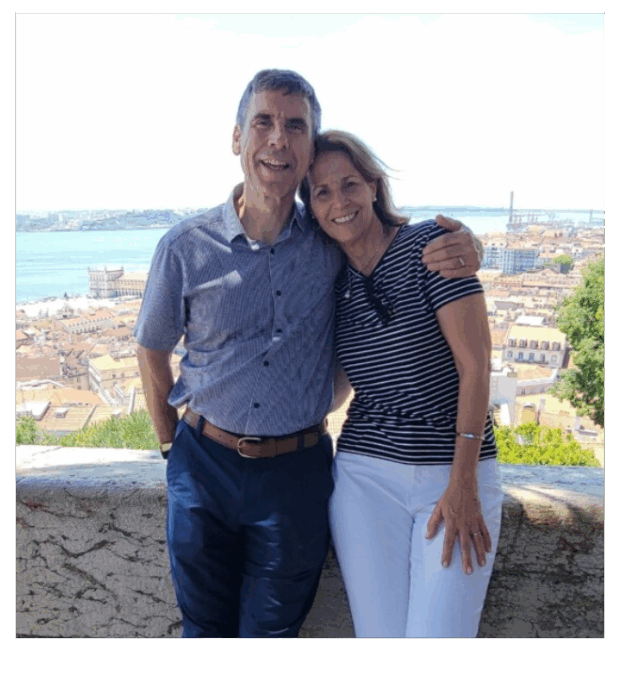
Dean and Michele on a recent trip to Portugal to spend time with her family
Find other testimonies of Changed Lives here. God is at work and I know these stories will encourage your heart!
This morning I had a 6am meeting in the office of our landscaping business. As I rolled groggily out of bed, I wondered yet again why we meet so early… Of course, I know why.
When I went over to the office a few minutes before our start time, I found the two people from our office staff who join the other family employees at our bi-weekly meeting.
The one was busily putting some reports together, giving me a cheery hi when I walked in the door and the other one was upstairs, I assume to take up the donuts he had kindly picked up on the way in to work and to make sure all was good with our conference room.
As I was sitting there alone for a few moments waiting for everyone to come upstairs to begin the meeting, I was thinking how grateful I am for our office staff. These two, along with our other two part-time staff, really make our jobs easier. They anticipate what we will need, they go out of their way to help us, they rarely complain, they all get along really well, and they respond kindly to requests. They just make owning a business so much easier.
Now, don’t get me wrong—life isn’t perfect in our office. People are people, after all. But all four of our office staff are genuine believers and you can definitely tell. We have so much to be thankful for.
So as I was thinking about how they help make our jobs so much easier, it hit me.
That’s what we are to be doing here on earth. We are to make God’s work easier. I don’t mean to sound flippant, so let me explain.
We are in the era of time where God is building His spiritual kingdom through calling people to salvation through His Son, Jesus Christ.
As those who are already saved, we know we are to share this Good News with others. We all know that we should tell others about this (although many of us struggle to do this).
But, I wonder if we think about this question:
Does the life I live make it easier or harder for people to respond to God’s call?
While I know there is nothing we could do to keep someone from heaven, I do wonder if we make it easier or harder for God? Of course, God will do what He is going to do, but we’ve all heard about those who reject Christ and use Christians and the examples they set as their reason. Are we someone’s excuse as to why they won’t come to Christ?
For example, if we are stingy, complaining, harsh, angry, lacking in self-control, anxious, fearful, what does that tell people about salvation? If we are living in sin; watching and listening to violent, sexually immoral tv shows and movies filled with bad language, what does that tell people about God and His impact upon our lives? If we hold grudges and refuse to forgive; if we gossip and slander; if we manipulate others to get our own way and, in doing all of these things, we call ourselves a “Christian”, what must people think??
There is much we can do to draw people to Jesus Christ and to make them take notice of the change He miraculously works in our lives. We are a brand new creature, after all, and this should show in our lives, through our daily choices and interactions with others (2 Corinthians 5:17).
Of all people, we should be the most loving and generous; we should be the most joyful and kind; we should never be characterized by anger or anxiety; We should be actively working to curb sin and worldliness in our lives; we should forgive as we have been forgiven, careful with our tongues, and think of others above ourselves.
None of us can do these things perfectly, of course. We all will stumble and struggle all too often. But we are ambassadors for Christ, now living for Him instead of ourselves. And this should stand out as noticeably different when compared to others in the world around us.
Whether this draws them to Christ or removes them further from Him, we cannot control (2 Corinthians 2:15-16). We know from scripture that most people will reject Christ. We just never want them to use us and our lives as their excuse!
May we stand as wonderful examples of new creations! May we be the reason someone asks questions about the Gospel. May we be a bright and shining light of love and truth in this very dark world.