growing in christ

The Allure of a Lie

There is one particular thing that I’ve encountered over and over again as I seek God through His Word and compare what I see in the world to what I read in the Bible.

And that being: An unwillingness of certain people to even have a thoughtful discussion.

So many people toss out something you’ve studied at length with a quick word given with ridicule. In fact, “study” has become a word that is viewed with disdain in a lot of ways. Particularly if it comes to the Bible and comparing what it says, both for our lives today and for what it says regarding the future, to the things we are encountering in the world around us—particular the world that calls itself “Christian” or “evangelical”.

A pastor by the name of David Nelson (1793-1844) wrote a book back in the early 1800s that addresses this unwillingness to study for oneself:

We do suppose that of all the scoffers who were to come in the last day and who were to be wilfully ignorant, there is scarce, one but would be willing to receive historic knowledge, at least, provided an angel could just grasp it in his hand, and throw it into his brain, without any exertion on his part. But the toil of research he never encounters. He may snatch at some plausible objection to truth, as he hears it repeated: but to impartial investigation he is an utter stranger.

As Pastor Nelson implies, we do find that people who are unwilling to study for themselves, are, however, eager to grab on to and repeat a lie that promotes what they want to believe.

I say “they”. But, honestly, we can all be in danger of this, including myself. It is so much easier and alluring to believe an appealing lie than to face an unpleasant truth.

David Nelson goes on to say this about the one who would prefer to believe a lie—

still it is true, that one small cunningly devised falsehood will influence him further than one hundred plain and forcible arguments in favour of Revelation.

It is true, isn’t it? A cleverly devised falsehood will be most influential in the one who does not love the truth, and a mountain of Bible verses, facts, or documentation given as proof that his belief is not true will not change the mind of one who does not love the truth.

I’ve been thinking a lot about 2 Thessalonians 2:10-12 over thee past few months, in regards to this:

And with all deceivableness of unrighteousness in them that perish; because they received not the love of the truth, that they might be saved. And for this cause God shall send them strong delusion, that they should believe a lie: That they all might be damned who believed not the truth, but had pleasure in unrighteousness.

This is speaking specifically to the day when the world will fall for the deception of the antichrist. But there is a lesson for us all in these verses: If we do not love the truth, we will be vulnerable to deception.

A genuine love for truth is the only thing that will protect us.

And this genuine love for truth will only be developed in the one who, by the power of the Holy Spirit, takes the time to pray and study the Bible. Not just read it, but study it.

Horatius Bonar has the best wisdom about our own personal study of God’s Word—

The Word must be studied in all its fullness. Over its whole length and breadth we must spread ourselves. Above all theologies, creeds, catechisms, books and hymns, the Word must be meditated on, that we may grow in the knowledge of all its parts, and in assimilation to its models.

Our souls must be steeped in it, not in certain favourite parts of it, but in the whole. We must know it, not from the report of others, but from our own experience and vision, else will our life be but an imitation, our religion second-hand, and therefore second-rate.

Another cannot breathe the air for us, nor eat for us, nor drink for us. We must do these for ourselves. So no one can do our religion for us, nor infuse into us the life of truth which he may possess. These are not things of proxy or merchandise, or human impartation. Out of the Book of God and by the Spirit of God must each one of us be taught, else we learn in vain. Hence the exceeding danger of human influence or authority.

Just like another cannot breathe the air for us, nor eat for us, nor drink for us, so no one can do our religion for us nor infuse into us the life of truth.

Oh, how many Christians rely on others for their growth? I used to do this myself, to be honest. I’ve shared that here often. I feel like my Christian life was status quo and without vigor until I picked up God’s Word for myself and began to study it on a regular basis.

I am a testimony of its power working to steadfastly transform an undeserved, sinful woman into the image of Christ, little by little.

This doesn’t mean we won’t continue to have blind spots that keep us from seeing ourselves as we really are. It doesn’t mean we will be perfect or that we will never fight sin or worldliness again.

What it does mean is that God, through our daily study of His Word and time spent in prayer, will open our blind eyes and then enable us to fight against the sin and worldliness that He has revealed to us. That’s it. All glory to God.

I want to be careful here. I have not “arrived”, by any stretch of the imagination (just ask my family!!) I am serious when I say any change in me is by God’s grace. But the Word is changing me. And it will do the same for you.

But it is only through our daily study of God’s Word that we will be filled with a love for the truth and be transformed into the image of Christ.

And this can only happen if we are willing to see ourselves as we really are. It can only happen if we are willing to see the people we love, the people we struggle to love, the world, and all that is happening in the world around us as they really are.

If we hold tightly to a lie—to our own reality that doesn’t represent truth—well, then, we will never change. And we will never be all that we can be for God’s Kingdom.

Oh, to be believers that love God’s Word—all of it in its entirety. Oh, to be believers that study the Bible, all of it—not just the parts that we like or find comforting. Oh, to be believers that will keep ourselves from deception and delusion because we dearly love the truth.

The Rich and Divine Mosaic

God has really been working on me over the past several months. Or shall I say convicting me?

I had gotten a bit lazy in the outworking of my faith in my day-to-day life. Don’t get me wrong, nothing really bad. Just little things.

Things like not redeeming my time; or not paying close attention to how I care for my body. Little indulgences that were showing me my priorities. Little remarks to my husband that revealed an unloving heart.

I find that this stage of my life yields a higher temptation to get lazy and not examine my life as carefully as I did when I had kids at home watching my every move. After all, no one really knows if I am lazy, or watching too much TV, or yelling at my dogs. No one knows if I am encouraging others in unseen ways, if I am denying self, or choosing to forgive instead of holding a grudge.

At this stage of my life, with my husband still busy working, I have little accountability to anyone but God. And it’s easy to grow lazier and less “self-examining”.

But God has been calling me to examine myself. And to live a different life in the little things. A more holy life. An intentional daily life for Him.

The other night I saw a movie and there was some dialogue regarding the gap between who the girl was and who she wanted to be. And her dad said this: “Why don’t you become the girl you wish to be?”

It was a secular movie and the dialogue was from a worldly perspective, but it made me stop and think.

We, God’s dear, redeemed children, are not STUCK being the person we are. We, of all people, have hope for change. Why do we act like we are hopeless? Why do we believe we can’t change?

There is a lot in God’s Word about this particular topic and gives us much hope in this area of becoming more like Christ. However, I have been especially meditating on Galatians 2:20, which tells us what the redeemed life should look like.

I am crucified with Christ: nevertheless I live; yet not I, but Christ liveth in me: and the life which I now live in the flesh I live by the faith of the Son of God, who loved me, and gave himself for me.

You see, we rarely hear about crucifying self. About crucifying our own wants, needs, desires (little ones and big ones) to live for Christ.

If we do hear about it, it’s in some grand big celebrity style of giving up everything. Sell all your stuff and go live for Jesus in a different country. But Jesus never said this.

Instead, dying to self is in the little things. The little things we do and don’t do each day in our daily lives.

This is what God has been reminding me of in His Word and through many other ways.

As if to confirm what He wants me to learn, I read just last night the following in a book I am reading about holiness by Horatius Bonar. It can’t be an accident right? I thought I’d share it with you as I close this post today. I hope it’s a good reminder for us all that our holiness and sanctification shows itself in the littlest things. It’s so tempting to grow lazy, but let’s not ever be satisfied with status quo Christianity.

Bonar reminds us: A holy life is composed of the rich and divine mosaic made up of the little things.

Here’s what Horatius Bonar says about a holy life (emphasis mine)—-

But a holy life is made up of a multitude of small things. It is the little things of the hour, and not the great things of the age, that fill up a life like that of Paul and John, like that of Rutherford (1600-1661), or Brainerd (1718-1747), or Martyn (1781-1812).

Little words, not eloquent speeches or sermons, little deeds, not miracles, nor battles, nor one great heroic act or mighty martyrdom, make up the true Christian life. The little constant sunbeam, not the lightning, the waters of Siloah “that go softly” (Isa 8:6) in their meek mission of refreshment, not “the waters of the river, strong and many” (vs. 8), rushing down in torrent noise and force, are the true symbols of a holy life.

The avoidance of little evils, little sins, little inconsistencies, little weaknesses, little follies, little indiscretions and imprudences, little foibles, little indulgences of self and of the flesh, little acts of indolence or indecision or slovenliness or cowardice, little equivocations or aberrations from high integrity, little touches of shabbiness and meanness, little bits of covetousness and penuriousness [stinginess], little exhibitions of worldliness and gaiety, little indifferences to the feelings or wishes of others, little outbreaks of temper, or crossness, or selfishness, or vanity—the avoidance of such little things as these goes far to make up at least the negative beauty of a holy life.

And then attention to the little duties of the day and hour, in public transactions, or private dealings, or family arrangements; to little words, and looks, and tones; little benevolences, or forbearances, or tendernesses; little self-denials, and self-restraints, and self-forgetfulnesses, little plans of quiet kindness and thoughtful consideration for others; to punctuality, and method, and true aim in the ordering of each day—these are the active developments of a holy life, the rich and divine mosaics of which it is composed.

What makes yon green hill so beautiful? Not the outstanding peak or stately elm, but the bright sward [expanse of grass] which clothes its slopes, composed of innumerable blades of slender grass. It is of small things that a great life is made up; and he who will acknowledge no life as great save that which is built up of great things, will find little in Bible characters to admire or copy.

~Horatius Bonar (God’s Way of Holiness)

A Look Back

The other day, while searching for something on Amazon Prime, a movie was suggested on the screen that we had watched years ago. We wouldn’t watch that movie today as God has so kindly been gradually convicting us of the things we set before our eyes since that time. There are many things I “used to watch” that I wouldn’t choose to watch today.

Sometimes I can find myself thinking even today, “oh, it probably wasn’t that bad” and turn something on for nostalgia’s sake. However, I almost always end up turning the movie or show off because I realize now that it simply doesn’t please the Lord. Sometimes it’s hard to turn something off. Mostly, I don’t miss my old entertainment but I need to be honest with you—sometimes it’s hard.

But when we saw that specific movie on the screen, my husband and I started talking about some friends that had encouraged us to watch it along with other things that were simply not beneficial to any believer. We had a period of time where we watched a lot of popular tv and movies and the reason for this was because of these friends, as we had mostly avoided it earlier in our lives.

When we started to drift apart from these friends, we were very, very sad. We had appreciated our friendship with them. However, we got used to life without them in it and moved on.

It wasn’t until we saw the movie pop up on the screen the other evening that we realized that God took something that was sad and hurtful to us, which certainly didn’t seem “good” to us at the time, and He used it to protect us and to move us away from something that was hurting us spiritually. We never really thought of that before.

And I have been thinking of two things to consider from this look back at our lives…

First, it’s a vivid reminder that God really does work all things for our good (Romans 8:28). But it doesn’t always feel good. And it doesn’t always seem good. And we might not know for years and years later of any good that came from it. Perhaps we may never find out. But we need to trust Him. We need to trust that God is good and that He will fulfill His promise: If we love Him, then all things will work for our good.

Second, it’s a convicting reminder to be the kind of friend that encourages and builds up our friends in the Lord, rather than the kind of friend that leads people towards worldliness and sin.

It’s not just about entertainment—although that is a sadly overlooked problem among those who profess Christ. It IS a big deal and it changes us, whether we believe it does or doesn’t.

I can’t even begin to express how much difference it made in my walk with God as I intentionally began to remove worldly entertainment filled with bad language, sexual immorality, violence, and vain humanistic philosophies (the most subtle of all! and found in even the most innocuous entertainment) from my life. Not that I ever watched, listened to, or read really bad stuff. We can always rationalize, can’t we?

Even today, I can still catch myself trying to rationalize. Thankfully, I am now at least aware that I need to really pay attention to what I am allowing in my mind. I really encourage you to do the same.

Entertainment of all kinds—what we watch, listen to, and read—is a big old open door for Satan to implant his philosophies and perspectives in our minds. It’s just so dangerous. NONE of us are so spiritually strong that we can withstand the barrage of wickedness that comes through entertainment. There will be some kind of collateral spiritual harm. There always is, whether we are willing to admit it to ourselves or not.

But, it’s not just entertainment. We can also, if we aren’t careful, lead people in things like gossip, anger, and grudges; in encouraging people in humanistic and psychological philosophies; we can be a stumbling block by drinking alcohol; we women can tempt a man to lust by wearing immodest, revealing clothing.

Another very common way we lead people towards the world is by only discussing the temporal things of this life—the news, work or career, sports, our children and their doings, fashion, celebrities, etc. There is nothing innately wrong with discussing these things but when God and His Word rarely, or never, come up in our conversations or when these things are not discussed in light of God and His Word, it shows something about where our hearts are and it leads people towards the world, rather than towards Christ.

There are a lot of ways we can lead people away from Christ instead of towards Him.

Honest self-examination is the first step to determining if we are helping God’s kingdom or hindering it.

Of course, none of us will help 100% of the time. That’s never the goal because it’s not even possible.

But may our lives, as a rule, lead people towards Christ. Jesus says we are His friends if we do what He commands (John 15:14). May we be shining examples of leading a life of submission and obedience to God and His Word, rather than leading a life of “doing just enough to get by”, while clinging to the world or our sin.


And so there are two things I’ve been reflecting upon as I have been thinking about those cherished friendships that simply…disappeared. I have no idea where those friends are today and how the Lord has led them in the area of entertainment. Perhaps He has led them on a similar journey.

One thing we can be sure of—the Lord will lovingly and faithfully lead anyone who seeks Him. One step at a time, He will conform us into His image and use all things for our good and His glory.

May we be faithfully examining ourselves and seeking to humbly obey Him as we take the path of growing in Christ.

Liberty to Love

Galatians 5 has always been a favorite chapter of mine. Paul has spent the preceding four chapters explaining that we can never be justified by the law and that Jesus Christ is enough. And then in chapter five, he starts off with—

Stand fast therefore in the liberty wherewith Christ hath made us free, and be not entangled again with the yoke of bondage.

We are to stand fast in the liberty that we are given through Christ. Paul then spends the rest of the book showing us what that looks like.

Does it mean we can immerse ourselves in worldliness and sinful behavior, knowing we are forgiven?

He answers this clearly in verse 13–

For, brethren, ye have been called unto liberty; only use not liberty for an occasion to the flesh, but by love serve one another.

Clearly the answer to that question is no. We are not saved so that we have the liberty to sin and embrace the world.

We are saved and given the liberty to love. To love and serve God. To love and serve one another.

Our new life in Christ has changed our WHY.

We don’t do the right things because we “have” to. We don’t do them to merit favor with God.

We do them because we have finally been given the liberty to love.

Most of us are very familiar with verses 22-23 of chapter 5, where we are given a list of the fruits of the Spirit. Can you remember what they are?

But the fruit of the Spirit is love, joy, peace, longsuffering, gentleness, goodness, faith, meekness, temperance: against such there is no law.

But the next verse is probably not as familiar to us—

And they that are Christ’s have crucified the flesh with the affections and lusts. (Vs 24)

Those that are Christ’s have crucified the flesh with its affections and lusts. This is a description of every believer. It should describe us. We have crucified (or are actively trying to crucify) our flesh.

Crucify— to subdue (conquer; bring into subjection; overcome; repress)

Flesh—our old man; our human nature

So, rather than fulfilling our desires for the world and to sin, we are to live with intention and be turning away from them. Crucifying them.

Crucify is such a strong word, isn’t it? We see Paul has used it earlier in this book, when he says in chapter 2:20–

I am crucified with Christ: nevertheless I live; yet not I, but Christ liveth in me: and the life which I now live in the flesh I live by the faith of the Son of God, who loved me, and gave himself for me.

So we aren’t crucifying our flesh for no purpose. As we crucify our flesh more and more, we make more and more room for Christ to live in us. As we live for Christ, we, through Him, love God and others.

This is reflected in our lives in all areas. It’s not just about “being nice” to people. It goes far deeper…it is reflected in how we love others when no one is watching—how we treat our spouses every day; how we respond when someone irritates us; it is reflected in how freely we forgive and the amount of grace we offer to others. It’s also reflected in how much we love God—shown clearly by what we put before our eyes on the tv, the Internet, or books (do we love Him enough to turn our eyes from the things He hates?) It is reflected in how we spend our money and time (do we consider His will as we make these decisions?) And it is reflected in how we respond when we face a trial, large or small (do we really trust Him?)

This topic is probably one of the most difficult things to navigate as a believer in our current culture. As soon as we raise the topic, cries of legalism rent the air.

But the liberty to love and then to live our lives in response to that love (for God and for others) is in direct opposition to legalism.

This verse has really been on my mind and so I thought I’d share what I’ve been thinking about. Hope it encourages you to also ponder our liberty to love and instills in you the same desire it has in me: To love God more and to love myself less. To turn from my fleshly desires and to fill the void with Christ.

May I seek God’s glory instead of my own. May I seek God’s approval rather than man’s. May I seek to submit and to obey God rather than to fulfill the desires and lusts of my flesh that insistently (and sometimes so very LOUDLY) call out to me each and every day.

We will never do this perfectly, but, by His grace, we will do it more and more with each passing day.

Who’s Really Inside?

This past weekend, we had the opportunity to spend the weekend with my parents at the beach. It was extra fun, as the kind couple who allowed us to use their beach house had a street-legal golf cart that they said we could use. And so off we set on our adventure of exploring our favorite beach town from a golf cart!

Traveling down streets unknown to us before, we came across beautiful new houses, as well as small cottages that had been there for a long, long time. Most houses were beautifully cared for, while just a few sat a bit forlorn, needing a new coat of paint or some landscaping.

At one point, we went around a corner and we saw a brand new—rather large—building. It was cream-colored with black shutters and looked rather like a hotel…but not quite. As we traveled the block, the building became one story and stretched out the entire block. Curious to see what the building was, we turned the corner to find out as we came to the end of the block.

Lo and behold, what we saw surprised us all. For right behind the single story “building” (which ended up being only about two feet wide) sat the town’s electrical plant. None of us had even noticed the wires and towers behind the one story building.

We drove off and then I told my husband to turn around so I could take a photo (see below). I had been reading about the Pharisees and I knew that what we were seeing was a little like the Pharisees. They looked all nice and proper on the outside but they were downright ugly inside. Jesus called them whitened sepulchres (or whitewashed tombs)—

Woe unto you, scribes and Pharisees, hypocrites! for ye are like unto whited sepulchres, which indeed appear beautiful outward, but are within full of dead men’s bones, and of all uncleanness. (Matthew 23:27)

We often hear stories of pastors or celebrities that “fall into sin” but these things do not happen in a vacuum. Many people put on an act and pretend to be something they are not. This is not unusual.

Oftentimes, the ugliest sins are hidden behind a “Christian” facade.

So many pretenders. So many liars. So many wolves in sheep’s clothing. They come as angels of light but they seek to starve your soul and take your eyes off the true God, the real Jesus, and the Bible.


But you know, these aren’t the only pretenders. I thought it was interesting to read this morning—

Nevertheless among the chief rulers also many believed on him; but because of the Pharisees they did not confess him, lest they should be put out of the synagogue: For they loved the praise of men more than the praise of God. (John 12:42-43)

Here we see chief rulers pretending not to believe on Jesus Christ because they loved the praise of men more than they loved God.

What an indictment! May this never be said of us.

Some people pretend to be something they aren’t because they lack courage and they love themselves and the praise of men more than they love God and the truth.


So how does this apply to us? Those of us who have been saved by faith in Christ alone are new creatures. And so what is inside of us should be consistent with what is outside of us.

There should be no hypocrisy in the life of a believer.

I remember years ago, someone using that verse about God looking on the heart, while man looks on the outside (I Samuel 16:7) as a reason to look and live like the world.

But that isn’t what that verse means at all. We can know this by reading this verse in the context of the rest of scripture.

God expects our outside to match our inside. We cannot be a new creature inside without looking like a new creature on the outside. All throughout the New Testament we are given the description of the true believer. We are told what God wants us to look like.

We will never be able to match that description perfectly, of course. But, through examining ourselves to see if we are in the faith (2 Corinthians 13:5), by proving all things and holding fast to what is good (I Thess. 5:21), and by being diligent to make our calling and election sure (2 Peter 1:10-11) we will be sure to continue moving in the right direction.

Remember: It’s about direction, not perfection.

These things we are called to aren’t meant to be burdensome. We know that because Jesus tells us that His yoke is easy and His burden is light (Matthew 11:30).

If we are feeling burdened; if these things we are called to do not feel easy or light, well, then, perhaps we are a little like those chief priests—loving the praise of men more than we love the Lord. Having our souls entrenched in the things of this world, we struggle to turn from things that are not building us up in the faith. Loving the world and loving our sin keep us from growing as we should.

As we become less enamored with the things of this world and as our hatred for sin grows, the heavy burden we were feeling about holiness, turning from the world, and living for Jesus grows lighter and lighter.

And just to be honest, this only began to change for me when I began to read the Word—to really study it—for myself personally.

If we genuinely want to grow but the burden feels so heavy, then we must pray that God will give us that desire and open our eyes to what is keeping us fettered and imprisoned. What is keeping us from feeling the freedom we have in Christ to live a righteous life for God?

By the way—not to get too off topic—however, I feel like it is important to mention—

We are free to live righteously. We are not free to sin and we are not free to love the world and be like the world. This is so clear all throughout scripture but Romans 6 is a great place to start if you want to know more.


Life is full of challenges and one of those challenges is to be real and authentic. To be a godly person on the inside and the outside. Wherever this is not taking place, there is hypocrisy. God hates hypocrisy.

May we be those who shine the genuine light of Christ and may those who see that light find in us an example of consistency. May we be the same person both inside and out.

The facade that hides the electrical plant

Never Satisfied with Status Quo

A few weeks ago, I was delighted to return to a church that has welcomed me as a speaker for several years now. This year my topic was about aging and beauty. What exactly does scripture have to say about these things?

The topic was my idea—as I had been wanting to dig into the Bible and see what it has to say about these things for a long time. We hear so many things about this topic but what does the Bible actually have to teach about them? That’s what I wanted to know. And I hoped the ladies at the church would be interested, too. Thankfully, they were! No matter who we are or what age, we women especially, find this topic particularly relevant to our daily lives in one way or another.

This morning, I’d like to share just one point of that presentation. This point has continued to personally cause me much consideration, reflection, and conviction.

There is a little verse at the end of I Corinthians 10 that says—

Whether therefore ye eat, or drink, or whatsoever ye do, do all to the glory of God.

Whatever we do, we are to do to the glory of God. Do ALL to the glory of God.

I don’t know about you, but I find myself doing so many things with myself much more in mind. Our flesh cries out not only for glory, but for love, comfort, convenience, indulgence, popularity, fairness, justice, revenge…to name just a few.

And we make choices with these things in mind. Many times, without even realizing it.

For example…

We may choose not to speak truth because we desire to be loved more than we desire to glorify God.

We may choose to eat too much or buy too much because our flesh wants to be indulged and that’s more important than glorifying God.

We may choose to wear something (or allow our daughter to wear something) that is utterly inappropriate because popularity is more important to us than glorifying God.

We may choose to say something sarcastically or make a snide remark because fairness and revenge take priority over glorifying God.

We may choose to watch, read, or listen to something for so many reasons—popularity, wanting to be liked or loved, indulging our flesh… we have so many reasons (and excuses and rationalizations) as to why we fill our minds with wicked entertainment.

We may… well, you get the idea. It is the nitty gritty of the Christian life. It encompasses life-altering choices and the smallest decisions of every single day.

Do I want to glorify God most? Do my choices and decisions reflect the fact that glorifying God is more important than anything that has to do with ME?

I’ll just be flat-out honest (since those who know me already know this, anyway). The answer to that question is: NO. I don’t.

I’d rather guess that you may have to answer this the same way. We believers are so far from perfect, it’s scary. And we know it, too. It’s why we are so grateful for Jesus. He is perfect so we don’t have to be.

But, that being said, we want to, right? We want to make decisions to glorify God instead of to fulfill some fleshly desire.

And we make more decisions based on this than we used to. We can see how God is growing us and changing us. So we need to be grateful and not wallow in a pit of discouragement. We are not the same people we used to be. Praise be to God, we are not the same as we used to be!

But there is always so much room for improvement, right? The further along we walk in the Christian life, the more we comprehend how far we have to go.

I don’t know if you ever noticed the tagline for Growing4Life. It is “never satisfied with status quo”.

It is so tempting to be satisfied with status quo in our current culture. To just do enough to be considered “Christian” without making any sacrifices; while still fulfilling our flesh.

But this is not what God calls us to. Over and over again in scripture we read of God’s call to deny self, turn from our fleshly desires, offer our bodies as a living sacrifice—to live as a new creature.

We are going upstream in a downstream world. We live a totally different life because God has changed us and is changing us into a totally different person.

I don’t know about you, but I find that I can lean into status quo far too easily and just live day to day without really considering these things. Ignoring verses like I Corinthians 10:31 (not purposefully) as I go about my day to day activities.

That speaking engagement really made me stop short and start paying attention to why I do what I do. And while it has been a rather discouraging exercise, I am thankful. Thankful that the Lord has, yet again, opened my eyes to see myself as I really am.

These things tend to keep us humble and full of grace for others who are on the spiritual battlefield beside us, as we realize we aren’t “all that” and have so much further to go in pleasing our Lord and Savior.

I know this isn’t the feel-good, touchy-feely kind of post that people tend to be drawn to these days. But sometimes we just need to face the cold, hard truth about ourselves, don’t we? Or we will never change. We will never look more like Christ.

Instead, we will be caught up in the endless quagmire of “status quo”, always and only trying to do just enough to be called a “Christian” while still fulfilling our own fleshly desires.

Oh, may this never be said of us. May we never be satisfied with status quo. May we get in the habit of asking the question: What will bring glory to God?

May we keep moving upward and onward, one choice at a time.

The Truth Will Mess with Your Peace (and that’s a good thing!)

Once upon a time, a man (we will call him John) went to the doctor due to a severe headache that wouldn’t go away. As the doctor examined him, he told him it could be due to a number of different reasons—some even fatal.

“What would you like to be the cause of your headache?” Asked the doctor.

Not expecting that response, John said wryly, “well, it doesn’t really matter what I want it to be, now, does it?”

“Well,” responded the doctor, “we are trying a new method—one where we let the patient decide what is wrong. This way we don’t mess with their peace or make them upset. We just assume that what they say is true and treat from their diagnosis.”

Silly story. And, yes, it’s just a story. (I wrote a longer post about this called Lindy’s Headaches, you can read that here.) But have you noticed that, while this would never happen in the medical world, it happens all the time in the spiritual world? As if we can all just decide what is sin and what isn’t. As if we can all just decide for ourselves what is truth and how we get to heaven.

And if we don’t like what someone says or they don’t agree with us, we can just unfriend them, delete them from our lives, and move on.

A friend told me he saw a meme on Facebook awhile back. It said this:

“If it messes with your peace, it’s not worth it.”

Have you noticed that this is the philosophy of so many today?

But here’s the thing: The truth will mess with your peace. It just does.

I can look back over my life and recall many times where someone told me the truth about something and it made me very uncomfortable and, sometimes, even angry. But, looking back now, I am so very grateful for those people who were willing to speak the truth to me.

After all, how do we grow if we only surround ourselves with people who are just like us and will never say anything that offends us? How will we grow if we are determined to do things our way, without wise counsel of godly, older people? How will we grow if we refuse to listen to anyone we don’t agree with? How will we grow if we ignore everything in God’s Word that we don’t like??

Well, we won’t. Approaching life this way will lead to looking inward towards self for strength and wisdom. Rather than looking towards God, His Word, and godly men and women that have walked the narrow path ahead of us, so many are looking to self (and to those who agree with self).

And, listen, that is the world’s way. Frank Sinatra released the song “I Did it My Way,” in 1969. The world has been on a the runaway train of self-esteem, self-improvement, self-promotion, self-strength, self-wisdom, and self-glory ever since.

It’s taken the Christian world awhile to follow after the world, but here we are. Most everyone today believes this:

If it doesn’t encourage me or make me feel good, it’s not worth it.

This is probably the main reason families and the visible church are in such a shambles. If someone makes me uncomfortable, it’s not worth it. If the relationship takes work, it’s not worth it. Truth and biblical doctrine can make us uncomfortable. Serving others sacrificially does not always make us feel good.

How much easier is it to run away from the hard? How much more fun and entertaining is it to go to a concert-like worship experience and then listen to a few shallow minutes of encouragement?

Of course, we can’t change this. We can’t change where the secular or the Christian culture finds itself these days.

But we can evaluate our own lives and we can, by God’s grace, intentionally determine not to be SELF-obsessed.

I am currently reading a biography of a missionary. As she has been describing her life, I have grown more and more disturbed. Would I have been willing to do what she did? I don’t think so. If I am honest, I have to say I don’t think so.

And it makes me realize that I, too, have fallen for the cult of self. I, too, put self on a higher pedestal than God all too often.

I think we all struggle with this at some level. As my daughter-in-law said recently: Do we ever do anything with a pure motive?

It is disconcerting to think about, isn’t it? But God knows this and I am so thankful for His grace and His mercy. Jesus came to die for us to pay the price for every sin, every insincere act of service, every time we didn’t do what was right and didn’t even realize it.

Praise the name of Jesus!

But it is my prayer that this short post, in the midst of a tsunami of internet information that will tell you the opposite, will encourage us to love God more than self. That it will bring awareness that this love for self is something we must fight and never embrace. That love for self is the antithesis of true, biblical Christianity. That this love for self is really part of our sin nature and it is called our “flesh” in scripture.

Look, we aren’t going to always agree with others. Even if we both love the Lord with all of our hearts, we will not agree on everything. I don’t expect you to always agree with me and I won’t always agree with you. But what a joy it is to have relationships where we can have open, honest conversations without malice and rancor and bitterness. What joy it is to talk about God’s Word and to grow together with those who also hold the Bible as their anchor and final authority.

Recently, I had the privilege of watching two of my best friends play this out right in front of my eyes. I watched one speak the truth in love and I watched the other one hear the truth with love. It was a beautiful thing. It is how it is supposed to be for us believers. Iron sharpens iron (Proverbs 27:17) and it is a wonderful encouragement when we can have this kind of relationship with someone.

Hearing the truth is a good thing! Being called away from self and towards God through our reading of God’s Word and the counsel of godly family and friends is a great thing!

May we, as believers, be willing to turn from self, experience discomfort, have our “peace messed with”, and hear the truth with love—so that we will grow in our faith and become more Christ-like as the years pass by.

A Sweet Gift That Taught me a Lesson

A few days ago, my daughter stopped by with one of her sons to pick up something. I was down at the pool and so he searched me out and, in his hand, he held something.

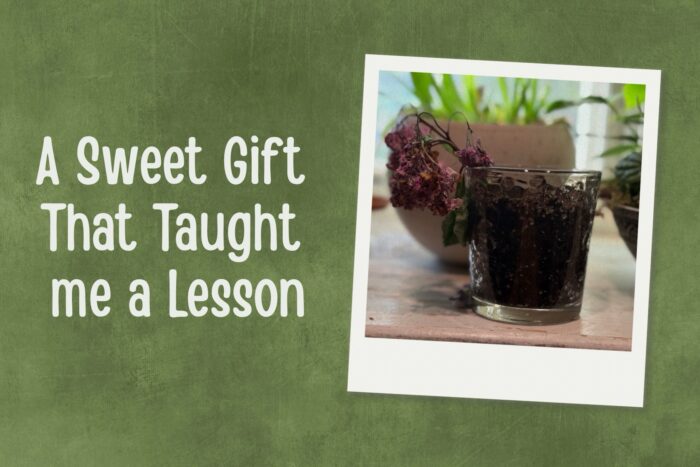
It was a hydrangea bloom that had fallen off its bush tucked into a drinking glass full of soil. It was such a sweet gift, although I knew that hydrangea would not last because it needed water, not soil. And its life was quite limited, at any rate, now that it was no longer connected to its source for life.

But he didn’t know that. And he had enthusiastically planted that little hydrangea branch for Grandma. How sweet is that?

I put the glass on my kitchen windowsill and watched it slowly deteriorate (as you can see from the photo above). The hydrangea cannot live in the conditions that my grandson gave it, although he truly thought he was doing what was best for that little branch.


I have been really thinking recently about James 1:5-8–

If any of you lack wisdom, let him ask of God, that giveth to all men liberally, and upbraideth not; and it shall be given him. But let him ask in faith, nothing wavering. For he that wavereth is like a wave of the sea driven with the wind and tossed. For let not that man think that he shall receive any thing of the Lord. A double minded man is unstable in all his ways.

I fear that I have been doubting as I bring my big requests before God. I don’t think I trust that He can work.

Yesterday, as I was sharing this with a friend, she said something quite profound.

It’s often not that we doubt God can work. It’s that we doubt that He will do things our way.

Ouch.

That is the bottom line, I fear.

And I had to think of my grandson and that hydrangea branch.

How often are we just like him? We think we know the best path but it’s not the best path. God stops us in our tracks and we get frustrated because we can’t understand why. But God knows what we don’t know.

That conversation yesterday really has had me thinking. We know we aren’t in control. We do know that. But yet we so often act like we are. And we grip things so tightly, as if that will keep things from changing. And we boldly march ahead as if we know the answers and the right way to go, when, so often, we just…don’t.

And then, when we end up with a wilting bloom, we are surprised.

It is a never-ending process to learn to lean into God’s will, especially when it is not my will. And to seek Him above all else.


Often, just like my grandson, we do things with the best of intentions and they aren’t necessarily wrong things. But we are finite and we just don’t know.

But God not only knows all—He loves us, too! (Romans 8:35-39; Galatians 2:20; I John 3:20)

Understanding this about God should change how we pray. It should give us the courage and the desire to pray with faith and without doubt.

Perhaps our struggle lies in the fact that we haven’t fully realized Who God is.


I recently read a book by Richard Sibbes called Discouragement’s Recovery. It was a very helpful book and I recommend it—particularly if you struggle with being discouraged.

I want to end with a quote from this book that helps us understand a bit more what we have in God if we are HIS. It was helpful to me and I hope it will be helpful to you, too—

I beseech you, give me a little leave to press this; for certainly there is more comfort in this word ‘My God,’ than in all the words of the world; for what is God to me if he be not my God, and so make me his? For this same propriety of comfort is more than all the comforts in the world.

We account a little patch of ground, or corner of an house of our own, more than all the city and town where we live. This comforts a man, when he can say, This is mine. As a man that hath a wife, it may be, she is not of the best, or the richest, or the fairest, yet she comforts him more, and he takes more content in her, than in all the women in the world, because she is his wife; so if a man can say, ‘O my God,’ he needs not say any more, for it is more than if he could say, All the world is mine. if we have God we have all, and if we had a thousand worlds, all were nothing to this, if we cannot say ‘God is my God.’

Therefore, though the child of God may seem to be a poor man, yet he is the only rich man. Other men have the riches of this world, as a kind of usurpers, for they have not the highest right unto them. Worldly men are like unto bankrupts, who are taken to be rich men because they have a great deal of goods in their possession, but the true right belongs to others, and so they prove in the end to be worth nothing. I beseech you, consider what God’s servants have said heretofore: ‘God is my portion,’ Lam. 3:24. If God be our God, then he will supply all our wants, as it shall make for the best unto us. This is a great comfort to all Christians in what estate soever. God in dividing things, it may be, he hath given others honours, beauty, and riches, and parts of nature. Well! God falleth to thy lot.

Let the worldlings, the lascivious and ambitions persons, make themselves merry with their portions in this life, yet let the Christian, in what estate soever, glory in his portion, for God is his, and all things else. Though there be many changes in thyself, why shouldst thou be discouraged or disquieted in any state whatsoever? God is thine to do thee good.

~Richard Sibbes, Discouragement’s Recovery

I know the language of this is a bit archaic, but there is such profound truth here. We forget that, if we are God’s dear redeemed child, then the God of ALL is OUR God. He loves and cares for us personally. How awesome is that?

Understanding this truth helps us to pray with faith and to abandon the doubt. This truth helps us keep an eternal perspective rather than a temporal one. This truth reminds us that we are not just a random dot on the timeline of history but that God loves us and He is watching over us. This truth will keep us from relying on ourselves and our own wisdom and leaning into God’s will and His wisdom.

Now, if only we could remember this when we are faced with that next trial or decision or challenge…

Older and Wiser

Life is designed in such a way that the older we get, the wiser we become. Our experiences teach us more than any teacher ever could. And so, hopefully, as believers, we are learning not to be so hasty; when to speak and when to keep quiet; we are growing less angry and more forgiving. And the list could go on and on.

This not only should inform our daily living in a good way by changing our choices and decisions and even our thought processes but it also gives us insight for those that come behind us.

As I was reading in II Chronicles 10 last week, I came across this interesting passage. It’s regarding Rehoboam, who asked two groups of men—old men and young men— how he should respond to a question the people have asked him—

𝘈𝘯𝘥 𝘬𝘪𝘯𝘨 𝘙𝘦𝘩𝘰𝘣𝘰𝘢𝘮 𝘵𝘰𝘰𝘬 𝘤𝘰𝘶𝘯𝘴𝘦𝘭 𝘸𝘪𝘵𝘩 𝘵𝘩𝘦 𝘰𝘭𝘥 𝘮𝘦𝘯 𝘵𝘩𝘢𝘵 𝘩𝘢𝘥 𝘴𝘵𝘰𝘰𝘥 𝘣𝘦𝘧𝘰𝘳𝘦 𝘚𝘰𝘭𝘰𝘮𝘰𝘯 𝘩𝘪𝘴 𝘧𝘢𝘵𝘩𝘦𝘳 𝘸𝘩𝘪𝘭𝘦 𝘩𝘦 𝘺𝘦𝘵 𝘭𝘪𝘷𝘦𝘥, 𝘴𝘢𝘺𝘪𝘯𝘨, 𝘞𝘩𝘢𝘵 𝘤𝘰𝘶𝘯𝘴𝘦𝘭 𝘨𝘪𝘷𝘦 𝘺𝘦 𝘮𝘦 𝘵𝘰 𝘳𝘦𝘵𝘶𝘳𝘯 𝘢𝘯𝘴𝘸𝘦𝘳 𝘵𝘰 𝘵𝘩𝘪𝘴 𝘱𝘦𝘰𝘱𝘭𝘦? 𝘈𝘯𝘥 𝘵𝘩𝘦𝘺 𝘴𝘱𝘢𝘬𝘦 𝘶𝘯𝘵𝘰 𝘩𝘪𝘮, 𝘴𝘢𝘺𝘪𝘯𝘨, 𝘐𝘧 𝘵𝘩𝘰𝘶 𝘣𝘦 𝘬𝘪𝘯𝘥 𝘵𝘰 𝘵𝘩𝘪𝘴 𝘱𝘦𝘰𝘱𝘭𝘦, 𝘢𝘯𝘥 𝘱𝘭𝘦𝘢𝘴𝘦 𝘵𝘩𝘦𝘮, 𝘢𝘯𝘥 𝘴𝘱𝘦𝘢𝘬 𝘨𝘰𝘰𝘥 𝘸𝘰𝘳𝘥𝘴 𝘵𝘰 𝘵𝘩𝘦𝘮, 𝘵𝘩𝘦𝘺 𝘸𝘪𝘭𝘭 𝘣𝘦 𝘵𝘩𝘺 𝘴𝘦𝘳𝘷𝘢𝘯𝘵𝘴 𝘧𝘰𝘳 𝘦𝘷𝘦𝘳. 𝘉𝘶𝘵 𝘩𝘦 𝘧𝘰𝘳𝘴𝘰𝘰𝘬 𝘵𝘩𝘦 𝘤𝘰𝘶𝘯𝘴𝘦𝘭 𝘸𝘩𝘪𝘤𝘩 𝘵𝘩𝘦 𝘰𝘭𝘥 𝘮𝘦𝘯 𝘨𝘢𝘷𝘦 𝘩𝘪𝘮, 𝘢𝘯𝘥 𝘵𝘰𝘰𝘬 𝘤𝘰𝘶𝘯𝘴𝘦𝘭 𝘸𝘪𝘵𝘩 𝘵𝘩𝘦 𝘺𝘰𝘶𝘯𝘨 𝘮𝘦𝘯 𝘵𝘩𝘢𝘵 𝘸𝘦𝘳𝘦 𝘣𝘳𝘰𝘶𝘨𝘩𝘵 𝘶𝘱 𝘸𝘪𝘵𝘩 𝘩𝘪𝘮, 𝘵𝘩𝘢𝘵 𝘴𝘵𝘰𝘰𝘥 𝘣𝘦𝘧𝘰𝘳𝘦 𝘩𝘪𝘮. (II Chronicles 10:6-8)

Instead of heeding the wiser, older men, he decided to go with what the young men had said (which was to be harsh with the people).

In this case, the older men had a much wiser answer for Rehoboam and had he followed it, his kingdom would have had a very different ending. Following the wrong advice can change everything, just as it did for Rehoboam.

Of course, older men do not always give the best advice—especially in a culture where so many older men and women spend the last twenty years of their lives playing and selfishly pursuing their own desires.

But there is still a principle to be found in this story from the Bible. We spend almost the entirety of our lives younger than some and older than some, so what are principles we need to consider from this story as a younger person and as an older person?

We live in a culture that is a bit upside down. In the past, the wisdom of old age was valued and elderly men and women were respected. In the world we find ourselves in, it is youth that people listen to and it is the young people that are respected.

It wasn’t until the mid-1900s that youth culture took on a life all its own and became a force to be reckoned with. There were no “youth groups” in the 1800s. No Botox or plastic surgery so we could look “younger”.

While growing older always has had its challenges, there was no shame in it back in the day. It was just a part of life. No one was trying to be younger. They just were taking life as it came.

But we live in this culture where youth is admired and old age is despised. How do we live in this culture but not be “of it”? Since we are all both “younger” and “older” for most of our lives we need to ask—according to scripture—what are things we need to consider as a younger person and what do we need to think about as an older person?

First, it’s important that we consider what those older than us have to say. Particularly, those who are walking with God.

There are lots of foolish old men and women in this materialistic, self-centered culture. But there are also many wise men and women who love the Lord and have so much to offer those of us who are younger than they are. May we be humble enough to listen to what they have to say and take time to reflect on it.

Some of my dearest friends have been women considerably older than me. One was thirty years older and one was twenty-two years older than me. Both were incredible blessings in that they had so much wisdom to offer me, because they loved the Lord and had lived longer than me. If we still have our parents and they love the Lord, we will find that they are also a wonderful resource for godly counsel.

Older people just think about things we never even considered. They understand dynamics we can have no clue about. They have been through what we are going through and can look back and see what they did right and what they did wrong. Hind sight is 20/20 and they have the blessing of having the hind sight we can’t possibly have.

And so may we be humble and teachable and willing to learn from those who are a bit ahead of us on this path called life.

Second, may we be worthy counselors.

We are all older than someone. May we be studying the Word and growing more like Christ through our life experiences, so that we may be a counselor of value as we get older.

As I mentioned above, many older men and women live selfishly. But as believers, we not only must turn away from that, we must realize the absolute privilege it is to build into the lives that are around us. Many of us have children (and their spouses), grandchildren, and even great-grandchildren whom we can support and encourage. We have nieces and nephews, Sunday School children, young parents, co-workers, and our church families. There is always someone younger than us that can use some support and encouragement to honor and obey the Lord.

But before we offer any counsel…

It is critical that we are an excellent listener. Spewing unwanted and condescending advice will be never be a blessing to anyone.

Compassionate listening with a well-spoken word of advice as God gives opportunity is what we are after.


We can’t change the world, but we can change our own hearts and attitudes, can’t we? May we be willing to listen and consider the counsel of those who are ahead of us and may we be willing encourage and build up in the Word those who are behind us.

And, in doing these things, we will be obeying scripture and be living out the pattern that God established for His people.

Judgements, the Bible, and Incomplete Information

We all make judgments. We make judgments about what is beautiful and what isn’t. And about what is “normal” and what “isn’t normal”. We make judgments about whether someone is doing something right or something wrong; And about whether someone is doing something wise or something foolish. We all do it. And we all do this quite naturally, whether we speak our judgments aloud or not.

But there are two things that we believers really should consider before we pass judgment. Before I go on I’d like to mention that this is something God has been teaching me, oh so gradually, over the course of my lifetime and I am definitely not the same person I used to be. But I am still growing in this area. It’s so easy to write about something the Bible teaches, but learning to live it out takes a lifetime.

The FIRST thing for our consideration is this: Is my judgment based on God’s Holy Word or is it based on my opinion?

If it’s based on my opinion then does it really matter? What makes one opinion better than another?

Here’s a silly example (albeit a practical one). Let’s consider a woman’s shirt. Let’s say I notice a co-worker’s new shirt and I just don’t like it. It’s bright and loud in a color I do not care for and I find it very unappealing. Why is my opinion about that shirt better than the wearer’s opinion? And does it really matter?

Now, let’s take that same shirt and let’s say that it is cut very low and is very immodest. The Bible tells us to dress modestly (I Timothy 2:9-10). So now I am making a judgment between right and wrong which, in fact, we are supposed to do (Matthew 7, I Thess. 5:21-22, and others).

Judgments that are based on our opinions don’t always need to be said. But sometimes they do need to be shared. For example, in committee meetings or family gatherings, when a plan is being developed or a vacation planned. At that point, we speak up with the understanding that there is really no “right” or “wrong” in the situation but that our opinion is simply based on preference.

But what we do with our biblical judgments? Are we to speak each one? This is probably worth a post all its own but, for the sake of time and space here today, let’s just nutshell it in this way: True love discerns, through prayer, when speaking truth is appropriate and is willing to confront when necessary. A lot of harm has been done by parents, pastors, teachers, and others who were simply unwilling to speak biblical truth into the lives of others because they were worried about offending.

This leads to the SECOND thing which we must consider: Are we are aware that we may have incomplete information as to why someone made a choice?

This is not regarding the actual making of judgments but, rather, about our attitudes that accompany our judgments.

When we make biblical judgments, we make them based on our own life experiences. This leads many of us to give no grace, no mercy, no lee-way for other life experiences.

So, for example, someone growing up in a Christian home will naturally know the Bible better than a baby Christian who just got saved as an adult and is learning. Do we have grace for the baby Christian who is just learning?

Or another example is that perhaps someone made a decision for a very good reason but you, looking from the outside, are not privy to the reason for that decision and are judging them for doing something unwise based on your incomplete information. We don’t always know the facts and perhaps they didn’t do anything unwise at all.

Do we give people the benefit of the doubt? Or do we fall prey to having a “holier than thou” attitude?

We only have our life experience from which to form judgements. But it’s so important to recognize that our life experiences are not the gold standard. Only the Bible can and should inform all of our judgments.

And this should lead us to grace and mercy as we remember our life is not their life. And they may have challenges about which we have no idea at all. This doesn’t mean we don’t talk with them when we see sin or worldliness. It just means we have a humble, loving attitude that acknowledges we may not know everything.


So… what if a judgment is based on scripture and you find yourself concerned about someone you love? What to do?

Our natural response is to gossip or to make sarcastic, passive-aggressive remarks letting others know how we feel. The godly response is to keep quiet and go to that person personally and find out the whole story; find out why they made the choice they did and lovingly and kindly point to the scripture that shows that it is wrong.

Can you see why correct interpretation and honest hermeneutics of God’s Word are so critical to life? There are so many manmade “rules” and “laws”—rules and laws that man has created that are simply not in scripture. And there are also so many principles and commands that go completely ignored and neglected by professing Christians who love the world.

And can you see why it’s so important to be able to recognize an opinion-based judgment from a scripture-based judgement?


I have been judged for many things throughout my life. One that sticks out in my memory is being judged for drinking orange juice with my pop-tart instead of milk. Someone made me feel like a fool because of this decision.

As I reflect on that experience, which is over twenty years ago now, I find it such an unnecessary judgement. It’s a silly example but there are so many just like it that happen every day.

Judgments like this build walls instead of building unity. They create division instead of creating a loving, safe place to grow together.

Oh, that we may recognize the difference between our subjective, opinion-based judgments and objective, scripture-based judgments. May we handle any judgment in a loving, biblical manner that will support and encourage God’s family, rather than tear it down.

Scroll to Top