Spiritual Growth

Running Ahead of God

Have you ever faced something that looked utterly unfixable but you just had to fix it? You didn’t know how but you just knew you had to try and do something. And so you come up with all kinds of ideas. You might think of these ideas while you are driving or while you lay in bed at night. Always thinking about how to fix a hopeless situation that so desperately needs to be fixed.

I wonder if Sarah did that, too? Did she lie awake at night wondering if she could help God fix the situation that she and her husband, Abraham, found themselves in? She knew that God had promised land to Abram’s descendants (Genesis 15:18) and yet they didn’t even have any children. That, combined with the fact that she was really old and past child-bearing years, probably caused her much consternation.

I wonder if she fussed and stewed and worried about this seemingly unfixable situation? I wonder if she lost sleep over this?

However she faced this insurmountable problem, she ended up doing what most of us do .

She tried to fix it herself (Genesis 16:1-4). She gave her maid to her husband so that she could have children for her. From our perspective this seems extremely strange. But to Sarah this seemed a very sensible way to fix a very dire situation.

Before we become too critical of her, think about yourself for just a moment. Haven’t you done the same? Oh, it may not have been a situation such as hers that had such far-reaching consequences, but, seriously, haven’t you ever tried to jump ahead of the Lord and fix something?

I know I have. I used to think I could fix situations by talking. God has since shown me that this is unlikely. And that if I am going to talk or discuss I need to wait on His timing instead of jumping ahead and making things worse. Not that I’ve mastered this, by any means. I still run ahead of God occasionally–especially with my family. And it still almost always makes things worse.

There are so many ways we try to run ahead of God instead of waiting. And praying.

Sometimes we do need to bravely and courageously stand up and take a step forward or have a hard conversation. But, so often, we do this without prayer. So often we do this before we seek wise counsel.

History would be very different if Sarah had not run ahead of God and tried to fix her problem without His help. She literally changed the course of history.

Of course, God, in His Sovereignty, knew all of this would happen and His purposes were not thwarted. They can never be thwarted. This thought is a true comfort for all of us who have the tendency to try to fix things.

And another thing to consider here, as well, is that God uses these waiting periods and unresolved situations in our lives to grow us. Romans 8:28-29 tells us that God uses all things to transform us into the image of Christ. When we try to fix things, not only may we botch things up but we may lose out on a wonderful opportunity to grow in Christ-likeness.

The thing I have struggled with, particularly, when this subject comes up is this: I hate for circumstances to be unhappy. I long for my life to be filled with ease and comfort and happy thoughts, and–perhaps even more than for myself– I long for this for those I love, as well. And so this makes it especially tempting to try and fix things.

But, before we do anything, we should probably wait a bit, pray, and then seek wise counsel. Anything we do before that will probably, at best, be unproductive, and, at worst, make things so much worse than they already are.

So let’s leave our circumstances in God’s hands rather than trying to help Him fix things. He can take care of it and He will in His timing. And He will be faithful in letting us know when it is time for action. He does this by opening doors and giving us opportunities that could only come from Him. He does this through the counsel of those who have walked with Him for a very long time, making them not only older in the faith than us but but generally so much wiser than we are, as well. And He does this through orchestrating circumstances in such a way that leaves little doubt it is time for action.

Sarah tried to fix her situation and it made things so much worse. Let’s not jump ahead of God like she did.

Reading Your Bible with SPECS

Do you remember *The Prayer of Jabez? Its author ripped a verse out of context and built a whole unbiblical theory around it. And then he wrote a book about it that thousands (or maybe millions?) of people bought and believed. This has happened over and over again and it happens for one reason: Improper interpretation that leads to wrong application.

So much of the unsound teaching and crazy doctrines that are so prevalent today are born out of improper interpretation of scripture which leads to wrong application. I wrote a post recently about interpretation and how important it is. You can find that here. As we head into the new year, I’d like to follow up that post with one on applying God’s Word correctly.

I am hoping that one thing you want to continue or begin in the new year is spending quality time in the Bible. But simply reading a few verses and calling it a day will not be sufficient to mine the treasure of the Word.

I will take just a minute here and caution you about simply using a devotional and reading a verse or two and then some man or woman’s thoughts about those verses. While these can be helpful, they should never be our only time spent with God’s Word. It is so important to study the scriptures for ourselves. As believers, we want to mature from being hand-fed milk to feeding ourselves solid food (Hebrews 5:13-14).

It’s not only important that we read and study the Bible for ourselves but it is also important that we do so in the right way and with the right heart attitude, as was discussed in this post. And then there is one more component: Application. How do we make the most out of its application in our lives? And, even before that, are we really willing to get serious and apply what we read to our own lives? No matter how much it costs us?

Let’s not gloss over this question because this is where we often lose zeal. Are we willing to apply God’s Word no matter how much it costs us? Are we willing to give up worldly things we love? Are we willing to forgive and give up long-held grudges? Are we willing to humble ourselves and forsake our pride? To love the unlovely? To love our enemies? Are we willing to be the odd (and sometimes despised) members of our families and workplaces and, sadly, increasingly, of our churches? Proper application of scripture includes all these and so much more.

As honest students of God’s Word we will embrace the wonderful promises of peace and joy and all of the wonderful blessings held within the scriptures while also understanding that the way of the Cross is one of tremendous sacrifice, difficulty, and persecution.

I just finished reading Basic Bible Interpretation by Roy B. Zuck (which I highly recommend, by the way). It took me awhile to get through, but I finally finished it. The final chapter was on applying God’s Word today. I wish I could share the whole chapter here with you, but, of course, that would be impractical. But one thing he suggests we use for application is the word SPECS. I don’t believe this originates with him and I’ve actually heard of this somewhere before but forgot about it. It was a great reminder and one I thought I’d share here with you.

There are five questions we can ask ourselves as we seek to apply the scriptures, using the acronym SPECS–

S–Does the passage speak of any SIN to be forsaken?
P–Is there any PROMISE to be claimed?
E–Is there an EXAMPLE to be followed?
C–Is there a COMMAND to be obeyed?
S–Is there a STUMBLING BLOCK or hindrance to be avoided?


We can use this acronym for any passage we are reading. In the Old Testament, with the exception of Proverbs, we will focus more on drawing principles from the lives and events that we read about. In the New Testament, we will run into much more that applies directly to us, as the Church.

Now don’t forget one extremely important thing: There may be many scriptures that don’t apply directly to you.

We are not reading the Bible just so that we can change us (a self-centered, modern-day thought), we are reading the Bible to know God. This is our main focus: to learn about God. If you are reading the Bible through this year or are spending a good amount of time in the Old Testament in your reading, you may grow discouraged at the lack of application there for you. Please don’t! Our most important task in reading God’s Word is learning about Him.

In fact, may I suggest that, before putting on our SPECS, we answer the question: What does this passage teach me about God?

So why don’t we grab a notebook and pen and put it with our Bible this year as we read? We can write down what each day’s reading tells us about God and then we can put on our “SPECS” and write down any applications as we read the passage in its proper context.

SO are you ready to begin?? Let’s make this year our best and most profitable year yet as we dig into God’s Word with an attitude of submission and obedience. And, in doing this, may we make personal changes that spill out and over into the lives of all those we touch. God is still changing people. May we be the ones He changes this year through the power of His Word!


* Here are some links that explore The Prayer of Jabez and its unbiblical principle–

The Real Prayer of Jabez

The Prayer of Jabez and Other Misuses of the Bible


There’s More to Christianity Than Doing Good Works

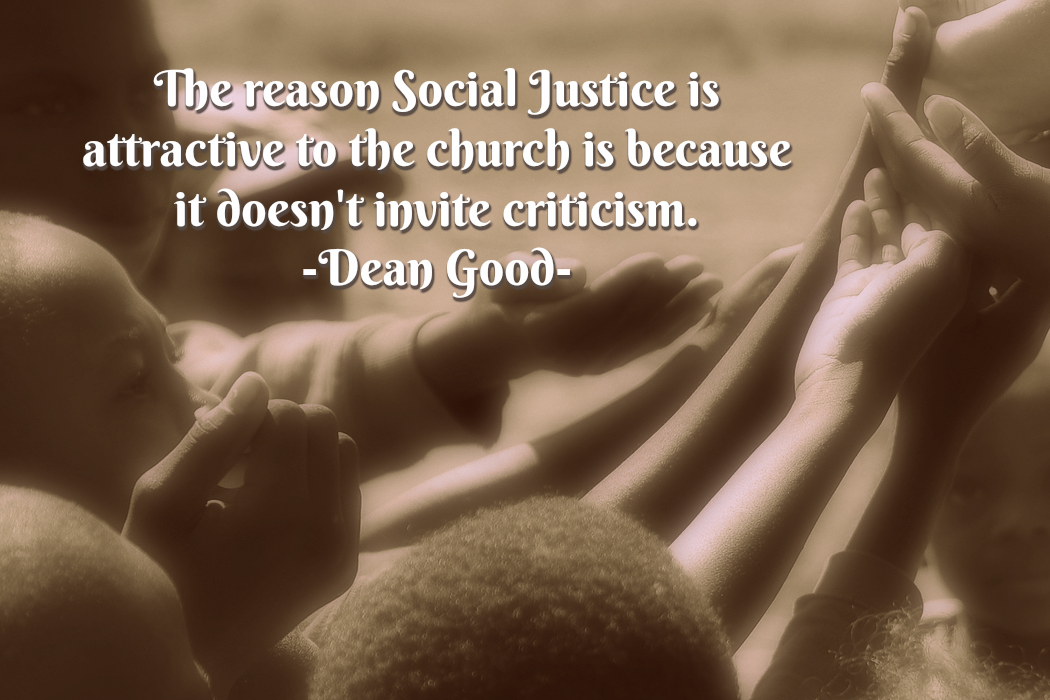
“The reason Social Justice is attractive to the church is because it doesn’t invite criticism.” My brother (Pastor Dean) said these words as we talked on the phone yesterday. I immediately realized just how profound his words were.

Perhaps they are words each and every one of us should reflect upon.

There are many good things the church does that all people love. It matters not if they are Christian or not Christian. Nothing matters as we work hard with our fellow man to make the world a better place. This includes things like–

Feeding the hungry ♥ Adopting orphans ♥ Caring for the homeless ♥ Providing fresh water for third world villages ♥ Providing food, clothing, and shelter to needy families ♥ Giving money to charities

Who in their right mind is going to oppose such things?

And, just to be clear, I am not opposed to these things. And neither should any of us be. The Bible is clear: We are told to care for orphans (James 1:27); we are to help our fellow man– and particularly our Christians brothers and sisters– who are in need (Ephesians 4:28; Hebrews 6:10). These are good things to do.

But these aren’t the only things Christians are to be doing. Doing good for others is just a part of what it means to live a godly, righteous life.

There’s so much more. But the “more” doesn’t often draw the praise of man.

As soon as we go out into the world and preach the Gospel–the clear, unadulterated Gospel as the scripture teaches it–we immediately invite the antagonism, the scorn, and the hatred of the world.

And as soon as we try to teach and live out the Christian life that is clearly mandated in scripture among the murky and muddy waters that is the mainstream church we invite the antagonism, the scorn, and the hatred of that church.

When we bring a message the world doesn’t want to hear, such as you cannot be reconciled to God without believing in Jesus Christ (John 14:6), we will be criticized, mocked, and labeled. We may even be persecuted. By both the world and those claiming to belong to the church.

When we bring a message the mainstream church doesn’t want to hear, such as encouraging believers to practice discernment (Hebrews 5:14), be separate from the world (James 1:27), and strive for holiness (I Peter 1:15-16), criticism and animosity will often rain down upon our head from within the church doors.

This is why so many of us choose to do the Christian things that invite the praise and laud of people. And it’s also why we avoid doing the Christian things that invite criticism.

How much do you care what people think about you? Does this change what you stand for or stand against?

I have to be honest and let you know right up front that this has been–by far–my biggest battle in this ministry.

It is natural for people to want to be liked and I am no exception. I don’t want to be labeled divisive, negative, unloving, arrogant, and whatever other words I have been called.

And yet, over and over again, God continues to remind me that my job is to please Him, first and foremost. As believers, our priority is to do all to the glory and pleasure of our Lord, irrespective of the opinions of man.

The opinions of those around us are, in essence, irrelevant.

Now reflect on that truth for just a few seconds. Why do we do what we do? How do we feel if we do something good and it goes unnoticed? How do we respond when we are faced with a choice to speak out against something we know God hates or a false teacher that is leading someone we love astray? Do we have the courage to share the Gospel unapologetically with the lost all around us? Are we truly living like no one’s opinion matters but God’s?

Inside each of us, a battle rages between the flesh and our new man. And the flesh wants to be pleasing to our fellow man. It is just how we are. But when we are saved, we have a new purpose. We seek first God and His Kingdom (Matthew 6:33). We are new creatures (2 Corinthians 5:17). Everything is changed.

In theory, that is.

In real life, it doesn’t just happen. It is a daily struggle.

However, as new creatures, we must fight this fight. For if we let the flesh win, it is not without deadly consequences. Think of how many children in Christian homes have grown up and gone out to live ungodly lives in the world because parents didn’t want to be unpopular? Think of how many inroads Satan has made into the lives of believers because they want to be cool to their friends? How many have followed false teachers because their Christian friends are afraid to speak up? Think of the light that has gone out in the church because of the desire to win the praise of the world?

If we aren’t willing to be different than the world and if we are driven by a passion to please the world (or the compromised, mainstream church), we will be rendered ineffective for the cause of Christ.

Sure, we can do all sorts of nice things for others and make this temporal world a better place to live in, but if we aren’t sharing the Gospel and pointing people to biblical Christian living, what eternal good are we even accomplishing?

Are we more likely to do the things that draw the praise of man? Do we shy away from the righteous and good things that draw criticism?

Pastor Dean’s words really made me think. And, once again, I was reminded: My priority is to please God.

Am I living to please God or are my daily life choices based on pleasing those around me? It is an important question that we should probably all give some thought to.


My Way or His Way?

In 1969 a song was written by Paul Anka that was made popular by a crooner named Frank Sinatra. The song has a thoughtful and appealing tune and is called “My Way”.  The final stanza of the song does a good job of summing up the song–

For what is a man, what has he got?
If not himself, then he has naught
To say the things he truly feels and not the words of one who kneels
The record shows I took the blows and did it my way
Yes, it was my way

It’s pretty clear that this song is an anti-Christian song since the entire song is like a theme for humanism. The author did things his way and didn’t answer to any supreme being or any human being. Of course, the author will answer to God one day, if he hasn’t already. So why am I talking about a 50 year old song?

I’ll tell you why.

Because I have seen more and more people who claim to be Christians live by this mantra:

I did it my way.

I’ll do it my way.

And then, eventually, in our obsession with our dreams, our purposes, and our goals, we end up believing that…

God exists to help me do it my way.

We are concerned only about our way.

The thing is…

Biblical Christianity teaches the opposite–

• Instead of being obsessed with our own plans and dreams, we are to submit to God’s plans. (Rom 14:8)

• Instead of being driven by our selfish desires, we are to deny ourselves. (Luke 9:23)

• Instead of thinking only of ourselves and our purpose and desires, we are to think of others. (Phil 2:3)

It’s easy to point a finger at others and shake our heads in sadness or disgust. See how selfishly they are living? Isn’t that a shame? But, while we may not ascribe to self-centered living in theory, how often do we live it without realizing it?

I am amazed, even though I have been walking with the Lord all these years, at how often I am driven by my own selfish desires and will. And disgusted at how often I find myself obsessing about myself and my happenings. Can you relate? Or am I alone on this one?

I think one of the greatest challenges of walking with the Lord is this:

Living for Him instead of for me.

And, in this current church culture, we aren’t even given this challenge, are we? We are told that we can live for ourselves and expect God to swoop in and be our personal genie to help us fulfill our big dreams and realize our insanely important purposes.

But God cares far more about our holiness than our happiness. (Romans 5:3-5)

And it’s not about us. Our lives are just a teeny-tiny point on the map of the universe and the timeline of history; both of which are utterly and absolutely under the sovereignty of God. (Isaiah 46:10)

God is choosing to use us for His glory and His purposes at this time. His glory. His purposes. (Ephesians 2:10)

I guess Paul sums it up best for all of us in Galatians 2:20–

I have been crucified with Christ; it is no longer I who live, but Christ lives in me; and the life which I now live in the flesh I live by faith in the Son of God, who loved me and gave Himself for me.

This, as true believers, is our aspiration. We are to die to self and live for God. It is a message that isn’t heard very much anymore. You won’t hear it from most pulpits or read it in the Christian best-sellers. In a culture obsessed with only positive messages, this is a message that isn’t very popular.

Everyone wants to live life their way and they want a God who will bless them as they do things their way. And even those of us who truly desire to live for Christ can be swayed a bit by this wrong thinking about God.

And so I hope that today you will take some time to reflect on how you are living for yourself instead of for God. And while you do that, I’ll be doing the same. Just because I can write things like this, doesn’t mean I don’t struggle with the same things you do. It’s one thing to write. It’s another thing to live.

So let’s strive to live for God together, always turning to His Word for guidance and direction. And, in a world full of people obsessed with doing things “my way”,  let’s do things His way.


Ants and Donuts

A few weeks ago I came downstairs to find ants. Normal-sized ones and teeny-tiny ones* were making themselves right at home on my kitchen counter. I had been fighting a battle with them since it got cooler. I thought we had beat them, although I would still find an occasional one making its lone way across the countertop. Until that morning.

I grabbed some thick sheets of wet paper towel and just started wiping it across the counter, gathering all I could see in my broad swipes, muttering to myself all the while. I. Hate. Ants. Especially in my house.

Nearby sat a container of apple cider donuts leftover from a gathering the night before. I carefully lifted them up in the dim light, twisting and turning the clear container all around. I didn’t have my glasses on but from what I could tell, they looked okay. I breathed a sigh of relief and moved them to the kitchen island where, at least so far, no ants had been spotted.

A little while later, my husband mentioned that the donuts had ants all through them. Rather shocked, I put on my glasses and sure enough! They were all over those donuts. What looked like hundreds of them crawling over, under, and through the holes in the middle.

How could I have not seen them?

I threw the donuts away and went on with my day.

But I’ve been thinking a lot about this incident. There are a few lessons to be learned.

The first lesson that came to mind is that worry and anxiety are like those ants. They crawl in and around and through everything good in our lives and destroy it. While worry and anxiety do nothing to help change the future, they do destroy the present. I think this is why Jesus tells us in Matthew 6:34–

Therefore do not worry about tomorrow, for tomorrow will worry about its own things. Sufficient for the day is its own trouble.

The fact that Jesus mentions this would tell us that worry has always been around. What is the antidote for worry? How do we get to “Do Not Worry”? I am actually still working on that. However, I think there are two things that can really help.

First, and most importantly, we need to fill our minds with God’s Word. His Word fills us with comfort and peace and gives us an eternal perspective. We should memorize a few verses about who God is. And Matthew 6:34 (or even back up a few verses and catch the rest of what Jesus has to say about worry). Saturating our minds with God’s Word will serve us well when the anxieties loom over us and steal our joy.

Second, we need to turn our attention from inward to outward. It is hard to see the needs of others when we are focused on ourselves. We render ourselves fairly ineffective for God’s Kingdom when we are overtaken and haunted by worry and anxiety about the future. But when we can think outside ourselves and serve others, we will find that the thoughts of anxiety and worry will melt away as other thoughts fill our minds.

I believe that our battle with worry and anxiety is a sin because it shows that we are not trusting God or submitting to His will for our lives. I also believe that this sin is one that almost all of us fight at one time or another. The first key is to recognize it as a sin (and not just blame it on our personality or circumstances) and then we need to actively work to eradicate that sin from our lives.

The second lesson from those ants is this: We need our glasses on in order to see the ants. The Bible functions as our glasses. It gives us understanding and shows us who God is, who we are, what sin is, how we can be saved, and how we can grow in Christ. Everything we need for life and godliness is within its pages.

But, too often, we try to navigate life without it. And so we have ants on our donuts but we don’t even realize it! We think all is fine when it’s not fine at all. The Bible not only helps us get rid of the ants, it shows us that the ants exist.

You may think you’d just rather know the ants don’t exist. And I feel that way, too, sometimes. But God’s way is always perfect and finding those ants (and sins!) sooner rather than later is always going to be best for us!

So we need to put on our Bible glasses in order to see ourselves as we really are (instead of our “friend” glasses that have us comparing ourselves to those around us).

And then we need to do something about it. Remember what James says–

But be doers of the word, and not hearers only, deceiving yourselves. 23 For if anyone is a hearer of the word and not a doer, he is like a man observing his natural face in a mirror; 24 for he observes himself, goes away, and immediately forgets what kind of man he was. 25 But he who looks into the perfect law of liberty and continues in it, and is not a forgetful hearer but a doer of the work, this one will be blessed in what he does. James 1:22-25


I don’t like ants, but they did give me something to write about this morning, so as it’s the first day of November I can say, in the spirit of Thanksgiving, there’s even a reason to be thankful for ants on my counter! Have a great day!


*The exterminator told me the really tiny ants were baby ants! Who knew??


When It’s Time to Reap

She sat there in her hospital room, old, confused, and alone. A lifetime of bitterness and grudges and pride was being harvested. Her unforgiving heart and her need to be in control had pushed away most of her friends and family, leaving her to walk through this latest health crisis alone. When one of her children reached out to her, she clung to her pride and her bitterness and pushed them firmly away.

It is, by far, one of the saddest, most heart-breaking things I have ever witnessed. And I was reminded of Galatians 6:7–

Do not be deceived, God is not mocked; for whatever a man sows, that he will also reap.

We reap what we sow. It is a principle of life we cannot escape. If we sow seeds of bitterness and unforgiveness and grudges, those seeds will grow into plants and those plants will produce fruit. Deformed, loathsome fruit.

If we sow seeds of love and grace and mercy, those seeds will produce good and healthy fruit.

But there are other bad seeds to sow, other seeds that produce bad fruit. Galatians 6 goes on to say this in verse 8–

For he who sows to his flesh will of the flesh reap corruption, but he who sows to the Spirit will of the Spirit reap everlasting life.

Any sowing that is done to our flesh will reap corruption. Any sowing that is done to the Spirit yields everlasting life.

BUT, you may be thinking, that old woman is not me. I am sowing good seeds, I have a good relationship with my family and friends. Lest we get too confident in ourselves, I remind you of something that John Stott once said–

“Every time we allow our mind to harbor a grudge, nurse a grievance, entertain an impure fancy, or wallow in self-pity, we are sowing to the flesh. Every time we linger in bad company who’s insidious influence we know we cannot resist, every time we lie in bed when we ought to be up and praying, every time we read pornographic literature, every time we take a risk that strains our self-control, we are sowing, sowing, sowing to the flesh.”

Oh, we all do it. Every. Single. Day. Maybe not to the extent that will leave us old and alone. But we all sow to the flesh, reaping the consequences of our sinful choices.

God sent His son to forgive our sins and give us eternal life. But salvation does not erase the consequences of sinful choices. We continue to live with those until we die.

Thankfully, living a life that is pleasing to the Lord eliminates so many of those ugly consequences. And that is something we can start to do right now! Today! His commands are not burdensome. They protect us! And what a wonderful protection they are.

We cannot change the consequences that we are experiencing from sinful choices of our past. BUT we can change the future. Here are a few questions we should ask ourselves as we contemplate our future harvest:

What seeds am I sowing that will yield an abundance of good fruit?

What seeds am I sowing that are going to yield the fruit of corruption?

AND…

What can I change to make my harvest so much better?


As God has a way of doing so often, He brings just the right book or sermon along at just the right time. That very thing happened this week. If you’d like to think on this topic a bit more, I recommend this sermon by John MacArthur on the principle of sowing and reaping: The Inescapable Law of Sowing and Reaping.


What Are You Willing to Give Up for Jesus?

I was having a conversation with an elementary-aged girl about unicorns a few weeks back. As you are probably already aware, they are currently all the rage. You find unicorns everywhere. They are the theme of birthday parties, plastered on lunch boxes, school supplies, girls’ clothing, and almost everywhere else. I have even seen them on baby clothing at Carter’s.

This little girl was telling me how much she loved unicorns. And then she stopped and looked at me: “Wait. Are unicorns bad?”

I do not know why she even asked me that question. I had not said even a word as she went on and on about how much she loved them. And the conversation took place while I was giving her a ride home in the evening so she couldn’t see my face. But she asked it. She asked me if they are bad.

And I had to answer honestly. I had no interest in bursting her bubble, but, yes, unicorns are bad. These mystical creatures are a symbol of feminism, magic/occult, and the LGBT movement, among other things. (Just do a search and see what shows up. It’s a bit disturbing). But I realize that most people don’t know this so I am not making any judgment on you if there are unicorns in the life of the little girls you love. This post isn’t about unicorns but about this little girl’s response…

I tried to kindly explain that unicorns might not be the best thing to love. But she cut me off and announced matter-of-factly that she didn’t care if they were bad because she loved them far too much. Nothing would make her give them up.

And I had to laugh inside. Not that it was all that funny. But how often are we just like that little girl? How often do we respond exactly like her? We are not willing to give up what we love even if God clearly directs us from His Word that we should do so.

Whether it’s unicorns or it’s–

• A TV show, book series, or music genre that we just love but recognize, deep-down inside, that it shouldn’t be a part of our lives.

• An unbiblical church that isn’t preaching truth…but all of our friends are there.

• Bad habits of eating too much, spending too much, drinking too much, knowing full-well we are not pleasing our heavenly Father.

• An unsaved boyfriend or girlfriend that, in our flesh, we want to date.

• Some secret sin that no one knows about or a secret place we go or a secret vice we cling to.

• A grudge or unforgiving heart towards someone that we love to nurse.

• Our penchant for gossip, or “white” lies (a lie is a lie, btw), or cheating our bosses or perhaps even the government (on our taxes).

• Allowing worry and anxiety to consume us and control our lives.


And we respond like the little girl:

I don’t care if it’s wrong, I am going to do this anyway.

Can you see how a seed of rebellion shows it first green leaves at this declaration? Oh, we may not say it out loud or even in our thoughts, but we know. We know when we are holding on to something sinful with an unwillingness to budge.

And this is when a wall starts to grow between us and the Lord.

Jesus says that if we love Him, we will keep His commandments (John 14:15). James tells us we must submit to God so that the devil will flee from us (James 4:7). Peter tells us to turn away from our former lusts and to be holy (I Peter 1:14-16). Paul tells us this same thing in Ephesians (Ephesians 4:22-24).

When we refuse to put away worldly, ungodly things that we know full well are sinful we are quite effectively blocking our own growth as a believer. Rebellion is what caused Satan to be removed from heaven (Isaiah 14:12-15) and it’s what led Eve to eat that apple (Genesis 3). She wasn’t going to let God tell her what was good and evil. She could decide for herself.

How often do we have this same attitude? God, I’ll obey you in this, this, and this but I am not going to give you that. I can make up my own mind about that and I don’t need to submit to you.

But these little decisions and behaviors do not go unnoticed by the God who loves us. I wonder if He grieves at our selfish, spoiled child mentality of wanting what we want and refusing to give it up?

We know that sinful choices always lead us away from Him. And as they lead us away from Him, they are moving us towards heartache, chains, and despair. Affairs, addictions, and broken relationships all begin with a seemingly insignificant decision of rebellion. But, even if it’s not going to lead us into something like that, we know that every sinful choice takes us just a step further away from pure fellowship with God. Rebellion always does this.

I am not here to give you a list of what you can and cannot do, where you can and cannot go, what you can and cannot watch or listen to. But, instead, I simply want to encourage you, as a believer, to follow your conscience. Listen to that niggling doubt that is in the back of your head. Ask the Lord to open your eyes to your sin and to any choices that are leading you away from Him. Be willing to surrender your own will and desires to the God who loves you.

I write this to myself, as well. Maybe mostly to myself. I found this to be oh, so challenging. A supposedly insignificant conversation with a little girl about unicorns filled me with conviction over how I can be so rebellious in the “little” sinful things I refuse to give up.

Maybe that little conversation will convict you, too, which is why I decided to share it.

Just what are we willing to give up for Jesus? What are we willing to give up so that we can have the best possible relationship with Him? Is any sin or selfish choice worth a break in our fellowship with our precious Lord and Savior?


The Issues Behind the Issues

We have become a people that responds to issues. Whether it’s our own emotional health (anxiety and depression) or our kids well-being (ADHD, anger issues, rebellion), our situations at work and church (relationship problems), or our marriages (struggles and strife) we work hard to find an escape hatch very quickly. We want to be free of the hassle, inconvenience, grief, and pain that these things bring. And so we quickly medicate, change jobs or churches, or leave our spouse.

Before I continue on, let me be clear about something. I am not judging you individually. I know that some people legitimately need medication, that sometimes we must change jobs or churches, and that there are even times that warrant leaving our spouse. So please know that this is not about any individual but rather about a trend I have been noticing.

It is easier to take the escape hatch than to wade through the unpleasant waters to fix the issue. It is easier to just fix something temporarily than to take the time to fix it for the long haul. Tape is easier to apply than digging and drilling and nailing.

So I do get it.

But there are almost always deeper, spiritual issues behind the issues we can see.

A hyperactive child may be crying out for discipline. Refusing to discipline in a biblical way leads to undisciplined, uncontrollable children.

An angry child may be frustrated by the lack of control he feels because mom and dad are always fighting or perhaps because something happened that they just don’t want to tell you. Instead of parenting to the issue, it is critical that we get to the bottom of things.

An anxious woman has an issue with trusting God and submitting to His will for her life.

An angry man may be struggling with his loss of control over his circumstances.

A struggling relationship at church or work is driven by envy or jealousy.

And sometimes there is no big underlying issue but it’s just a certain stage in our lives or our children’s lives that we must walk through.

And on and on and on the list goes.

But as a culture we have been conditioned to simply fix problems without digging deeper. When we do dig deeper it is through the use of a humanistic psychologist and not through God and studying His Word or even by using a biblical counselor. (This is a tricky area because even a lot of “Christian” psychologists and counselors use a lot of human wisdom that is in complete opposition to what God’s Word teaches. See here for more information.)

And there is nothing wrong with getting the right outside help. Sometimes our pastor or a good biblical counselor or even a friend can help us see things we can’t see. But may I suggest that we first pray and ask the Lord to guide and direct us and start digging into His Word to see if there is something we are missing?

I know that as I have struggled with terrible bouts of anxiety and depression these past few years that it has been a sin issue for me. Yes, I have had a tremendous amount of change in my life over the past 5-7 years, some that I saw coming and some that I did not. And, yes, I have hormones that are wreaking havoc in my body. And, yes, owning a business and having a ministry that is not the most popular can be extremely stressful. But at the end of the day, it was a sin issue. I was not trusting God, I was self-centered and self-absorbed, and I was not in submission to God’s Will for my life. Plain and simple.

I thank the Lord that He showed this to me. It was extremely painful (another reason we avoid digging beyond the issue) and it’s not over yet. I still have days of great struggle and pain. I share this to hopefully encourage you because I know that I am not alone in this. Others have shared with me their struggles in this area.

But mostly I share this because I think it is so important that we do a little digging and wading through the gunk before we find that escape hatch. I believe that we must give some effort and prayer before we head to the pharmacy or walk away from a situation. Perhaps this is just the thing that God is using to teach us and/or our children an important lesson. Perhaps by lessening the pain, we are actually missing out on learning something very important. In our urgency to diminish the pain and grief and hassles, we may be missing out on something very glorious.

And so today I want to encourage you to spend some time in prayer and God’s Word and to be patient as you work through issues in your life and the lives of your children before heading for that escape hatch. God is so faithful and He will meet your needs–sometimes in ways you could never even have imagined! But when we are so quick to fix our own problems, we miss out on seeing His provision.

And sometimes…

We can’t fix the issue. And God doesn’t fix the issue. That doesn’t settle very well with our 21st century selves. We believe we should be able to fix everything. But sometimes God allows a situation in our lives that remains unresolved. Just like Paul’s thorn in his flesh, we plead for it to be removed and God says no. But we know from 2 Corinthians 12:7-10, that we can rest in God’s sovereignty even when this is the case. God has a reason and we can trust Him (Romans 8:28-30).

Life is not fun and we are burdened with all kinds of heartaches and frustrations living in this fallen world. But God is faithful and will meet our needs. But we are so often caught up in fixing and solving our own problems that we leave little opportunity for God to work in the way that only He can.

So let’s take some time to figure out the issues behind the issues, praying and asking the Lord for guidance as we study the Word to find out what He has to say on the matter. And let’s do this first rather than as a last resort.


What Determines Truth for You?

“You can’t argue against someone’s experience”

“But this book {that doesn’t line up with scripture} helped me and made me feel closer to God.”

“We play rock music in our church service {or have sermons based on movies or hold church poker nights} because it makes the unsaved feel comfortable and want to come.”

These are all things that I’ve heard people say at least once. Some more than once. And it makes sense to them. If something works why not use it or read it or do it?

In other words, truth is determined by consequences.

Pragmatism first became popular in the late 1800s and was introduced to society by several different men–two of whom you may recognize. John Dewey (instrumental in creating the public school system) and C.S. Lewis, the “Christian” apologist. I use quotes because C.S. Lewis’s beliefs and interests were actually not all in line with the Cristian faith (see here and here and here for more information). I continue to remain amazed and dismayed that he has become so respected in the Christian world.

There are some real problems with the ideology of pragmatism for a Christian. Although Christians try to join their biblical beliefs with this philosophy all the time, we can see how pragmatism is a slippery slope that leads us away from scripture.

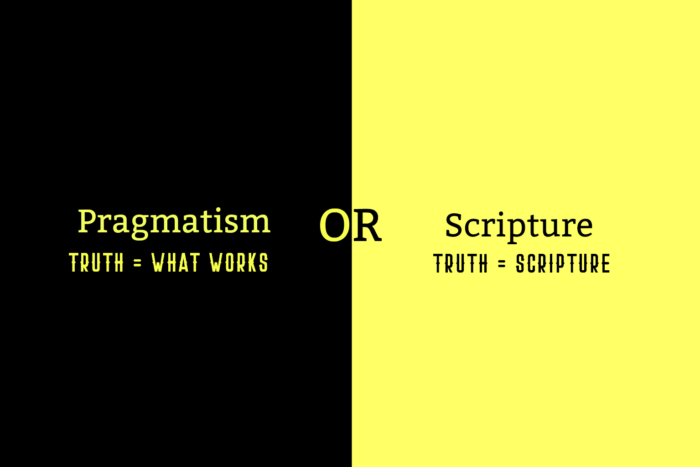
First, we have to recognize that only one thing can determine truth. Is it scripture or is it by what works? We can’t philosophically have it both ways. We will have to make a choice.

For instance, take the Christian who reads a book that makes them feel good but has a message that does not align with scripture and then they go on to recommend that book to all of their friends. They have chosen pragmatism over scripture. By default, they have made the choice to elevate the consequences (their good feelings) over what the Bible says.

Or take a church that brings in secular rock music or worldly movies to their services. They nobly profess to do this to make the unbeliever comfortable. This works. But, again, they are elevating what works (unsaved in their pews and feeling comfortable) over what scripture teaches (Love not the world or the things that are in the world I John 2:15).

In fact, that church had already given in to pragmatism when they realized that their numbers would increase if they chose to market to the unsaved rather than to follow the biblical church model. In scripture we find that the local church isn’t for the unsaved but for the saved; and that it doesn’t exist to make us feel comfortable but to encourage, teach and support us as we strive to grow in holiness. Comfort is never the goal of church. For saved or unsaved. And, yet, pragmatism, would say that comfortable = increased numbers at church. See how this works?

Can you see how this has infiltrated and changed everything?

It has crept into our own lives far more than we even realize. I wrote in this post how I was struggling to get through Jeremiah and mentioned to my brother (Pastor Dean) that I just wasn’t enjoying that particular book of the Bible. He laughed and reminded me that the Bible wasn’t for my enjoyment but to teach me about God. Oh, how dismayed I was to realize that I was viewing my personal Bible reading pragmatically! I was judging my Bible reading by how it made me feel.

Can you see how seductive this belief is? How invasive and natural it has become for us to judge things in this manner? We see it not only in churches, but on a large scale in the corporate world, in the academic realm, and everywhere else. It has invaded en masse and it’s not going anywhere soon.

But we can’t have it both ways. We can’t have our experience determine truth and the Bible determine truth. If we don’t intentionally set a line in the sand and say we choose the Bible, I can almost guarantee that we will be lured away into this dangerous and faith-squashing philosophy.

Second, we have to recognize that if truth is determined by consequences, then it must follow that truth is changeable. What works one year may not work another year. What worked in the past may not work in the future.

But God tells us that truth never changes. His Word is the same yesterday, today, and tomorrow. It is the same forever. Isaiah 40:7-8 puts it like this–

All flesh is grass,
And all its loveliness is like the flower of the field.
The grass withers, the flower fades,
Because the breath of the Lord blows upon it;
Surely the people are grass.
The grass withers, the flower fades,
But the word of our God stands forever.”

Peter repeats this thought in I Peter 1:23-25

Since you have purified your souls in obeying the truth [i]through the Spirit in [j]sincere love of the brethren, love one another fervently with a pure heart, 23 having been born again, not of [k]corruptible seed but [l]incorruptible, through the word of God which lives and abides [m]forever, 24 because

“All flesh is as grass,
And all[n]the glory of man as the flower of the grass.
The grass withers,
And its flower falls away,
25 But the[o]word of the Lord endures forever.”

From these verses we know that God’s truth does not change. Current culture does not change it. Modern desires and demands do not change it. Because truth doesn’t change.

The Bible remains a blessed anchor in the midst of a world where “truth” is what anyone wants it to be. Where “truth” is what works for that moment.

Pragmatism is a big word but it has literally affected each and every one of us. It is important that we examine our hearts and lives for the fruits of this deadly philosophy that so easily and subtly slip in.

Because we know that the Scripture does determine truth and we know that the truth we find there never changes. What a relief in this ever-changing and mixed-up world!

*A link for further research–

ThoughtCo:What is Pragmatism?

Cultivating A Healthy Soul (Why we need both the positive and the negative to be healthy Christians)

Something that has disturbed me greatly over the past ten or so years is the belief that if a message is positive it is good and righteous and if a message is negative it is bad and sinful.

Where did this belief come from? For it is certainly not from the Bible. (Actually I do know where this belief originates and there is a link further on in this post for those of you who would like to know, too.)

Jesus Himself tells us to look out for false teachers, to deny ourselves, to expect hatred from the world, explains the awful (and extremely negative) things to expect in the last days, and calls out and even severely criticizes false teachers. These would not be called positive messages by anyone’s standards.

Paul follows the example of Jesus and encourages us to confront fellow Christians living in sin, publicly calls out those who have left the faith, and encourages all of us to examine our lives for sin. Again, not positive by anyone’s standards.

Thankfully, both Jesus and Paul also abound in positive messages. The Bible provides the perfect balance of both because the Bible is the holy and inerrant Word of God.

Yesterday I heard an illustration by A.W. Tozer regarding this very thing. It had to do with the human body and how it stays healthy. It so impacted me that I actually did an online search to find it in print. I found it in a book called Gems from Tozer. Here is a brief portion of it–

The healthy soul, like the healthy blood stream, has its proper proportion of white and red cells. The red corpuscles are like faith: they carry the life-giving oxygen to every part of the body. The white cells are like disbelief: they pounce upon dead and toxic matter and carry it out to the drain. Thus the two kinds of cells working together keep the tissues in good condition. In the healthy heart there must be provision for keeping dead and poisonous matter out of the life stream. This the credulous person never suspects. He is all for faith.*

I have been thinking about this since I heard it and how applicable this comparison is to our spiritual lives. I even did some further research. What happens if our blood is out of balance? Without getting too technical, I thought I’d give a quick overview. The field of medicine is not my field (by any stretch of the imagination) so hopefully I get this right–

Too Many Red Blood Cells: The condition of the body creating too many red blood cells is called polycythemia vera. This slow-growing cancer actually can sometimes be symptom-free. But whether the person feels it or not, the blood is thickening and the blood flow is slowing down, which can lead to all kinds of issues, including death. You can be feeling great but still have this fatal disease. Thankfully, the medical world has developed a treatment for this cancer and those that have it can expect to live a fairly normal life as long as they make regular visits to the hospital for treatment. But the key here is that this can cause symptoms in a person or it might not but, either way, the over-production of these red blood cells will eventually cause death if there is no treatment.

Too Few Red Blood Cells: The condition of having too few blood cells is called anemia. Most of us have heard of this. It is a condition that leads to sluggishness and exhaustion. When the red blood cells are working properly they distribute oxygen and also carry carbon dioxide to your lungs from other parts of the body to be exhaled. If there aren’t enough red blood cells they can’t do their job and it keeps the body from functioning properly.

Too Many White Blood Cells: This condition is called leukocytosis. Elevated white blood cell count can be caused by many things–leukemia, infection, stress, immune system disorders, and smoking can all lead to an elevated count. High white blood cell count is an indication that something is wrong in the body and the body is working to fight against it.

Too Few White Blood Cells:Called leukopenia, this condition leaves your body at risk for other infections. This is the reason that some patients die from diseases and infections unrelated to their original diagnosis. Chemotherapy will often cause this and this is why cancer patients must be so concerned about catching colds. Without a proper white blood cell count, the body is in grave danger.

Okay, so let’s pretend that the red blood cells are the happy, positive thoughts and words and white blood cells are the negative, unpleasant thoughts and words.

We obviously need both in order to have a healthy soul.

If we only focus on the happy and the positive, we may not realize it, but we will be putting our souls at peril. We may feel great but, meanwhile, a deadly lethargy is invading our blood stream while we are blithely unaware. However, if we never focus on the good and positive things, we put ourselves at risk for an apathy in the faith. We will lack vibrance and joy. We won’t encourage, we won’t be lifting others up, and we will have a tired and lackluster faith. Both extremes lead to a severe and harmful imbalance.

And, of course, if we only focus on the negative and unpleasant, constantly talking only about how bad this world is and making sure everyone knows every false teacher that is out there, then this is an indication that something is not quite right with the health of our soul. We should never be so focused on the negative that we completely ignore the positive. But, on the opposite side of things (and where I believe more people are) are those that never want to focus on the negative and believe it to be a sin. These folks put their souls in grave danger. They have compromised their spiritual immune systems and are at risk to fall for all kinds of false teachings and wrong belief systems.

We can see that none of these are ideal. And just as we shouldn’t have too many or too little of red or white blood cells, we also shouldn’t be spiritually imbalanced when it comes to our focus on the positive or the negative.

As I mentioned above, I believe that there are few that focus on the negative. That type of life style has been so maligned that we have been almost (not quite but almost) led to believe that someone who focuses on the negative is not a Christian. And they most certainly aren’t a good Christian, even if they are one. After all, negative words aren’t kind words (according to most) and the majority of Christians don’t want to be known as the negative, unkind one (not understanding that “unkind” is being defined by this culture and not by it’s historical definition).

I think far more of us have bought the lie that positive messages are all we should speak. That negative words are sinful. This is what we are being taught in so many different ways. Whether it’s the latest “Christian” books, TV preachers, popular blogs and podcasts, social media, and even sometimes in our own churches, we find that we are praised by men for speaking the positive and uplifting and we are marginalized and condemned for speaking the negative and discerning. Ironically, and tragically, the truth seems to be irrelevant.

Of course, if we are serious about our walk with the Lord we desire to have a healthy soul. We want to be obedient and submissive children. So how do we do this? We do this by getting our instructions for living from the Bible and not from pop Christianity or humanistic psychology. What does the Bible teach? What does the Bible say?

2 Timothy 3:16 can get us started–

All Scripture is given by inspiration of God, and is profitable for doctrine, for reproof, for correction, for [a]instruction in righteousness,

There we find both the positive (doctrine and instruction in righteousness) and negative (reproof and correction). If you have time, do a study of this topic in God’s Word.

For it is only by knowing what God has to say about this that we can defend ourselves against the plethora of lies that abound around the idea of “positive thinking” (which is an occult/new age teaching, by the way! find out more at this link).

We must have a balance of the positive and the negative; of both love and truth; both grace and justice. Leaning one way or the other will cripple our souls and hinder our work for Christ.

May we be filled with plenty of red blood cells–positive, encouraging, happy thoughts and words that carry life and oxygen to our souls and to the Body of Christ and may we also have a healthy amount of white blood cells–discerning the true from the false, diligently removing and warning of the toxins that threaten our own soul as well as the souls of other believers. For both are critical to cultivating a healthy soul.


*Tozer, A. W.. Gems from Tozer: Selections from the Writings of A.W. Tozer (Uqp Poetry) (Kindle Locations 625-629). Moody Publishers. Kindle Edition.

Other resources:

https://www.mayoclinic.org

http://blog.insidetracker.com/45247913486-high-white-blood-cell-count-what-you-should

 

Scroll to Top