Current Events

What Determines Truth for You?
“You can’t argue against someone’s experience”

“But this book {that doesn’t line up with scripture} helped me and made me feel closer to God.”

“We play rock music in our church service {or have sermons based on movies or hold church poker nights} because it makes the unsaved feel comfortable and want to come.”

These are all things that I’ve heard people say at least once. Some more than once. And it makes sense to them. If something works why not use it or read it or do it?

In other words, truth is determined by consequences.

Pragmatism first became popular in the late 1800s and was introduced to society by several different men–two of whom you may recognize. John Dewey (instrumental in creating the public school system) and C.S. Lewis, the “Christian” apologist. I use quotes because C.S. Lewis’s beliefs and interests were actually not all in line with the Cristian faith (see here and here and here for more information). I continue to remain amazed and dismayed that he has become so respected in the Christian world.

There are some real problems with the ideology of pragmatism for a Christian. Although Christians try to join their biblical beliefs with this philosophy all the time, we can see how pragmatism is a slippery slope that leads us away from scripture.

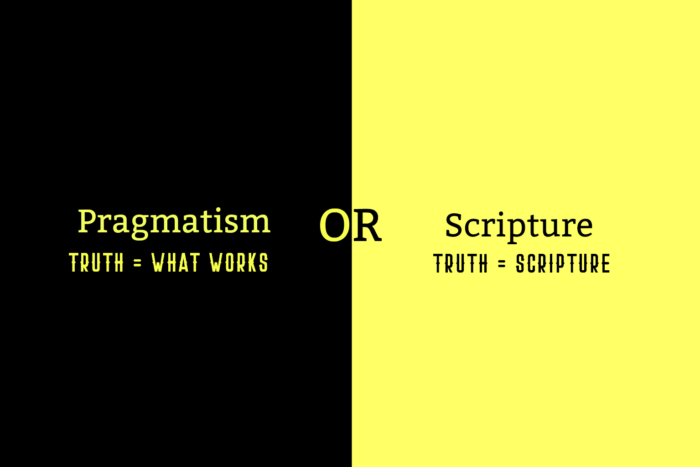
First, we have to recognize that only one thing can determine truth. Is it scripture or is it by what works? We can’t philosophically have it both ways. We will have to make a choice.

For instance, take the Christian who reads a book that makes them feel good but has a message that does not align with scripture and then they go on to recommend that book to all of their friends. They have chosen pragmatism over scripture. By default, they have made the choice to elevate the consequences (their good feelings) over what the Bible says.

Or take a church that brings in secular rock music or worldly movies to their services. They nobly profess to do this to make the unbeliever comfortable. This works. But, again, they are elevating what works (unsaved in their pews and feeling comfortable) over what scripture teaches (Love not the world or the things that are in the world I John 2:15).

In fact, that church had already given in to pragmatism when they realized that their numbers would increase if they chose to market to the unsaved rather than to follow the biblical church model. In scripture we find that the local church isn’t for the unsaved but for the saved; and that it doesn’t exist to make us feel comfortable but to encourage, teach and support us as we strive to grow in holiness. Comfort is never the goal of church. For saved or unsaved. And, yet, pragmatism, would say that comfortable = increased numbers at church. See how this works?

Can you see how this has infiltrated and changed everything?

It has crept into our own lives far more than we even realize. I wrote in this post how I was struggling to get through Jeremiah and mentioned to my brother (Pastor Dean) that I just wasn’t enjoying that particular book of the Bible. He laughed and reminded me that the Bible wasn’t for my enjoyment but to teach me about God. Oh, how dismayed I was to realize that I was viewing my personal Bible reading pragmatically! I was judging my Bible reading by how it made me feel.

Can you see how seductive this belief is? How invasive and natural it has become for us to judge things in this manner? We see it not only in churches, but on a large scale in the corporate world, in the academic realm, and everywhere else. It has invaded en masse and it’s not going anywhere soon.

But we can’t have it both ways. We can’t have our experience determine truth and the Bible determine truth. If we don’t intentionally set a line in the sand and say we choose the Bible, I can almost guarantee that we will be lured away into this dangerous and faith-squashing philosophy.

Second, we have to recognize that if truth is determined by consequences, then it must follow that truth is changeable. What works one year may not work another year. What worked in the past may not work in the future.

But God tells us that truth never changes. His Word is the same yesterday, today, and tomorrow. It is the same forever. Isaiah 40:7-8 puts it like this–

All flesh is grass,
And all its loveliness is like the flower of the field.
The grass withers, the flower fades,
Because the breath of the Lord blows upon it;
Surely the people are grass.
The grass withers, the flower fades,
But the word of our God stands forever.”

Peter repeats this thought in I Peter 1:23-25

Since you have purified your souls in obeying the truth [i]through the Spirit in [j]sincere love of the brethren, love one another fervently with a pure heart, 23 having been born again, not of [k]corruptible seed but [l]incorruptible, through the word of God which lives and abides [m]forever, 24 because

“All flesh is as grass,
And all[n]the glory of man as the flower of the grass.
The grass withers,
And its flower falls away,
25 But the[o]word of the Lord endures forever.”

From these verses we know that God’s truth does not change. Current culture does not change it. Modern desires and demands do not change it. Because truth doesn’t change.

The Bible remains a blessed anchor in the midst of a world where “truth” is what anyone wants it to be. Where “truth” is what works for that moment.

Pragmatism is a big word but it has literally affected each and every one of us. It is important that we examine our hearts and lives for the fruits of this deadly philosophy that so easily and subtly slip in.

Because we know that the Scripture does determine truth and we know that the truth we find there never changes. What a relief in this ever-changing and mixed-up world!

*A link for further research–

ThoughtCo:What is Pragmatism?

“Wordless” Christianity

Jesus told us the way would be narrow (Matthew 7:13-14), but this is starting to take on new meaning, isn’t it? If we don’t look past the surface then the Christian road looks pretty wide. There are still so many all over the world that go to a “Christian” church every Sunday and that claim to have a relationship with God. But when we start to scratch away at that bright exterior, what we find underneath is ugly.

While claiming to have a relationship with God, these “Christians” have divorced themselves from the Word of God.

What does this mean? It means that they are biblically illiterate, they do not live their lives according to the Word, and they do not hold the Word has their authority for their “Christian” life.

Their feelings, their desires, their dreams have that place and their “Christianity” is there to help them achieve their dreams and to escape pain.

Wordless Christianity is not Christianity. Let’s be clear on that, shall we? Christianity that is not based on the Bible is not Christianity. It’s just another false religion that has hi-jacked the name.

The Bible has been the anchor of Christianity since its inception. In other words, always. And, yet, more and more increasingly, we find ourselves defending the Bible in our conversations with…

…other Christians.

What is wrong with this picture?

And we find ourselves vastly discouraged and–if we are honest–left wondering if we have missed something. Maybe we are the ones who are wrong?

Until we go back to the Bible and recognize that not only does it re-confirm what we believe but that every thing taking place fits right into God’s timeline for the last days in an incredible and awe-inspiring kind of way.

Wordless Christianity is like a cancer. It is infiltrating and consuming even the most conservative of churches. And as it does so, we find that there is really no place for those who still hold to the Word. Churches that aren’t based on the Bible do not want pesky little congregants that keep reminding them that they have left the straight and narrow. And so, eventually, this person ends up doing one of two things. They shut up or they leave.

If you are in a good church where the Bible is still upheld as the authority and your pastor preaches the hard truths from scripture along with the pleasant ones, consider yourself blessed.

But many–maybe even many of you reading this–are struggling to find a solid church. It is such a sad situation.

As this wordless Christianity takes over we find it also affecting the Christian culture. When you unhook Christianity from the Bible then anything goes. And, suddenly, it is okay to do just about anything and still call yourself a Christian. The only verse that most seem to know is Matthew 7:1 “Judge not” and this is used completely out of context on a regular basis. If you mention anything as a sin–anything at all– you are judgmental. And this is the greatest and gravest sin of all (according to the Christian culture).

So what to do?

There is nothing really to do but to hang on for dear life to God’s Word. Is is our only anchor. Our churches, our favorite celebrity preachers, our favorite singers, our families, our friends may fail us. They may lead us away from the Word. We must stay in the Word, knowing it by studying it so that we can give a proper defense of biblical Christianity (I Peter 3:15) and so that we can discern truth from error (Acts 17:11; I Thessalonians 5:21).

Historical Christianity has always viewed the Bible as sufficient, as its authority, as its very lifeblood. Since the first book of the Bible was written, it has served as an authoritative source of comfort, strength, guidance, correction, rebuke, and growth. It has always been recognized as a special book unlike any others.

Satan recognizes the power that is in this Book and so this gives us a greater understanding of his monumental effort to detach Christians and Christianity from the Holy Bible. And he’s done a spectacular job, hasn’t he? It would seem fairly clear that this battle has been won–at least in America.

So how do we respond?

I believe we must encourage others to study and know the Bible. Nothing is more important. In a culture where most people simply watch video clips or mindless TV, this is a challenge. In a culture where books that are geared to the individual’s fixing specific problems and helping them achieve their dreams are the best sellers, this is a challenge.

But let us remember–the battle is the Lord’s and, one by one, He calls those who are His (John 6:44). May we be used by God to aid and encourage the few who seek to find the Truth and join us on the narrow way.


Is This Really Happening?

I have to admit that I am absolutely astonished at the most recent turn of events in the evangelical world. But, if we are honest, we could see this coming for some time now.

If you are completely out of the loop of what’s going on, let me fill you in briefly.

In the last ten or so years, there has been a tremendous push by some key evangelical leaders, particularly Tim Keller, Russell Moore, along with others, to add social justice issues to the Gospel of Jesus Christ. In plain language, they are putting the need to be socially just (keep in mind this is a communist term and never anywhere in scripture) as a necessary addition to the Gospel in order to be right with God.  They have both implied as well as clearly stated that true Christians should and will be socially just in order to be saved. This is exploding with the race issue. The sexual orientation issue isn’t far behind with the help of Sam Allberry.

This is just wrong on so many levels. Of course, there is a call as believers for us to care deeply for others and to hold no bias. These things are clearly the outcome of a saved and transformed life. But they take it too far. They are promoting anti-biblical, marxist ideas under the guise of the Gospel. They are adding things to the Gospel that are simply not in scripture. To find out more about it, please read this awesome post by John MacArthur: No Division in the Body. He expresses very clearly what is going on and it’s frightening and, frankly, incredibly strange.

Most of the men involved are part of the Gospel Coalition. They are pastors and authors who, in the past, have been trustworthy and biblical. The other organization that is functioning as a driving force behind this movement is The Ethics and Religious Liberty Commission of the Southern Baptist Convention. So why would they do this? Why would they add to the Gospel?

In an effort to speak out against this atrocity, some men have gathered to create “The Statement on Social Justice and the Gospel”. Here are the first two paragraphs of the introduction–

In view of questionable sociological, psychological, and political theories presently permeating our culture and making inroads into Christ’s church, we wish to clarify certain key Christian doctrines and ethical principles prescribed in God’s Word. Clarity on these issues will fortify believers and churches to withstand an onslaught of dangerous and false teachings that threaten the gospel, misrepresent Scripture, and lead people away from the grace of God in Jesus Christ.

Specifically, we are deeply concerned that values borrowed from secular culture are currently undermining Scripture in the areas of race and ethnicity, manhood and womanhood, and human sexuality. The Bible’s teaching on each of these subjects is being challenged under the broad and somewhat nebulous rubric of concern for “social justice.” If the doctrines of God’s Word are not uncompromisingly reasserted and defended at these points, there is every reason to anticipate that these dangerous ideas and corrupted moral values will spread their influence into other realms of biblical doctrines and principles.

I encourage you to read this entire document. This is what is going on in the evangelical circles and it is a BIG deal. The document was created for pastors, leaders, authors, and anyone else to sign as an affirmation of their position on biblical truth regarding this issue.

There are a {very} few familiar names who have openly given their support to this document. John MacArthur, Voddie Baucham, Phil Johnson, James White, and Justin Peters have all affirmed and signed it.

But I am gravely concerned about something Pulpit and Pen brought to light recently regarding this document:

It is heart-breakingly revealing to observe those who will not or have not signed.

Al Mohler, D.A. Carson, Mark Dever, David Platt, Matt Chandler, J.D. Greear, Ligon Duncan, Steve Lawson, Tim Challies, and Tim Keller (of course) have not signed it. Along with other trusted authors and pastors.

Why is this? Why wouldn’t they?

Could it be that these men we have trusted to lead us in the right direction are actually going in the wrong direction? Is that a possibility?

It does make one wonder but, of course, we obviously can’t know why these men haven’t signed this document. Wrong direction or peer pressure or even ignorance?

However–no matter the reason–we should be extremely concerned if they haven’t. I have read the document and it asserts what every Bible-believing Christian from the last two thousand years should assert.

I am writing this today to make you aware of what’s going on and to also encourage you to write to your favorite authors and pastors and ask them to sign this. If they actually get back to you and let you know that they refuse, ask them why. (And, yes, I have signed it, just in case anyone is wondering.)

Christianity is being divided into two very different and opposing camps. One is marxist, socialistic, communist, melt-right-into-the New World Order and the other is the tiny, shrinking remnant that is left of true biblical Christianity.

Put on your life jackets and buckle your seat belts. I have a feeling this sea is going to get rougher.


What Does the Bible Say About…(Being Relevant)?

I am not sure I can remember when the church wasn’t caught up in relevance. I guess when I was a child it was only beginning, but, even then, the “Jesus Music” had already been birthed and the direction had been set to bring in worldly entertainment. Looking even further back, there was a move to wed the church to the world in philosophy. I am sure Satan places some of his greatest effort into wooing the church with the world, since this renders the church ineffective.

And that is exactly what we have seen. A church caught up in being like the world becomes the world. The true Gospel disappears in the frenzy to stay relevant.

And what a futile task. It is impossible to stay relevant in a world that changes constantly. At first, it was only music. What is wrong with that? Throw out the stuffy hymns and bring in something new! But new grows old rather quickly and, since we have become a people fixated on “new”, we always need something different, something greater, something better. And so we have seen a steady increase in bringing in the latest, greatest thing. I have even heard of a church that brought in a strip tease act! Can you even imagine?

But how can this be?

Because the church’s people aren’t hungering for the right thing. Because the church’s people are most likely goats and not sheep.

Funny how the Bible never, ever mentions relevance. The passage that is most often used to defend relevance is in I Corinthians 9, so let’s unpack that a bit here today–

verses 19-23–For though I am free from all, I have made myself a servant to all, that I might win more of them. 20 To the Jews I became as a Jew, in order to win Jews. To those under the law I became as one under the law (though not being myself under the law) that I might win those under the law. 21 To those outside the law I became as one outside the law (not being outside the law of God but under the law of Christ) that I might win those outside the law. 22 To the weak I became weak, that I might win the weak. I have become all things to all people, that by all means I might save some. 23 I do it all for the sake of the gospel, that I may share with them in its blessings.

There are three differences to Paul’s style of evangelism and that of the modern day church’s style (that uses this passage to back up their warped view of evangelism)–

1. Paul was not interested in pleasing the world or making sure he was good friends with someone before sharing Christ. He had only the Gospel in mind. Nothing else. All he did was for the sake of the Gospel. This is far different from what we see today, where there seems to be a race to see how much we can be like the world and still be a Christian. And what we can see is that with this style of living, the Gospel becomes irrelevant and old-fashioned and eventually disappears altogether.

2. Paul was not willing to sin in order to share the Gospel. When Paul says that he will be like certain groups of people, he did not mean he would participate in their sinful activities. How do we know this? We know this because that would conflict with a hundred other passages Paul wrote to us about the Christian life. That means Paul wouldn’t have hung out at a bar drinking with his buddies and getting tipsy. He wouldn’t have sat down at a poker table and gambled away his day’s wages. He wouldn’t have joined his friends at the movie theater to watch a film filled with sex and violence. And he certainly wouldn’t have sanctioned bringing in worldly entertainment into God’s holy church. Paul would never advocate compromise with sin. Thinking that this is what that passage means is taking it completely out of the context of the rest of Paul’s writings.

3. Paul was a servant. Paul did what he did with a servant’s heart and not a selfish heart. He did so with a humble heart and not a prideful heart. This is very different than what we see today as people talk about what they can do or don’t have to do under the banner of the freedom that’s found in Christ. While there may be a pretense of service, when the veneer is stripped away, we find it’s really about feeding one’s appetite for the world and justifying it.

Darby sums up this passage very nicely in his commentary–

“It was the power of charity which denied itself in all things, in order to be the servant of all, and not the selfishness which indulged itself under the pretence of gaining others. He did so in every respect for the sake of the gospel, desiring, as he said, to be a partaker with it, for he personifies it as doing the work of God’s love in the world.”

So what did Paul mean with those verses? I think a comparable example in today’s society would be something like this–

If I am going to minister to the homeless on the street, I am not going to wear high heels and diamonds. If I am going to minister to the wealthy, I am not going to dress in rags. I will do all I can do–without sinning–to be like the group I am with, in order to gain an audience in which to share the Gospel.

This is a far cry from what we are hearing and seeing today. And, honestly, the church that brings in the world is so far gone as to have separated herself from the true church now. The true colors are finally showing. But there are still some walking the fence and it is to those that I address this post.

God never sanctions fence-walking. He demands we clearly pick a side. I John 2:15 makes it clear–

Do not love the world or the things in the world. If anyone loves the world, the love of the Father is not in him.

As does James 4:4–

You adulterous people! Do you not know that friendship with the world is enmity with God? Therefore whoever wishes to be a friend of the world makes himself an enemy of God.

We cannot be friends with God and be friends with the world. The two are mutually exclusive. And because of this, we know that the mainstream church has swallowed a lie that has led to her demise.

But what saddens me beyond measure are the many, many true churches that have swallowed this lie and have made or are making this final compromise that will lead to their death. It is tragic. And it is everywhere.

While there is probably little most of us can do to change the wrong direction of the churches, there is much we can do personally. Let’s keep ourselves from falling prey to the lie that we need to be “like the world in order to win the world”. In our personal Christian life and evangelism, may we be like Paul: Doing all out of a heart of charity, with a passion to live a holy life, and all for the sake of the Gospel.


Six Hated Truths from the Word

I have been thinking recently about the specific things the Bible teaches that the world hates. And, along with this, about just how many in the church are scrambling about trying to appease the world and to change and twist what the Bible says. What it has always said.

It’s a strange place we find ourselves in as Christians committed to the inerrant, inspired, and sufficient Word of God. We are labeled bigots, unloving, intolerant, etc. simply for believing what the Bible teaches. Of course, if anyone who said that knew anything about history at all, they would know that true Christians aren’t any of those things and, in fact, are responsible for much that is good in this world. But that’s another post for another day.

So what does the Bible teach (that we believe) that is so distasteful to the world and to a worldly church that is trying to appease and be like the world? (By the way, I will give only one or two verses below for each point but each of these things is an integral part of the Christian faith, as written in the Bible. They aren’t mentioned just once or twice but in several–and often many–places, so that there is no question about interpreting them correctly. This leaves us confident that there is no hidden or different interpretation than that which has always existed.)

First, Jesus is the only way to heaven. Oh, this is one that is hated and that seems so unfair. How could a kind and loving God only provide one way to spend eternity in heaven? And I have to confess that I don’t understand myself. But I believe this with the understanding that I am finite and small and God is infinite and perfect. Jesus said “I am the way, the truth, and the life. No man comes to the Father except through Me.” (John 14:6) No man comes to the Father except through Jesus Christ. A hard truth to swallow for many. This is why universalism is pushed so hard today–both outside the church and within. Many popular authors and preachers are now preaching that everyone can be saved, no matter if they believe in Jesus or not. There is even a video with Billy Graham saying this very thing.

Second, forsaking our sin is part of the deal. In Luke 5:32, Jesus says this: I have not come to call the righteous, but sinners, to repentance. Repentance is a conversion from sin to God. From sin to God. We can’t have both. But the world wants their fire insurance from hell and their sin. As do many who claim Christ. And so talking about sin and forsaking it is no longer even a thought to those in the world and it has also completely gone out of vogue in many churches.

Third, Christians are called to holiness. I Peter 1:13-16 couldn’t make this any clearer:

Therefore gird up the loins of your mind, be sober, and rest your hope fully upon the grace that is to be brought to you at the revelation of Jesus Christ; 14 as obedient children, not conforming yourselves to the former lusts, as in your ignorance; 15 but as He who called you is holy, you also be holy in all your conduct, 16 because it is written, “Be holy, for I am holy.”

Being a believer is a sober and serious task. We are to turn away from who we were in our efforts to become more Christlike. As believers, we are in a lifetime battle with our flesh. Few want to hear this news and so this doctrine is generally ignored.

Fourth, works must back up our claim to faith. James couldn’t make this any clearer:

But do you want to know, O foolish man, that faith without works is dead? James 2:20

But, just in case, you need more evidence for this unpopular truth, Jesus confirms James words in Matthew 7:18-20:

A good tree cannot bear bad fruit, nor can a bad tree bear good fruit. 19 Every tree that does not bear good fruit is cut down and thrown into the fire. 20 Therefore by their fruits you will know them.

We can expect good fruit from the life of a true believer. There may not be a lot and their “tree” may be unhealthy but there will be some fruit to back up their claim of being a believer in Jesus Christ.

I find it interesting why this one causes so much conflict. This same truth holds forth in all aspects of life. If my husband tells me he loves me, I can and will expect that to be evident in how he treats me. If we say we are committed to our job, we will expect to see that commitment played out in our lives or else we will know it is a lie. If it is like this in all of life, then why, in claims of faith in Christ, is it so distasteful and hard to believe that actions must match words in order for the words to actually be true?

Fifth, we are not to love the world. This does not mean we are not to love the people in the world or that we are to become hermits in the deep woods never talking to anyone. Obviously, we are commanded to share the Gospel, so we know that this can’t be what it means. We can go to a few places in scripture to help us understand what separating from the world does mean–

James 1:27   Pure and undefiled religion before God and the Father is this: to visit orphans and widows in their trouble, and to keep oneself unspotted from the world.

I John 2: 15-17 Do not love the world or the things in the world. If anyone loves the world, the love of the Father is not in him. 16 For all that is in the world—the lust of the flesh, the lust of the eyes, and the pride of life—is not of the Father but is of the world. 17 And the world is passing away, and the lust of it; but he who does the will of God abides forever.

While we can (and most certainly should) show love and kindness to the people of the world, we should not love the same things they do. The actual ramifications of this are staggering, when you think of it. How many Christians do you know who love the same things that their ungodly friends love? Gambling, drinking, partying, the way women dress, entertainment, anger, language, gossip, slander–why it is downright hard to tell the difference anymore between Christians and non-Christians if we look at these things. And, yet, the Bible clearly shows that this should not be. And so separating ourselves from the world is abhorred by those who desire the things of this world or just don’t have the courage to look different from the world.  This leaves us with a weak and ineffective church. For how can you encourage someone to new life in Christ if your life looks just like theirs? What do you even have to offer?

Sixth, homosexuality is a sin. I guess we could see this one coming back in the 80s. Right around the time Murphy Brown had her child out of wedlock and Dan Quayle was crucified for mentioning the immorality of this, I think I knew things were changing. Anyone else remember that? When we start tossing out the morality of the Bible, anything goes. We shouldn’t be surprised. And so the world doesn’t just hate that homosexuality is labeled a sin, it hates that anything is labeled a sin. This really stems back to the rebellion that lives in the hearts of the unredeemed. Christians may cave to the desires and the name-calling and the pressure, but it doesn’t change the truth. All sex outside of marriage between a man and woman is sin. Here are a few verses to confirm this–

I Corinthians 7:2 Nevertheless, because of sexual immorality, let each man have his own wife, and let each woman have her own husband.

I Timothy 1:8-11 Now we know that the law is good, if one uses it lawfully, understanding this, that the law is not laid down for the just but for the lawless and disobedient, for the ungodly and sinners, for the unholy and profane, for those who strike their fathers and mothers, for murderers, 10 the sexually immoral, men who practice homosexuality, enslavers,[b] liars, perjurers, and whatever else is contrary to sound[c] doctrine, 11 in accordance with the gospel of the glory of the blessed God with which I have been entrusted.

Romans 1:26-27 For this reason God gave them up to dishonorable passions. For their women exchanged natural relations for those that are contrary to nature; 27 and the men likewise gave up natural relations with women and were consumed with passion for one another, men committing shameless acts with men and receiving in themselves the due penalty for their error.


If we read on in Romans 1, we will find a description of our current culture–

And since they did not see fit to acknowledge God, God gave them up to a debased mind to do what ought not to be done. 29 They were filled with all manner of unrighteousness, evil, covetousness, malice. They are full of envy, murder, strife, deceit, maliciousness. They are gossips, 30 slanderers, haters of God, insolent, haughty, boastful, inventors of evil, disobedient to parents, 31 foolish, faithless, heartless, ruthless. 32 Though they know God’s righteous decree that those who practice such things deserve to die, they not only do them but give approval to those who practice them.

And so this is where we are. Believing the unpopular truths that the Bible teaches in a culture that hates the God of the Bible. But believing or not believing what the Bible teaches doesn’t change the truth. And the truth is that the Bible is TRUE. It has been proven over and over. There is an incredible and miraculous validity to the scriptures. The Christian faith that has been passed down since its inception is solid and true. No matter what others like or don’t like; believe or don’t believe.

If we can remember this, it will help us stand strong and confident–not in our own selves. Never in our own selves. But in the Word of God. The Holy Bible that was given to us by God in order to know Him and to make Him known.

So let us stay true to the Word, no matter if the whole world turns against us. And remember–

What then shall we say to these things? If God is for us, who can be against us?

(Romans 8:31)


What Is Your Litmus Test?

The other day I was at a Christian Writer’s Conference for an afternoon session. During the couple of hours I was there, the teacher said something like this:

I love the book The Shack. Don’t you just love that? It was an awesome book. I know some people say it is blasphemous, but I just don’t really care. I just loved that book! 

She went on to talk about the beauty of the story. Now, this was a Christian speaking these words. Not once did she talk about the Word of God or why someone might say it is blasphemous when comparing the book’s message to what scripture says. (I’ll attach a few links about The Shack below, for those that may not already realize the danger.)

Her litmus test for truth appeared to be her feelings. Since her feelings gave her the “go ahead” to read, enjoy, and promote that book, no other test was necessary. And she is certainly not alone. I find that, today, most people’s litmus tests are their feelings and experience. This is true for even most Christians.

If it feels right, it must be true. If I feel happy and at peace when I do something, then it must be right.

But this can’t and should never be our litmus test for what is true and right. We know from scripture that we dare not trust our own thoughts, feelings, inclinations, and instincts–

The heart is deceitful above all things,
And desperately wicked;
Who can know it? (Jeremiah 17:9)

There is a way that seems right to a man, But its end is the way of death. (Proverbs 14:12)

This tells us the state of our hearts and minds and it isn’t a pretty picture. Our feelings, thoughts, experiences, and, above all, our hearts cannot be trusted.

Think of all the places we get led because we trust these wrong things–

• They lead us out of marriages simply because of discontentment (he’s not meeting my needs and I’m not happy)

• They lead us into new age beliefs about spiritual things (But this is such a wonderful and comforting message)

• They lead us into alcohol, drug, sexual, and even technology addictions (one time, one peek won’t hurt…)

• They lead us into not being the parents we should be (I am not going to discipline like I should because I don’t want my child to hate me)

• They lead to forsaken families and broken relationships (I will fulfill this dream at all costs and no matter who I have to hurt to get there)

• They lead to financial troubles (I must have that new thing, even if I can’t afford it)

Our feelings, desires, and thoughts lead us right off the straight and narrow and onto the miry and pitted path of worldly troubles–the kind we could avoid. For, as believers, God has made a way for us to bypass these pitfalls–but it’s only if we turn away from following our feelings and relying on our experiences, and, instead, submit to God and obey His Word.

But we so often don’t. Because we want so badly to trust our own selves. And the world tells us we should trust ourselves. We are told to follow our hearts and our dreams. And this appeals to us because we want our own way. We want to read that popular book or go to that questionable place or fulfill that selfish dream. Running any of it through the litmus test of scripture could put these things in jeopardy. Feelings are much more apt to take us where our flesh wants to go–at least where it wants to go at first. We rarely think of the long-term ramifications.

And so this is where we find ourselves. In a world where the Bible has little influence–even for most Christians.

During this same day where the woman promoted The Shack, I had the interesting experience of hearing people (who claim to be Christians) tell the group who their favorite non-fiction Christian author is. Not one--not one–was a biblically solid author. And this at a Christian conference.

Why?

It is because most Christians aren’t using the Bible as their litmus test, they are using their feelings. And most Christians aren’t holding the Word as the authority of their lives, for their experiences have that holy place.

I wanted to shout out to that group of people–what are you doing? Why can’t you see? But I restrained myself. I can’t fix this. You can’t fix this. God will open the eyes of His true children in His timing. I will take opportunities as He provides them, but I won’t force them.

All we can do is make sure that we–as a quickly shrinking remnant of Bible-believing Christians–follow the example of our Christian brothers and sisters throughout the ages:

1. Have the Bible as our final authority and only litmus test

2. Know the Bible and live according to what it teaches

3. Submit our whole lives to God and obey Him

4. Have the courage to stand for what’s right and according to scripture despite the slander, gossip, accusations, and hatred

5. Be willing to sacrifice our friends, family, material possessions, and even our very lives, if necessary


*Find helpful articles that compare The Shack to what scripture teaches here and here.


Before We Can Learn to Discern

Isn’t it hard these days to keep with the plethora of false teachers and the deluge of false teaching that are flowing into the church?? It used to be fairly subtle but now it’s an all-out war on biblical, historical Christianity. Personally, I find it incredibly discouraging. Never in a million years did I see this coming.

Last year I wrote a series on how we can learn to discern (you can find it here). I am placing this post at the beginning of that series because it provides a critical step we need to take in our efforts to discern.

People will sometimes ask me about a specific teacher and I am happy to do a little research and see what I can find out. It usually isn’t too hard to figure out if you know what you are looking for.

So how can we know what to look for? Who am I to tell you? Who is anybody to tell you?

See, this has become a very real issue in this world of strong opinions. On what opinion do you stand? And why do you stand there?

There’s really only one way to know and that is through complete and utter reliance on the Word of God and what it teaches. Before we can learn to discern–and as we are learning to discern–we must spend consistent, daily time in the Word, approaching it with humble submission and a spirit of obedience.

When we do this and when we take the Bible at face-value (literally) from beginning to end we will find it makes so much sense. Especially in light of what we are experiencing these days.

The Bible predicts a one-world religion. We are watching all religions–including Christianity–being funneled into a global religion even as I write this. This shouldn’t surprise us. God told us it would happen. (Revelation 17:1-18). This understanding gives us a framework, doesn’t it? Whether it happens tomorrow or in a hundred years, we understand Satan’s game plan. We know what he is working towards. (GodQuestions.org has a good (and brief) article on this here.)

We also find out in our Bibles that justification is by faith in Christ alone (Romans 10:9-10 and many, many other places). This means that any religion–no matter how “Christian” it sounds–is a false religion if it requires any works as part of salvation. We know that any religion is false if it takes the focus off of the finished work of Christ on the cross.

We find out in God’s Word that He condemns drunkenness, sorcery, homosexuality, rebellion, impurity, dissensions, fits of anger, impurity, obscene language (Galatians 5:19-21; Colossians 3:5-9). Knowing this helps us intelligently discern in the world of entertainment and in living our daily lives. We not only know that entertainment that incorporates these things should not be regular part of the Christian’s life, but we also know that anyone or any organization that promotes these things is not the real deal. I’m not judging motive or eternal destiny here. People get confused. I am no judge. But what we can know is that they are off biblically and we shouldn’t follow them.

So these are three examples from the Word to show how it helps us to discern. You see, it is hard for me or anybody to keep up with all the false teachers that are out there. But if we are studying our Bibles with the right heart, we will be amazed at how God will open our eyes to what is going on. We will become more aware the more we study the Bible.

So what about the people who seem to study the Bible all the time and don’t discern at all? This has been a conundrum I have faced for a long time. How does that work?

There are so many things that can keep us from really seeing the truths of scripture, no matter how much we read it–

1. A proud heart. Many people approach the Word with their preconceived ideas of what they want it to say, what they wish it would say, what they think it should say. God will not give insight to the person who studies the Bible with preconceived notions. We have to humble ourselves and yield ourselves to Him and His message. (How arrogant of us to think we know better than He does? But we can all fall into this trap.)

2. A fearful heart. I believe another very real issue is that the ramifications of really believing what the Bible teaches is frightening. The way is narrow? My husband…daughter…mom & dad…are not saved and that means…? It is not a pleasant message. (But, as we all know, pleasantness is irrelevant when it comes to truth. Many people face the Bible’s message in a very different way than they would ever face an unpleasant medical diagnosis. Can you imagine ignoring a deadly disease and pretending it’s just not there??)

3. A heart that loves sin. This is probably the biggest thing that hinders believers in their biblical discernment. We Christians love our sin. And reading the Bible with a heart to obey means we are willing to give up our sin. But many are just not willing to do this. Whether it’s sexual immorality, sorcery, occasional drunkenness, ungodly entertainment, an unforgiving heart–whatever it may be–many of us hold on to these things for dear life, believing (mistakenly) that we can’t possibly be happy without them.

Do you have any of these attitudes as you approach the scripture? I know I certainly have had them and still do at times. This isn’t a black and white issue. We must be constantly checking our heart as we go before the Lord each day. We must be examining ourselves (2 Corinthians 13:5) on a regular basis to make sure our hearts aren’t becoming hardened.

Recognizing that scripture is our final authority and our only legitimate way to know who God is and what His plan is for mankind will be the first healthy step in learning to discern. As we get ourselves into the Word with a humble heart willing to turn away from sin, we will be surprised at how aware we become of all that God is ready and willing and wants to teach us as we study His Word consistently.


Christians and Politics

There are a lot of really big political issues going on right now with really strong opinions coming from both sides. But I guess this is nothing new. Throughout history, there have always been enormous issues in every nation and people who have had strong and opposing opinions about them.

This can lead to arguments, debates, and even mean comments on social media. Whether it’s at work, on the sidelines, at family gatherings, or on our social media account, we all hear opinions about political matters.

So today I want to take a look at how we deal with those who are coming from the opposite world view than we are. What should be our protocol as believers when a “Big Issue” comes up?

1. Remember that, as a believer, we are not here to push a political agenda. I can’t think of anywhere in scripture that God gives instructions to believers to moralize their country. Now–don’t get me wrong–there isn’t anything wrong with working in government or helping a ministry that is working towards this, but this is not our main purpose. Our purpose is to share the Gospel. We are here as instruments of God to share His Good News. If we can remember that this is our purpose, rather than pushing a political agenda we feel strongly about, it naturally changes our attitude, doesn’t it? Matthew 28:19-20 reminds us of our greatest calling as believers–

Go therefore and make disciples of all nations, baptizing them in the name of the Father and of the Son and of the Holy Spirit, teaching them to observe all that I have commanded you. And behold, I am with you always, to the end of the age.

2. Remember that any issue involves real people. Whether it is our President and his family, immigration, the LGBT agenda, or any other hot button topic, they involve real people who have feelings. Any opinion we choose to give, no matter what it is, should be respectful and kind. We’d best stick to the issue at hand rather than lashing out in attacks towards the people involved. There is no room in a Christian’s life for mean, ugly words about others, no matter what the issue. Matthew 7:12 makes this clear–

So whatever you wish that others would do to you, do also to them, for this is the Law and the Prophets.

3. Remember that debates and arguments are generally useless. If someone has a really strong opinion, no amount of debate is going to change their mind. Thoughtful and intelligent conversations about the issues can be useful in understanding the opposition’s point of reference but vehement debates and angry attacks only make things worse. Proverbs 18:13 encourages us to hear before we talk–

If one gives an answer before he hears,
    it is his folly and shame.

4. Remember that everything is in God’s Hands. Sometimes we may be tempted to panic as we watch things take place in this world that we never could have imagined. But God knows exactly what is going on. He is completely sovereign over all that is taking place and we do not need to panic if we can’t change our culture. Proverbs 21:1 says it this way–

The king’s heart is a stream of water in the hand of the Lord;
    He turns it wherever He will.

5. Remember that our opinion will be part of a shrinking minority. Why are we so surprised about this? We are not part of this world. We don’t belong here and never have–even though we have made ourselves pretty comfortable in the Christianized nations most of us found ourselves living in for awhile. With nations that are no longer “Christianized”, we find ourselves a bit distraught. But we shouldn’t be confused or dismayed by this turn of events, as we are told to expect this throughout scripture–

John 15:18-19If the world hates you, know that it has hated me before it hated you. If you were of the world, the world would love you as its own; but because you are not of the world, but I chose you out of the world, therefore the world hates you.

Acts 14:21-22 When they had preached the gospel to that city and had made many disciples, they returned to Lystra and to Iconium and to Antioch, strengthening the souls of the disciples, encouraging them to continue in the faith, and saying that through many tribulations we must enter the kingdom of God.

I John 3:13 Do not be surprised, brothers, that the world hates you.

And these words by Jesus describe the end of the age in Matthew 24:9-14

Then they will deliver you up to tribulation and put you to death, and you will be hated by all nations for my name’s sake. 10 And then many will fall away[a] and betray one another and hate one another. 11 And many false prophets will arise and lead many astray. 12 And because lawlessness will be increased, the love of many will grow cold. 13 But the one who endures to the end will be saved. 14 And this gospel of the kingdom will be proclaimed throughout the whole world as a testimony to all nations, and then the end will come.

So, you see, we are not, as a general rule, going to land on the “politically-correct” side of these big, political issues if we are standing with biblical conviction. There isn’t anything wrong with speaking our opinion in a respectful and kind way, but don’t expect to be lauded for it. Unless you are with a group of like-minded Christians, you will most likely be mocked and ridiculed. We must expect this instead of being so hurt and troubled by it.

But guess what? So many who have gone on before us have had to stand against popular opinion, as well. We can look back at so many–the Roman Christians, the Huguenots, the Reformers, the Puritans, the Christians under Hitler’s regime, and so many more–who stood strong in the face of adversity. We have a long history of standing strong behind us. May we follow their examples.

—————————————————————————-

These big issues can be overwhelming but it is my hope this morning to help us remember that our main purpose in life is not pushing some political agenda. Instead, it is sharing the Gospel and encouraging others towards a biblical walk with Christ. Doing the work of God is our main priority and it is incredibly important that we do not let political agendas build walls between us and the lost.  Or even us and other believers. We must remember what is our main purpose.


Simply Broken or Thoroughly Dead?

There is a really big difference between a body that is broken and a body that is dead. A body that is just broken means there is still hope it can be fixed. A body that is dead brings only hopelessness.

Paul declares that we were dead in our trespasses. Dead. Without any hope.

Ephesians 2:4-5 puts it like this–

 But[c] God, being rich in mercy, because of the great love with which he loved us, even when we were dead in our trespasses, made us alive together with Christ—by grace you have been saved—

This is really in a bit of a contrast to today’s common theme of “brokenness”. While there is nothing inherently wrong with the word “broken”, is this the best term to describe us before our redeemed state?

You see, broken would imply that there is something worth fixing in humans.

But we were not broken. We were dead. Utterly and completely dead in our trespasses and without any hope at all.

When we realize this truth from Ephesians 2, we also realize just how miraculous God’s mercy and grace are. Raising us from spiritual death is far greater and much more amazing than fixing us when we are broken. Wouldn’t you agree?

God didn’t just fix us, he raised us from the dead and made us alive!

A lot of this goes back to the doctrine of total depravity, which would state that all men are born sinful and dead in their sins. This is clearly in scripture from Genesis to Revelation (Ephesians 2 is just one place of many) but it is also a very distasteful doctrine. And, so, over the past years, the mainstream Church has started to be more lax on this particular doctrine, until eventually instead of dead we are just broken. And instead of hopeless in our sins, we are hopeful in our brokenness.

Can you see how this changes the essence of salvation? How it diminishes the sacrifice of Jesus Christ on the cross?

Suddenly, it becomes about Jesus fixing us rather than raising us from the dead.

Sure, it’s semantics, but I believe this is important because it takes some of the credit and glory from God and puts it squarely on us. And, yet, scripture makes it clear that this is not the case (Romans 3:11-18)–

None is righteous, no, not one;
11     no one understands;
    no one seeks for God.
12 All have turned aside; together they have become worthless;
    no one does good,
    not even one.”
13 “Their throat is an open grave;
    they use their tongues to deceive.”
“The venom of asps is under their lips.”
14     “Their mouth is full of curses and bitterness.”
15 “Their feet are swift to shed blood;
16     in their paths are ruin and misery,
17 and the way of peace they have not known.”
18     “There is no fear of God before their eyes.”

What does the Bible teach about human depravity is the question we must ask, and, once again, we find that what the Bible teaches is in complete opposition to what most of modern-day “Christianity” is teaching.

It is disconcerting, quite frankly, to always find myself in such opposition to what is being taught in the mainstream. Sometimes I feel like I must be wrong. That I must have missed something in my Bible. The doubts come but then I go back to the Word. What does the Bible say? And, again, I see that even though I am part of a quickly shrinking minority, the rock of the Word will not fail. No matter what the mainstream church says, no matter what they do, no matter how they persecute and mock us, we can hang on to the anchor of God’s Word with the assurance that God will keep us safe and secure.

We, who were dead in our trespasses are now alive in Christ! How awesome is that? So, let us not grow weary in standing on the truth of God’s Word and let’s hold each other up in prayer and through fellowship.

And let’s, by all means, continue to hold to the doctrines of the Bible that must be upheld for if we do not, we will find our own faith completely eroded into the man-centered, God-diminished thing we see in the lives of so many around us. God be with you as you stand for Him this week.


The Untouchables

A few months ago I posted something negative about a man that was much beloved by the Christian world. What I posted was based on his documented actions of unity with a false religion and his recorded words on video where he said he does not believe Jesus is the only way. But because this man was so beloved, I was greatly attacked on both social media and personally. In fact, I lost both readers and perhaps even a few friends over this.

This has happened to me before with a few other men and women that I have spoken up about and I have come to realize that there are certain people one must never talk about if one does not want to be maligned, gossiped about, and openly attacked. I have deemed these the “untouchables”.

They have become such a part of the fabric of Christianity that even solid believers are unwilling to take a hard look at their actions and words–even if they conflict with scripture.

So who are these “untouchables”? There are a few similarities I have noticed among them–

1. They generally begin their ministries in a biblically solid way. While they may not hold to orthodox beliefs, their initial books and teachings will hold few things that conflict with the traditional interpretation of scripture.

2. They generally have friends in high places. Not only are they trusted by the masses, but they are trusted (and lauded and praised) by men and women that we trust.

3. They generally do and encourage a lot of good things. They promote the things that almost all people have a heart for: Helping others; Loving Jesus; Loving others; Unity.

4. They generally do not accept the biblical account of creation or at least leave the door open for evolution.

5. There is always a gradual and subtle creep away from what scripture teaches. This is slow and sure. It will always happen.

So what does it matter? If they’ve done a lot of good, why not leave them alone?

I would ask this: Can it possibly be God’s definition of “good” if the teacher is leading his followers off of the narrow way and on to the broad way?

Can someone’s good outweigh the bad when it comes to the health and destiny of people’s souls?

We are a culture that is obsessed with following people. Movie stars. Athletes. Musicians. And, yes, even pastors and Bible teachers. This blind obsession often leads to an unbiblical loyalty and trust that reassures us that we can stop discerning.

I saw a quote by Mike Gendron the other day that sums up why this is so dangerous–

One of the most troubling problems within the church today is the unwavering loyalty to a “Christian” personality rather than to Christ and His Word. The unwillingness to test every man’s teaching with God’s Word, coupled with a stubborn lack of discernment, produces fertile ground for deception to flourish.

And that is exactly what we have these days–a fertile ground for deception to flourish because of unwavering loyalty combined with a stubborn lack of discernment.

Look, I am not so naive to think that I can change the world with a blog post. This is the Christian world we live in and my blog post isn’t going to change anything. But here’s what I hope to do this morning–

I hope to encourage you (and myself, too) to not let any man or woman become an “untouchable” in our lives. Everyone we read or listen to should be held to the authority of scripture. And when someone says something negative about someone we dearly admire and trust, then we should be willing to take an honest look at what they are saying and compare it to scripture (rather than attacking the messenger, as is so often the case). We must be careful to let no man or woman receive a pass on teaching what is right and true simply because we like them or because discernment happens to be dreadfully unpopular.

I know it’s a discouraging, time-consuming, and exhausting task to hold teachers and preachers and authors up to the light of God’s Word. We are living in an age where deception is flourishing and discernment is viewed as sinful. It’s not fun to be in this camp. But it is not only necessary if we want to stay on the straight and narrow, it is what we are commanded to do as believers.

I leave you with this verse (I Thessalonians 5:21)–

Test all things; hold fast what is good.


Scroll to Top