
Christianity

Here Lies a Man…

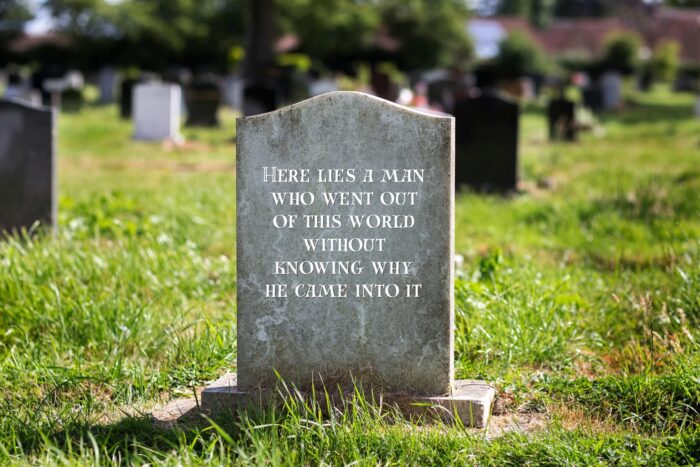
Yesterday, My Sunday School teacher (also my father-in-law) shared this epitaph that someone had found on a tombstone:

Here lies a man who went out of this world without knowing why he came into it.

Is that not one of the saddest things you ever heard? To never know purpose? To flounder and to wander through this world, always asking the question “why am I here?”

I don’t believe he is the only person who died not knowing why they were born. And even those who find some semblance of purpose through their jobs, their manmade religions, their families, or charity work still feel empty if they take a moment to actually examine their hearts and be honest with themselves.

This is because we all have only one true purpose and that is to worship, glorify, and obey the One True God in the way He demands, according to His Word, the Holy Bible.

There is rebellion in a man’s heart that keeps him from having a natural desire to do this. And so he searches in all kinds of places, hoping to fill that desire to worship with inferior, temporal things.

It’s only when we bow our knee to Jesus Christ and turn to Him alone as our Savior from sin and death, that we can even begin to understand our true purpose in this world. Jesus is not just one way. He is the only way to be right with God (John 14:6).

We can choose to bow our knee to Jesus Christ now and acknowledge Him as Lord….or we will be forced to do this later. It’s our choice. God leaves it up to us. For now.

Paul puts it like this—

Let this mind be in you, which was also in Christ Jesus: Who, being in the form of God, thought it not robbery to be equal with God: But made himself of no reputation, and took upon him the form of a servant, and was made in the likeness of men: And being found in fashion as a man, he humbled himself, and became obedient unto death, even the death of the cross. Wherefore God also hath highly exalted him, and given him a name which is above every name: That at the name of Jesus every knee should bow, of things in heaven, and things in earth, and things under the earth; And that every tongue should confess that Jesus Christ is Lord, to the glory of God the Father. (Philippians 2:5-11)

Believing this—that Jesus is our Savior and Lord and our only way to be right with God—is life-changing.

I came across these verses yesterday (also from Philippians) and found myself meditating on them and what they mean for me (and for you) today, in this current time we find ourselves living in.

Here’s what Paul writes—

But what things were gain to me, those I counted loss for Christ. Yea doubtless, and I count all things but loss for the excellency of the knowledge of Christ Jesus my Lord: for whom I have suffered the loss of all things, and do count them but dung, that I may win Christ, And be found in him, not having mine own righteousness, which is of the law, but that which is through the faith of Christ, the righteousness which is of God by faith: That I may know him, and the power of his resurrection, and the fellowship of his sufferings, being made conformable unto his death; If by any means I might attain unto the resurrection of the dead. Not as though I had already attained, either were already perfect: but I follow after, if that I may apprehend that for which also I am apprehended of Christ Jesus. Brethren, I count not myself to have apprehended: but this one thing I do, forgetting those things which are behind, and reaching forth unto those things which are before, I press toward the mark for the prize of the high calling of God in Christ Jesus (Philippians 3:7-14).

Paul tells us to follow him as he follows Christ (I Corinthians 11:1). His example has been providentially given to us by God. If this is true, then what can we learn or be looking to attain for our own lives, based on this passage from Philippians?

First: All things are considered loss when compared to Christ. Counted as garbage, even. While these verses are nice to read, they are very difficult verses to actually live out. God has been revealing some idols in my life over the course of the last few months. Things that have taken too high of a priority in my life. While it can be painful, I am so thankful that God is opening my eyes to this.

Second: Christ alone is my righteousness. We stand before God clothed in Christ’s righteousness. There is nothing good in us and we can do nothing to make ourselves right with God (Isaiah 64:6, Romans 3:10) Any good works we do for the Lord should be because we love Him, and not because we need to do them to attain salvation or because we think He will be mad at us if we don’t do them. We can get a little mixed up with our motivation for good works, can’t we? Even those of us who know and believe this truth with our whole hearts.

Third: We must stop looking behind us and press toward the mark. One of Satan’s biggest tricks is to get us focusing on all we’ve done wrong in the past. Or to imprison us in our disappointments, our grudges, our unmet expectations of yesteryear. Again, easy to read and be inspired by these verses, but much more difficult to actually live out.


As we approach Resurrection Sunday and take time to reflect on what Christ has done for us, may we also reflect on the change His victory at the cross has wrought in our own lives.

May we remember our true purpose and turn from those temporal things that call to us, demanding our allegiance. May we turn back yet again with bowed knee and surrendered heart to the One who loves us most.


A Look Back

The other day, while searching for something on Amazon Prime, a movie was suggested on the screen that we had watched years ago. We wouldn’t watch that movie today as God has so kindly been gradually convicting us of the things we set before our eyes since that time. There are many things I “used to watch” that I wouldn’t choose to watch today.

Sometimes I can find myself thinking even today, “oh, it probably wasn’t that bad” and turn something on for nostalgia’s sake. However, I almost always end up turning the movie or show off because I realize now that it simply doesn’t please the Lord. Sometimes it’s hard to turn something off. Mostly, I don’t miss my old entertainment but I need to be honest with you—sometimes it’s hard.

But when we saw that specific movie on the screen, my husband and I started talking about some friends that had encouraged us to watch it along with other things that were simply not beneficial to any believer. We had a period of time where we watched a lot of popular tv and movies and the reason for this was because of these friends, as we had mostly avoided it earlier in our lives.

When we started to drift apart from these friends, we were very, very sad. We had appreciated our friendship with them. However, we got used to life without them in it and moved on.

It wasn’t until we saw the movie pop up on the screen the other evening that we realized that God took something that was sad and hurtful to us, which certainly didn’t seem “good” to us at the time, and He used it to protect us and to move us away from something that was hurting us spiritually. We never really thought of that before.

And I have been thinking of two things to consider from this look back at our lives…

First, it’s a vivid reminder that God really does work all things for our good (Romans 8:28). But it doesn’t always feel good. And it doesn’t always seem good. And we might not know for years and years later of any good that came from it. Perhaps we may never find out. But we need to trust Him. We need to trust that God is good and that He will fulfill His promise: If we love Him, then all things will work for our good.

Second, it’s a convicting reminder to be the kind of friend that encourages and builds up our friends in the Lord, rather than the kind of friend that leads people towards worldliness and sin.

It’s not just about entertainment—although that is a sadly overlooked problem among those who profess Christ. It IS a big deal and it changes us, whether we believe it does or doesn’t.

I can’t even begin to express how much difference it made in my walk with God as I intentionally began to remove worldly entertainment filled with bad language, sexual immorality, violence, and vain humanistic philosophies (the most subtle of all! and found in even the most innocuous entertainment) from my life. Not that I ever watched, listened to, or read really bad stuff. We can always rationalize, can’t we?

Even today, I can still catch myself trying to rationalize. Thankfully, I am now at least aware that I need to really pay attention to what I am allowing in my mind. I really encourage you to do the same.

Entertainment of all kinds—what we watch, listen to, and read—is a big old open door for Satan to implant his philosophies and perspectives in our minds. It’s just so dangerous. NONE of us are so spiritually strong that we can withstand the barrage of wickedness that comes through entertainment. There will be some kind of collateral spiritual harm. There always is, whether we are willing to admit it to ourselves or not.

But, it’s not just entertainment. We can also, if we aren’t careful, lead people in things like gossip, anger, and grudges; in encouraging people in humanistic and psychological philosophies; we can be a stumbling block by drinking alcohol; we women can tempt a man to lust by wearing immodest, revealing clothing.

Another very common way we lead people towards the world is by only discussing the temporal things of this life—the news, work or career, sports, our children and their doings, fashion, celebrities, etc. There is nothing innately wrong with discussing these things but when God and His Word rarely, or never, come up in our conversations or when these things are not discussed in light of God and His Word, it shows something about where our hearts are and it leads people towards the world, rather than towards Christ.

There are a lot of ways we can lead people away from Christ instead of towards Him.

Honest self-examination is the first step to determining if we are helping God’s kingdom or hindering it.

Of course, none of us will help 100% of the time. That’s never the goal because it’s not even possible.

But may our lives, as a rule, lead people towards Christ. Jesus says we are His friends if we do what He commands (John 15:14). May we be shining examples of leading a life of submission and obedience to God and His Word, rather than leading a life of “doing just enough to get by”, while clinging to the world or our sin.


And so there are two things I’ve been reflecting upon as I have been thinking about those cherished friendships that simply…disappeared. I have no idea where those friends are today and how the Lord has led them in the area of entertainment. Perhaps He has led them on a similar journey.

One thing we can be sure of—the Lord will lovingly and faithfully lead anyone who seeks Him. One step at a time, He will conform us into His image and use all things for our good and His glory.

May we be faithfully examining ourselves and seeking to humbly obey Him as we take the path of growing in Christ.

Some Thoughts About Our Nation’s Past Few Weeks

I was out of town for the past week and a half and had little time to write much of anything. Even over on the Facebook page I didn’t post much. In the meantime, there was a quite a lot going on in our nation.

While I didn’t have time to write, I did find some time to think about it all.

*When that horrible incident took place on the university campus almost two weeks ago, we all were in shock. It was unexpected and it was frightening.

What has taken place since then has been…interesting. To say the least.

And I may as well just tell you now: What I am going to write below is going to go against the flow of what is being said.

However…

As believers it is critical that we be more interested in what is true than we are in what is popular.

I’d like to go back in time for a moment. A little over 500 years ago, God moved men to leave the false Catholic Church. Until then, true believers were comprised of a small remnant that could be found in pockets throughout the world. But in the 1500s, Martin Luther, along with other men, recognized that the Catholic Church was teaching a works-based salvation while the Bible teaches a grace-based salvation. The two religions are in complete opposition to one another, although they use much of the same language and terms (see here for more information).

Since that time, the Catholic Church has been trying to bring Protestantism back to the “mother church”. And, in fact, accomplishing this has been one of the main purposes (or perhaps THE purpose) of the Jesuits.

What we have seen taking place over the past few weeks has done more to accomplish this than anything in recent or distant history.

Here’s why: The Charlie Kirk incident brought everyone together and very few Christians even raised an eyebrow. Catholics, Christians, Mormons, even Hindus praising God together. Doctrinal differences just fell away in the midst of the memorial service held to honor this man.

Why are we rejoicing about this? Even people who understand the danger of ecumenism have been rejoicing? I am honestly bewildered.

So what do we know to be true, according to scripture?

We know that God does not want us to link arms with people who do not teach biblical doctrine (Romans 16:17; 2 John 9-10). We know that the genuine way of Christianity is narrow and difficult, not popular and easy (Matthew 7:13-14). We know that we cannot be friends with the world (James 4:4) and that the world will hate us (John 15:18-19).

We also know that the world will join hands in a one-world worship system (Revelation 13). This will not happen in a vacuum.

So, if we understand these things from the Bible, how can we rejoice at what has been taking place? Why aren’t red flags being raised inside of us?

I have an idea about that…

But, first, let me say this: I do think that the Gospel being preached to such a large audience was wonderful. I wholeheartedly agree with Paul—

Some indeed preach Christ even of envy and strife; and some also of good will: The one preach Christ of contention, not sincerely, supposing to add affliction to my bonds: But the other of love, knowing that I am set for the defence of the gospel. What then? notwithstanding, every way, whether in pretence, or in truth, Christ is preached; and I therein do rejoice, yea, and will rejoice.

I am thankful that the Gospel was preached. But being thankful for this is not mutually exclusive with being wary. The verses above make it clear that not everyone who preaches the Gospel has pure motives.

Okay, so why are most Christians rejoicing at religions joining together to praise God?

Could it be that we have gotten distracted about what our role is as believers? Have we been deceived into believing our job is to make the world a better place?

This is an easy deception to fall for. We hear it everywhere we turn. It’s the message of much of the music labeled “Christian”; it’s in podcasts and sermons and books.

The “left” side has given us an enemy to fight against and many Christians have risen to the challenge. We have been told that the left side is wrong and the right side is right. But is it that simple?

It is not.

Morality is not Christianity. Changing policies and laws does not change hearts.

And, while any Christian most certainly would love to live in a moral country, we have to be careful we do not equate that with genuine conversions of souls. They are not even close to the same thing.

We need to remember this important truth: We are sojourners and pilgrims. We do not belong to this world.

We need to search the scripture for our purpose and our calling, instead of listening to “Christian” celebrities.


Amidst the cries of “Revival!” We need to ask ourselves: What is Revival, according to scripture?

I wrote this on Facebook yesterday—

Let’s remember that genuine revival is always based on scripture and transforms lives. Regenerated people become less sinful and less worldly (Romans 6:5-11; James 1:27; 4:4). True believers travel a narrow path that is hard and never popular (Matthew 7:13-14; John 15:18-19). Believers are told to never join with those teaching false doctrine (Romans 16:17; 2 John 9-11).

“Revival” that is based on policy or morals is not revival. “Revival” that comes by linking arms with false religions is not revival. These things may yield cultural change but we cannot call it revival, according to scripture.

If what has taken place is true revival, then we will see transformed lives that are turning from sin and the world. We will see people who desire to avoid false teachers. We will see a rising interest in studying all of the Bible instead of cherry-picking verses.

And, while none of us can say for sure that revival isn’t taking place, it is important in these situations that we watch and wait to see what happens before adding our voices to the voices crying “Revival”.


On a different note…

I have found it extremely interesting (and deeply concerning) that conservatives are praising the fact that Jimmy Kimmel has been removed from TV for saying some very tasteless words in the middle of all of this. And they were tasteless and thoughtless and awful. On that we agree.

But, if we truly value free speech, we should be more than a little concerned about this.

To only have free speech for one side and not the other is an extremely dangerous view. It’s important to recognize this.


I have so much more I could say. But let me just conclude with this reminder: Don’t believe everything you hear.

We can’t just believe something is from God and of God because they use His name or quote a Bible verse. Our enemy seeks to devour us (I Peter 5:8). He comes as an angel of light (2 Corinthians 11:14). We need to be wise and wary.

We are called to test all things (I Thessalonians 5:21). We test them against scripture, which is our only anchor in all of this craziness (Acts 17:11).

That includes even the things that “everyone” is praising. It includes the things that will draw criticism and ridicule from even other believers if you can find the courage to question them.

But, at the end of the day, we must care about the truth of God’s Word more than we care about anything else.

I know that what I write here is not going to win me any prizes. I know that it is going in direct opposition to most of the Christian world and even many of my Christian friends.

I am not writing this from a heart of a criticism but, rather, I simply feel puzzled and concerned. Why are we Christians not asking questions about what just took place?

I pray that this post will be an encouragement to you to pause and consider what is really going on. And may we all be driven to get on our knees in humility and pray for discernment. We desperately need God’s help in the midst of these confusing and troublesome times!


*I am purposely being vague because of censorship. If you don’t know what happened, feel free to reply to this email.

The Butterfly Method

I enjoy a well-written novel. Always have. Sometimes it’s just wonderful to lose yourself in a good story. Of course, the challenge is finding one that doesn’t dishonor the Lord and His Word. And quite a challenge that is.

A few weeks ago, I decided to read a Historical fiction novel that is labeled “Christian”. I don’t have particularly high expectations with this label anymore and I am always curious to see if it really IS Christian. Most skirt around the Gospel and remain pretty vague but, thankfully, they aren’t filled with offensive content.

This particular novel, however, was interesting in that it basically promoted the belief that everyone is saved (what is called universalism). The author basically took all the happy and comforting promises from scripture and applied them to everyone.

Jesus’s death saved every person in the book and, thus, they were all entitled to God’s wonderful promises. There was no sin. No repentance. No Gospel. No indwelling of the Holy Spirit. No sanctification. God loves everyone and, therefore, everyone is going to heaven. Sure, it’s because of Jesus that everyone can feel so loved but why Jesus even had to die if there is no sin is simply never explained.

A few days later I was listening to an exposition on Ezekiel (I have been trying to understand this book at a basic level as I was reading it) and the teacher, in order to help us understand the context of the book, told us to turn to Jeremiah 29. In the midst of that, he asked how many people love verse 11 and have embraced it as a promise to themselves personally—

For I know the thoughts that I think toward you, saith the LORD, thoughts of peace, and not of evil, to give you an expected end. (Jeremiah 29:11)

He went on to say how it is such a bad practice to take these Old Testament verses that are specifically promises for Israel and apply them to ourselves.

He then went on to call this the “Butterfly Method” of reading the Bible. People just flit and float to the happy verses and take them for themselves. They imbibe the pleasant promises and the verses that bring good feelings. And then completely ignore the hard-to-understand and the unpleasant.

In fact, they even flit to promises that weren’t for them because they are such happy promises. The promise in Jeremiah 29:11 is not for us. Admittedly, there is a principle behind the promise that is repeated in the New Testament (Romans 8:28-29) but we mustn’t pull verses out of context in the Old Testament and apply them to ourselves. A lot of false teaching has been a result of this practice. As serious Bible students, we need to understand the difference between a specific promise and a principle.

If we take a step back, we can see why it is so tempting to use the Butterfly Method of scripture study. We live in a culture that thrives on the pleasant and the good. We love a good happy ending. To focus on anything unpleasant or negative has become one of the greatest sins in this culture.

We have been steadily brainwashed with the message that “positive is good” and “negative is bad”. This is a very destructive message.

And here is the thing…

Is the Bible true or is it false? Either the entire Bible is true. Or the entire Bible is false.

We simply cannot just pick and choose what we like from the scriptures, while ignoring or changing the passages we don’t like.

That is simply intellectually dishonest. And it is self-serving.

The Bible is inspired, inerrant, and infallible. It is cohesive throughout and proves itself over and over for the serious student who takes the time to actually study it.

The entire Bible IS true. We may not understand it all and we may even abhor some of its messages, but that doesn’t change the fact that it’s true.

Oh, that we may be courageously willing to accept the difficult messages while, at the same time, embracing the wonderful promises. It isn’t an either/or. It is always AND. We need to study and accept both.

May we be wise and courageous Bible students who trust in God and His Word—every single word of it.

How Do I Know if a Teacher is False or Just Confused?

So how do I know if a teacher, preacher, author, or songwriter is false? What if they are just confused? Does it matter?

Over the past year or two, I’ve noticed a cacophony of voices growing louder and louder. None of them are saying the same thing but, as a rule, they are mostly pointing away from God’s Word and pointing towards man’s opinions and experiences.

The one thing that makes this so VERY confusing is that most of these voices have lots of good (and even biblical) things to say. So unless you know what your Bible says, you will fall prey to the false teachings that creep into their messages—often unnoticed.

It’s a confusing, scary world where the church is no longer a safe space (actually…I am uncertain that it ever was a safe space in my lifetime, as I look back from this vantage point.)

But let’s go back in history for a moment before we continue on…

In the early 300s, Satan brought his tactic of syncretism to the Roman church through an Emperor named Constantine. Most of us remember hearing of Christians killed by lions in the Roman Amphitheaters or used as lights while they burned at the stake at Nero’s parties. Satan has been behind the cruel, torturous death of believers throughout the ages. That continues today in some areas of the world.

But in 312, he implemented something new in the church, as Constantine joined Rome’s pagan religion with the Christian religion. It became a religion that was a conglomeration of worship of “God” and worship of pagan deities.

If you are reading along with me in the Bible Reading Challenge this year, you will remember how God feels about syncretism. The Old Testament contains several stories of Israel combining their worship of the One True God with the pagan worship of the nations surrounding them. God hated it.

Well, this is, in essence, what the Catholic Church is. It is the amalgamation of Christianity with pagan religion. Do some research if you don’t believe me. Most saints are directly connected to a pagan deity.

So what is my point?

Satan has achieved tremendous success using this model of religion. He doesn’t care if someone is moral or upright. If they never turn from their own works and to Jesus alone for salvation, he still has them for eternity.

And, so, throughout the ages, he has worked hard to compromise any biblical church, organization, and institution with false doctrine and syncretism. It’s fairly easy to see if we take the time to look back over history.

Today, we can see this in living color, as we watch Satan try to marry biblical Christianity with mysticism. Once you see it, you can never unsee it. It’s so clear. But it’s also so very subtle.

Peter tells us that the devil is a roaring lion, seeking whom he may devour (I Peter 5:8) and Paul reminds us that we wrestle not again flesh and blood but against powers of darkness and spiritual wickedness (Ephesians 6:12).

Really consider those truths for a moment. We don’t like to dwell on them. And we don’t need to, necessarily. But we must be aware of them. We are targets of Satan and he’s working hard to a) gain worship for himself and b) to render Christians ineffective.

Okay, what does that mean for us right now in our daily lives?

It means that we can’t just read any old book labeled Christian and call it good. We cannot just turn on a Christian radio station or watch a “Christian” movie and check our brains at the door. It means we have to use discernment for our new Bible Study book, the “Christian” bestseller recommended by a friend, the “Christian” show that everyone’s raving about, and, yes, the “Christian” band that sings those catchy tunes.

We have to be actively engaged in thinking “is this true according to scripture”? All the time. This takes so much work. But, given the truths from I Peter 5:8 and Ephesians 6:12, it’s vital for our spiritual protection (as well as for the spiritual protection of our precious children and grandchildren).

So back to my original question (which you are probably thinking that I totally forgot by now!)

How do I know if a teacher is false or just confused?

I just don’t think it matters. Whatever they are, we need to keep our distance from them as soon as we realize they are off.

The deception is growing by leaps and bounds. It can be exhausting to spot it. And ignorance is way easier to live in for the short term. But the damage will be great if we stay in deception.

Thankfully, God gives us the help we need for this time in His Word. Yes, evil men will grow worse in the last days. That is clearly true from the Word and from our experience, right?

So how do we discern the truth about all that swirls about us? Paul, through the inspiration of the Holy Spirit, gives us the answer to this question—

But evil men and seducers shall wax worse and worse, deceiving, and being deceived. But continue thou in the things which thou hast learned and hast been assured of, knowing of whom thou hast learned them; And that from a child thou hast known the holy scriptures, which are able to make thee wise unto salvation through faith which is in Christ Jesus. All scripture is given by inspiration of God, and is profitable for doctrine, for reproof, for correction, for instruction in righteousness: That the man of God may be perfect, throughly furnished unto all good works. (2 Timothy 3:13-17)

Scripture is the key. At the end of the day, why someone is teaching a false doctrine and leading their followers astray is fairly irrelevant.

The important and quite relevant thing is to be aware that someone is leading us astray. And this will be done only through knowing God’s Word and recognizing its authority in the life of every believer.

It’s a crazy, confusing Christianity we find ourselves living in. And when you realize the level of deception that has infiltrated even the most solid of churches, it can be discouraging and exhausting. Situations come up and you wonder if you should say anything. Books are recommended and you just smile while inside you shudder to think of the deception that the book is teaching. Someone invites you to a concert or to hear a speaker and you have to say no but you know that if you explain why, the person who invited you won’t understand and maybe even get angry at you.

It’s no easy thing to follow hard after the truth. And, in fact, earlier in 2 Timothy 3, Paul reminds us that we will be persecuted if we do so.

The encouragement I offer to you as I close today is to be in the Word and in much prayer, as you seek to discern in this age of deception. God will give us the wisdom to discern and the courage and love to speak up when we are given the opportunity. We must rely solely on the Lord to fill us with His wisdom, His love, and His grace as we live in these spiritually confusing and troubled times.

The Truth Will Mess with Your Peace (and that’s a good thing!)

Once upon a time, a man (we will call him John) went to the doctor due to a severe headache that wouldn’t go away. As the doctor examined him, he told him it could be due to a number of different reasons—some even fatal.

“What would you like to be the cause of your headache?” Asked the doctor.

Not expecting that response, John said wryly, “well, it doesn’t really matter what I want it to be, now, does it?”

“Well,” responded the doctor, “we are trying a new method—one where we let the patient decide what is wrong. This way we don’t mess with their peace or make them upset. We just assume that what they say is true and treat from their diagnosis.”

Silly story. And, yes, it’s just a story. (I wrote a longer post about this called Lindy’s Headaches, you can read that here.) But have you noticed that, while this would never happen in the medical world, it happens all the time in the spiritual world? As if we can all just decide what is sin and what isn’t. As if we can all just decide for ourselves what is truth and how we get to heaven.

And if we don’t like what someone says or they don’t agree with us, we can just unfriend them, delete them from our lives, and move on.

A friend told me he saw a meme on Facebook awhile back. It said this:

“If it messes with your peace, it’s not worth it.”

Have you noticed that this is the philosophy of so many today?

But here’s the thing: The truth will mess with your peace. It just does.

I can look back over my life and recall many times where someone told me the truth about something and it made me very uncomfortable and, sometimes, even angry. But, looking back now, I am so very grateful for those people who were willing to speak the truth to me.

After all, how do we grow if we only surround ourselves with people who are just like us and will never say anything that offends us? How will we grow if we are determined to do things our way, without wise counsel of godly, older people? How will we grow if we refuse to listen to anyone we don’t agree with? How will we grow if we ignore everything in God’s Word that we don’t like??

Well, we won’t. Approaching life this way will lead to looking inward towards self for strength and wisdom. Rather than looking towards God, His Word, and godly men and women that have walked the narrow path ahead of us, so many are looking to self (and to those who agree with self).

And, listen, that is the world’s way. Frank Sinatra released the song “I Did it My Way,” in 1969. The world has been on a the runaway train of self-esteem, self-improvement, self-promotion, self-strength, self-wisdom, and self-glory ever since.

It’s taken the Christian world awhile to follow after the world, but here we are. Most everyone today believes this:

If it doesn’t encourage me or make me feel good, it’s not worth it.

This is probably the main reason families and the visible church are in such a shambles. If someone makes me uncomfortable, it’s not worth it. If the relationship takes work, it’s not worth it. Truth and biblical doctrine can make us uncomfortable. Serving others sacrificially does not always make us feel good.

How much easier is it to run away from the hard? How much more fun and entertaining is it to go to a concert-like worship experience and then listen to a few shallow minutes of encouragement?

Of course, we can’t change this. We can’t change where the secular or the Christian culture finds itself these days.

But we can evaluate our own lives and we can, by God’s grace, intentionally determine not to be SELF-obsessed.

I am currently reading a biography of a missionary. As she has been describing her life, I have grown more and more disturbed. Would I have been willing to do what she did? I don’t think so. If I am honest, I have to say I don’t think so.

And it makes me realize that I, too, have fallen for the cult of self. I, too, put self on a higher pedestal than God all too often.

I think we all struggle with this at some level. As my daughter-in-law said recently: Do we ever do anything with a pure motive?

It is disconcerting to think about, isn’t it? But God knows this and I am so thankful for His grace and His mercy. Jesus came to die for us to pay the price for every sin, every insincere act of service, every time we didn’t do what was right and didn’t even realize it.

Praise the name of Jesus!

But it is my prayer that this short post, in the midst of a tsunami of internet information that will tell you the opposite, will encourage us to love God more than self. That it will bring awareness that this love for self is something we must fight and never embrace. That love for self is the antithesis of true, biblical Christianity. That this love for self is really part of our sin nature and it is called our “flesh” in scripture.

Look, we aren’t going to always agree with others. Even if we both love the Lord with all of our hearts, we will not agree on everything. I don’t expect you to always agree with me and I won’t always agree with you. But what a joy it is to have relationships where we can have open, honest conversations without malice and rancor and bitterness. What joy it is to talk about God’s Word and to grow together with those who also hold the Bible as their anchor and final authority.

Recently, I had the privilege of watching two of my best friends play this out right in front of my eyes. I watched one speak the truth in love and I watched the other one hear the truth with love. It was a beautiful thing. It is how it is supposed to be for us believers. Iron sharpens iron (Proverbs 27:17) and it is a wonderful encouragement when we can have this kind of relationship with someone.

Hearing the truth is a good thing! Being called away from self and towards God through our reading of God’s Word and the counsel of godly family and friends is a great thing!

May we, as believers, be willing to turn from self, experience discomfort, have our “peace messed with”, and hear the truth with love—so that we will grow in our faith and become more Christ-like as the years pass by.

The Wheat and the Tares

Recently, I decided to research some reviews for something we are preparing to buy. Reviews can be tricky because some people are never happy. But you can generally find a trend if you look hard enough.

But this got me thinking. Have you considered that religion is the one thing you are not allowed to honestly review? It’s the one thing that is considered off-limits to critique, evaluate, or examine.

Why is this?

It’s because religion, in all its forms, has become completely and utterly subjective. The individual gets to decide what is right for them (they are the judge), rather than God deciding what is good and right (He is the judge and has given us His Word to show us what is good and right).

While lots of people calling themselves Christians would never admit that they believe in universalism (everyone is going to heaven), they do believe in a form of it (everyone who “believes in Jesus” is going to heaven—no matter if their Jesus is in direct opposition to the Jesus of the Bible; no matter if they utterly ignore God’s Word; no matter that they live in sin and worldliness without conviction.)

I am not sure I realized until just now how we have been so deeply affected by relativism. Of course, I knew at some level. But it has so exponentially exploded so that you aren’t “allowed” to criticize anything. And if you do, you are the worst of the worst. You are the unloving, unkind one. YOU are the wicked, evil one.

It doesn’t matter if you have Bible verses in context as an argument. How dare you argue against someone’s opinion or feelings?

But opinions or feelings never inform true religion. My opinions and feelings are irrelevant to how Christianity is defined and lived out. And so are yours. I am no judge. None of us are. Our desire should be to proclaim the Word of God in its entirety. The Bible contains the most beautiful promises for God’s redeemed child. It also contains difficult commands that are not pleasant to my flesh. It has painful truths and delightful encouragement. Every single word of it is true and we don’t get to pick and choose what we want.

The Bible is what makes Christianity an objective religion. We don’t get to just go by our feelings, wherever they lead us. And, honestly, would we even want to? Oh, thank the Lord, we are not dependent upon our feelings for they will always end up leading us astray and away from God.

Many truths of scripture do not feel good. Many lies of the devil feel great. We can’t go by what we feel.

I was talking to one of my daughters last night and we were talking about how this subjectivity has infiltrated the churches—almost all churches— now. To the point that there are few Christians who don’t subscribe at some level to this feelings-oriented “Christianity”.

Who is saved? Who isn’t? The wheat and the tares are basically indistinguishable now (Matthew 13:24-30) and I certainly don’t know. But what I do know is that scripture is the basis for true, genuine Christianity and it will continue to be my guide, my litmus test, and my anchor.

If what someone is saying doesn’t line up with the Bible, I will be skeptical. If some famous celebrity is claiming to know Christ while boasting about still living in sin, I will assume he is lying. If some new trend comes on the scene to help me experience “God’s presence”, I will run.

Just because someone names the name of Jesus does not make them a genuine Christian. Remember—even the demons believe and tremble (James 2:17). Anyone can say words. It is our actions that prove our words.

So where does grace come in? Grace is an important word here because many people are blind to certain things. In fact, I would venture to say we are all blind at some level, no matter how much we love the Lord. It is the nature of humanity.

The other thing to remember is that true believers can resist certain truths because of what following the truth would cost them. I resisted a certain truth for 15 years. My conviction of it would come and go through those years, while I continued in a pattern of something that was not pleasing to my Savior. I praise the Lord for His patience with me over those years.

And so, we must have grace. True believers can be blind and can resist certain truths. We are not the judge and we are not God. We can’t know what is going on in any heart.

But the one thing we can do—and we can do with fervency—is pray. Ask God to save them or to grow their faith—He knows which is needed. Pray for those you see who are blind or are resisting the truth. Pray that God would open their eyes and soften their hearts.

And then, while we are at it, let’s pray the same thing for ourselves. Oh, that our eyes would be open and our hearts be teachable to the things God tells us in His Word.

We must just continue to do the next right thing as we endeavor to avoid the works of the flesh, walk in the Spirit, and crucify our flesh (Galatians 5). And this lifestyle is not burdensome to us because we have a new heart. It is the genuine Christian’s heart’s desire to live in this way and to please our Heavenly Father. Oh, our flesh may argue with us sometimes but, deep down inside, we want to be righteous.

May we not allow anyone to hoodwink us into thinking that we can worship or act any old way we want to and still follow Jesus. That is just not true, according to scripture. God has given us very specific guidance on what our lives should look like after salvation and those who are genuinely saved desire to follow this guidance.

May we hold onto the Bible with all our might as we live in the midst of this relative, subjective, groundless religion called “Christianity” (which clearly isn’t Christianity at all).

The Representative

In the past week, I ended up at the same restaurant two different times. Interestingly enough, I had two very different experiences.

During the first visit, my group was served by a waitress that was fantastic. She was there before you knew you had a need. With a smile and a pleasant word, she checked in with us often. She boxed our leftovers and gave us extra bread to take home with us. She just made the whole experience very pleasant.

The second visit was not as pleasant. The waitress wasn’t terrible but she wasn’t great either. I found myself searching the room for her several times, wondering if she had forgotten about us. She completely forgot one request and we didn’t ask again. She was pleasant enough but she seemed a bit scatterbrained and generally uninterested in the people at her assigned tables. I wondered if she is perhaps just not really cut out for waitressing.

Waitresses are the representatives of their restaurants. Like it or not, restaurant owners are putting their reputation in the hands of these people. We do the same with our landscape company. Employees represent their companies.

Sometimes, as in our first waitress, that is a wonderful thing. They represent well with stellar service and a smile. Sometimes, as in our second waitress, they are just okay. They don’t necessarily damage the business owner’s reputation, but they also don’t do anything to help it. And, sometimes, employees do irreparable damage to the reputation of a business. Lacking wisdom and only caring about self, they bring a carelessness of deed and tongue to their job that gives the company a bad name.

In all three cases it’s the same business. The same owners desire to have employees that treat their customers well. Unfortunately, they cannot always control how their employees treat customers and sometimes do not even know until it’s too late that there was a problem.

It’s just the way it is. It’s the way it has always been. It just is.

Do you see a similarity here to Christianity? Believers are representatives (lights) and we should represent our King well. What people think about God is often based on what they think about us.

Some represent Him very well—they speak the truth in love; they love and obey His Word; they love others well; and they strive to live holy, pure lives unspotted from the world.

And then there are others who don’t necessarily hurt Christ’s reputation but they certainly don’t help it, either. They struggle with worldliness and sin; lacking courage, they know they should speak the truth of God’s Word but they are are afraid ; they aren’t necessarily selfish but they aren’t really unselfish either, as they tend to things in their own little world.

And then there are those who profess Christ (only God knows the truth if they are saved or not) who claim to love Him and yet continue in sin and worldliness with not even one niggling conviction; they are self-focused instead of God-focused; they aren’t even thinking about speaking truth because they are too worried about what others will think. This last group does irreparable damage to the name of Christ.

(Parenthetically, I’d rather guess that many genuine believers vacillate between the first two types of representatives. Sometimes we do so well and we have courage and love well and then other times we get so distracted and fearful or caught up in some besetting sin that we need to battle. Probably none of us are 100% in one of the first two categories all the time. I know I am not. Praise God for His marvelous grace…!)

But, in the end, Jesus is Jesus. His weak (or even false) representatives do not change who He is.

I’ve heard of so many people who walk away from the faith because of the “hypocrites in the church”. Or use it as an excuse not to go to church or “get involved with religion.”

And I just want to say: Of course, there are going to be hypocrites in the church! Just as there will always be lousy employees.

People are people are people. Some things never change.

We should not judge a business based on one bad experience. And we certainly should never judge God based on His human representatives, genuine or otherwise.

We have to keep our eyes on Jesus. We can’t get mired in the broken, sinful world around us, wondering if what we read in the Bible is true and basing that belief on those who claim to represent Him here on earth.

The Bible IS true and if someone isn’t representing Jesus and what is written in the Bible with integrity and righteousness, we must turn from them, rather than turning from the One they claim to be representing.

𝘠𝘦 𝘢𝘳𝘦 𝘵𝘩𝘦 𝘭𝘪𝘨𝘩𝘵 𝘰𝘧 𝘵𝘩𝘦 𝘸𝘰𝘳𝘭𝘥. (Matthew 5:14a)

Which Eagles?

If I were to write you a letter and include the sentence “I went to town with Jack to watch the Eagles,” you’d have to have the context to understand that sentence. What town? Which Jack?Which Eagles?

There’s a lot that could be construed to be something totally different than what I mean. I could call Philadelphia “town” and have gone with my friend, Jack, to watch an Eagles football game. I could have gone to a town across the way to see local Golden Eagles with my grandson, Jack.

But knowledge about me along with sentences above and below the original sentence—as well as the entire letter and even previous letters from me—will give you the knowledge and the context you need so that you will rightly comprehend that I went to my hometown with my bird-watcher nephew, Jack, to see the Bald Eagles that have been hanging around in the park.

This is what I meant when I wrote the sentence and this is what you will be able to understand if you take to the time to know me and to read all the letters that I send to you.

I know it’s a silly example, but we wouldn’t ever dream of interpreting anyone’s letter without considering the intent of what they mean. We would never just come up with something we “think it means” and call it a day.

I, as the author of the letter, intended a specific thing with the sentence that I wrote. No reader has the right to make an assumption about what they believe I meant. Instead, the right and very natural thing to do is to keep reading to understand my intent.

This is called authorial intent and it’s a really big deal when it comes to interpreting scripture.

You see, so many these days want to tell you that scripture can mean anything you want it to. Verses can be ripped out of context and turned into false doctrines (and we’ve talked about this before) but I think there is something far more dangerous to those of us who want to sincerely follow Christ.

While we wouldn’t think of falling for some errant doctrine that is clearly not biblical, many are starting to wonder if there is just one interpretation for any given Bible passage.

I remember a conversation I had with someone a while back and it surrounded a small group of friends who were talking about whether or not the Bible has just one interpretation. Most of the group believed that it does not; instead, they believed that there are various interpretations and that we can choose to interpret it as we would want. The group was made up of conservative, Bible-believing Christians. This wrong thinking is weaving its way into the church like a cancer.

Just as any letter or sentence that you write will have specific intent, so does the letter written to us by God.

Our job is not to just interpret it willy-nilly but to take time to understand the context; to grasp the meaning of the Author in its historical-grammatical-literal sense.

There are many attacks on scripture these days. Authority, inerrancy, and inspiration have been denied and ignored by many. But, for those of us who would still wholly claim to believe in these things, I believe the most dangerous attack is this idea that there is more than one interpretation and we can choose which one we want to believe.

I have been giving a great deal of thought to why this is happening and, more specifically, why this way to approach scripture appeals to people. I’ll probably write about that next week.

But, in the meantime, I hope this will help us all to remember that we have no right to decide what the Divine Author meant when He wrote the Bible through His Holy Spirit moving in men (2 Peter 1:21). I hope this will remind us of our life-long duty to go about reading the entire letter (Book of the Bible) and the rest of the letters (the Bible) to discern what the Author intended about any passage we may come across.

God gave us His Word as a gift. And that gift is inerrant and inspired and serves as our authority. But so much of understanding the Truth and having our lives changed by that Truth hinges on interpreting God’s letter correctly. May we be dedicated to understanding and dividing it rightly (2 Timothy 2:15).

The Temptation for the Writer (and for the rest of us, too)

There is a temptation to anyone who writes that is hard to put into words but it exists nonetheless. It is the temptation to write what people want to read. We want to write that viral post or that next great bestseller. Whether it be fiction or non-fiction, we all desire to be liked and to have lots of readers/followers. By default, we writers (and any other content creator or social media influencer) almost always fall to this temptation as it is the amount of readers and followers that [supposedly] gives us validity.

And so it is a very conscious decision when a Christian writer (or content creator/social media influencer) chooses to share some truth from scripture that they know will not be popular or very well received.

As I have blogged here over these past fourteen years, it has continued to be my desire, above all, to write what I believe scripture teaches. But, as the years have passed by, I can see that interest in this is growing less and less popular. The average Christian seems to gravitate toward only two types of content: 1) Content that brings encouragement and warm, fuzzy feelings and 2) content that is new or sensational.

And so, I have had to ask myself many times– over the recent years especially– am I doing the right thing? Should I be focused on only encouraging believers? Should I try to be more creative in what I write here?

In the end, I keep coming back to the same conclusion: I write for God and not for my readers. And, while, of course, I really do write for you as I write for God, my goal cannot be to make you happy, to gather the greatest number of readers, or to agonize over whether or not what I write will be popular.

But this can be discouraging in a world that seems to only give validity and the label “successful” to the one who is popular and well-liked. Every so often, I pour out my heart to the Lord and He always reminds me: Seek ye first the Kingdom of God... (Matthew 6:33)

The Bible isn’t all warm, fuzzy feelings and sensational. While those two things are nice and they are both part of scripture at some places, much of scripture is about knowing God and understanding what He desires of those He has redeemed…things like holiness, purity, and turning from sin and the world. Never popular topics.

But this is not only about the writer or content creator. This is about you, too. I’d rather guess that you also face the same temptation to not speak or share on certain topics with your family, friends, and co-workers because of the reaction you will get. Popularity is not generally going to characterize the life of the believer who speaks the whole counsel of God rather than just the pleasant or good stuff.

However, as believers, we are to be sharing the truth of scripture–the whole truth and not just the good parts–because partial truth leads to lies.

For example, the good news of Jesus dying on the cross is inoffensive and impotent unless we understand the unpleasant truth that we are without any good; that we are lost and hopeless sinners and that Jesus Christ died so that we can be reconciled to God. “Accepting Christ” so that we have a better life, to find purpose, or to have a fulfilled dreams is NOT salvation but, in fact, is a damning heresy. We must speak the whole truth.

Thankfully, we are not responsible for someone’s response. This was a real relief when I finally realized this. It means we can lay our written and spoken words on the altar before God and let Him do what He will with them.

And, while we should always be examining ourselves to make sure we are speaking truth in love, “being popular” can never be the measuring stick to determine this (John 15:18-19) and, in fact, this may be a sign that we aren’t speaking the whole truth, as we should be (James 4:4; I John 2:15-16).

It is so important that we believers take time once in a while to evaluate and examine our testimony among others as we live each day and encounter the many different people that God brings into each of our lives. Do we only speak what we know will be well-received? Do we try to avoid ridicule or antagonism? Does our desire to be well-liked supersede our desire to please the Lord?

We need to remind ourselves that, if we claim to love Christ, our priorities are no longer what they were. We are new creatures living a new life. Old things have passed away (2 Corinthians 5:17) Instead, our desire should be to seek God first and His righteousness. This will be a lifelong pursuit that will serve to keep our priorities in order, whatever the Lord has given us to do and wherever He has placed us. May we live for His honor and glory alone!

 But seek ye first the kingdom of God, and his righteousness; and all these things shall be added unto you. (Matthew 6:33)

Scroll to Top